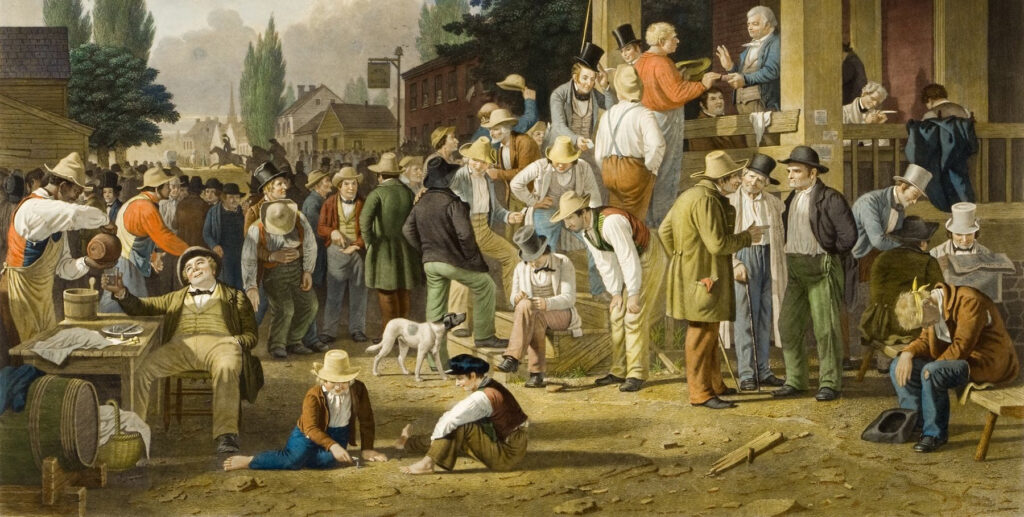
*The American Yawp is an evolving, collaborative text. Click here to help improve this chapter.*
- I. Introduction
- II: Jackson’s Chaotic Cabinet
- III. Nullification and the Bank War
- IV: The Second Party System
- V. The Panic of 1837
- VI: Indigenous Dispossession
- VII. The Cotton Belt
- VIII: An Urbanizing South
- IX. Texas, Mexico, and the United States
- X: An Age of Reform
- XI. Antislavery and Abolition
- XII: Conclusion
- XIII: Primary Sources
- XIV: Reference Material
I. Introduction
On January 20, 1835, an unemployed English immigrant name Richard Lawrence aimed two pistols at President Andrew Jackson. From a mere eight feet away, he pulled both triggers in the first ever assassination attempt on an American president. Remarkably, both weapons misfired, and Jackson took off after the would-be killer with his cane upraised. Although the assailant was motivated by a misguided belief that Jackson had killed his father, Jackson insisted the incident must have been politically motivated. Jackson interpreted the assassination attempt within the political climate of the time, one in which violence was a regular occurrence, immigrants drew increased scrutiny, conspiracy theories ran rife, and partisan strains threatened the sinews of American life.
Few political figures in American history have been mired in as much controversy as Andrew Jackson, so it is perhaps unsurprising that he was the first to face an attempt on his life. To some, Jackson represented the nation’s first and greatest champion of democracy for “the common man.” To others, Jackson was a tyrannical and aggressive threat to American republicanism. Undoubtedly, Jackson was a pivotal figure in a transitional moment in the nineteenth century. During the 1830s, the United States grappled with foundational questions relating to the nature of the nation’s government, economy, political life, demographic composition, and moral character. In some way, each of these issues became a flashpoint for debate during Jackson’s administration.
II: Jackson’s Chaotic Cabinet
As Jackson entered the White House, his desire to institute reform would be hampered by a series of political crises engulfing his cabinet. These controversies would test not only the bounds of Jackson’s political power but the configuration of American constitutional democracy itself. His supporters—a loose coalition of small farmers and “mechanics” (skilled urban laborers) in the North and West along with Southern planters—lacked a clear vision of what that reform might look like, a problem that would plague his administration in coming years. He assembled a geographically and ideologically diverse cabinet to advise him on national affairs and balance the tensions brewing between Vice President John C. Calhoun and Jackson’s close advisor, Martin Van Buren. Yet even within the ranks of his allies, issues ranging from tax policy to the politics of high society would threaten Jackson’s ability to govern effectively.
Jackson promptly instructed his cabinet to begin instituting the first of his major reforms in 1829: removing “corrupt” officials from federal positions and instituting a policy of “rotation in office.” Breaking with the precedent of former presidents who rarely dismissed people from appointments unless they were visibly unscrupulous or incompetent, his administration removed nine hundred federal officials from positions on the basis that long-term office holding represented a kind of undemocratic privilege. While many of his supporters lauded this move as egalitarian, others could not make sense of the decision to remove qualified public servants and replace them with those they saw as inexperienced lackeys. These critics followed New York Senator William L. Macy in derisively describing this as the “spoils system.” Jackson set a new precedent: presidents for the next fifty years would distribute patronage posts as a reward to their political supporters, regardless of their level of qualification.
While Jackson’s cabinet began the work of rooting out corruption (for indeed they did uncover evidence of officials having embezzled $457,000 from the government), a more personal crisis would begin to drive a wedge between Jackson, his vice president, and the entire cabinet.1 The Eaton Affair, sometimes insultingly called the “Petticoat Affair,” began as a disagreement among elite women in Washington, DC, that would eventually lead to the disbanding of Jackson’s cabinet.
Jackson preferred Washington outsiders. One such man was his friend John Henry Eaton, a senator from Tennessee, whom Jackson nominated to serve as secretary of war. Only a few months earlier, Eaton had married Margaret O’Neale Timberlake, the recent widow of a navy officer. She was the daughter of Washington boardinghouse proprietors, and her humble origins and her combination of beauty, outspokenness, and familiarity with so many men in the boardinghouse led to gossip. When her first husband died, rumors swirled that she and Eaton had been having an affair. Their quick marriage a mere nine months following her first husband’s death scandalized the women of high Washington society. One wrote that Margaret Eaton’s reputation had been “totally destroyed.”2 The wives of cabinet members, led by the vice president’s wife Floride Calhoun, refused to have anything to do with her.
This social snubbing had great political importance. Although women could not vote or hold office, they played an important role in politics.3 They held considerable influence and, as one local society woman noted, had “as much rivalship and party spirit” as their male counterparts.4 Their presence in DC blurred the lines between the social and political realms, with purportedly social events becoming the sites of ongoing political dealmaking. The social exclusion of Margaret Eaton snowballed into a major political crisis when the president, already sensitive to these types of dynamics due to a similar scandal involving his recently deceased wife Rachel, took her under his wing. When Jackson realized the gossip originated from the wives of his own cabinet members, it opened a deep rift between himself and especially his vice president that would eventually lead to the dissolution of his cabinet.

The hostility among Jackson’s cabinet would only deepen amid a sectional dispute over national tax policy. When Jackson was inaugurated, most Southerners—Calhoun included—expected him to do away with the so-called Tariff of Abominations. The Tariff of 1828, an import tax providing protection for Northern manufacturing interests from European competitors, drove up costs for Southerners who were forced to purchase more expensive Northern goods and hit with retaliation from countries like Great Britain who purchased less Southern cotton in response. South Carolina, Calhoun’s home state, led the charge against the tariff, which they also saw as an entering wedge for federal legislation limiting slavery. The real fear was that the federal government might attack “the peculiar domestick institution of the Southern States”—meaning slavery.5 When Jackson failed to act against the tariff, Vice President Calhoun was caught in a tight position.
In 1828, Calhoun secretly drafted the “South Carolina Exposition and Protest,” an essay and set of resolutions that laid out the doctrine of nullification or declaring a law null and void.6 Drawing from the Virginia and Kentucky Resolutions of 1798 and 1799, he argued that the states retained sovereignty within the national compact and could thus nullify unconstitutional federal statutes (or, if necessary, leave the Union). When Calhoun’s authorship became public, Jackson interpreted it as a personal betrayal as well as a challenge to his authority and increasingly began to rely more heavily on the more informal group of advisors dubbed his “kitchen cabinet.”
Regardless of the distractions caused by the Eaton Affair and Calhoun’s disloyalty, Jackson worked to promote his agenda and use his authority as executive to dismantle federal overreach. That he could do so while also launching political assaults on his enemies (Henry Clay and now John C. Calhoun) was an added bonus. Under the justification that it was a local rather than national matter, Jackson vetoed an 1830 bill championed by Clay and Calhoun that would have funded internal improvements in Kentucky. The Maysville Road veto would not be the only time he mobilized this distinct presidential power. During his two terms, he would invoke the veto power more than any of his predecessors.
The ongoing tensions in his cabinet would continue to vex Jackson until March 1831, when Van Buren offered his resignation, opening the door for Jackson to reorganize his entire cabinet. By mid-April, Jackson called for and received the resignations of the anti-Eaton cabinet members. In the end, only a single member of his original cabinet remained, the rest replaced with new appointees whose primary loyalty was to the president himself.
III. Nullification and the Bank War
Another long-simmering issue central to Jackson’s platform and popularity was his distrust of the Bank of the United States. First established under Alexander Hamilton’s financial plan and then rechartered by Congress in 1816, the bank was designed to stabilize the growing American economy by establishing a national currency and regulating state banks and public credit. A private corporation, the Second Bank of the United States was tasked with federal responsibilities, including holding and disbursing federal funds. Though many Democratic-Republicans had supported the bank, some remained suspicious about the dependability and constitutionality of the institution and grew distrustful of paper currency. The bank came under additional scrutiny after the Panic of 1819 as Jackson and others blamed the bank for the economic downturn. And, as federal land sales brought in enormous amounts of money by the early 1830s, critics worried that the bank and its representatives were restricting state banks and businesses for their own profit.
Early in his first term, Jackson set his sights on the bank and its director, Nicholas Biddle, who represented the elite monied interests he hoped to dislodge. An early effort to recharter the “Monster Bank” fell in the midst of an election year and its passage through both houses of Congress left Jackson in a difficult position. As Biddle clearly knew, if Jackson failed to sign the rechartering bill into law, it could impact his reelection. For Jackson, Biddle’s tactics smacked of blackmail. Unswayed, he told Van Buren, “The Bank is trying to kill me, but I will kill it!”7 He vetoed the bill to recharter the bank.

In his veto message, Jackson articulated the values that defined his presidency. He called the bank unconstitutional and “dangerous to the liberties of the people.” The bank was virtually a federal agency, but it had powers that were not granted anywhere in the Constitution. Worst of all, the bank was a way for well-connected people to get richer at everyone else’s expense.8 Only a strictly limited government, Jackson believed, would treat people equally. Although its charter would not be renewed, the Bank of the United States could still operate for several more years. So, in 1833, to diminish its power, Jackson also directed his cabinet to stop depositing federal funds in it. From now on, the government would do business with selected state banks instead. Critics called them Jackson’s “pet banks,” and although the bank veto set off fierce controversy, the Bank War gave his supporters a specific “democratic” idea to rally around. More than any other issue, opposition to the national bank came to define their beliefs.
Meanwhile, Jackson continued to try to calm the situation that had emerged with his Southern supporters over tariff disputes. Congress had acceded to Jackson’s calls for reductions in tariffs in 1832, lowering rates on some products but keeping them high on others—but this was not enough to diffuse the tensions. Jackson had replaced Calhoun as his running mate, and Calhoun returned to South Carolina where a special state convention nullified the federal tariffs of 1828 and 1832. It declared them unconstitutional and therefore “null, void, and no law” within South Carolina.9 The convention ordered South Carolina customs officers not to collect tariff revenue and declared that any federal attempt to enforce the tariffs would lead to secession.
President Jackson responded dramatically. He denounced the ordinance of nullification and declared that “disunion, by armed force, is TREASON.”10 Vowing to hang Calhoun and any other nullifier who defied federal power, he persuaded Congress to pass a Force Bill that authorized him to send the military to enforce the tariffs. Faced with such threats, other Southern states declined to join South Carolina. Privately, however, Jackson supported the idea of compromise and allowed his political enemy Henry Clay to broker a solution with Calhoun. Congress passed a compromise bill that slowly lowered federal tariff rates. South Carolina rescinded nullification for the tariffs but also nullified the Force Bill.
Jackson’s decisive action seemingly forced South Carolina to back down. But the crisis also united the ideas of secession and states’ rights, two concepts that had not necessarily been linked before. Perhaps most clearly, nullification showed the immense political power of enslavers. During later debates in the 1840s and 1850s, they would raise the idea of nullification again.
IV: The Second Party System
Increasingly, supporters of Andrew Jackson referred to themselves as Democrats. Under the strategic leadership of Martin Van Buren, they built a highly organized national political party, the first modern party in the United States. Much more than earlier iterations, this Democratic Party had a centralized leadership structure and a consistent ideological program for all levels of government: they denounced federal overreach, promoted laissez-faire economic approaches, supported geographic expansion, and put a premium on personal and political loyalty. Meanwhile, Jackson’s enemies, mocking him as “King Andrew the First,” named themselves after the patriots of the American Revolution, the Whigs.
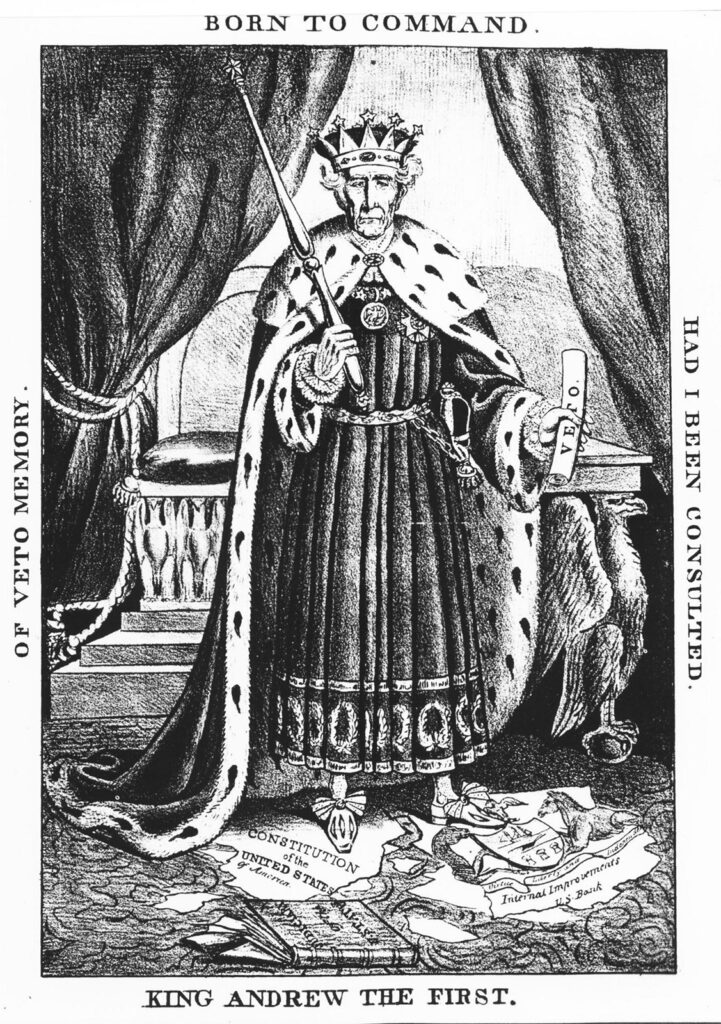
Growing out of the National Republican’s loose political coalition, the Whigs operated as an anti-Jackson opposition party. But Jackson’s enemies were a varied and sometimes entirely contradictory group. For example, Whigs included proslavery Southerners angry about Jackson’s behavior during the Nullification Crisis as well as antislavery Yankees. Because of this motley coalition, the party struggled to bring a cohesive message to voters in the 1830s. Anti-Jackson leaders stressed Protestant culture and federally sponsored internal improvements and courted the support of a variety of reform movements, including temperance, nativism, and even antislavery. Even before the party formally coalesced, these positions attracted a wide range of figures, including Henry Clay of Kentucky who served as the anti-Jackson nominee in 1832. Ridiculed by Democrats as an elitist champion of the Bank, Clay was roundly defeated by Jackson.
A number of voters in 1832, equally dissatisfied with Clay and Jackson, cast their ballots for the Anti-Masonic Party, a short-lived party formed in opposition to the secular fraternal order known as the Freemasons. While Freemasonry had been an important part of the social life of wealthy men in the early republic, the brotherhood’s secrecy, elitism, and rituals generated deep suspicion among many Americans. Following the strange disappearance and probable murder of William Morgan, who had planned to publish an exposé of the order’s secret rites, anti-Masonic sentiment rose to new levels and coalesced into a political movement that, though small, had significant power in New York and parts of New England. The Anti-Masons would be the first political party to hold a national nominating convention, a political move subsequently adopted by other parties. After their dismal showing in the 1832 election, the Anti-Masonic Party folded into the nascent Whig movement.
While some blamed Freemasons for the problems they saw in American society, others, called nativists, turned against immigrants, particularly those who practiced Catholicism. Nativists watched with horror as more and more Catholic immigrants from Ireland and Germany arrived in American cities. These immigrants professed different beliefs, often spoke unfamiliar languages, and participated in alien cultural traditions. They feared that Catholics would bring religious violence with them to the United States and worried about their influence on political life.

In industrial Northern cities, Irish immigrants swelled the ranks of the working class and quickly encountered the politics of industrial labor. Trade unions such as Philadelphia’s Federal Society of Journeymen Cordwainers or the Carpenters’ Union of Boston operated within specific industries in major American cities. These unions protected the economic power of their members by creating closed shops—workplaces wherein employers could only hire union members—and striking to improve working conditions. By the 1840s, labor organizers demanded better pay, protections for children in factories, and limits on working hours. Activists established the Ten-Hour Movement, arguing that a ten-hour day would improve the immediate conditions of laborers by allowing “time and opportunities for intellectual and moral improvement.”11
Although Democrats tended to support the interests of the working class and garnered the votes of urban workers in 1832, many politicians denounced these organizations as unlawful combinations to promote the narrow self-interest of workers above the rights of property holders and the interests of the common good. In response, some skilled workers formed political organizations like the Workingmen’s Party established in Philadelphia in 1828. Unions did not become legally acceptable until 1842 when the Massachusetts Supreme Judicial Court ruled in favor of a union organized among Boston bootmakers, arguing that the workers were capable of acting “in such a manner as best to subserve their own interests.”12 Even after the case, unions remained in a precarious legal position and were often ineffectual in achieving their objectives. Amid this kind of organizing, immigrants remained particularly vulnerable to assault by nativists who feared their religious proclivities as much as their politics.
In the summer of 1834, a mob of Protestants attacked a Catholic convent near Boston after hearing rumors that the nuns were holding a woman against her will. Angry men broke into the convent and burned it to the ground. Later, a young woman named Rebecca Reed, who had spent time in the convent, published a memoir describing abuses she claimed the nuns had directed toward novices and students.13 The convent attack was among many eruptions of nativism in the Northeast during the early nineteenth century. Growing numbers of Protestants accused Catholic priests of not only preying sexually on young women but also of politically controlling their parishioners, whom they presumed to be enslaved to the will of the pope in Rome. Protestant minister Lyman Beecher lectured in various cities, delivering a stark warning. “If the potentates of Europe have no design upon our liberties,” Beecher demanded, then why were they sending over “such floods of pauper emigrants—the contents of the poorhouse and the sweepings of the streets—multiplying tumults and violence, filling our prisons, and crowding our poorhouses, and quadrupling our taxation”—not to mention voting in American elections?14 As they struggled to make sense of their rapidly changing world, nativists turned against the Democratic Party, which increasingly courted the vote of urban immigrants.
After failing to prevent Andrew Jackson’s reelection, this fragile coalition of old National Republicans, Anti-Masons, and Nativists formally organized as a new party in 1834 “to rescue the Government and public liberty.”15 Henry Clay, serving again as a senator from Kentucky after losing his bid for the presidency, held private meetings to persuade anti-Jackson leaders from different backgrounds to unite. He also gave the new Whig Party its antimonarchical name. The emergence of two cohesive, modern political parties gave rise to what historians term the Second Party System: the two-party political system pitting Whigs against Democrats that would last until 1854.
At first, the Whigs focused mainly on winning seats in Congress, opposing “King Andrew” from outside the presidency. They remained divided by regional and ideological differences. In 1836, the Democratic presidential candidate, Vice President Martin Van Buren, easily won election as Jackson’s successor. But the Whigs gained significant public support after the Panic of 1837, and they became increasingly well organized.
V. The Panic of 1837
Although Jackson and the Democratic Party had anticipated that their victory over the Bank of the United States would solve the country’s economic problems, this optimism proved unfounded. The demise of the Second Bank not only helped usher in an era of economic instability but also gave disgruntled partisans a motive to throw their support behind the fledgling Whig Party.
The economic outlook of the nation looked good throughout much of Jackson’s two terms, even initially after his veto of the Bank’s reauthorization. Between 1834 and 1836, a combination of high cotton prices, freely available foreign and domestic credit, and an infusion of specie (“hard” currency in the form of gold and silver) from Europe spurred a sustained boom in the American economy. At the same time, sales of western land by the federal government promoted speculation and poorly regulated lending practices, creating a vast real estate bubble.
Meanwhile, state-charted banks rapidly proliferated and paper banknotes circulated at higher rates than ever. Jackson’s Treasury Department, concerned that paper money was increasing inflation, issued the Specie Circular in 1836, requiring payment in hard currency for federal land purchases. The resulting contraction of credit, foreign lenders calling in their American loans, and limited availability of specie led to the Panic of 1837.
Runs on banks began in New York on May 4, 1837, as panicked customers scrambled to exchange their banknotes for hard currency. By May 10, New York banks, running out of gold and silver, stopped redeeming their notes. As news spread, banks around the nation did the same. By May 15, the largest crowd in Pennsylvania history had amassed outside Independence Hall in Philadelphia, denouncing banking as a “system of fraud and oppression.”16

The Panic of 1837 led to a general economic depression. Between 1839 and 1843, the total capital held by American banks dropped by 40 percent as prices fell and economic activity around the nation slowed to a crawl. The price of cotton in New Orleans, for instance, dropped 50 percent.17 Two hundred banks closed, cash and credit became scarce, prices declined, and trade slowed. Eight states and a territorial government defaulted on loans made by British banks to finance internal improvements.18 Martin Van Buren, dubbed “Van Ruin” by his opponents, would spend his presidency mired in the economic fallout of the Panic, creating a rich political opportunity for the newly formed Whigs.
VI: Indigenous Dispossession
American politicians in the 1830s were mostly preoccupied with debates over tariff policy and banking, but meanwhile, the federal government increasingly threatened the power of tribal nations. Presidents since at least Thomas Jefferson had discussed removal, but Jackson took the most dramatic action, believing that “it [speedy removal] will place a dense and civilized population in large tracts of country now occupied by a few savage hunters.”19 Jackson’s famed reputation as an “Indian fighter” generated much of his support, particularly from Americans eager to seize more and more Indigenous land. State and federal governments began to cease trying to assimilate Native Americans and instead planned for forced removal. Indeed, Jackson in part won the Southern vote because his supporters understood that he would expel Native peoples from desirable lands east of the Mississippi.
Beginning in 1826, Georgia officials asked the federal government to negotiate with the Cherokee to secure lucrative lands. The Adams administration resisted the state’s request, but harassment from local settlers against the Cherokee forced the Adams and Jackson administrations to begin negotiations. Georgia grew impatient and abolished existing state agreements with the Cherokee that had guaranteed rights of movement and jurisdiction of tribal law. Jackson penned a letter soon after taking office that encouraged the Cherokee, among others, to voluntarily relocate to the West. The discovery of gold in Georgia in the fall of 1829 further exacerbated the situation.
The Cherokee, Choctaw, and Chickasaw began to collaborate with missionaries in part to protect themselves from these encroachments. Many tribal members adopted some Euro-American ways, including intensified agriculture, slaving, and Christianity. Missionary groups celebrated when their efforts seemed to be met with success. Evangelicals proclaimed that the Cherokee were becoming “civilized,” which could be seen in their adoption of a written language, the Cherokee syllabary, and of a constitution modeled on that of the US government.
The Cherokee syllabary was later named after its creator Sequoyah in 1821. While settlers hailed the Sequoyah as progress, for the Cherokee it was a way “to unify the tribe, codify their laws and government, and form a national and distinctive cultural identity as a people.”20 It was also a message to Americans that their culture was as sophisticated and equal to theirs. Elias Boudinot, Cherokee writer and editor of the first Native American newspaper, the Cherokee Phoenix, wrote about tribal affairs, especially Indian Removal, from 1828 to 1834. The Phoenix unified the tribe, and it also provided evidence of the tribe’s sovereignty and civilization.21

In 1827, the Cherokee Nation used Sequoyah to write their constitution modeled after that of the United States. This new constitution demonstrated sovereignty and equality in a way that many Americans understood.22 Still, the state and federal governments pressured the Choctaw, Chickasaw, Creek, and Cherokee Nations to sign treaties and surrender land. Mission supporters were shocked and appalled at these efforts for removal. Meanwhile tribal nations used the law in hopes of protecting their lands. Most notable among these efforts was the Cherokee Nation’s attempt to sue the state of Georgia.
The Cherokee defended themselves against Georgia’s laws by citing treaties signed with the United States that guaranteed the Cherokee Nation both their land and independence. They had allies in many missionaries, including Reverend Jeremiah Evarts of the American Board of Commissioners of Foreign Missions, and Americans who supported the missions’ movement.23
Other allies could be found in religious periodicals. Over two hundred thousand people opposed removal on legal grounds, including Arthur Tappan’s New York Journal of Commerce, the Methodist Christian Advocate and Journal, and the Presbyterian New York Observer. Angelina Grimké and Harriet Beecher both wrote letters protesting removal.24 In 1829, Catharine Beecher, in Circular Addressed to Benevolent Ladies of the United States, 1829, beseeched women of the nation to petition Congress to stop Jackson’s removal policy from going forward: “Will those who boast of liberty, and feel their breasts throb at the name of freedom and their country, will they permit the free and noble Indian to be driven from his native land?”25
Cherokee women also joined the resistance. Peggy Scott Vann Crutchfield coauthored a petition to be sent to the president. She wrote, “The land was given to us by the Great Spirit above as our common right, to raise our children upon. . . . As the Cherokee nation have been the first settlers of this land; we therefore claim the right of the soil.” She continued, “Our Father the President advised us to become farmers, to manufacture our own clothes, & to have our children instructed. To this advice we have attended in every thing as far as we were able.”26 Many understood the implied promise of civilization in earlier governmental action to mean peaceful coexistence.
In 1831 Cherokee appealed to the Supreme Court against Georgia to prevent dispossession. The Court, while sympathizing with the Cherokee’s plight, ruled that it lacked jurisdiction to hear the case (Cherokee Nation v. Georgia). In an associated case, Worcester v. Georgia (1832), the Supreme Court ruled that Georgia laws did not apply within Cherokee territory.27 The court’s decision declared that “Indian nations had always been considered as distinct, independent political communities.”28 Regardless of these rulings, the state government ignored the Supreme Court and did little to prevent conflict between settlers and the Cherokee.
Congress passed the Indian Removal Act in 1830, granting the president authority to begin treaty negotiations that would give Native Americans land in the West in exchange for their lands east of the Mississippi. Many advocates of removal, including Jackson, paternalistically claimed that it would protect Native American communities from outside influences that jeopardized their chances of becoming “civilized” farmers. Jackson emphasized this paternalism—the belief that the government was acting in the best interest of Native peoples—in his 1830 State of the Union Address, where he argued that removal might cause Indians “gradually, under the protection of the Government and through the influence of good counsels, to cast off their savage habits and become an interesting, civilized, and Christian community.”29
In Jackson’s message to Congress, he laid out the reasons he believed Native Americans would be better served by a move westward. While this message was addressed to Congress, his real audience was the Native American people. Jackson suggested that the government had always wanted to introduce “the arts of civilization” to Indigenous Americans. He went on to argue that if the tribes moved west of the Mississippi River, they would be given land there and would be free to set up their own governments largely free from US interference in the future.30 This land would come to be known as the “Big Reservation.”
In response to Jackson, Muskogee chief Speckled Snake, with feigned thankfulness and a great deal of sarcasm, tells his people “Brothers! We have heard the talk of our great father [Jackson]; it is very kind. He says he loves his red children.”31 Snake then explained how the Muscogee helped the settlers who first came to the shores but that this was not enough. The white settlers continued to take advantage of the Native Americans. “But when the white man had warmed himself before the Indian’s fire, and filled himself with the Indian’s hominy, he became very large; he stopped not for the mountain tops and his feet covered the plains and the valley.”32
Jackson sent Secretary of War Lewis Cass to offer title to Western lands and the promise of tribal governance in exchange for relinquishing the Cherokee’s Eastern lands. These negotiations exploited rifts within the Cherokee Nation. Cherokee leader John Ridge believed removal was inevitable and pushed for a treaty that would give the best terms. Others, called nationalists and led by John Ross, refused to consider removal. The Jackson administration rejected any deal that fell short of large-scale removal, thereby fueling a devastating and violent intratribal battle between the two factions. Tensions grew to the point that several treaty advocates were assassinated by members of the national faction.33
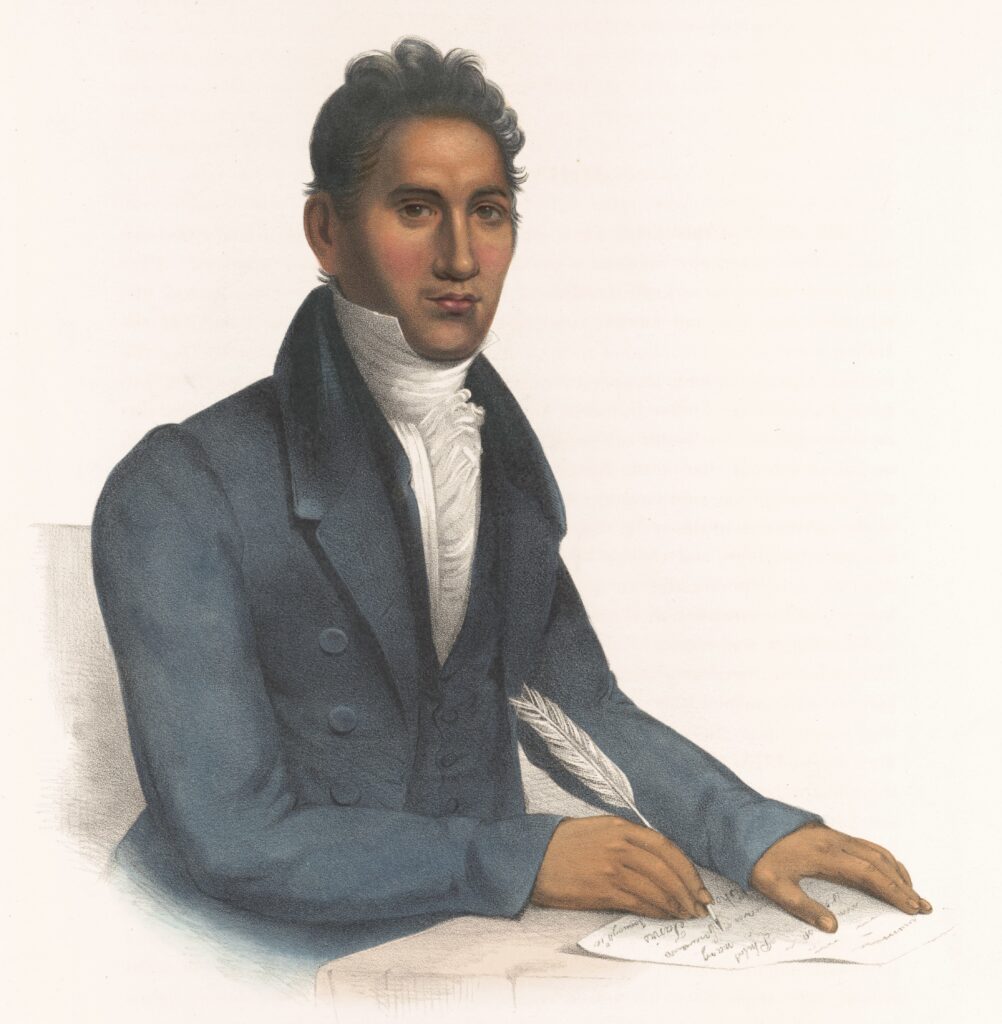
A portion of the Cherokee Nation led by Ridge, hoping to prevent further tribal bloodshed, signed the Treaty of New Echota in 1835. This treaty ceded lands in Georgia for $5 million and, the signatories hoped, would limit future conflicts between the Cherokee and white settlers. However, most of the tribal members refused to adhere to the terms, viewing the treaty as illegitimately negotiated. John Ross pointed out the US government’s hypocrisy. “You asked us to throw off the hunter and warrior state: We did so—you asked us to form a republican government: We did so. . . . You asked us to cast away our idols and worship your god. We did so. Now you demand we cede to you our lands. That we will not do.”34
In 1838, President Martin Van Buren used the New Echota Treaty provisions to order the army to forcibly remove Cherokee not obeying the treaty’s cession of territory. Harsh weather, poor planning, and difficult travel compounded the tragedy of what became known as the Trail of Tears. Sixteen thousand Cherokee embarked on the journey; only ten thousand completed it.35 Not every instance of removal was as treacherous or demographically disastrous as the Cherokee example. Furthermore, tribes responded in a variety of ways. Some tribes violently resisted removal. The influx of settlers into the Florida territory, for instance, was temporarily halted in the mid-1830s by the outbreak of the Second Seminole War (1835–1842), although this conflict was fueled as much by fears of the territory serving as a haven for escaped enslaved laborers. In the Old Northwest, Odawa and Ojibwe communities resisted removal, with some purchasing land independently. They formed successful alliances with missionaries and merchants who depended on trade with Native peoples. Yet Indian Removal occurred in the North as well—the Black Hawk War in 1832, for instance, led to the removal of many Sauk to Kansas.36 Ultimately, over sixty thousand Native Americans were forced west prior to the Civil War.37
Despite the disaster of removal, tribal nations slowly rebuilt their cultures and, in some cases, even achieved prosperity in new territories. Leaders hoped education would help ensuing generations to protect political sovereignty. In 1841, the Cherokee Nation opened a public school system that within two years included eighteen schools. By 1852, the system expanded to twenty-one schools with a national enrollment of 1,100 pupils.38 Many of the students educated in these tribally controlled schools later served their nations as teachers, lawyers, physicians, bureaucrats, and politicians. Tribal nations blended traditional cultural practices, including common land systems, with Western practices including constitutional governments, common school systems, and creating an elite enslaving class.
VII. The Cotton Belt
The hunger for land caused Indian Removal, and that hunger grew even greater after Rush Nutt developed the Petit Gulf hybrid strain of cotton in 1833.39 Petit Gulf slid through the cotton gin—a machine developed by Eli Whitney in 1794 for deseeding cotton—more easily than other strains. It also grew tightly, producing more usable cotton than other types. Together, these developments ushered in the Cotton Revolution that would drastically reshape the American South.
Between the 1830s and the beginning of the Civil War in 1861, the South expanded its wealth and population and became an integral part of an increasingly global economy. It did not, as previous generations of histories have told, sit back on its cultural and social traditions and insulate itself from an expanding system of communication, trade, and production that connected Europe and Asia to the Americas. Quite the opposite; the South actively engaged new technologies and trade routes while also seeking to assimilate and upgrade its most “traditional” and culturally ingrained practices—such as slavery and agricultural production—within a modernizing world.

Thousands rushed into the Cotton Belt. William Henry Sparks, a lawyer living in Natchez, Mississippi, remembered it as “a new El Dorado” in which “fortunes were made in a day, without enterprise or work.”40 Money flowed from newly formed banks in New York City, Baltimore, Philadelphia, and London on promises of “other-worldly” profits and overnight returns. Some even sent their own agents to purchase cheap land at auction for the express purpose of selling it, sometimes the very next day, at double and triple the original value, a process known as speculation.
The numbers were staggering. In 1793, just a few years after the first shipment of American cotton to Europe, the South produced around 5 million pounds of cotton.41 By 1835, it would export more than 500 million pounds of Petit Gulf for a global market. The 2 billion pounds of cotton produced in 1860 amounted to more than 60 percent of the United States’ total exports that year.42 With greater availability of land through Indian Removal, federal auctions, readily available credit, and the seemingly universal dream of cotton’s immediate profit, slavery became increasingly normalized and engrained. The heyday of American slavery had arrived.
This so-called Cotton Revolution wed the South to slavery. Without slavery there could be no Cotton Kingdom, no massive production of raw materials stretching across thousands of acres worth millions of dollars. Although slavery arrived in the Americas long before cotton became a profitable commodity, the use and purchase of enslaved laborers, the moralistic and economic justifications for the continuation of slavery, and even the urgency to protect the practice from extinction before the Civil War all received new life from the rise of cotton.
As cotton became the foundation of the Southern economy, Southern planters, politicians, merchants, and traders became more dedicated to the means of its production: slavery. In 1834, Joseph Ingraham wrote that “to sell cotton in order to buy negroes—to make more cotton to buy more negroes, ‘ad infinitum,’ is the aim and direct tendency of all the operations of the thorough going cotton planter; his whole soul is wrapped up in the pursuit.”43 Alongside the geographic expansion of slavery as the Cotton Kingdom moved westward, the numerical expansion of slavery tells the story of the antebellum South. From fewer than a million enslaved people in the United States in 1800, that number would quadruple to nearly four million held in bondage by the eve of the Civil War.
Enslaved people, the literal and figurative backbone of the Southern economy, served as the highest and most important expense for any successful cotton grower. Prices for enslaved laborers varied drastically, depending on skin color, sex, age, and location. In Virginia in the 1820s, for example, a single enslaved woman of childbearing age sold for an average of $300; an unskilled man above age eighteen sold for around $450; and boys and girls below age thirteen sold for between $100 and $150.44 By the 1840s, prices had nearly doubled—a result of both standard inflation and the increasing importance of enslaved laborers in the cotton market. “Prime field hands,” as they were called by merchants and traders, averaged $1,600 at market by 1850, a figure that fell in line with the rising prices of the cotton they picked.45
But enslaved people were not merely abstract prices. They were human beings. Among the many evils of slavery included the way that the system required men, women, and children to act like property. When an enslaved person experienced the terrifying, invasive process of a sale, whether in the marketplace or in the place they may have called home, sellers expected them to stand, walk, dance, dress, act, look, and respond like sound slaves— more specifically, like an enslaved person who was healthy, subservient, and could be exploited for their labor. Solomon Northup, a free man of color who was kidnapped and sold as an enslaved person, likened the process of a sale to “precisely as a jockey examines a horse which he is about to barter for or purchase.”46 Still, in circumstances defined by violent separations and unknowable possibilities, enslaved people worked to navigate the process of a sale as best they could. Indeed, because buyers’ expectations and ambitions were wrapped up in an enslaved person’s performance, behavior, and disclosures, there was space for an enslaved person, albeit at great risk to themselves, to shape their own sale.47
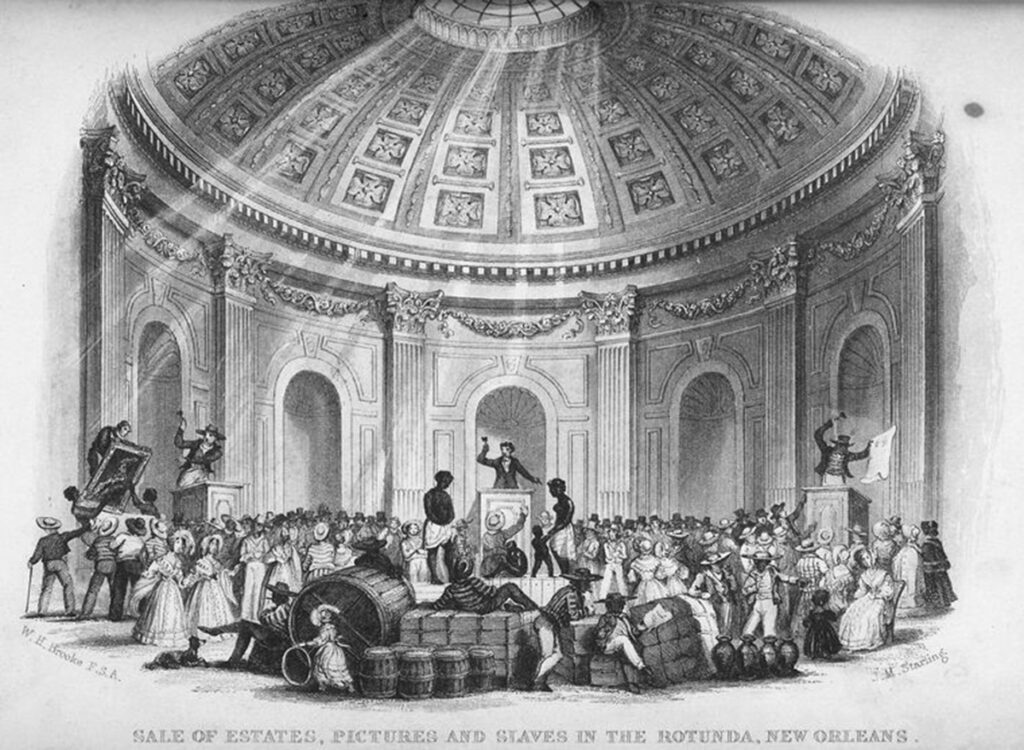
And even after sale, enslaved people continued to insist on their humanity and worked to build lives of meaning despite ongoing brutality. Some resisted with violence, but many others worked to carve out their own spaces of freedom and to pursue their own interests as best as they could. Enslaved people built relationships, pursued personal passions, and even fought to make the sites of their enslavement feel like their home.48
The Cotton Revolution was a time of capitalism, panic, stress, and competition. Although the cotton market was large and profitable, it was also fickle, risky, and cost intensive. The more wealth one gained, the more land one needed to procure, which led to more enslaved laborers, more credit, and more mouths to feed. The decades before the Civil War in the South, then, were not times of slow, simple tradition. They were times of high competition, high risk, and high reward.
Of course, enslaved women were even more vulnerable in this slave society. Sexual violence, unwanted pregnancies, and constant childrearing while continuing to work the fields all made life as an enslaved woman more prone to disruption and uncertainty. Harriet Jacobs, an enslaved woman from North Carolina, chronicled her enslaver’s attempts to sexually abuse her in her narrative, Incidents in the Life of a Slave Girl. Jacobs suggested that her successful attempts to resist sexual assault and her determination to love whom she pleased was “something akin to freedom.”49 But this “freedom,” however empowering and contextual, did not cast a wide net. Many enslaved women had no choice concerning love, sex, and motherhood. On plantations, small farms, and even in cities, rape was ever present. Enslavers used sexual violence as a form of terrorism, a way to promote increased production, obedience, and power relations. In numerous accounts, violent enslavers forced men to witness the rape of their wives, daughters, and relatives, often as punishment, but occasionally as a sadistic expression of power and dominance.50
The paternalism that subordinated both white and Black women to white men further reinforced the racial hierarchy that had emerged centuries prior, bolstered by new religious arguments defending the Southern social order. By the outbreak of the Civil War, the vast majority of Southerners who affiliated with a religious denomination belonged to either the Baptist or Methodist faith.51 Both of these churches in the South briefly attacked slavery before transforming into some of the most vocal proponents of slavery. Whether on the plantation or in newly booming urban centers, Southern society centered on the production of cotton and the defense of the institution of slavery that made rich profits possible.
VIII: An Urbanizing South
Despite an emphasis on plantation agriculture in depictions of the Old South, the economic significance of cotton resulted in rapid urban growth between 1820 and 1860. New Orleans, Richmond, Charleston, and St. Louis all saw massive explosions in their populations as the Cotton Revolution hit full stride. As Southern cities grew, they became more cosmopolitan, attracting types of people either unsuited for or uninterested in rural life. These people—merchants, skilled laborers, traders, sellers of all kinds and colors—brought rural goods to a market desperate for raw materials. Everyone, it seemed, had a place in the cotton trade.
Among the more important aspects of Southern urbanization was the development of a middle class in urban centers, something that never fully developed in rural areas. In a very general sense, the rural South fell under a two-class system in which a landowning elite controlled the politics and most of the capital, and a working poor survived on subsistence farming or basic, unskilled labor. The development of large urban centers founded on trade gave rise to a large middle class in the South. Predicated on the idea of separation from those above and below them, middle-class men and women in the South thrived in the active, feverish rush of port city life.

Skilled craftsmen, merchants, traders, speculators, and store owners made up the Southern middle class. Neighbors, friends, and business partners formed and joined benevolent societies to aid orphans and the destitute. But in many cases these benevolent societies simply served as a way to keep other people out of middle-class circles, sustaining both wealth and social prestige within an insular, well-regulated community. Members and partners married each other’s sisters, stood as godparents for each others’ children, and served as executors of fellow members’ wills.
Rural and urban Southern society deferred to white men, under whom laws, social norms, and cultural practices were written, dictated, and maintained. White and free women of color lived in a society dominated by men. Denied voting rights, women of all statuses and colors had no direct representation in the creation and discussion of law. In many cases, too, the law did not protect white women the same way it protected men. In most states, marriage effectively transferred all a woman’s property to her husband. Divorce existed, but it hardly worked in a woman’s favor, and often, if successful, ruined the wife’s standing in society, even leading to well-known cases of suicide.52
IX. Texas, Mexico, and the United States
The debate over slavery became one of the prime forces behind the Texas Revolution and the resulting republic’s annexation by the United States. After gaining its independence from Spain in 1821, Mexico hoped to attract new settlers to its northern areas to create a buffer between it and the powerful Comanche. New immigrants, mostly from the southern United States, poured into Mexican Texas. Over the next twenty-five years, concerns over growing Anglo influence and possible American designs on the area produced great friction between Mexicans and the former Americans in the area. In 1829, Mexico, hoping to quell both anger and immigration, outlawed slavery and required all new immigrants to convert to Catholicism. American immigrants, eager to expand their agricultural fortunes, largely ignored these requirements. In response, Mexican authorities closed their territory to any new immigration in 1830—a prohibition ignored by Americans who often squatted on public lands.53
In 1834, an internal conflict between federalists and centralists in the Mexican government led to the political ascendency of General Antonio López de Santa Anna. Santa Anna, governing as a dictator, repudiated the federalist Constitution of 1824, pursued a policy of authoritarian central control, and crushed several revolts throughout Mexico. Anglo settlers in Mexican Texas, or Texians as they called themselves, opposed Santa Anna’s centralizing policies and met in November. They issued a statement of purpose that emphasized their commitment to the Constitution of 1824 and declared Texas to be a separate state within Mexico. After the Mexican government angrily rejected the offer, Texian leaders abandoned their fight for the Constitution of 1824 and declared independence on March 2, 1836.54 The Texas Revolution of 1835–1836 was a successful secessionist movement in the northern district of the Mexican state of Coahuila y Tejas that resulted in an independent Republic of Texas.
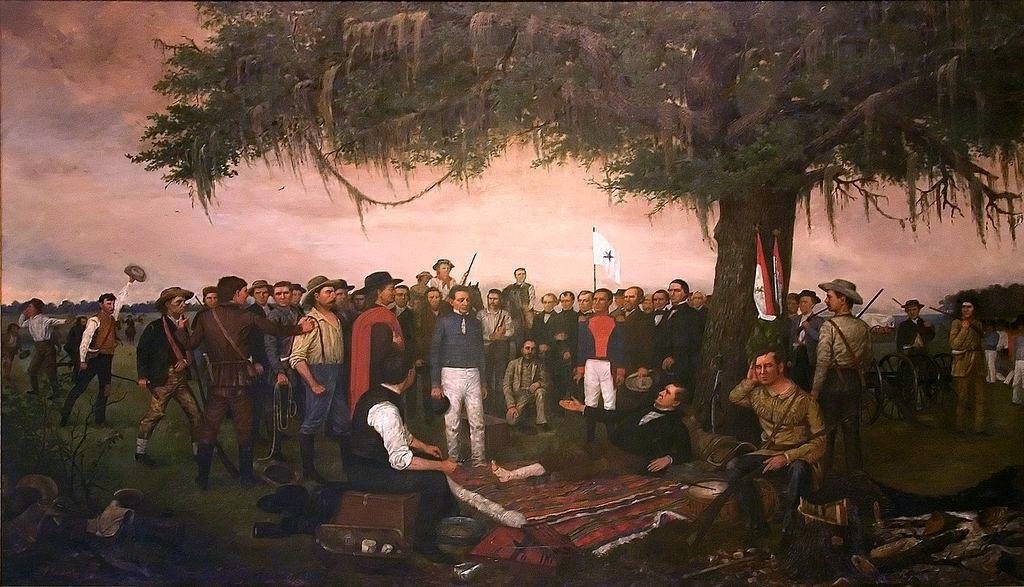
At the Alamo and Goliad, Santa Anna crushed smaller rebel forces and massacred hundreds of Texian prisoners. The Mexican army pursued the retreating Texian army deep into East Texas, spurring a mass panic and evacuation by American civilians known as the Runaway Scrape. The confident Santa Anna consistently failed to make adequate defensive preparations, an oversight that eventually led to a surprise attack from the outnumbered Texian army led by Sam Houston on April 21, 1836. The battle of San Jacinto lasted only eighteen minutes and resulted in a decisive victory for the Texians, who retaliated for previous Mexican atrocities by killing fleeing and surrendering Mexican soldiers. Santa Anna was captured in the aftermath and compelled to sign the Treaty of Velasco on May 14, 1836, by which he agreed to withdraw his army from Texas and acknowledge its independence. Although a new Mexican government never recognized the Republic of Texas, the United States and several other nations gave the new country diplomatic recognition.55
X: An Age of Reform
The upheavals of the 1830s were also reflected and shaped by religious developments. Both enthusiasm and anxiety around spiritual egalitarianism spawned the Second Great Awakening and the many reform movements that made up the benevolent empire. The ranks of Methodists, Baptists, and Presbyterians swelled precipitously alongside new denominations such as the Seventh-Day Adventist Church and the Church of Jesus Christ of Latter-Day Saints. The evangelical fire reached such heights, in fact, that one swath of western and central New York state came to be known as the Burned-Over District. Charles Grandison Finney, the influential revivalist preacher who first coined the term, explained that the residents of this area had experienced so many revivals by different religious groups that there were no more souls to awaken to the fire of spiritual conversion.56
The democratic fervor of the era also informed a substantial theological critique of orthodox Calvinism with far-reaching consequences for religious individuals and for society as a whole. Calvinists believed that all of humankind was marred by sin, and God predestined only some for salvation. Worshippers, seeing this perspective as too pessimistic, increasingly took responsibility for their own spiritual role in effecting salvation. Revivalist preachers such as Finney were quick to recognize these cultural shifts and evangelize by appealing to worshippers’ hearts and emotions. Even more conservative spiritual leaders like Lyman Beecher adopted a less orthodox approach to Calvinist doctrine.57 Though these men did not see eye to eye, they both contributed to the emerging consensus that all souls are equal in salvation and that all people can be saved by surrendering to God. The ideas of perfectionism and spiritual equality were among the most important transformations to emerge out of the Second Great Awakening.
Difficulties arose, however, when the benevolent empire attempted to take up more explicitly political issues. The failed movement against Indian Removal was the first major example of this. Antiremoval activism was also notable for the entry of ordinary American women into political discourse. The first major petition campaign by American women focused on opposition to removal and was led (anonymously) by Catharine Beecher. Beecher was already a leader in the movement to reform women’s education and came to her role in removal through her connections to the mission movement. She used religious and moral arguments to justify women’s entry into political discussion when it concerned an obviously moral cause. This petitioning effort was unsuccessful but paved the way for women’s political activism.
The divisions that the antiremoval campaign revealed became more dramatic with the next political cause of nineteenth-century reformers: abolition.
XI. Antislavery and Abolition
The revivalist doctrines of salvation, perfectionism, and disinterested benevolence led some evangelical reformers to believe that slavery was the most God-defying of all sins and the most terrible blight on the moral virtue of the United States. While interest in abolition had existed for several decades, organized advocacy had been largely restricted to gradual emancipation (seen in several Northern states following the American Revolution) and colonization efforts to remove Black Americans to Africa.
By the 1830s, however, a rising tide of anticolonization sentiment among Northern free Black Americans and middle-class white evangelicals’ flourishing commitment to social reform radicalized the movement and pushed the idea of immediate emancipation (immediatism) onto center stage. Inspired by a strategy known as “moral suasion,” young abolitionists believed they could convince enslavers to voluntarily release their enslaved laborers by appealing to their sense of Christian conscience. The result would be national redemption and moral harmony. They rested their mission for immediate emancipation “upon the Declaration of our Independence, and upon the truths of Divine Revelation,” binding their cause to both national and Christian redemption.58 Abolitionists fought to save the enslaved and thereby save the nation.
Figures like William Lloyd Garrison, the white abolitionist who established an antislavery newspaper called The Liberator in 1831 and the American Anti-slavery Society in 1833, have most famously illustrated this transition toward immediatism and moral suasion. Yet, it was an approach born out of the financial support of Northern freemen like James Forten (who financed The Liberator) and the intellectual work of Black activists, like the three thousand freemen who assembled in Philadelphia in 1817 to issue resolutions proclaiming their American identity and declaring themselves entitled to the same rights of white citizens.
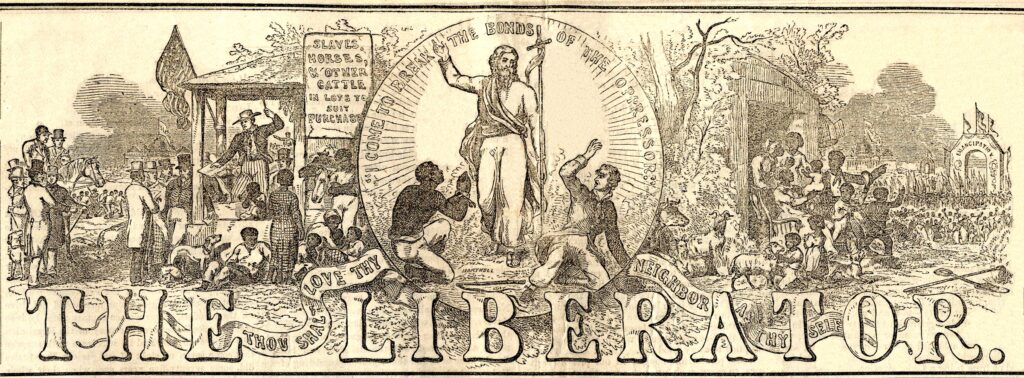
The racially integrated abolition movement was rife with racism and overwhelmingly relegated Black activists to a backseat role. Despite the popularity of moral suasion among white abolitionists, an alternative approach was steeped in calls for resistance and, if necessary, violence. David Walker, born free in North Carolina before moving north to Boston, published his famous Appeal in IV Articles in 1829. In this widely circulated pamphlet, Walker defended slave rebellions and believed that violent resistance might be necessary to end slavery and racial inequity. Henry Highland Garnet, who had escaped from bondage as a child, would make similar claims in a speech in 1843. Drawing on the legacy of the American and Haitian Revolutions, in which the promise of liberty justified violent rebellion, he spoke to his enslaved brethren: “Strike for your lives and liberties. . . . Rather die freemen than live to be slaves.”59
Abolitionists collectively employed every method of outreach and agitation, establishing hundreds of antislavery societies. Harnessing the potential of steam-powered printing and mass communication, abolitionists blanketed the free states with pamphlets and antislavery newspapers. They blared their arguments from lyceum podiums and broadsides. Prominent individuals such as Wendell Phillips and Angelina Grimké saturated Northern media with shame-inducing exposés of Northern complicity in fugitive rendition, and white reformers sentimentalized slave narratives to tug at middle-class heartstrings. Women launched antislavery fairs to raise funds for the cause. Abolitionists used the US Postal Service in 1835 to inundate Southern enslavers with calls to save their souls by emancipating their enslaved laborers. Turning to more explicitly political methods in 1836, they prepared thousands of petitions for Congress as part of the Great Petition Campaign. In the six years from 1831 to 1837, abolitionist activities reached dizzying heights.60
Such efforts encountered fierce opposition. Abolitionists remained a small, marginalized group detested by most white Americans in both the North and the South. Immediatists were attacked as the harbingers of disunion, rabble-rousers who would stir up sectional tensions and thereby imperil the American experiment of self-government. Particularly troubling to some observers was the public engagement of women as abolitionist speakers and activists. Fearful of disunion and outraged by the interracial nature of abolitionism, Northern mobs smashed abolitionist printing presses and even killed a prominent antislavery newspaper editor named Elijah Lovejoy in 1837.
For enslaved people themselves, resistance existed in a multitude of forms. Simple acts of resistance, such as breaking a hoe, running a wagon off the road, causing a delay in production due to injury, running away, or even pregnancy provided a language shared by nearly all enslaved laborers, a sense of unity that remained unsaid but was acted out daily. A small number turned to armed rebellion.
Nat Turner, leader of the deadliest slave rebellion in the antebellum South, found inspiration from religion early in life. Adopting an austere Christian lifestyle during his adolescence, Turner claimed to have been visited by “spirits” and considered himself a singular prophet whose visions encouraged him to do the work of God. As scholars have recently shown, however, his broader community—including women—formed an important backdrop for the work of resistance and rebellion.61 On the morning of August 22, 1831, in Southampton County, Virginia, Turner and six collaborators attempted to free the region’s enslaved population. Turner initiated the violence by killing his enslaver with an ax blow to the head. By the end of the day, Turner and his band, which had grown to over fifty men, killed fifty-seven white men, women, and children on eleven farms. By the next day, the local militia and white residents had captured or killed all the participants except Turner, who hid for weeks in nearby woods before being captured and executed. The white terror following the Southampton Rebellion transformed Southern religion, as antiliteracy laws increased and Black-led churches were broken up and placed under the supervision of white ministers.

The hysteria prompted by the Southampton Rebellion created additional challenges for the abolition movement. White Southerners, believing that abolitionists had incited the rebellion, aggressively purged antislavery dissent from the region. Violent harassment threatened abolitionists’ personal safety. In Congress, Whigs and Democrats joined forces in 1836 to pass an unprecedented restriction on freedom of political expression known as the gag rule, prohibiting all discussion of abolitionist petitions in the House of Representatives. Two years later, mobs attacked the Anti-Slavery Convention of American Women, throwing rocks through the windows and burning the newly constructed Pennsylvania Hall to the ground.62 While many white abolitionists would continue to espouse moral suasion, Black activists would increasingly turn to a politics of force, recognizing that nonresistance failed to protect Black Americans or end chattel slavery.63
XII: Conclusion
The age of Jackson ushered in sweeping changes. From the chaos of Jackson’s cabinet emerged a new vision of executive power, one that prioritized personal and party loyalty, entwined populist democratic rhetoric with authoritarianism, and legitimized violence. The Jacksonian values that infused the Democratic Party were far from universal, however, and controversies over patronage, banking, tariffs, Indian Removal, immigration, and the expansion of slavery in the new cotton economy ensured the emergence of an opposition party. In the wake of the Panic of 1837, the Whigs were poised to enter American politics as a force to be reckoned with moving into the 1840s.
XIII: Primary Sources
1. David Walker’s Appeal to the Colored Citizens of the World, 1829
2. William Lloyd Garrison Introduces The Liberator, 1831
3. Nat Turner explains the Southampton rebellion, 1831
4. Maria Stewart bemoans the consequences of racism, 1832
5. Andrew Jackson’s Veto Message Against Re-chartering the Bank of the United States, 1832
6. Harriet Jacobs on Rape and Slavery, 1860
7. Cherokee Petition Protesting Removal, 1836
8. Martin Van Buren Cartoon, 1837
9. Anti-Catholic Cartoon, 1855
XIV: Reference Material
This chapter was edited by Emily Arendt, with content contributions by Myles Beaupre, Marjorie Brown, Michelle Cassidy, Steffi Cerato, Christopher Childers, Kristin Condotta, Emily Conroy-Krutz, William Cossen, Adam Costanzo, Jeff Fortney, Jane Fiegen Green, Nathaniel C. Green, Robert Gudmestad, Nathan Jeremie-Brink, Christopher C. Jones, Lindsay Keiter, Brenda Lakhani, Spencer McBride, Maria Montalvo, James Anthony Owen, Katherine Rohrer, Marie Stango, Kevin Waite, Kelly Weber, Jonathan Wilfred Wilson, Caroline Wright, and Ben Wright.
Recommended Reading
• Allgor, Catherine. Parlor Politics: In Which the Ladies of Washington Help Build a City and a Government. University Press of Virginia, 2000.
• Baptist, Edward E. The Half Has Never Been Told: Slavery and the Making of American Capitalism. Basic Books, 2014.
• Beckert, Sven. Empire of Cotton: A Global History. Knopf, 2014.
• Berry, Daina Ramey. The Price for Their Pound of Flesh: The Value of the Enslaved, from Womb to Grave, in the Building of a Nation. Beacon Press, 2017.
• Burstein, Andrew. The Passions of Andrew Jackson. Knopf, 2003.
• Cheathem, Mark R. The Coming of Democracy: Presidential Campaigning in the Age of Jackson. Johns Hopkins University Press, 2018.
• Conroy-Krutz, Emily. Christian Imperialism: Converting the World in the Early American Republic. Cornell University Press, 2015.
• Ellis, Richard E. The Union at Risk: Jacksonian Democracy, States’ Rights and the Nullification Crisis. Oxford University Press, 1987.
• Hahn, Barbara. Making Tobacco Bright: Creating an American Commodity, 1617–1937. Johns Hopkins University Press, 2011.
• Hatch, Nathan O. The Democratization of American Christianity. Yale University Press, 1989.
• Holden, Vanessa M. Surviving Southampton: African American Women and Resistance in Nat Turner’s Community. University of Illinois Press, 2021.
• Holt, Michael F. The Rise and Fall of the American Whig Party: Jacksonian Politics and the Onset of the Civil War. Oxford University Press, 1999.
• Jackson, Kellie Carter. Force and Freedom: Black Abolitionists and the Politics of Violence. University of Pennsylvania Press, 2019.
• Lepler, Jessica. The Many Panics of 1837: People, Politics, and the Creation of a Transatlantic Financial Crisis. Cambridge University Press, 2013.
• McDaniel, W. Caleb. The Problem of Democracy in the Age of Slavery: Garrisonian Abolitionists and Transatlantic Reform. Louisiana State University Press, 2013.
• Rothman, Joshua D. Flush Times and Fever Dreams: A Story of Capitalism and Slavery in the Age of Jackson. University of Georgia Press, 2012.
• Saunt, Claudio. Unworthy Republic: The Dispossession of Native Americans and the Road to Indian Territory. W. W. Norton, 2020.
• Sinha, Manisha. The Slave’s Cause: A History of Abolition. Yale University Press, 2016.
• Sommerville, Diane Miller. Rape and Race in the Nineteenth-Century South. University of North Carolina Press, 2004.
• Snyder, Christina. Great Crossings: Indians, Settlers, and Slaves in the Age of Jackson. Oxford University Press, 2017.
• Varon, Elizabeth R. We Mean to Be Counted: White Women and Politics in Antebellum Virginia. University of North Carolina Press, 1998.
• Vaughn, William Preston. The Anti-Masonic Party in the United States: 1826–1843. University Press of Kentucky, 2009.
• Wright, Ben. Bonds of Salvation: How Christianity Inspired and Limited American Abolitionism. Louisiana State University Press, 2006.
• Wellman, Judith. Grassroots Reform in the Burned-Over District of Upstate New York: Religion, Abolitionism, and Democracy. Routledge, 2016.
• Yacovzazzi, Cassandra L. Escaped Nuns: True Womanhood and the Campaign Against Convents in Antebellum America. Oxford University Press, 2018.
Notes
- Jonathan M. Atkins, From Confederation to Nation: The Early American Republic, 1789–1848 (Routledge, 2016), 202.[↩]
- Catherine Allgor, Parlor Politics: In Which the Ladies of Washington Help Build a City and a Government (University Press of Virginia, 2000), 200.[↩]
- Elizabeth R. Varon, We Mean to Be Counted: White Women and Politics in Antebellum Virginia (University of North Carolina Press, 1998).[↩]
- Margaret Bayard Smith to Margaret Bayard Boyd, December 20 [?], 1828, Margaret Bayard Smith Papers, quoted in Varon, We Mean to Be Counted, 215.[↩]
- Calhoun to Virgil Maxcy, September 11, 1830, quoted in William M. Meigs, The Life of John Caldwell Calhoun, vol. 1 (Stechert, 1917), 419.[↩]
- John C. Calhoun, “Exposition and Protest,” in Union and Liberty: The Political Philosophy of John C. Calhoun, ed. Ross M. Lence (Liberty Fund, 1992), 311–65, http://oll.libertyfund.org/titles/683.[↩]
- Michel Chevalier and Andrew Jackson, quoted in Andrew Burstein, The Passions of Andrew Jackson (Knopf, 2003), 200.[↩]
- Andrew Jackson, veto message regarding the Bank of the United States, July 10, 1832, Avalon Project, Yale Law School, http://avalon.law.yale.edu/19th_century/ajveto01.asp.[↩]
- South Carolina ordinance of nullification, November 24, 1832, Avalon Project, Yale Law School, http://avalon.law.yale.edu/19th_century/ordnull.asp.[↩]
- Andrew Jackson, proclamation regarding nullification, December 10, 1832, Avalon Project, Yale Law School, http://avalon.law.yale.edu/19th_century/jack01.asp.[↩]
- New England Artisan and Laboring Man’s Repository (Pawtucket, Providence, and Boston), March 8, 1832.[↩]
- Commonwealth v. Hunt, 45 Mass. 111 (1842).[↩]
- Rebecca Theresa Reed, Six Months in a Convent, or, The Narrative of Rebecca Theresa Reed (Boston, 1835), http://archive.org/details/sixmonthsinconve00reedr.[↩]
- Lyman Beecher, A Plea for the West, 2nd ed. (Cincinnati, 1835), 54, http://archive.org/details/pleaforwest00beec.[↩]
- Henry Clay to Francis Brooke, December 16, 1833, quoted in Michael F. Holt, The Rise and Fall of the American Whig Party: Jacksonian Politics and the Onset of the Civil War (Oxford University Press, 1999), 29.[↩]
- “Great Public Meeting in Philadelphia,” Niles’ Weekly Register (Baltimore), May 27, 1837, 198.[↩]
- Alasdair Roberts, America’s First Great Depression: Economic Crisis and Political Disorder After the Panic of 1837 (Cornell University Press, 2012), 23.[↩]
- Roberts, America’s First Great Depression, 53. Also see Jessica Lepler, The Many Panics of 1837: People, Politics, and the Creation of a Transatlantic Financial Crisis (Cambridge University Press, 2013).[↩]
- “President Andrew Jackson’s Message to Congress ‘On Indian Removal’ (1830),” https://www.archives.gov/milestone-documents/jacksons-message-to-congress-on-indian-removal.[↩]
- Ellen Cushman, The Cherokee Syllabary Writing the People’s Perseverance (University of Oklahoma Press, 2011).[↩]
- Cushman, The Cherokee Syllabary, 127.[↩]
- Cushman, The Cherokee Syllabary, 122.[↩]
- John P. Bowes. “American Indian Removal Beyond the Removal Act,” Native American and Indigenous Studies 1, no. 1 (Spring 2014): 65–87, https://doi.org/10.1353/nai.2014.a843652.[↩]
- Mary Hershberger. “Mobilizing Women, Anticipating Abolition: The Struggle Against Indian Removal in the 1830s.” The Journal of American History 86, no. 1 (1999): 15–40, https://doi.org/10.2307/2567405.[↩]
- Circular Addressed to Benevolent Ladies of the United States, 1829. Published in the Cherokee Phoenix, January 6, 1830, https://www.wcu.edu/library/DigitalCollections/CherokeePhoenix/Vol2/no39/circular-page-2-column-3b-page-3-column-2b.html.[↩]
- Cherokee Indian Women, Cherokee Indian/Native American Women to National Council at Amohee, May 2. May 2, 1817, https://www.loc.gov/item/maj007262/.[↩]
- Tim A. Garrison, “Worcester v. Georgia (1832),” New Georgia Encyclopedia, http://www.georgiaencyclopedia.org/articles/government-politics/worcester-v-georgia-1832.[↩]
- Bowes. “American Indian Removal,” 75.[↩]
- Garrison, “Worcester v. Georgia (1832).”[↩]
- Andrew Jackson, message to Congress, December 8, 1829, in Richardson, Messages and Papers, 2:456–59. [↩]
- Speckled Snake, “Response to a Message from President Andrew Jackson Concerning Indian Removal, 1830,” in Great Documents in American Indian History, ed. Wayne Moquin and Charles Van Doren (Praeger, 1973), 149.[↩]
- Speckled Snake, “Response to a Message from President Andrew Jackson.” Historian Angie Debo argues that Speckled Snake was a pseudonym likely used by the influential Cherokee leader John Ridge. For more on this see Angie Debo, The Road to Disappearance: A History of the Creek Nation (University of Oklahoma Press, 1984).[↩]
- Fay A. Yarbrough, Race and the Cherokee Nation: Sovereignty in the Nineteenth Century (University of Pennsylvania Press, 2008), 15–21.[↩]
- John Ross, quoted in Brian Hicks, Toward the Setting Sun: John Ross, the Cherokees, and the Trail of Tears (Atlantic Monthly Press, 2011), 210.[↩]
- Russell Thornton, The Cherokees: A Population History (University of Nebraska Press, 1990), 76.[↩]
- John P. Bowes, Land Too Good for Indians: Northern Indian Removal (University of Oklahoma Press, 2016).[↩]
- Senate Document #512, 23 Cong., 1 Sess., vol. 4, pt. 6, x, https://books.google.com/books?id=KSTlvxxCOkcC.[↩]
- William C. Sturtevant, Handbook of North American Indians: History of Indian-White Relations, vol. 4 (Smithsonian Institution, 1988), 289.[↩]
- D. Clayton James, Antebellum Natchez (Louisiana State University Press, 1968), 156; Walter Johnson, River of Dark Dreams: Slavery and Empire in the Cotton Kingdom (Belknap, 2013), 151–52; John Solomon Otto, The Southern Frontiers, 1607–1860: The Agricultural Evolution of the Colonial and Antebellum South (Greenwood, 1989), 94–96.[↩]
- W. H. Sparks, Memories of Fifty Years (Philadelphia, 1870), 364.[↩]
- Sven Beckert, Empire of Cotton: A Global History (Knopf, 2014), 102–3.[↩]
- For more cotton statistics, see Joshua D. Rothman, Flush Times and Fever Dreams: A Story of Capitalism and Slavery in the Age of Jackson (University of Georgia Press, 2012), 3–5, 96–103; Johnson, River of Dark Dreams, 254–60; Beckert, Empire of Cotton, 102–4; Avery Plaw, “Slavery,” in Cynthia Clark, ed., The American Economy: A Historical Encyclopedia (ABC-Clio, 2011), 108–9, 787–98; William J. Phalen, The Consequences of Cotton in Antebellum America (McFarland, 2014), 110–14; Gene Dattel, Cotton and Race in the Making of America: The Human Costs of Economic Power (Rowman and Littlefield, 2009), 370–71.[↩]
- See Joseph Holt Ingraham, The Southwest, by a Yankee, vol. 2 (New York, 1835), 91, quoted in Harold D. Woodman, King Cotton and His Retainers: Financing and Marketing the Cotton Crop of the South, 1800–1925 (University of Kentucky Press, 1968), 135. A similar quote, recorded in 1854 and attributed to Edward Russell, appears in Johnson, River of Dark Dreams, 12.[↩]
- See Brenda E. Stevenson, Life in Black and White: Family and Community in the Slave South (Oxford University Press, 1996), 171–81.[↩]
- James L. Huston, “The Pregnant Economies of the Border South, 1840–1860: Virginia, Kentucky, Tennessee, and the Possibilities of Slave-Labor Expansion,” in The Old South’s Modern Worlds: Slavery, Region, and Nation in the Age of Progress, ed. L. Diane Barnes, Brian Schoen, and Frank Towers (Oxford University Press, 2011), 132–34.[↩]
- Solomon Northup, Twelve Years a Slave (Auburn, NY, 1853), 80.[↩]
- Daina Ramey Berry, The Price for Their Pound of Flesh: The Value of the Enslaved, from Womb to Grave, in the Building of a Nation (Beacon Press, 2017); Maria R. Montalvo, Enslaved Archives: Slavery, Law, and the Production of the Past (Johns Hopkins University Press, 2024).[↩]
- Whitney Nell Stewart, This Is Our Home: Slavery and Struggle on Southern Plantations (University of North Carolina Press, 2023).[↩]
- Harriet Jacobs, Incidents in the Life of a Slave Girl (Boston, 1861), 85.[↩]
- Kevin Bales and Jody Sarich, “The Paradox of Women, Children, and Slavery,” in Trafficking in Slavery’s Wake: Law and the Experience of Women and Children in Africa, ed. Benjamin N. Lawrence and Richard L. Roberts (Ohio University Press, 2012), 241–43; Diane Miller Sommerville, Rape and Race in the Nineteenth-Century South (University of North Carolina Press, 2004), 44–48; Jacqueline Jones, Labor of Love, Labor of Sorrow: Black Women, Work, and the Family, from Slavery to the Present (Basic Books, 2010), 35–38.[↩]
- Samuel S. Hill, Southern Churches in Crisis Revisited (University of Alabama Press, 1999), 33.[↩]
- On divorce, see Carol Lasser and Stacey Robertson, Antebellum Women: Private, Public, Partisan (Rowman and Littlefield, 2010), 5–8; Nancy Isenberg, Sex and Citizenship in Antebellum America (University of North Carolina Press, 1998), 200–204; David Silkenat, Moments of Despair: Suicide, Divorce, and Debt in Civil War Era North Carolina (University of North Carolina Press, 2011), chap. 4, particularly 77–88.[↩]
- David Reimers, Other Immigrants: The Global Origins of the American People (New York University Press, 2005), 27.[↩]
- H. P. N. Gammel, ed., The Laws of Texas, 1822–1897, vol. 1 (Austin, TX, 1898), 1063, https://texashistory.unt.edu/ark:/67531/metapth5872/m1/1071/.[↩]
- Randolph B. Campbell, An Empire for Slavery: The Peculiar Institution in Texas, 1821–1865 (Louisiana State University Press, 1989).[↩]
- Charles G. Finney, Memoirs of Charles G. Finney (New York, 1876), 78.[↩]
- Gary J. Dorrien, The Making of American Liberal Theology: Imagining Progressive Religion, 1805–1900, Volume 1 (Westminster John Knox Press, 2001), 119.[↩]
- Paul Goodman, Of One Blood: Abolitionism and the Origins of Racial Equality (University of California Press, 1998), 105.[↩]
- Henry Highland Garnet, “An Address to the Slaves of the United States of America,” in Lift Every Voice: African American Oratory, 1787–1900, ed. Philip S. Foner and Robert James Branham (University of Alabama Press, 1998), 204.[↩]
- James Brewer Stewart, Abolitionist Politics and the Coming of the Civil War (University of Massachusetts Press, 2008), 13–14.[↩]
- Nat Turner, The Confessions of Nat Turner, the Leader of the Late Insurrection in Southampton, Va. (Baltimore, 1831), 9–11; Vanessa M. Holden, Surviving Southampton: African American Women and Resistance in Nat Turner’s Community (University of Illinois Press, 2021).[↩]
- Beverly C. Tomek, Pennsylvania Hall: A “Legal Lynching” in the Shadow of the Liberty Bell (Oxford University Press, 2013).[↩]
- Kellie Carter Jackson, Force and Freedom: Black Abolitionists and the Politics of Violence (University of Pennsylvania Press, 2019).[↩]