
*The American Yawp is an evolving, collaborative text. Click here to help improve this chapter.*
I. Introduction
The Great Railroad Strike of 1877 heralded a new era of labor conflict in the United States. That year, mired in the stagnant economy that followed the bursting of the railroads’ financial bubble in 1873, rail lines slashed workers’ wages (even, workers complained, as they reaped enormous government subsidies and paid shareholders lucrative stock dividends). Workers struck from Baltimore to St. Louis, shutting down railroad traffic—the nation’s economic lifeblood—across the country.
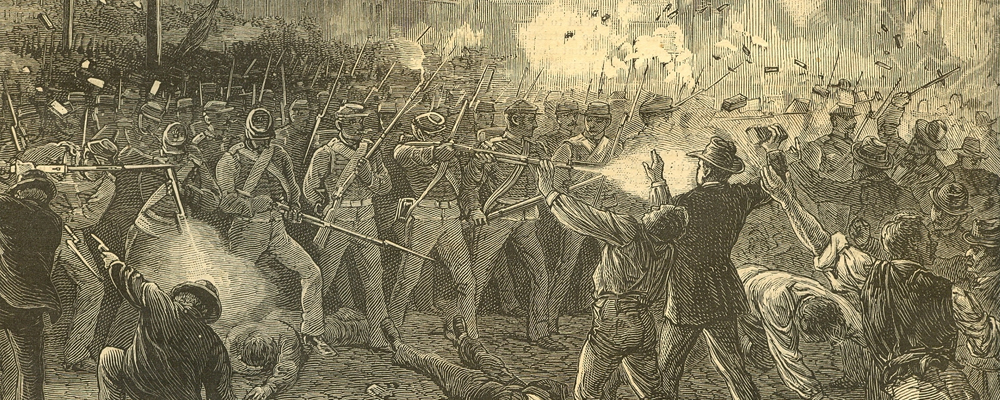
Panicked business leaders and friendly political officials reacted quickly. When local police forces would not or could not suppress the strikes, governors called out state militias to break them and restore rail service. Many strikers destroyed rail property rather than allow militias to reopen the rails. The protests approached a class war. The governor of Maryland deployed the state’s militia. In Baltimore, the militia fired into a crowd of striking workers, killing eleven and wounding many more. Strikes convulsed towns and cities across Pennsylvania. The head of the Pennsylvania Railroad, Thomas Andrew Scott, suggested that if workers were unhappy with their wages, they should be given “a rifle diet for a few days and see how they like that kind of bread.”1 Law enforcement in Pittsburgh refused to put down the protests, so the governor called out the state militia, which killed twenty strikers with bayonets and rifle fire. A month of chaos erupted. Strikers set fire to the city, destroying dozens of buildings, over a hundred engines, and over a thousand cars. In Reading, strikers destroyed rail property, and an angry crowd bombarded militiamen with rocks and bottles. The militia fired into the crowd, killing ten. A general strike erupted in St. Louis, and strikers seized rail depots and declared for the eight-hour day and the abolition of child labor. Federal troops and vigilantes fought their way into the depot, killing eighteen and breaking the strike. Rail lines were shut down all across neighboring Illinois, where coal miners struck in sympathy, tens of thousands gathered to protest under the aegis of the Workingmen’s Party, and twenty protesters were killed in Chicago by special police and militiamen.
Courts, police, and state militias suppressed the strikes, but it was federal troops that finally defeated them. When Pennsylvania militiamen were unable to contain the strikes, federal troops stepped in. When militia in West Virginia refused to break the strike, federal troops broke it instead. On the orders of President Rutherford B. Hayes, American soldiers were deployed all across northern rail lines. Soldiers moved from town to town, suppressing protests and reopening the rail network. Six weeks after it had begun, the strike had been crushed. Nearly a hundred Americans died in “The Great Upheaval.” Workers destroyed nearly $40 million worth of property. The strike galvanized the country. It convinced laborers of the need for institutionalized unions, persuaded businesses of the need for even greater political influence and government aid, and foretold a half century of labor conflict in the United States.2
II. The March of Capital

The greatest strikes first hit the railroads only because no other industry had so effectively marshaled together capital, government support, and bureaucratic management. National railroad mileage tripled in the twenty years after the outbreak of the Civil War, and tripled again over the four decades that followed. Railroads compelled the creation of uniform time zones across the country, gave industrialists access to remote markets, and opened the American West. Railroad companies were the nation’s largest businesses. Their vast national operations demanded the creation of innovative new corporate organizational structures, advanced management techniques, and vast sums of capital. Their huge expenditures spurred countless industries and drew in droves of laborers. And as they crisscrossed the nation, they created a national market, a truly national economy, and, seemingly, a new national culture.3
The railroads were not natural creations. Their vast capital requirements required the use of incorporation, a legal innovation that protected shareholders from losses. Enormous amounts of government support followed. Federal, state, and local governments offered unrivaled handouts to create the national rail networks. Lincoln’s Republican Party—which dominated government policy during the Civil War and Reconstruction—passed legislation granting vast subsidies. Hundreds of millions of acres of land and millions of dollars’ worth of government bonds were freely given to build the great transcontinental railroads and the innumerable trunk lines that annihilated the vast geographic barriers that had so long sheltered American cities from one another.
Revolutions in American industry followed. Technological innovations and national investments slashed the costs of production and distribution. New administrative frameworks sustained the weight of vast firms. National credit agencies eased the uncertainties surrounding the rapid movement of capital among investors, manufacturers, and retailers. Plummeting transportation and communication costs opened new national media outlets, which advertising agencies used to nationalize various products.
Growing labor unrest accompanied the industrialization of the American economy. As railroad construction drove economic development, new means of production spawned new systems of labor. Many wage earners had traditionally seen factory work as a temporary stepping stone to attaining their own small businesses or farms. After the war, however, new technology and greater mechanization meant fewer and fewer American workers could legitimately aspire to economic independence. Many perceived their new powerlessness in the coming industrial order. Skills mattered less and less in an industrialized, mass-producing economy, and their strength as individuals seemed ever smaller and more insignificant as companies grew in size and power and managers grew flush with wealth and influence. Long hours, dangerous working conditions, and the difficulty of supporting a family on meager and unpredictable wages compelled armies of labor to organize and battle against the power of capital.
Stronger and more organized labor unions formed to fight on behalf of a growing, more permanent working class. At the same time, the growing scale of economic enterprises increasingly disconnected owners from their employees and day-to-day business operations. To handle their vast new operations, owners turned to managers. Educated bureaucrats swelled the ranks of an emerging middle class.
Industrialization, meanwhile, remade much of American life outside the workplace. Rapidly growing industrialized cities knit together urban consumers and rural producers into a single, integrated national market. Food production and consumption, for instance, were utterly nationalized. Chicago’s stockyards seemingly tied it all together. Between 1866 and 1886, ranchers drove a million head of cattle annually overland from Texas ranches to railroad depots in Kansas for shipment by rail to Chicago. After traveling through modern “disassembly lines,” the animals left the adjoining slaughterhouses as slabs of meat to be packed into refrigerated rail cars and sent to butcher shops across the continent. By 1885, a handful of large-scale industrial meatpackers in Chicago were producing nearly five hundred million pounds of “dressed” beef annually.4 The new scale of industrialized meat production transformed the landscape. Buffalo herds, grasslands, and old-growth forests gave way to cattle, corn, and wheat. Chicago became the Gateway City, a crossroads connecting American agricultural goods, capital markets in New York and London, and consumers from all corners of the United States.
Technological innovation accompanied economic development. For April Fool’s Day in 1878, the New York Daily Graphic published a fictitious interview with the celebrated inventor Thomas A. Edison. The piece described the “biggest invention of the age”—a new Edison machine that could create forty different kinds of food and drink out of only air, water, and dirt. “Meat will no longer be killed and vegetables no longer grown, except by savages,” promised “Edison.” The machine would end “famine and pauperism.” And all for $5 or $6 per machine! The story was a joke, of course, but Edison nevertheless received inquiries from readers wondering when his food machine would be ready for the market. Americans had apparently witnessed such startling technological advances—advances that would have seemed far-fetched mere years earlier—that the Edison food machine seemed entirely plausible.5
In September 1878, Edison announced a new and ambitious line of research and development—electric power and lighting. The scientific principles behind dynamos and electric motors—the conversion of mechanical energy to electrical power, and vice versa—were long known, but Edison applied the age’s bureaucratic and commercial ethos to the problem. Far from a lone inventor gripped by inspiration and toiling in isolation, Edison advanced the model of commercially minded management of research and development. Edison folded his two identities, business manager and inventor, together. He called his Menlo Park research laboratory an “invention factory” and promised to turn out “a minor invention every ten days and a big thing every six months or so.” He brought Menlo Park, fully equipped, and his team of skilled machinists and scientists to bear on the problem of building an electric power system—and commercializing it.
By late fall 1879, Edison exhibited his system of power generation and electrical light for reporters and investors. Then he scaled up production. He sold generators to businesses. By the middle of 1883, Edison had overseen construction of 330 plants powering over sixty thousand lamps in factories, offices, printing houses, hotels, and theaters around the world. He convinced municipal officials to build central power stations and run power lines. New York’s Pearl Street central station opened in September 1882 and powered a square mile of downtown Manhattan. Electricity revolutionized the world. It not only illuminated the night, it powered the Second Industrial Revolution. Factories could operate anywhere at any hour. Electric rail cars allowed for cities to build out, and electric elevators allowed for them to build up.
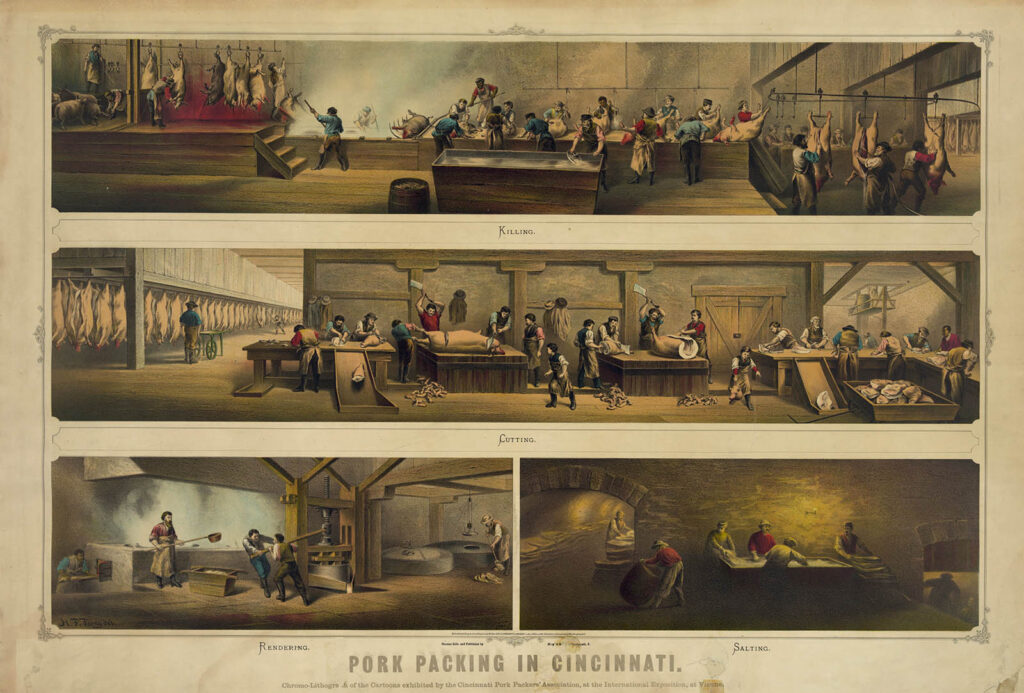

By the turn of the century, corporate leaders and wealthy industrialists embraced the new principles of scientific management, or Taylorism, after its noted proponent, Frederick Taylor. The precision of steel parts, the harnessing of electricity, the innovations of machine tools, and the mass markets wrought by the railroads offered new avenues for efficiency. To match the demands of the machine age, Taylor said, firms needed a scientific organization of production. He urged all manufacturers to increase efficiency by subdividing tasks. Rather than having thirty mechanics individually making thirty machines, for instance, a manufacturer could assign thirty laborers to perform thirty distinct tasks. Such a shift would not only make workers as interchangeable as the parts they were creating, it would also dramatically speed up the process of production. If managed by trained experts, specific tasks could be done quicker and more efficiently. Taylorism increased the scale and scope of manufacturing and allowed for the flowering of mass production. Building on the use of interchangeable parts in Civil War–era weapons manufacturing, American firms advanced mass production techniques and technologies. Singer sewing machines, Chicago packers’ “disassembly” lines, McCormick grain reapers, Duke cigarette rollers: all realized unprecedented efficiencies and achieved unheard-of levels of production that propelled their companies into the forefront of American business. Henry Ford made the assembly line famous, allowing the production of automobiles to skyrocket as their cost plummeted, but various American firms had been paving the way for decades.6 Cyrus McCormick had overseen the construction of mechanical reapers (used for harvesting wheat) for years. He had relied on skilled blacksmiths, skilled machinists, and skilled woodworkers to handcraft horse-drawn machines. But production was slow, and the machines were expensive. The reapers still enabled massive efficiency gains in grain farming, but their high cost and slow production times put them out of reach of most American wheat farmers. But then, in 1880, McCormick hired a production manager who had overseen the manufacturing of Colt firearms to transform his system of production. The Chicago plant introduced new jigs, steel gauges, and pattern machines that could make precise duplicates of new, interchangeable parts. The company had produced twenty-one thousand machines in 1880. It made twice as many in 1885; by 1889, less than a decade later, it was producing over one hundred thousand a year.7

Industrialization and mass production pushed the United States into the forefront of the world. The American economy had lagged behind Britain, Germany, and France as recently as the 1860s, but by 1900 the United States was the world’s leading manufacturing nation. Thirteen years later, by 1913, the United States produced one third of the world’s industrial output—more than Britain, France, and Germany combined.8 Firms such as McCormick’s realized massive economies of scale: after accounting for their initial massive investments in machines and marketing, each additional product lost the company relatively little in production costs. The bigger the production, then, the bigger the profits. New industrial companies therefore hungered for markets to keep their high-volume production facilities operating. Retailers and advertisers sustained the massive markets needed for mass production, and corporate bureaucracies meanwhile allowed for the management of giant new firms. A new class of managers—comprising what one prominent economic historian called the “visible hand”—operated between the worlds of workers and owners and ensured the efficient operation and administration of mass production and mass distribution. Even more important to the growth and maintenance of these new companies, however, were the legal creations used to protect investors and sustain the power of massed capital.9 The costs of mass production were prohibitive for all but the very wealthiest individuals, and, even then, the risks would be too great to bear individually. The corporation itself was ages old, but the actual right to incorporate had generally been reserved for public works projects or government-sponsored monopolies. After the Civil War, however, the corporation, using new state incorporation laws passed during the Market Revolution of the early nineteenth century, became a legal mechanism for nearly any enterprise to marshal vast amounts of capital while limiting the liability of shareholders. By washing their hands of legal and financial obligations while still retaining the right to profit massively, investors flooded corporations with the capital needed to industrialize.
But a competitive marketplace threatened the promise of investments. Once the efficiency gains of mass production were realized, profit margins could be undone by cutthroat competition, which kept costs low as price-cutting ate into profits. Companies rose and fell—and investors suffered losses—as manufacturing firms struggled to maintain supremacy over their particular industries. Economies of scale were a double-edged sword: while additional production provided immense profits, the high fixed costs of operating expensive factories dictated that even modest losses from selling underpriced goods were preferable to not selling profitably priced goods at all.
Desperate for any advantage, firms turned to advertising, propelling it into a multi-million-dollar industry. There were about 40 advertising firms in New York City in the 1860s; by 1890, there were 300. The industry professionalized. New business colleges taught courses on marketing, and trade groups published experts published a flurry of manuals and how-to guides. Advertisers worked as “copywriters,” “commercial artists,” and other newly specialized jobs.10 Advertising itself changed. Ads became more colorful and distinct and entertaining. Congress created new national trademark protections in 1870, and companies responded by putting forward new trademarks and logos and corporate characters, such as the Quaker Oat Man (trademarked 1895). Ads, meanwhile, became ubiquitous, appearing in magazines, on billboards, in newspapers, on the sides of buildings, and even as free products on shop counters: printers created small, colorful, collectible cards (“chromolithographs”) that blended entertainment and branding and became omnipresent in late nineteenth-century America.
Manufactured brand loyalty, however, could not triumph over economic law. As market share was won and lost, profits proved unstable. American industrial firms tried everything to avoid competition: they formed informal pools and trusts, they entered price-fixing agreements, they divided markets, and, when blocked by antitrust laws and renegade price cutting, merged into consolidations. Rather than suffer from ruinous competition, firms combined and bypassed it altogether.
Between 1895 and 1904, and peaking between 1898 and 1902, a wave of mergers rocked the American economy. Competition melted away in what has been called “the great merger movement.” In nine years, four thousand companies—nearly 20 percent of the American economy—were folded into rival firms. In nearly every major industry, newly consolidated firms such as General Electric and DuPont utterly dominated their market. Forty-one separate consolidations each controlled over 70 percent of the market in their respective industries. In 1901, financier J. P. Morgan oversaw the formation of United States Steel, built from eight leading steel companies. Industrialization was built on steel, and one firm—the world’s first billion-dollar company—controlled the market. Monopoly had arrived.11
III. The Rise of Inequality
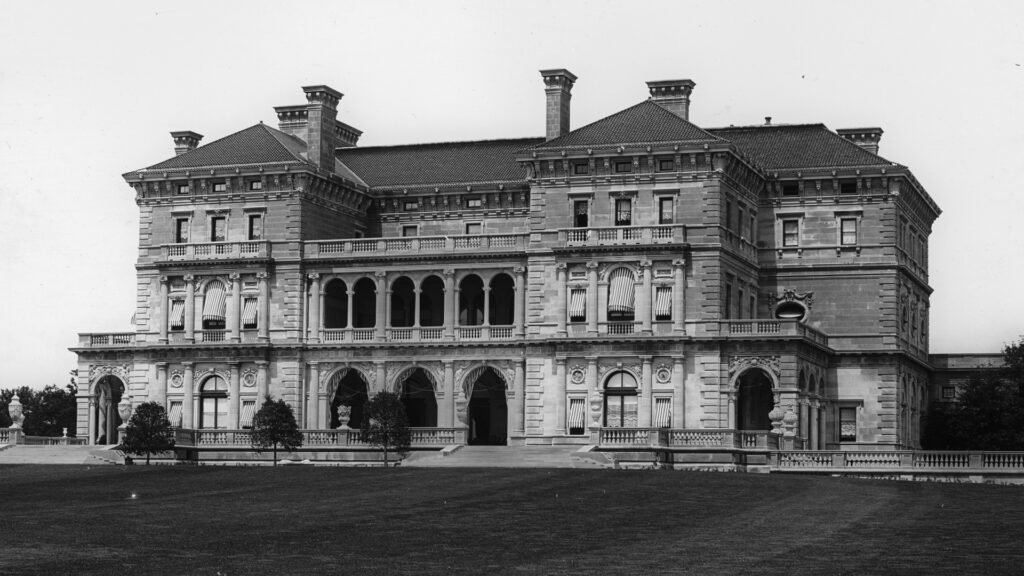
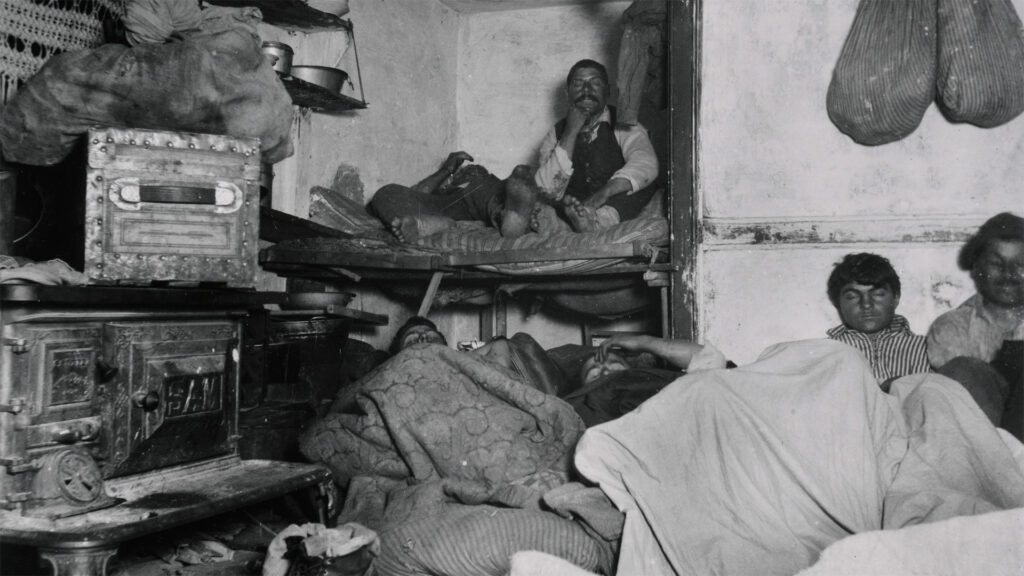
Industrial capitalism realized the greatest advances in efficiency and productivity that the world had ever seen. Massive new companies marshaled capital on an unprecedented scale and provided enormous profits that created unheard-of fortunes. But it also created millions of low-paid, unskilled, unreliable jobs with long hours and dangerous working conditions. The notion of a glittering world of wealth and technological innovation masking massive social inequities and deep-seated corruption gave the era its most common label, the Gilded Age, which drew from the title of an 1873 satirical novel written by Mark Twain and Charles Warner. Industrial capitalism confronted Gilded Age Americans with unprecedented inequalities. The sudden appearance of the extreme wealth of industrial and financial leaders alongside the crippling squalor of the urban and rural poor shocked Americans. “This association of poverty with progress is the great enigma of our times,” economist Henry George wrote in his 1879 bestseller Progress and Poverty.12
The great financial and industrial titans, the so-called robber barons, including railroad operators such as Cornelius Vanderbilt, oilmen such as John D. Rockefeller, steel magnates such as Andrew Carnegie, and bankers such as J. P. Morgan, won fortunes that, adjusted for inflation, are still among the largest the nation has ever seen. According to various measurements, in 1890 the wealthiest 1 percent of Americans owned one fourth of the nation’s assets; the top 10 percent owned over 70 percent. And inequality only accelerated. By 1900, the richest 10 percent controlled perhaps 90 percent of the nation’s wealth.13
As these vast and unprecedented new fortunes accumulated among a small number of wealthy Americans, new ideas arose to bestow moral legitimacy upon them. In 1859, British naturalist Charles Darwin published his theory of evolution through natural selection in his On the Origin of Species. It was not until the 1870s, however, that those theories gained widespread traction among biologists, naturalists, and other scientists in the United States and, in turn, challenged the social, political, and religious beliefs of many Americans. One of Darwin’s greatest popularizers, the British sociologist and biologist Herbert Spencer, applied Darwin’s theories to society and popularized the phrase survival of the fittest. The fittest, Spencer said, would demonstrate their superiority through economic success, while state welfare and private charity would lead to social degeneration—it would encourage the survival of the weak.14
Library of Congress, LC-USZ62-16348
“There must be complete surrender to the law of natural selection,” the Baltimore Sun journalist H. L. Mencken wrote in 1907. “All growth must occur at the top. The strong must grow stronger, and that they may do so, they must waste no strength in the vain task of trying to uplift the weak.”15 By the time Mencken wrote those words, the ideas of social Darwinism had spread among wealthy Americans and their defenders. Social Darwinism identified a natural order that extended from the laws of the cosmos to the workings of industrial society. All species and all societies, including modern humans, the theory went, were governed by a relentless competitive struggle for survival. The inequality of outcomes was to be not merely tolerated but encouraged and celebrated. It signified the progress of species and societies. Spencer’s major work, Synthetic Philosophy, sold nearly four hundred thousand copies in the United States by the time of his death in 1903. Gilded Age industrial elites such as Carnegie, Edison, and Rockefeller were among Spencer’s prominent followers. Other American thinkers, such as Yale’s William Graham Sumner, echoed his ideas. Sumner said, “Before the tribunal of nature a man has no more right to life than a rattlesnake; he has no more right to liberty than any wild beast; his right to pursuit of happiness is nothing but a license to maintain the struggle for existence.”16
But not all so eagerly welcomed inequalities. The spectacular growth of the US economy and the ensuing inequalities in living conditions and incomes confounded many Americans. As industrial capitalism overtook the nation, it secured political protections. Although both major political parties facilitated the rise of big business and used state power to support the interests of capital against labor, big business looked primarily to the Republican Party.
The Republican Party had risen as an antislavery faction committed to “free labor,” but it was also an ardent supporter of American business. Abraham Lincoln had been a corporate lawyer who defended railroads, and during the Civil War the Republican national government took advantage of the wartime absence of southern Democrats to push through a pro-business agenda. The Republican Congress gave millions of acres and dollars to railroad companies. Republicans became the party of business, and they dominated American politics throughout the Gilded Age and the first three decades of the twentieth century. Of the sixteen presidential elections between the Civil War and the Great Depression, Republican candidates won all but four. Republicans controlled the Senate in twenty-seven out of thirty-two sessions in the same period. Republican dominance maintained a high protective tariff, an import tax designed to shield American businesses from foreign competition. Southern planters had opposed this policy before the war but now could do nothing to stop it. It provided the protective foundation for a new American industrial order, while Spencer’s social Darwinism provided moral justification for national policies that minimized government interference in the economy for anything other than the protection and support of business.
IV. The Labor Movement

The ideas of social Darwinism attracted little support among the mass of American industrial laborers. American workers toiled in difficult jobs for long hours and little pay. Mechanization and mass production threw skilled laborers into unskilled positions. Industrial work ebbed and flowed with the economy. The typical industrial laborer could expect to be unemployed one month out of the year. They labored sixty hours a week and could still expect their annual income to fall below the poverty line. Among the working poor, wives and children were forced into the labor market to compensate. Crowded cities, meanwhile, failed to accommodate growing urban populations, and skyrocketing rents trapped families in crowded slums.
Strikes ruptured American industry throughout the late nineteenth and early twentieth centuries. Workers seeking higher wages, shorter hours, and safer working conditions had struck throughout the antebellum era, but organized unions were fleeting and transitory. The Civil War and Reconstruction seemed to briefly distract the nation from the plight of labor, but the end of the sectional crisis and the explosive growth of big business, unprecedented fortunes, and a vast industrial workforce in the last quarter of the nineteenth century sparked the rise of a vast American labor movement.
The failure of the Great Railroad Strike of 1877 convinced workers of the need to organize. Union memberships began to climb. The Knights of Labor enjoyed considerable success in the early 1880s, due in part to its efforts to unite skilled and unskilled workers. It welcomed all laborers, including women (the Knights barred only lawyers, bankers, and liquor dealers). By 1886, the Knights had over seven hundred thousand members. The Knights envisioned a cooperative producer-centered society that rewarded labor, not capital, but, despite their sweeping vision, the Knights focused on practical gains that could be won through the organization of workers into local unions.17
In Marshall, Texas, in the spring of 1886, one of Jay Gould’s rail companies fired a Knights of Labor member for attending a union meeting. His local union walked off the job, and soon others joined. From Texas and Arkansas into Missouri, Kansas, and Illinois, nearly two hundred thousand workers struck against Gould’s rail lines. Gould hired strikebreakers and the Pinkerton Detective Agency, a kind of private security contractor, to suppress the strikes and get the rails moving again. Political leaders helped him, and state militias were enlisted in support of Gould’s companies. The Texas governor called in the Texas Rangers. Workers countered by destroying property, which had the effect of winning them negative headlines and, for many, justifying the use of strikebreakers and militiamen. The strike broke, briefly undermining the Knights of Labor, but the organization regrouped and set its eyes on a national campaign for the eight-hour day.18
The campaign for an eight-hour day, long a rallying cry that united American laborers, culminated in a national strike on May 1, 1886. Somewhere around four hundred thousand workers struck across the country.
In Chicago, police forces killed several workers while breaking up protesters at the McCormick reaper works. Labor leaders and radicals called for a protest at Haymarket Square the following day, which police also proceeded to break up. But as they did, a bomb exploded and killed seven policemen. Police fired into the crowd, killing four. The deaths of the Chicago policemen sparked outrage across the nation, and the sensationalization of the Haymarket Riot helped many Americans link unionism with radicalism. Eight Chicago anarchists were arrested and, despite a lack of direct evidence implicating them in the bombing, were charged and found guilty of conspiracy. Four were hanged (one died by suicide before he could be executed). Membership in the Knights had peaked earlier that year but fell rapidly after Haymarket; the group became associated with violence and radicalism. The national movement for an eight-hour day collapsed.19
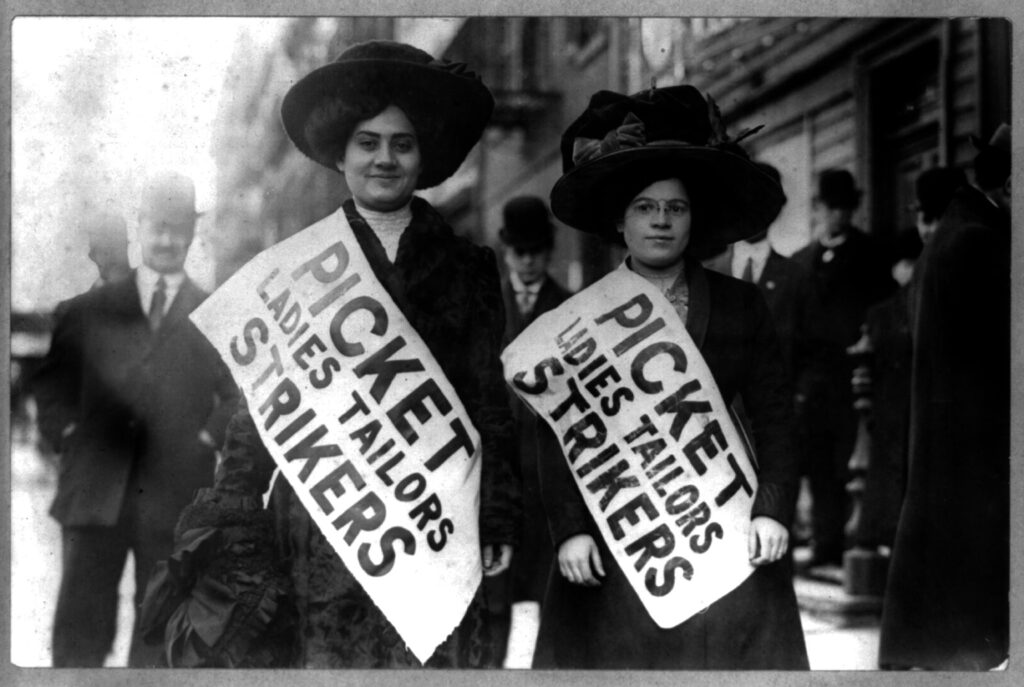
The American Federation of Labor (AFL) emerged as a conservative alternative to the vision of the Knights of Labor. An alliance of craft unions (unions composed of skilled workers), the AFL rejected the Knights’ expansive vision of a “producerist” economy and advocated “pure and simple trade unionism,” a program that aimed for practical gains (higher wages, fewer hours, and safer conditions) through a conservative approach that tried to avoid strikes. But workers continued to strike.
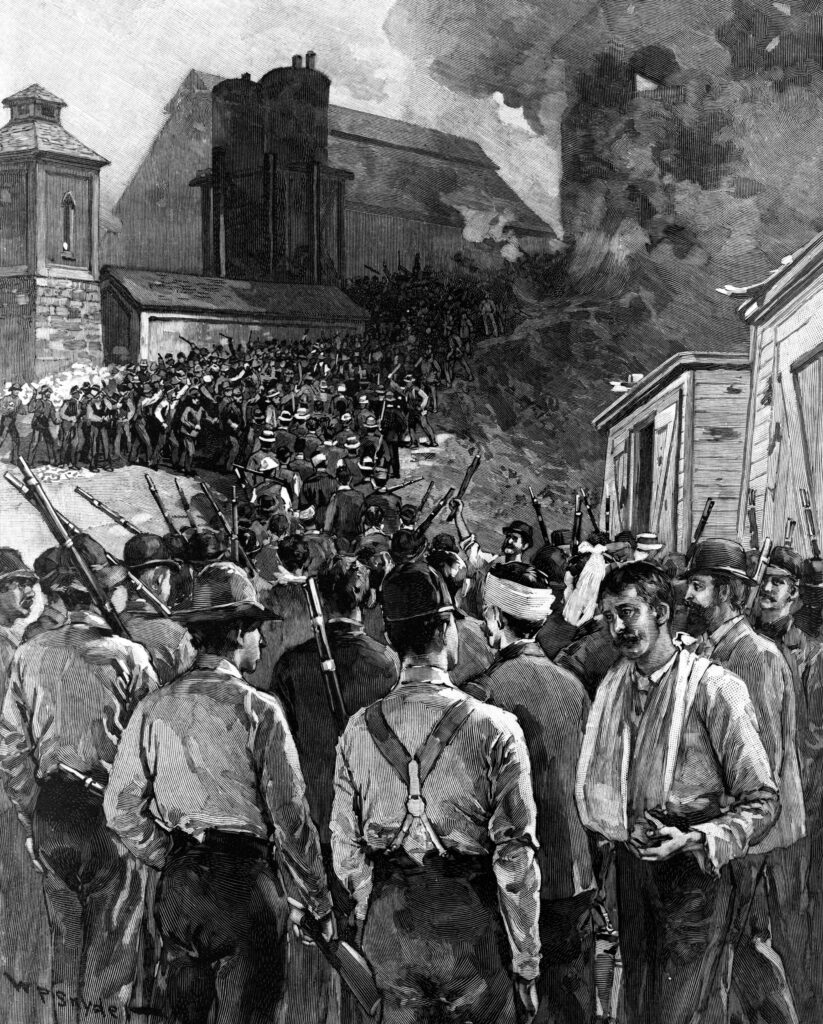
In 1892, the Amalgamated Association of Iron and Steel Workers struck at one of Carnegie’s steel mills in Homestead, Pennsylvania. After repeated wage cuts, workers shut the plant down and occupied the mill. The plant’s operator, Henry Clay Frick, immediately called in hundreds of Pinkerton detectives, but the steel workers fought back. The heavily armed Pinkertons, attempting to approach the mill by river barges, were besieged by the striking steel workers. After several hours of pitched battle, the Pinkertons surrendered. Angry workers forced them to run through a bloody gauntlet of clubs and fists before they were expelled from the mill grounds. The Pennsylvania governor called the state militia, broke the strike, and reopened the mill. The union was essentially destroyed in the aftermath.20
Still, despite repeated failure, strikes continued to roll across the industrial landscape. In 1894, workers in George Pullman’s Pullman car factories struck when he cut wages by a quarter but kept rents and utilities in his company town constant. The American Railway Union (ARU), led by Eugene V. Debs, launched a sympathy strike: the ARU would refuse to handle any Pullman cars on any rail line anywhere in the country. Thousands of workers struck, and national railroad traffic ground to a halt. Unlike in nearly every other major strike, the governor of Illinois sympathized with workers and refused to dispatch the state militia. It didn’t matter. In July, President Grover Cleveland dispatched thousands of American soldiers to break the strike, and a federal court issued a preemptive injunction against Debs and the union’s leadership. The strike violated the injunction, and Debs was arrested and imprisoned. Without the union’s leadership, the strike evaporated. Jail radicalized Debs, proving to him that political and judicial leaders were merely tools for capital in its struggle against labor.21 But it wasn’t just Debs. In 1905, the degrading conditions of industrial labor sparked strikes across the country. The final two decades of the nineteenth century saw over twenty thousand strikes and lockouts in the United States. Industrial laborers struggled to carve for themselves a piece of the prosperity lifting investors and a rapidly expanding middle class into unprecedented standards of living. But workers were not the only ones struggling to stay afloat in industrial America. American farmers also lashed out against the inequalities of the Gilded Age and denounced political corruption for enabling economic theft.
V. The Populist Movement
“Wall Street owns the country,” the Populist leader Mary Elizabeth Lease told dispossessed farmers around 1890. “It is no longer a government of the people, by the people, and for the people, but a government of Wall Street, by Wall Street, and for Wall Street.” Farmers, who remained a majority of the American population through the first decade of the twentieth century, were hit especially hard by industrialization. The expanding markets and technological improvements that increased efficiency also decreased commodity prices. Commercialization of agriculture put farmers in the hands of bankers, railroads, and various economic intermediaries. As the decades passed, more and more farmers fell ever further into debt, lost their land, and were forced to enter the industrial workforce or, especially in the South, became landless farmworkers.
The rise of industrial giants reshaped the American countryside and the Americans who called it home. Railroad spur lines and telegraph lines crept into farming communities and linked rural Americans, who also still made up a majority of the country’s population, with towns, regional cities, American financial centers in Chicago and New York, and, eventually, London and the world’s financial markets. Meanwhile, improved farm machinery, easy credit, and the latest consumer goods flooded the countryside. But the new connections and new conveniences came at a price.
Farmers had always been dependent on the whims of the weather and local markets. But now they staked their financial security on a national economic system subject to rapid price swings, rampant speculation, and limited regulation. Frustrated American farmers attempted to reshape the fundamental structures of the nation’s political and economic systems, systems they believed enriched parasitic bankers and industrial monopolists at the expense of the many laboring farmers who fed the nation by producing its many crops and farm goods. Their dissatisfaction with an erratic and impersonal system put many of them at the forefront of what would become perhaps the most serious challenge to the established political economy of Gilded Age America. Farmers organized and launched their challenge first through the cooperatives of the Farmers’ Alliance and later through the politics of the People’s (or Populist) Party.
Mass production and business consolidations spawned giant corporations that monopolized nearly every sector of the US economy in the decades after the Civil War. In contrast, the economic power of the individual farmer sank into oblivion. Threatened by ever-plummeting commodity prices and ever-rising indebtedness, Texas agrarians met in Lampasas, Texas, in 1877 and organized the first Farmers’ Alliance to restore some economic power to farmers as they dealt with railroads, merchants, and bankers. If big business relied on its numerical strength to exert its economic will, why shouldn’t farmers unite to counter that power? They could share machinery, bargain from wholesalers, and negotiate higher prices for their crops. Over the following years, organizers spread from town to town across the former Confederacy, the Midwest, and the Great Plains, holding evangelical-style camp meetings, distributing pamphlets, and establishing over a thousand alliance newspapers. As the alliance spread, so too did its near-religious vision of the nation’s future as a “cooperative commonwealth” that would protect the interests of the many from the predatory greed of the few. At its peak, the Farmers’ Alliance claimed a million and a half members meeting in forty thousand local sub-alliances.22

The alliance’s most innovative programs were a series of farmers’ cooperatives that enabled farmers to negotiate higher prices for their crops and lower prices for the goods they purchased. These cooperatives spread across the South between 1886 and 1892 and claimed more than a million members at their high point. While most failed financially, these “philanthropic monopolies,” as one alliance speaker termed them, inspired farmers to look to large-scale organization to cope with their economic difficulties.23 But cooperation was only part of the alliance message.
In the South, alliance-backed Democratic candidates won four governorships and forty-eight congressional seats in 1890.24 But at a time when falling prices and rising debts were conspiring against the survival of family farmers, the two political parties seemed incapable of representing the needs of poor farmers. And so alliance members organized a political party—the People’s Party, or the Populists, as they came to be known. The Populists attracted supporters across the nation by appealing to those convinced that there were deep flaws in the political economy of Gilded Age America, flaws that both political parties refused to address. Veterans of earlier fights for currency reform, disaffected industrial laborers, proponents of the benevolent socialism of Edward Bellamy’s popular Looking Backward, and the champions of Henry George’s farmer-friendly “single-tax” proposal joined alliance members in the new party. The Populists nominated former Civil War general James B. Weaver as their presidential candidate at the party’s first national convention in Omaha, Nebraska, on July 4, 1892.25
At that meeting the party adopted a platform that crystallized the alliance’s cooperate program into a coherent political vision. The platform’s preamble, written by longtime political iconoclast and Minnesota populist Ignatius Donnelly, warned that “the fruits of the toil of millions [had been] boldly stolen to build up colossal fortunes for a few.”26 Taken as a whole, the Omaha Platform and the larger Populist movement sought to counter the scale and power of monopolistic capitalism with a strong, engaged, and modern federal government. The platform proposed an unprecedented expansion of federal power. It advocated nationalizing the country’s railroad and telegraph systems to ensure that essential services would be run in the best interests of the people. In an attempt to deal with the lack of currency available to farmers, it advocated postal savings banks to protect depositors and extend credit. It called for the establishment of a network of federally managed warehouses—called subtreasuries—which would extend government loans to farmers who stored crops in the warehouses as they awaited higher market prices. To save debtors it promoted an inflationary monetary policy by monetizing silver. Direct election of senators and the secret ballot would ensure that this federal government would serve the interest of the people rather than entrenched partisan interests, and a graduated income tax would protect Americans from the establishment of an American aristocracy. Combined, these efforts would, Populists believed, help shift economic and political power back toward the nation’s producing classes.
In the Populists’ first national election campaign in 1892, Weaver received over one million votes (and twenty-two electoral votes), a truly startling performance that signaled a bright future for the Populists. And when the Panic of 1893 sparked the worst economic depression the nation had ever yet seen, the Populist movement won further credibility and gained even more ground. One of the movement’s most fervent speakers, Mary Lease, a Kansan, famously (and perhaps apocryphally) called on farmers to “raise less corn and more Hell.” Populist stump speakers crossed the country, speaking with righteous indignation, blaming the greed of business elites and corrupt party politicians for causing the crisis fueling America’s widening inequality. Southern orators like Texas’s James “Cyclone” Davis and Georgian firebrand Tom Watson stumped across the South decrying the abuses of northern capitalists and the Democratic Party. Pamphlets such as W. H. Harvey’s Coin’s Financial School and Henry D. Lloyd’s Wealth Against Commonwealth provided Populist answers to the age’s many perceived problems. The faltering economy combined with the Populists’ extensive organizing; in the 1894 elections, Populists elected six senators and seven representatives to Congress.27
The Populist movement, however, still faced substantial obstacles, especially in the South. The failure of alliance-backed Democrats to live up to their campaign promises drove some southerners to break with the party of their forefathers and join the Populists. Many, however, were unwilling to take what was, for southerners, such a radical step. Southern Democrats, for their part, responded to the Populist challenge with electoral fraud and racial demagoguery. Both severely limited Populist gains. Alliance organizers struggled to balance the pervasive white supremacy of the American South with their call for a grand union of the producing class. American racial attitudes—and their virulent southern strain—simply proved too formidable. Democrats race-baited Populists, and Populists capitulated. The Colored Farmers’ Alliance, which had formed as a segregated sister organization to the southern alliance with as many as 250,000 members at its peak, fell prey to racial and class-based hostility. The group went into rapid decline in 1891 when faced with the violent white repression of a number of alliance-sponsored cotton picker strikes. Racial mistrust and division remained the rule, even among Populists, and even in North Carolina, where a political marriage of convenience, or “fusion,” between Populists and Republicans resulted in the election of Populist Marion Butler to the Senate. Populists opposed Democratic corruption, but this did not necessarily make them champions of interracial democracy. As Butler explained to an audience in Edgecombe County, “We are in favor of white supremacy, but we are not in favor of cheating and fraud to get it.”28
By the middle of the 1890s, Populism had exploded in popularity. The first major political force to tap into the vast discomfort of many Americans with the disruptions wrought by industrial capitalism, the Populist Party seemed poised to capture political victory. And yet, even as Populism gained national traction, the movement was stumbling. The party’s often divided leadership found it difficult to shepherd what remained a diverse and loosely organized coalition of reformers toward unified political action. The Omaha Platform was a radical document, and some state party leaders selectively embraced its reforms. More important, the institutionalized parties were still too strong, and the Democrats loomed, ready to swallow Populist frustrations and inaugurate a new era of American politics.
VI. William Jennings Bryan and the Politics of Gold

William Jennings Bryan accomplished many different things in his life: he was a skilled orator, a Nebraska congressman, a three-time presidential candidate, US secretary of state under Woodrow Wilson, and a lawyer who supported prohibition and opposed Darwinism (most notably in the 1925 Scopes Monkey Trial). In terms of his political career, he won national renown for his attack on the gold standard and his tireless promotion of free silver and policies for the benefit of the average American. Although Bryan was unsuccessful in winning the presidency, he forever altered the course of American political history.29
Bryan was born in Salem, Illinois, in 1860 to a devout family with a strong passion for law, politics, and public speaking. At twenty, he attended Union Law College in Chicago and passed the bar shortly thereafter. After his marriage to Mary Baird in Illinois, Bryan and his young family relocated to Nebraska, where he won a reputation among the state’s Democratic Party leaders as an extraordinary orator. Bryan later won recognition as one of the greatest speakers in American history.
When economic depressions struck the Midwest in the late 1880s, despairing farmers confronted with low crop prices found few politicians on their side. While many rallied to the Populist cause, Bryan worked from within the Democratic Party, using the strength of his oratory. After delivering one speech, he told his wife, “Last night I found that I had a power over the audience. I could move them as I chose. I have more than usual power as a speaker. . . . God grant that I may use it wisely.”30 He soon won election to the House of Representatives, where he served for two terms. Although he lost a bid to join the Senate, Bryan turned his attention to a higher position: the presidency of the United States. There, he believed he could change the country by defending farmers and urban laborers against the corruptions of big business.
In 1895–1896, Bryan launched a national speaking tour in which he promoted the free coinage of silver. He believed that bimetallism, by inflating American currency, could alleviate farmers’ debts. In contrast, Republicans championed the gold standard and a flat money supply. American monetary standards became a leading campaign issue. Then, in July 1896, the Democratic Party’s national convention met to choose their presidential nominee in the upcoming election. The party platform asserted that the gold standard was “not only un-American but anti-American.” Bryan spoke last at the convention. He astounded his listeners. At the conclusion of his stirring speech, he declared, “Having behind us the commercial interests and the laboring interests and all the toiling masses, we shall answer their demands for a gold standard by saying to them, you shall not press down upon the brow of labor this crown of thorns. You shall not crucify mankind upon a cross of gold.”31 After a few seconds of stunned silence, the convention went wild. Some wept, many shouted, and the band began to play “For He’s a Jolly Good Fellow.” Bryan received the 1896 Democratic presidential nomination.
The Republicans ran William McKinley, an economic conservative who championed business interests and the gold standard. Bryan crisscrossed the country spreading the silver gospel. The election drew enormous attention and much emotion. According to Bryan’s wife, he received two thousand letters of support every day that year, an enormous amount for any politician, let alone one not currently in office. Yet Bryan could not defeat McKinley. The pro-business Republicans outspent Bryan’s campaign fivefold. A notably high 79.3 percent of eligible American voters cast ballots, and turnout averaged 90 percent in areas supportive of Bryan, but Republicans swayed the Northeast and Midwest and stymied the Democrats.32
In early 1900, Congress passed the Gold Standard Act, which put the country on the gold standard, effectively ending the debate over the nation’s monetary policy. Bryan sought the presidency again in 1900 but was again defeated, as he would be yet again in 1908.
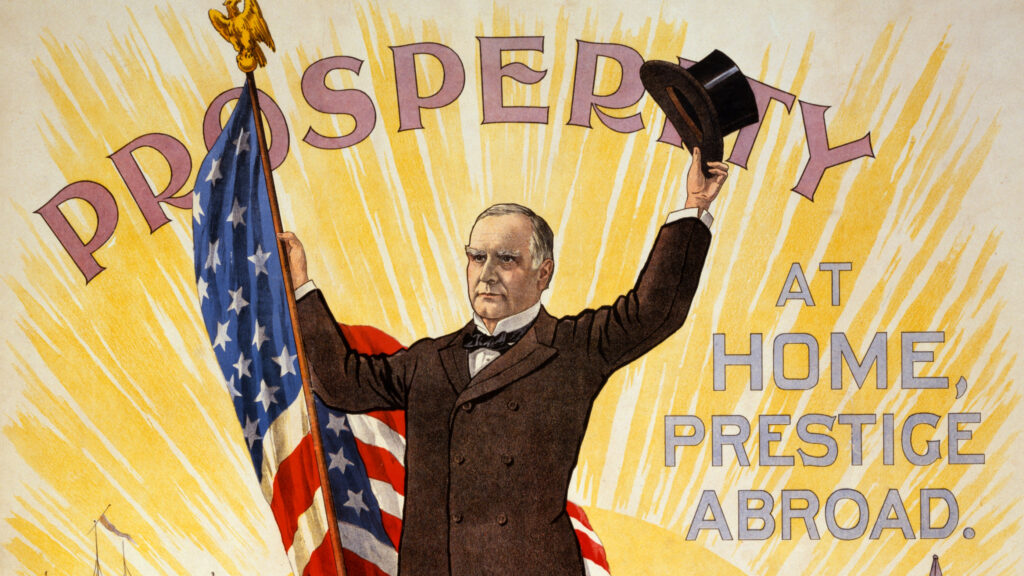
Bryan was among the most influential losers in American political history. When the agrarian wing of the Democratic Party nominated the Nebraska congressman in 1896, Bryan’s fiery condemnation of northeastern financial interests and his impassioned calls for “free and unlimited coinage of silver” co-opted popular Populist issues. The Democrats stood ready to siphon off a large proportion of the Populists’ political support. When the People’s Party held its own convention two weeks later, the party’s moderate wing, in a fiercely contested move, overrode the objections of more ideologically pure Populists and nominated Bryan as the Populist candidate as well. This strategy of temporary “fusion” fatally fractured the movement and the party. Populist energy moved from the radical-yet-still-weak People’s Party to the moderate-yet-powerful Democratic Party. And although at first glance the Populist movement appears to have been a failure—its minor electoral gains were short-lived, it did little to dislodge the entrenched two-party system, and the Populist dream of a cooperative commonwealth never took shape—in terms of lasting impact, the Populist Party proved the most significant third-party movement in American history. The agrarian revolt established the roots of later reform, and the majority of policies outlined within the Omaha Platform would eventually be signed into law over the following decades under the management of middle-class reformers. In large measure, the Populist vision laid the intellectual groundwork for the coming progressive movement.33

VII. American Radicalism
Many varieties of economic and political radicalism pushed back against industrial capitalism’s newfound American supremacy. Thousands identified as anarchists, for instance. More a political attitude than a fixed platform, anti-government dissidents, generally associated with German and other European immigrants, didn’t just reject political and economic authority, they wanted to dismantle it, sometimes violently. When, amid the national eight-hour-day May Day protests in 1886, an individual threw a pipe bomb into an advancing phalanx of policemen moving to break up a rally outside of a McCormick plant in Chicago, the police opened fire. The bomb had killed officer Mathias Degan, and when the shooting subsided, seven policemen and at least four protestors were dead. No one knew who threw the bomb, but police raided the offices of anarchist newspaper publisher August Spies, and charged eight, including the prominent anarchist Albert Parsons, with conspiracy. With no direct evidence tying them to the bombing, a jury found them guilty, and four were hanged (two asked for clemency and received life in prison; one committed suicide on the eve of the hanging). Haymarket galvanized Americans against radicalism—political traditions often associated with “hyphenated Americans” from Germany, Italy, Russia, and other hotbeds of European radicalism—and undermined support for the broader labor movement. “Shut the National door to such [anarchist] scum,” the Chicago Tribune wrote.34
Anarchism wasn’t merely a specter conjured up by the Haymarket bombing, and Parsons and Spies weren’t the movement’s only prominent American champions. Russian-born Emma Goldman migrated to the United States in 1885 and became known as the “high priestess of anarchy” for her opposition to government, war, capitalism, religion, and even marriage—any phenomenon, she wrote, that oppressed the individual.35 Goldman and many other anarchists championed the concept of attentat, or “propaganda of the deed,” a targeted act of violence that could spark revolution. Goldman, her lover Alexander Berkman, and a third conspirator, for instance, tried and failed to assassinate Henry Clay Frick, a staunchly anti-union officer of Carnegie Steel who had dramatically decimated unionization at the Homestead Steel Works in Pennsylvania (Berkman served fourteen years in prison). Others bombed the homes of prominent American capitalists and political leaders. And in 1901, anarchist Leon Czolgosz shot and killed President William McKinley.
American socialists, meanwhile, carried on the Populists’ radical economic tradition by uniting farmers and workers in a sustained, decades-long political struggle to reorder American economic life. Socialists argued that wealth and power were consolidated in the hands of too few individuals, that monopolies and trusts controlled too much of the economy, and that owners and investors grew rich while the workers who produced their wealth, despite massive productivity gains and rising national wealth, still suffered from low pay, long hours, and unsafe working conditions. Karl Marx had described the new industrial economy as a worldwide class struggle between the wealthy bourgeoisie, who owned the means of production, such as factories and farms, and the proletariat, factory workers and tenant farmers who worked only for the wealth of others. According to Eugene Debs, socialists sought “the overthrow of the capitalist system and the emancipation of the working class from wage slavery.”36 Under an imagined socialist cooperative commonwealth, the means of production would be owned collectively, ensuring that all men and women received a fair wage for their labor. According to socialist organizer and newspaper editor Oscar Ameringer, socialists wanted “ownership of the trust by the government, and the ownership of the government by the people.”37

The socialist movement drew from a diverse constituency. Party membership was open to all regardless of race, gender, class, ethnicity, or religion. Many prominent Americans, such as Helen Keller, Upton Sinclair, and Jack London, became socialists. They were joined by masses of American laborers from across the United States: factory workers, miners, railroad builders, tenant farmers, and small farmers all united under the red flag of socialism. Many united with labor leader William D. “Big Bill” Haywood and other radicals in 1905 to form the Industrial Workers of the World (IWW), the “Wobblies,” a radical and confrontational union that welcomed all workers, regardless of race or gender.38 Others turned to politics.
The Socialist Party of America (SPA), founded in 1901, carried on the American third-party political tradition. Socialist mayors were elected in thirty-three cities and towns, from Berkeley, California, to Schenectady, New York, and two socialists—Victor Berger from Wisconsin and Meyer London from New York—won congressional seats. All told, over one thousand socialist candidates won various American political offices. Julius A. Wayland, editor of the socialist newspaper Appeal to Reason, proclaimed that “socialism is coming. It’s coming like a prairie fire and nothing can stop it . . . you can feel it in the air.”39 By 1913 there were 150,000 members of the Socialist Party and, in 1912, Eugene Debs, the Indiana-born Socialist Party candidate for president, received almost one million votes, or 6 percent of the total.40
Over the following years, however, the embrace of many socialist policies by progressive reformers, internal ideological and tactical disagreements, a failure to dissuade most Americans from the perceived incompatibility between socialism and American values, and, especially, government oppression and censorship, particularly during and after World War I, ultimately sank the party. Like the Populists, however, socialists had tapped into a deep well of discontent, and their energy and organizing filtered out into American culture and American politics.
VIII. Conclusion
The march of capital transformed American life. While some enjoyed unprecedented levels of wealth, and an ever-growing slice of middle-class workers won an ever more comfortable standard of living, vast numbers of farmers lost their land and a growing industrial working class struggled to earn wages sufficient to support themselves and their families. Industrial capitalism brought wealth and it brought poverty; it created owners and investors and it created employees. But whether winners or losers in the new economy, all Americans reckoned in some way with their new industrial world.
IX. Reference Material
This chapter was edited by Joseph Locke, with content contributions by Andrew C. Baker, Jennifer M. Black, Nicholas Blood, Justin Clark, Dan Du, Kollin Fields, Caroline Bunnell Harris, David Hochfelder Scott Libson, Joseph Locke, Chad Pearson, Leah Richier, Matthew Simmons, Kate Sohasky, Joseph Super, and Kaylynn Washnock.
Recommended Reading
• Beckert, Sven. Monied Metropolis: New York City and the Consolidation of the American Bourgeoisie, 1850–1896. Cambridge, UK: Cambridge University Press, 2001.
• Cameron, Ardis. Radicals of the Worst Sort: Laboring Women in Lawrence, Massachusetts, 1860–1912. Champaign: University of Illinois Press, 1993.
• Chandler, Alfred D., Jr. The Visible Hand: The Managerial Revolution in American Business. Cambridge, MA: Belknap Press, 1977.
• Chandler, Alfred D., Jr. Scale and Scope: The Dynamics of Industrial Capitalism. Cambridge, MA: Harvard University Press, 1990.
• Costaguta, Lorenzo. Workers of All Colors Unite: Race and the Origins of American Socialism. Urbana: University of Illinois Press, 2023.
• Cronon, William. Nature’s Metropolis: Chicago and the Great West. New York: Norton, 1991.
• Currarino, Rosanne. The Labor Question in America: Economic Democracy in the Gilded Age. Urbana: University of Illinois Press, 2011.
• Edwards, Rebecca. New Spirits: Americans in the Gilded Age, 1865–1905. New York: Oxford University Press, 2005.
• Enstad, Nan. Ladies of Labor, Girls of Adventure: Working Women, Popular Culture, and Labor Politics at the Turn of the Twentieth Century. New York: Columbia University Press, 1999.
• Fink, Leon. Workingmen’s Democracy: The Knights of Labor and American Politics. Chicago: University of Illinois Press, 1993.
• Goodwyn, Lawrence. Democratic Promise: The Populist Moment in America. New York: Oxford University Press, 1976.
• Green, James. Death in the Haymarket: A Story of Chicago, the First Labor Movement, and the Bombing That Divided Gilded Age America. New York City: Pantheon Books, 2006.
• Greene, Julie. Pure and Simple Politics: The American Federation of Labor and Political Activism, 1881–1917. New York: Cambridge University Press, 1998.
• Hofstadter, Richard. Social Darwinism in American Thought. Philadelphia: University of Pennsylvania Press, 1944.
• Johnson, Kimberley S. Governing the American State: Congress and the New Federalism, 1877–1929. Princeton, NJ: Princeton University Press, 2006.
• Jones, Jacqueline. Goddess of Anarchy: The Life and Times of Lucy Parsons, American Radical. New York: Basic Books, 2017.
• Kazin, Michael. A Godly Hero: The Life of William Jennings Bryan. New York: Knopf, 2006.
• Kessler-Harris, Alice. Out to Work: A History of Wage-Earning Women in the United States. New York: Oxford University Press, 1982.
• Krause, Paul. The Battle for Homestead, 1880–1892: Politics, Culture, and Steel. Pittsburgh, PA: University of Pittsburgh Press, 1992.
• Lamoreaux, Naomi R. The Great Merger Movement in American Business, 1895–1904. New York: Cambridge University Press, 1985.
• Montgomery, David. The Fall of the House of Labor: The Workplace, the State, and American Labor Activism, 1865–1925. New York: Cambridge University Press, 1987.
• Painter, Nell Irvin. Standing at Armageddon: The United States, 1877–1919. New York: Norton, 1987.
• Postel, Charles. The Populist Vision. New York: Oxford University Press, 2009.
• Sanders, Elizabeth. Roots of Reform: Farmers, Workers, and the American State, 1877–1917. Chicago: University of Chicago Press, 1999.
• Trachtenberg, Alan. The Incorporation of America: Culture and Society in the Gilded Age. New York: Hill and Wang, 1982.
Notes
- David T. Burbank, Reign of the Rabble: The St. Louis General Strike of 1877 (New York: Kelley, 1966), 11.[↩]
- Robert V. Bruce, 1877: Year of Violence (New York: Dee, 1957); Philip S. Foner, The Great Labor Uprising of 1877 (New York: Monad Press, 1977); David Omar Stowell, ed., The Great Strikes of 1877 (Champaign: University of Illinois Press, 2008).[↩]
- See Richard White, Railroaded: The Transcontinentals and the Making of Modern America (New York: Norton, 2011). [↩]
- William Cronon, Nature’s Metropolis: Chicago and the West (New York: Norton, 1991), 239.[↩]
- David Hochfelder, “Edison and the Age of Invention,” in A Companion to the Reconstruction Presidents 1865–1881, ed. Edward O. Frantz (Chichester, UK: Blackwell, 2014), 499.[↩]
- Alfred D. Chandler Jr., The Visible Hand: The Managerial Revolution in American Business (Cambridge, MA: Belknap Press, 1977); David A. Hounshell, From the American System to Mass Production, 1800–1932 (Baltimore: Johns Hopkins University Press, 1984).[↩]
- Hounshell, From the American System, 153–188.[↩]
- Alfred D. Chandler Jr., Scale and Scope: The Dynamics of Industrial Capitalism (Cambridge, MA: Harvard University Press, 1990), 52.[↩]
- Chandler, Visible Hand.[↩]
- Jennifer M. Black, Branding Trust: Advertising and Trademarks in Nineteenth-Century America (Philadelphia: University of Pennsylvania Press, 2023); Edd Applegate, The Rise of Advertising in the United States: A History of Innovation to 1960 (Lanham, MD: Scarecrow Press, 2012), 149–170.[↩]
- Naomi R. Lamoreaux, The Great Merger Movement in American Business, 1895–1904 (New York: Cambridge University Press, 1985).[↩]
- See especially Edward O’Donnell, Henry George and the Crisis of Inequality: Progress and Poverty in the Gilded Age (New York: Columbia University Press, 2015), 41–45.[↩]
- Michael McGerr, A Fierce Discontent: The Rise and Fall of the Progressive Movement in America, 1870–1920 (New York: Free Press, 2003).[↩]
- Richard Hofstadter, Social Darwinism in American Thought (Boston: Beacon Books, 1955).[↩]
- Henry Louis Mencken, The Philosophy of Friedrich Nietzsche (Boston: Luce, 1908), 102–103.[↩]
- William Graham Sumner, Earth-Hunger, and Other Essays, ed. Albert Galloway Keller (New Haven, CT: Yale University Press, 1913), 234.[↩]
- Leon Fink, Workingmen’s Democracy: The Knights of Labor and American Politics (Urbana: University of Illinois Press, 1983).[↩]
- Ruth A. Allen, The Great Southwest Strike (Austin: University of Texas Press, 1942). [↩]
- James R. Green, Death in the Haymarket: A Story of Chicago, the First Labor Movement, and the Bombing That Divided Gilded Age America (New York: Pantheon Books, 2006).[↩]
- Paul Krause, The Battle for Homestead, 1890–1892: Politics, Culture, and Steel (Pittsburgh, PA: University of Pittsburgh Press, 1992).[↩]
- Almont Lindsey, The Pullman Strike: The Story of a Unique Experiment and of a Great Labor Upheaval (Chicago: University of Chicago Press, 1943).[↩]
- Historians of the Populists have produced a large number of excellent histories. See especially Lawrence Goodwyn, Democratic Promise: The Populist Moment in America (New York: Oxford University Press, 1976); Charles Postel, The Populist Vision (New York: Oxford University Press, 2009).[↩]
- Lawrence Goodwyn argued that the Populists’ “cooperative vision” was the central element in their hopes of a “democratic economy.” Goodwyn, Democratic Promise, 54.[↩]
- John Donald Hicks, The Populist Revolt: A History of the Farmers’ Alliance and the People’s Party (Minneapolis: University of Minnesota Press, 1931), 178.[↩]
- Ibid., 236.[↩]
- Edward McPherson, A Handbook of Politics for 1892 (Washington, DC: Chapman, 1892), 269.[↩]
- Hicks, Populist Revolt, 321–339.[↩]
- Postel, Populist Vision, 197.[↩]
- On William Jennings Bryan, see especially Michael Kazin, A Godly Hero: The Life of William Jennings Bryan (New York: Knopf, 2006).[↩]
- Ibid., 25.[↩]
- Richard Franklin Bensel, Passion and Preferences: William Jennings Bryan and the 1896 Democratic Convention (Cambridge, UK: Cambridge University Press, 2008), 232.[↩]
- Lyn Ragsdale, Vital Statistics on the Presidency (Washington, DC: Congressional Quarterly Press, 1998), 132–138.[↩]
- Elizabeth Sanders, Roots of Reform: Farmers, Workers, and the American State, 1877–1917 (Chicago: University of Chicago Press, 1999).[↩]
- Quoted in Michael Willrich, American Anarchy: The Epic Struggle between Immigrant Radicals and the U.S. Government at the Dawn of the Twentieth Century (New York: Basic Books, 2023), 21.[↩]
- Emma Goldman, “Anarchism: What It Really Stands For,” in Emma Goldman, Red Emma Speaks: An Emma Goldman Reader, 3rd ed., ed. Alix Kates Shulman (Amherst, NY: Humanity Books, 1998), 71.[↩]
- Eugene V. Debs, “The Socialist Party and the Working Class,” International Socialist Review (September 1904).[↩]
- Oscar Ameringer, Socialism: What It Is and How to Get It (Milwaukee, WI: Political Action, 1911), 31.[↩]
- Philip S. Foner, The Industrial Workers of the World, 1905–1917 (New York: International Publishers, 1965).[↩]
- R. Laurence Moore, European Socialists and the American Promised Land (New York: Oxford University Press, 1970), 214.[↩]
- Nick Salvatore, Eugene V. Debs, Citizen and Socialist (Chicago: University of Illinois Press, 1983).[↩]