*The American Yawp is an evolving, collaborative text. Click here to help improve this chapter.*
- I. Introduction
- II. Post–Civil War Westward Migration
- III. The Indian Wars and Federal Peace Policies
- IV. Western Economic Expansion: Railroads and Cattle
- V. The Allotment Era and Resistance in the Native West
- VI. Rodeos, Wild West Shows, and the Mythic American West
- VII. The US-Mexico Borderlands
- VIII. Patterns of Foreign Interventions
- IX. 1898
- X. Theodore Roosevelt and American Imperialism
- XI. Women and American Imperialism
- XII. Conclusion
- XIII. Reference Material
I. Introduction
In the decades after the American Civil War, the United States, long busy fulfilling its “Manifest Destiny,” roared across the continent and asserted itself overseas. Settlers poured into the US West, and, alongside the American military, destroyed Indigenous sovereignties. Investors and ranchers raced into the US-Mexico borderlands, overwhelming long-standing Mexican American communities with American economic and racial systems. And, increasingly, Americans looked overseas, flooding much of the world with missionaries, consumer goods, and territorial ambitions. By the end of the century, the United States, flexing its power and sovereignty more widely than ever before, had established itself as a global power.
II. Post–Civil War Westward Migration
Native Americans long dominated the vastness of the American West. Linked culturally and geographically by trade, travel, and warfare, various Indigenous groups controlled most of the continent west of the Mississippi River deep into the nineteenth century. Spanish, French, British, and later American traders had integrated themselves into many regional economies, and American emigrants pushed ever westward, but no imperial power had yet achieved anything approximating political or military control over the great bulk of the continent. But then the Civil War came and went and decoupled the West from the question of slavery just as the United States industrialized and laid down rails and pushed its ever-expanding population farther west.
Indigenous Americans have lived in North America for over ten millennia and, into the late nineteenth century, perhaps as many as 250,000 Native people still inhabited the American West.1 But then unending waves of American settlers, the American military, and the unstoppable onrush of American capital conquered all. Often in violation of its own treaties, the United States removed Native groups to ever-shrinking reservations, incorporated the West first as territories and then as states, and, for the first time in its history, controlled the vast bulk of land between the two oceans.
The history of the late nineteenth-century West is not a simple story. What some Americans touted as a triumph—the westward expansion of American authority—was for others a tragedy—the loss of Indigenous sovereignty outside of the reservation system. The West contained many peoples and many places, and their intertwined histories marked a pivotal transformation in the history of the United States.
In the decades after the Civil War, spurred by the 1862 Homestead Act and the vast system of speculative land sales that allowed railroad companies to realize profits from massive government land grants, American settlers poured across the Mississippi River in record numbers. Rapidly expanding railroad mileage stitched far-flung communities into American commerce, facilitating widespread settlement. No longer simply crossing the continent for new imagined Edens in California or Oregon, Americans settled in the vast heart of the continent, where they grew crops, raised livestock, and mined precious minerals.
Settlement served American sovereignty. While often individually motivated by the economic incentives of cheap land peddled by land speculators, American settlers nevertheless participated in a kind of grassroots colonial system many historians have come to call “settler colonialism”: rather than the state asserting power over sovereign peoples through direct military action and top-down colonial governance to extract wealth and resources, land-hungry settlers instead inundated Native lands, provoked conflict, and created the logic for persistent military intervention to secure new territory for the United States.2


Others destroyed Indigenous ways of life more directly: many came to the Plains to extract the hides of the great bison herds. Millions of animals had roamed the Plains, but their tough leather supplied industrial belting in eastern factories and raw material for the booming clothing industry. Specialized teams took down and skinned the herds. The infamous American bison slaughter peaked in the early 1870s. The number of American bison plummeted from over ten million at midcentury to only a few hundred by the early 1880s. The expansion of the railroads allowed ranching to replace the bison with cattle on the American grasslands.3
III. The Indian Wars and Federal Peace Policies
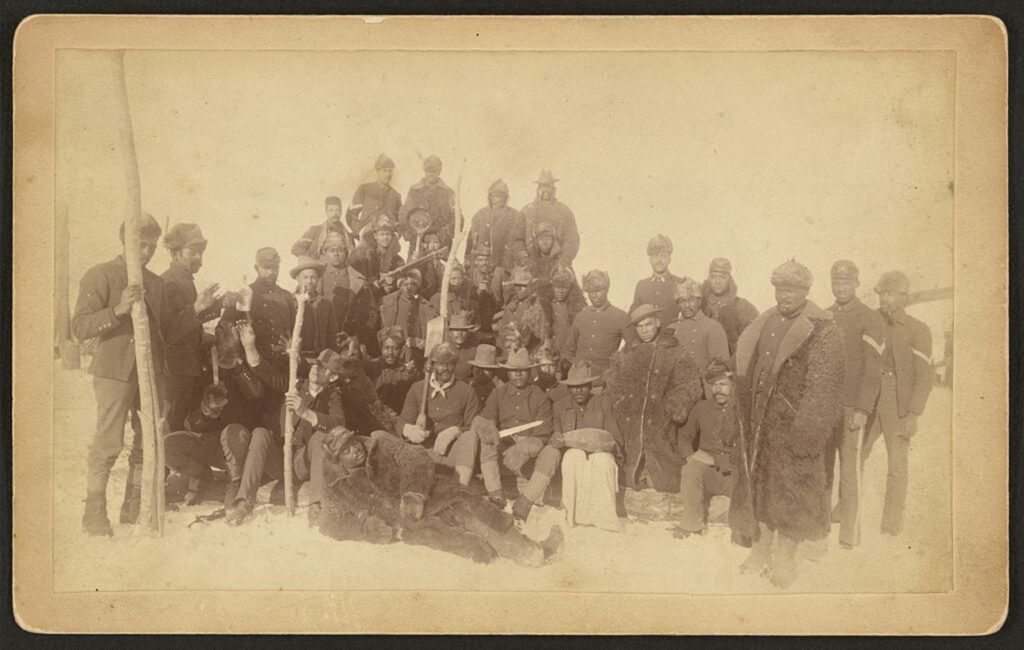
The “Indian wars,” so mythologized in western folklore, were a series of seemingly sporadic, localized, and often brief engagements between US military forces and various Native American groups. But these were not isolated military encounters. New patterns of American settlement, railroad construction, and material extraction provoked conflict. Settlers, for instance, clashed with the vast and cyclical movement across the Great Plains to hunt buffalo, raid enemies, and trade goods. Thomas Jefferson’s old dream that Indigenous nations might live isolated in the West was, in the face of American expansion, no longer a viable reality. Imperialistic, economic, and even humanitarian concerns intensified American efforts to isolate Native Americans onto reservations. Although Indian removal had long been a part of federal Indian policy, after the Civil War the US government redoubled its efforts. If treaties and other forms of persistent coercion would not work, federal officials pushed for more drastic measures: after the Civil War, coordinated military action by celebrity Civil War generals such as William Sherman and Philip Sheridan exploited and exacerbated local conflicts sparked by illegal business ventures and settler incursions. Against the threat of confinement and the extinction of traditional ways of life, Native Americans battled the American army and the encroaching lines of American settlement.
Most Americans agreed that it was acceptable to use force to protect settlers, and the United States militarized the frontier with an extensive network of forts and army posts. Native groups resisted. In Texas and the southern Plains, the Comanche, the Kiowa, and their allies had wielded enormous influence. The Comanche in particular controlled huge swaths of territory and raided vast areas, inspiring terror from the Rocky Mountains to the interior of northern Mexico to the Texas Gulf Coast. But after the Civil War, the US military refocused its attention on the southern Plains.
The American military first sent messengers to the Plains to find the elusive Comanche and Kiowa bands and ask them to come to peace negotiations at Medicine Lodge Creek in the fall of 1867. But the terms were muddled: American officials believed that Comanche bands had accepted reservation life, while Comanche leaders believed they had been guaranteed vast lands for buffalo hunting. Comanche and Kiowa bands used designated reservation lands as a base from which to collect supplies and federal annuity goods while continuing to hunt, trade, and raid American settlements in Texas.
Confronted with renewed Comanche and Kiowa raiding, particularly by the famed Comanche war leader Quanah Parker, the US military finally proclaimed that all Indigenous peoples who were not settled on the reservation by the fall of 1874 would be considered “hostile.” The Red River War began when many Comanche and Kiowa bands refused to resettle and the American military launched expeditions into the Plains to subdue them, culminating in the defeat of the remaining roaming bands in the canyonlands of the Texas Panhandle. It was total war: the American military targeted horses, homes, and food stores. Cold and hungry, their way of life already decimated by soldiers, settlers, cattlemen, and railroads, the last free Kiowa and Comanche bands were moved to the reservation at Fort Sill in what is now southwestern Oklahoma. Many who fought were incarcerated.4
On the northern Plains, the Lakota and Dakota peoples had yet to fully surrender. Following military defeats—and massacres and mass executions—during the Civil War, many bands had signed treaties with the United States and drifted into the Red Cloud and Spotted Tail agencies to collect rations and annuities, but many continued to resist American encroachment, particularly during what the US called Red Cloud’s War, a rare victory for Plains peoples that resulted in the Treaty of Fort Laramie (1868) between the United States and Lakota, Dakota, and Arapaho bands, acknowledging Indigenous control over the Black Hills of South Dakota as part of the 32-million-acre “Great Sioux Reservation.” But then, in 1874, an American expedition to the Black Hills discovered gold. American prospectors flooded the territory. Caring little about Indigenous treaty rights but very much about getting rich, they brought the Sioux situation again to its breaking point. Aware that US citizens were violating treaty provisions but unwilling to prevent them from searching for gold, federal officials pressured the Indigenous groups to sign a new treaty that would transfer control of the Black Hills to the United States while General Philip Sheridan quietly moved US troops into the region. Initial clashes between US troops and Indigenous warriors resulted in several Native victories that, combined with the visions of Sitting Bull, who had dreamed of an even more triumphant victory, attracted bands who had already signed treaties but now joined to fight.5
In late June 1876, a division of the 7th Cavalry Regiment led by Lieutenant Colonel George Armstrong Custer was sent up a trail into the Black Hills as an advance guard for a larger force. Custer’s men approached a camp in modern-day Montana along a river known locally as Greasy Grass but marked on Custer’s map as Little Bighorn and found an influx of defiant bands who had swelled the population of the village far beyond Custer’s estimation. Custer’s 7th Cavalry was vastly outnumbered, and he and 268 of his men were killed.6
Custer’s fall shocked the nation. Cries for a swift American response filled the public sphere, and military expeditions were sent out to crush Native resistance. Resisting bands splintered off into the wilderness and began a campaign of intermittent resistance but, outnumbered and suffering after a long, hungry winter, the Lakota leader Crazy Horse led an Oglala band to surrender in May 1877. Other bands gradually followed until finally, in July 1881, Sitting Bull and his own Lakota followers at last laid down their weapons and came to the reservation. The Indigenous powers had been defeated. The Plains, it seemed, had been pacified. Today, over $1 billion sits unused in a Bureau of Indian Affairs account accruing interest following a judgment against the US government in United States v. Sioux Nation of Indians (1980) for violating the terms of the Treaty of Fort Laramie. Indigenous leaders have thus far refused to accept the judgment—doing so would concede their sovereignty over the Black Hills.
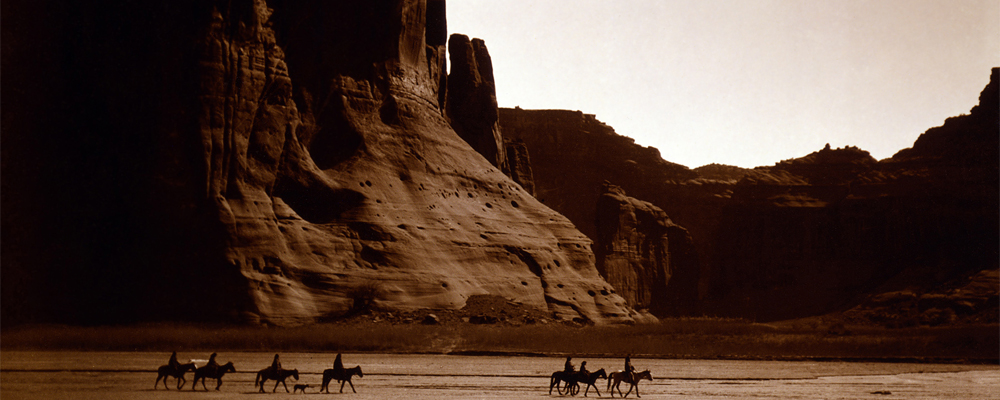
American settlers and the American military pushed against Indigenous sovereignty across North America. Attacks on Native nations in California and the Pacific Northwest, for instance, received significantly less attention than the dramatic conquest of the Plains, but Native peoples in these regions also experienced violence, population decline, and territorial loss. For example, in 1872, the California/Oregon border erupted in violence when the Modoc people left the reservation of the Klamath Nation onto which they had been forced and returned to their homelands in an area known as Lost River. Americans had settled the region after Modoc removal several years before, and they complained bitterly of their return. The US military intervened after fifty-two remaining Modoc warriors, led by Kintpuash, known to settlers as Captain Jack, refused to return to the reservation and holed up in defensive positions along the state border. They fought a guerrilla war for eleven months in which at least two hundred US troops were killed before they were finally forced to surrender. Despite appeals from settlers acquainted with the Modoc, the federal government hanged Kintpuash and three others leaders in a highly choreographed and publicized public execution.7
Four years later, in the Pacific Northwest, a branch of the Nez Perce (who, generations earlier, had aided Lewis and Clark in their famous journey to the Pacific Ocean) refused to be moved to a reservation and, under the leadership of Hin-mah-too-yah-lat-kekt, known to settlers and American readers as Chief Joseph, attempted to flee to Canada but were pursued by the US Cavalry. The outnumbered Nez Perce battled across a thousand miles and were attacked nearly two dozen times before they succumbed to hunger and exhaustion, surrendered, were imprisoned, and were removed to a reservation in Indian Territory. The flight of the Nez Perce captured the attention of the United States, and a transcript of Chief Joseph’s surrender, as allegedly recorded by a US Army officer, became a landmark of American rhetoric. “Hear me, my chiefs,” Joseph is supposed to have said, “I am tired. My heart is sick and sad. From where the sun now stands, I will fight no more forever.” Chief Joseph used his celebrity and, after several years, negotiated his people’s relocation to a reservation nearer to their historic home.8
Meanwhile, in the American Southwest, American soldiers and Indigenous resistance perpetuated a simmering conflict between settlers, mining interests, and various Apache bands who had long traded violence back and forth.9 Apache bands who once exercised enormous power in the Southwest suffered at the hands of Americans, Mexicans, and Indigenous rivals. They endured forced removals and brutal reservations and, when they fled, were pursued relentlessly by the US and Mexican armies on both sides of the US-Mexico border, and then entered into reciprocal military agreements.10 In the mid-1880s, Geronimo, a Bedonkohe Apache leader who had become famous for continually escaping the US Army, consumed American attention. General George Crook led a headline-grabbing campaign but resigned after failing to subdue Geronimo. Finally, in 1886, Geronimo surrendered to the American army at Skeleton Canyon, Arizona. He and his warriors were taken as prisoners of war and later exiled from Arizona.11 Although Geronimo became a national celebrity—he rode in Theodore Roosevelt’s 1905 inauguration—he and his people never returned to their home. “I should have never surrendered,” he is alleged to have said soon on his deathbed. “I should have fought until I was the last man alive.”

While incarcerated, many of their children were sent to boarding schools, such as the Carlisle Indian School in Pennsylvania, founded in 1879 as the first off-reservation boarding school for Indigenous children in the United States. Federal agencies had almost unlimited powers to remove children from Native families and place them in boarding schools such as Carlisle, where administrators sought to strip away the Indigenous identity of children and Americanize them: “Kill the Indian,” Carlisle superintendent Richard H. Pratt said in 1892, “and save the man.” Some assimilated; others resisted. At Chilocco Indian Agricultural School in Oklahoma, for instance, students resisted through “trixing,” or the use of pranks, practical jokes, and sabotage. “We used to deliberately do things,” Chilocco alum Curtis Carr (Muscogee/Creek Nation) recalled, “just . . . to let them know we could still outwit them.”12
IV. Western Economic Expansion: Railroads and Cattle

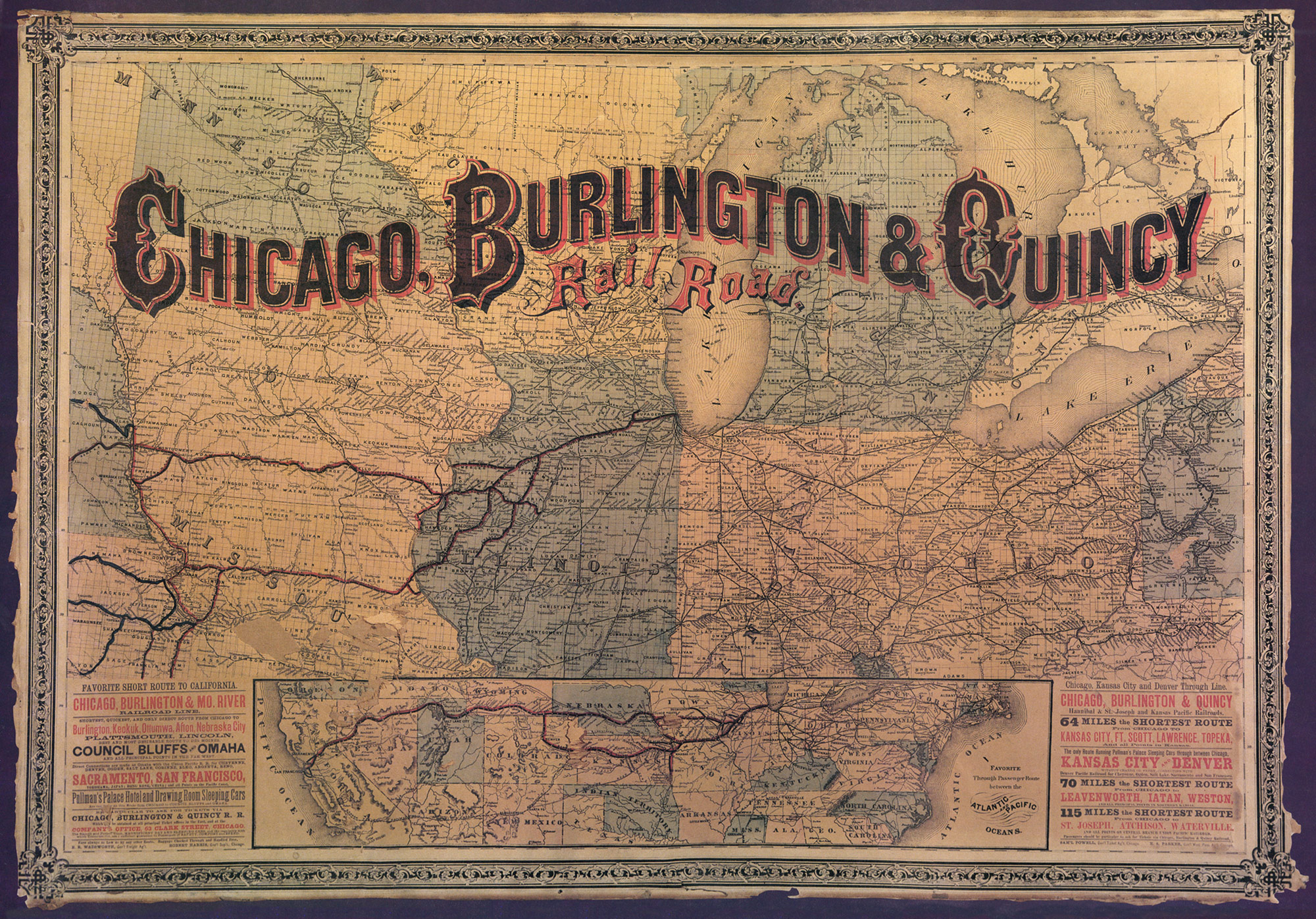
Aside from agriculture and the extraction of natural resources—such as timber and precious metals—two major industries fueled the new western economy: ranching and railroads. Both developed in connection with each other, accelerated the inrush of settlers displacing Native peoples, and shaped the collective American memory of the post–Civil War “Wild West.”
As one booster put it, “the West is purely a railroad enterprise.” No economic enterprise rivaled the railroads in scale, scope, or sheer impact. No other businesses had ever attracted such enormous sums of capital, and no other ventures had ever received such lavish government subsidies (business historian Alfred Chandler called the railroads the “first modern business enterprise”).13 By “annihilating time and space”—by connecting the vastness of the continent—the railroads transformed the United States and made the American West.
No railroad enterprise so captured the American imagination—or federal support—as the transcontinental railroad. The transcontinental railroad crossed western plains and mountains and linked the West Coast with the rail networks of the eastern United States. Constructed from the west by the Central Pacific and from the east by the Union Pacific, the two roads were linked in Utah in 1869 to great national fanfare. But such a herculean task was not easy, and national legislators threw enormous subsidies at railroad companies, a part of the Republican Party platform since 1856. The 1862 Pacific Railroad Act gave bonds of between $16,000 and $48,000 for each mile of construction and provided vast land grants to railroad companies. Between 1850 and 1871 alone, railroad companies received more than 175 million acres of public land, an area larger than the state of Texas. Investors reaped enormous profits. As one congressional opponent put it in the 1870s, “If there be profit, the corporations may take it; if there be loss, the Government must bear it.”14
If railroads attracted unparalleled subsidies and investments, they also created enormous labor demands. By 1880, approximately four hundred thousand men—or nearly 2.5 percent of the nation’s entire workforce—labored in the railroad industry. Much of the work was dangerous and low-paying, and companies relied heavily on immigrant labor to build tracks. Companies employed Irish workers in the early nineteenth century and Chinese workers in the late nineteenth century. By 1880, over two hundred thousand Chinese migrants lived in the United States. Once the rails were laid, companies still needed a large workforce to keep the trains running. Much railroad work was dangerous, but perhaps the most hazardous work was done by brakemen. Before the advent of automatic braking, an engineer would blow the “down brake” whistle and brakemen would scramble to the top of the moving train, regardless of the weather conditions, and run from car to car manually turning brakes. Speed was necessary, and any slip could be fatal. Brakemen were also responsible for coupling the cars, attaching them together with a large pin. It was easy to lose a hand or finger, and even a slight mistake could cause cars to collide.15
The railroads boomed. In 1850, there were nine thousand miles of railroads in the United States. In 1900 there were 190,000, including several transcontinental lines.16 To manage these vast networks of freight and passenger lines, companies converged rails at hub cities. Of all the Midwestern and western cities that blossomed from the bridging of western resources and eastern capital in the late nineteenth century, Chicago was the most spectacular. It grew from two hundred inhabitants in 1833 to over a million by 1890. By 1893 it and the region from which it drew were completely transformed. The World’s Columbian Exposition that year trumpeted the city’s progress and broader technological progress with typical Gilded Age ostentation. A huge, gleaming (but temporary) “White City” was built in neoclassical style to house all the features of the fair and cater to the needs of the visitors who arrived from all over the world. Highlighted in the title of this world’s fair were the changes that had overtaken North America since Columbus made landfall four centuries earlier. Chicago became the most important western hub and served as the gateway between the farm and ranch country of the Great Plains and eastern markets. Railroads brought cattle from Texas to Chicago for slaughter, where they were then processed into packaged meats and shipped by refrigerated rail to New York City and other eastern cities. Such hubs became the central nodes in a rapid-transit economy that increasingly spread across the entire continent linking goods and people together in a new national network.
This national network created the fabled cattle drives of the 1860s and 1870s. The first cattle drives crossed the central plains soon after the Civil War. Railroads created the market for ranching, and for the few years after the war that railroads connected eastern markets with important market hubs such as Chicago but had yet to reach Texas ranchlands, ranchers began driving cattle north, out of the Lone Star State, to major railroad terminuses in Kansas, Missouri, and Nebraska. Ranchers used well-worn trails, such as the Chisholm Trail, for drives, but conflicts arose with Native Americans in the Indian Territory and farmers in Kansas who disliked the intrusion of large and environmentally destructive herds onto their own hunting, ranching, and farming lands. Other trails, such as the Western Trail, the Goodnight-Loving Trail, and the Shawnee Trail, were therefore blazed.
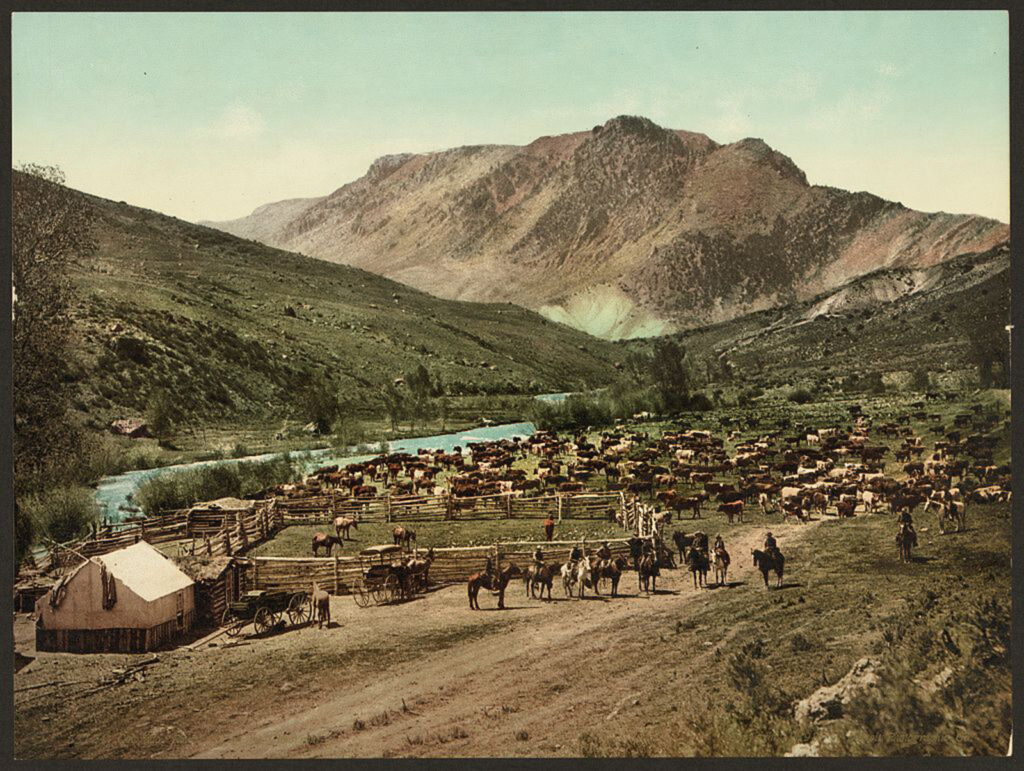
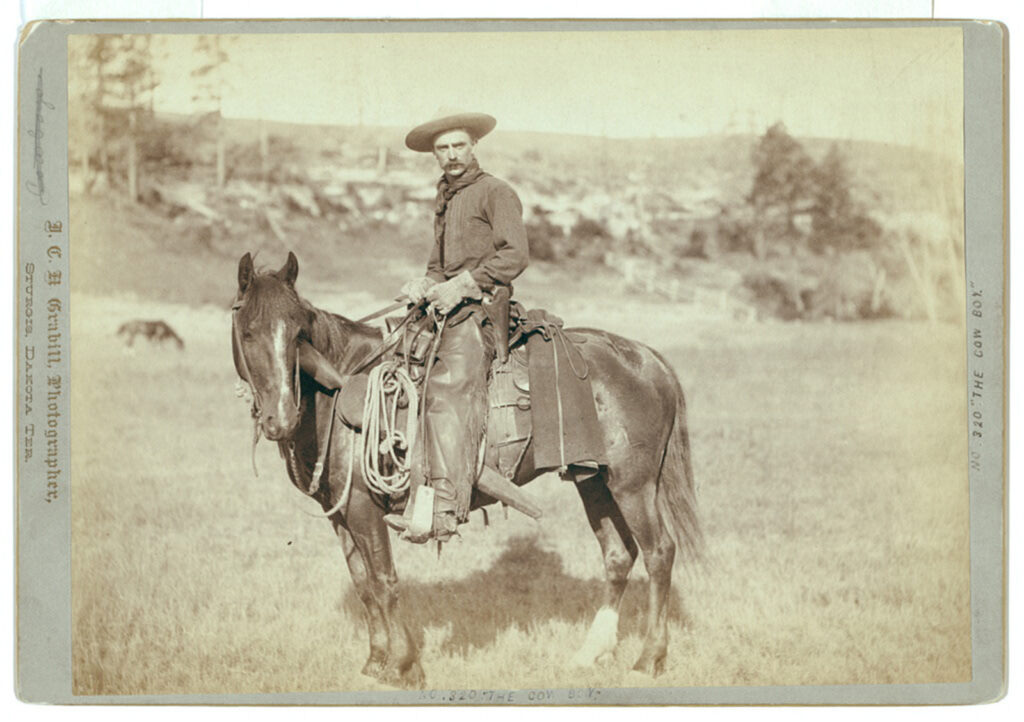
Cattle drives were difficult tasks for the crews of men who managed the herds. Historians estimate the number of men who worked as cowboys in the late nineteenth century to be between twelve thousand and forty thousand. Perhaps a fourth were African American, and more were likely Mexican or Mexican American. Much about the American cowboys evolved from Mexican vaqueros: cowboys adopted Mexican practices, gear, and terms such as rodeo, bronco, and lasso.
While most cattle drivers were men, there are at least sixteen verifiable accounts of women participating in the drives. Some, like Molly Dyer Goodnight, accompanied their husbands. Others, like Lizzie Johnson Williams, helped drive their own herds. Williams made at least three known trips with her herds up the Chisholm Trail.
Many cowboys hoped one day to become ranch owners themselves, but employment was insecure and wages were low. Beginners could expect to earn $20–$25 per month, and those with years of experience might earn $40–$45. Trail bosses could earn over $50 per month. And it was tough work. On a cattle drive, cowboys worked long hours and faced extremes of heat and cold and intense blowing dust. They subsisted on limited diets with irregular supplies.17
But if workers of cattle earned low wages, owners and investors could receive riches. At the end of the Civil War, a steer worth $4 in Texas could fetch $40 in Kansas. Although profits slowly leveled off, large profits could still be made. And yet, by the 1880s, the great cattle drives were largely done. The railroads had created them, and the railroads ended them: railroad lines pushed into Texas and made the great drives obsolete. But ranching still brought profits and the Plains were better suited for grazing than for agriculture, so western ranchers continued supplying beef for national markets.
Ranching was just one of many western industries that depended on the railroads. By linking the Plains with national markets and rapidly moving people and goods, the railroads made the modern American West.
V. The Allotment Era and Resistance in the Native West
As the rails moved into the West and more and more Americans followed, the situation for Native groups deteriorated even further. Treaties negotiated between the United States and Native groups had typically promised that if tribes agreed to move to specific reservation lands, they would hold those lands collectively. But as American westward migration mounted and open lands closed, white settlers began to argue that Native people had more than their fair share of land, that the reservations were too big, that Native people were using the land “inefficiently,” and that they still preferred nomadic hunting instead of intensive farming and ranching.
By the 1880s, Americans increasingly championed legislation to allow the transfer of Indigenous lands to farmers and ranchers, while many argued that allotting land to individual Native Americans, rather than to tribes, would encourage American-style agriculture and finally put the Indigenous peoples who had previously resisted the efforts of missionaries and federal officials on the path to “civilization.”

Passed by Congress on February 8, 1887, the Dawes General Allotment Act splintered Native American reservations into individual family homesteads. Each head of a Native family was to be allotted 160 acres, the typical size of a claim that any settler could establish on federal lands under the provisions of the Homestead Act. Single individuals over age eighteen would receive an eighty-acre allotment, and orphaned children received forty acres. A four-year timeline was established for Indigenous peoples to make their allotment selections. If at the end of that time no selection had been made, the act authorized the secretary of the interior to appoint an agent to make selections for the remaining tribal members. Allegedly to protect Native Americans from being swindled by unscrupulous land speculators, all allotments were to be held in trust—they could not be sold by allottees—for twenty-five years. Lands that remained unclaimed by tribal members after allotment would revert to federal control and be sold to American settlers.18
Americans publicly touted the Dawes Act as an uplifting humanitarian reform, but it upended Native lifestyles and left Native nations without sovereignty over their lands. The act claimed that to protect Native property rights, it was necessary to extend “the protection of the laws of the United States . . . over the Indians.” Tribal governments and legal principles could be superseded, or dissolved and replaced, by US laws. Under the terms of the Dawes Act, Native nations struggled to hold on to some measure of tribal sovereignty. President Theodore Roosevelt later referred to Dawes as “a mighty pulverizing engine to break up the tribal mass.”19
The stresses of conquest unsettled generations of Native Americans. Many took comfort from the words of prophets and holy men. In Nevada, on January 1, 1889, Northern Paiute prophet Wovoka experienced a great revelation. He had traveled, he said, from his earthly home in western Nevada to heaven and returned during a solar eclipse to prophesy to his people. “You must not hurt anybody or do harm to anyone. You must not fight. Do right always,” he allegedly exhorted. And they must, he said, participate in a religious ceremony that came to be known as the Ghost Dance. If the people lived justly and danced the Ghost Dance, Wovoka said, their ancestors would rise from the dead, the droughts would dissipate, the whites in the West would vanish, and the buffalo would once again roam the Plains.20
Native American prophets had often confronted American imperial power. Some prophets, including Wovoka, incorporated Christian elements like heaven and a messiah figure into Indigenous spiritual traditions. And so, though it was far from unique, Wovoka’s prophecy nevertheless caught on quickly and spread beyond the Paiutes. From across the West, members of the Arapaho, Bannock, Cheyenne, and Shoshone nations, among others, adopted the Ghost Dance religion. Perhaps the most avid Ghost Dancers—and certainly the most famous—were the Lakota Sioux.
The Lakota were in dire straits. South Dakota, formed out of land that belonged by treaty to the Lakota, became a state in 1889. White homesteaders had poured in, reservations were carved up and diminished, starvation set in, corrupt federal agents cut food rations, and drought hit the Plains. Many Lakota feared a future as the landless subjects of a growing American empire when a delegation of eleven men, led by Kicking Bear, joined Ghost Dance pilgrims on the rails westward to Nevada and returned to spread the revival in the Dakotas.
The energy and message of the revivals frightened settlers and Indian agents. Indian agent Daniel Royer, newly assigned to the Pine Ridge Reservation in South Dakota, sent fearful dispatches to Washington and the press urging a military crackdown. Newspapers, meanwhile, sensationalized the Ghost Dance.21 Agents began arresting Lakota leaders. Chief Sitting Bull and several others were killed in December 1890 during a botched arrest, convincing many bands to flee the reservations to join fugitive bands farther west, where Lakota adherents of the Ghost Dance preached that the Ghost Dancers would be immune to bullets.

Two weeks later, an American cavalry unit intercepted a band of 350 Lakota, including over 100 women and children, under Chief Spotted Elk (later known as Bigfoot) seeking refuge at the Pine Ridge Agency. They were escorted to Wounded Knee Creek, where they camped for the night. The following morning, December 29, American cavalrymen entered the camp to disarm Spotted Elk’s band. Tensions flared, a shot was fired, and a skirmish became a massacre. The Americans fired their heavy weaponry indiscriminately into the camp. Two dozen cavalrymen had been killed by the Lakotas’ concealed weapons or by friendly fire, but when the guns went silent, between 150 and 300 Native men, women, and children were dead.22
Wounded Knee marked the end of sustained, armed Native American resistance on the Plains. Individuals continued to resist the pressures of assimilation and preserve traditional cultural practices, but sustained military defeats, the loss of sovereignty over land and resources, and the onset of crippling poverty on the reservations marked the final decades of the nineteenth century as a particularly dark era for America’s western tribes. For Americans, however, it became mythical.
VI. Rodeos, Wild West Shows, and the Mythic American West

“The American West” conjures visions of tipis, cabins, cowboys, Native Americans, farm wives in sunbonnets, and outlaws with six-shooters. Such images pervade American culture, but they are as old as the West itself: novels, rodeos, and Wild West shows mythologized the American West throughout the post–Civil War era.
In the 1860s, Americans devoured dime novels that embellished the lives of real-life individuals such as Calamity Jane and Billy the Kid. Owen Wister’s novels, especially The Virginian, established the character of the cowboy as a gritty stoic with a rough exterior but the courage and heroism needed to rescue people from train robbers, Native Americans, and cattle rustlers. Such images were later reinforced when the emergence of rodeo added to popular conceptions of the American West. Rodeos began as small roping and riding contests among cowboys in towns near ranches or at camps at the end of the cattle trails. In Pecos, Texas, on July 4, 1883, cowboys from two ranches, the Hash Knife and the W Ranch, competed in roping and riding contests as a way to settle an argument; this event is recognized by historians of the West as the first real rodeo. Casual contests evolved into planned celebrations. Many were scheduled around national holidays, such as Independence Day, or during traditional roundup times in the spring and fall. Early rodeos took place in open grassy areas—not arenas—and included calf and steer roping and roughstock events such as bronc riding. They gained popularity, and soon dedicated rodeo circuits developed. Although about 90 percent of rodeo contestants were men, women helped popularize the rodeo and several popular female bronc riders, such as Bertha Kaepernick, entered men’s events, until around 1916 when women’s competitive participation was curtailed. Americans also experienced the “Wild West”—the mythical West imagined in so many dime novels—by attending traveling Wild West shows, arguably the unofficial national entertainment of the United States from the 1880s to the 1910s. Wildly popular across the country, the shows traveled throughout the eastern United States and even across Europe and showcased what was already a mythic frontier life. William Frederick “Buffalo Bill” Cody was the first to recognize the broad national appeal of the stock “characters” of the American West—cowboys, “Indians,” sharpshooters, cavalrymen, and rangers—and put them all together into a single massive traveling extravaganza. Operating out of Omaha, Nebraska, Buffalo Bill launched his touring show in 1883. Cody himself shunned the word show, fearing that it implied an exaggeration or misrepresentation of the West. He instead called his production “Buffalo Bill’s Wild West.” He employed real cowboys and Native Americans in his productions. But it was still, of course, a show. It was entertainment, little different in its broad outlines from contemporary theater. Storylines depicted westward migration, life on the Plains, and Indigenous attacks, all punctuated by “cowboy fun”: bucking broncos, roping cattle, and sharpshooting contests.23

Buffalo Bill, joined by shrewd business partners skilled in marketing, turned his shows into a sensation. But he was not alone. Gordon William “Pawnee Bill” Lillie, another popular Wild West showman, got his start in 1886 when Cody employed him as an interpreter for Pawnee members of the show. Lillie went on to create his own production in 1888, “Pawnee Bill’s Historic Wild West.” He was Cody’s only real competitor in the business until 1908, when the two men combined their shows to create a new extravaganza, “Buffalo Bill’s Wild West and Pawnee Bill’s Great Far East” (most people called it the “Two Bills Show”). It was an unparalleled spectacle. The cast included American cowboys, Mexican vaqueros, Native Americans, Russian Cossacks, Japanese acrobats, and an Australian aboriginal.
Cody and Lillie knew that Native Americans fascinated audiences in the United States and Europe, and both featured them prominently in their Wild West shows. Most Americans believed that Native cultures were disappearing—or had already disappeared—and felt a sense of urgency to see their dances, hear their song, and be captivated by their bareback riding skills and their elaborate buckskin and feather attire. The shows certainly veiled the true cultural and historic value of so many Native demonstrations and the Native performers were curiosities to white Americans, but the shows were one of the few ways for many Native Americans to make a living in the late nineteenth century.
In an attempt to appeal to women, Cody recruited Annie Oakley, a female sharpshooter who thrilled onlookers with her many stunts. Billed as “Little Sure Shot,” she shot apples off her poodle’s head and the ash from her husband’s cigar, clenched trustingly between his teeth. Gordon Lillie’s wife, May Manning Lillie, also became a skilled shot and performed as the “World’s Greatest Lady Horseback Shot.” Female sharpshooters were Wild West show staples. As many as eighty toured the country at the shows’ peak. But if such acts challenged expected Victorian gender roles, female performers were typically careful to blunt criticism by maintaining their feminine identity—for example, by riding sidesaddle and wearing full skirts and corsets—during their acts.
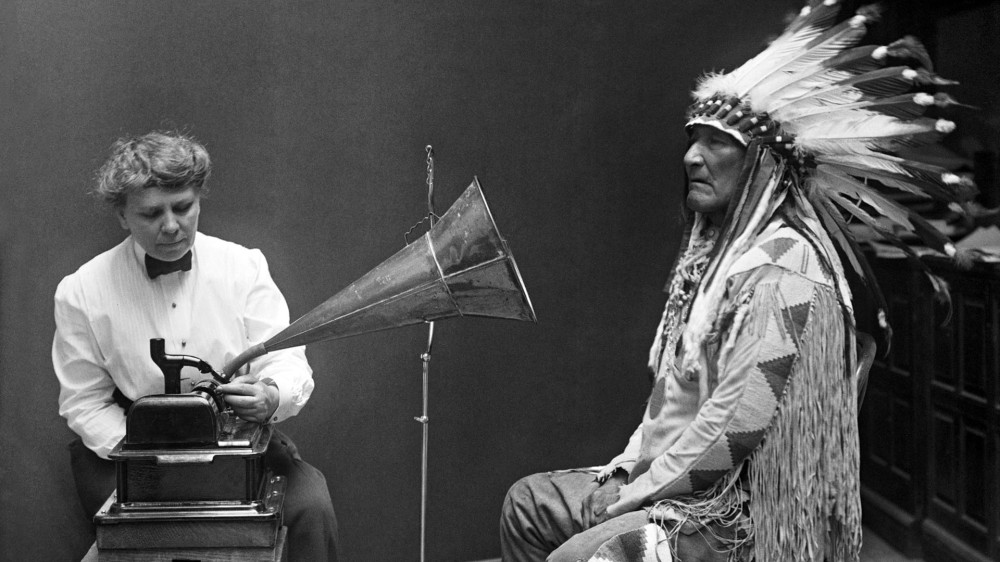
The western “cowboys and Indians” mystique, perpetuated in novels, rodeos, and Wild West shows, was rooted in romantic nostalgia and, perhaps, in the anxieties that many felt in the late nineteenth century’s new and seemingly “soft” industrial world of factory and office work. The mythical cowboy’s “aggressive masculinity” was the seemingly perfect antidote for middle- and upper-class, city-dwelling Americans who feared they “had become over-civilized” and longed for what Theodore Roosevelt called the “strenuous life.” Roosevelt himself, scion of a wealthy New York family and later a popular American president, turned a brief tenure as a failed Dakota ranch owner into a potent part of his political image. Americans looked longingly to the West, whose romance would continue to pull at generations of Americans.
In 1893, the American Historical Association met during that year’s World’s Columbian Exposition in Chicago. The young Wisconsin historian Frederick Jackson Turner presented his “frontier thesis,” one of the most influential theories of American history, in his essay “The Significance of the Frontier in American History.”
Turner looked back at the historical changes in the West and saw, instead of a tsunami of war and plunder and industry, waves of “civilization” that washed across the continent. A frontier line “between savagery and civilization” had moved west from the earliest English settlements in Massachusetts and Virginia across the Appalachians to the Mississippi and finally across the Plains to California and Oregon. Turner invited his audience to “stand at Cumberland Gap [the famous pass through the Appalachian Mountains], and watch the procession of civilization, marching single file—the buffalo following the trail to the salt springs, the Native American, the fur trader and hunter, the cattle-raiser, the pioneer farmer—and the frontier has passed by.”24
Americans, Turner said, had been forced by necessity to build a rough-hewn civilization out of the frontier, giving the nation its exceptional hustle and its democratic spirit and distinguishing North America from the stale monarchies of Europe. Moreover, the style of history Turner called for was democratic as well, arguing that the work of ordinary people (in this case, pioneers) deserved the same study as that of great statesmen.
But Turner looked ominously to the future. The Census Bureau in 1890 had declared the frontier closed. There was no longer a discernible line running north to south that, Turner said, any longer divided civilization from savagery. Turner worried for the the country’s future: what would become of the United States without the safety valve of the frontier? It was a common sentiment. Theodore Roosevelt wrote to Turner that his essay “put into
shape a good deal of thought that has been floating around rather loosely.”25
The history of the West was made by many persons and peoples. Turner’s thesis was rife with faults, not only in its bald Anglo-Saxon chauvinism—in which nonwhites fell before the march of “civilization” and Chinese and Mexican immigrants were invisible—but in its utter inability to appreciate the impact of technology and government subsidies and large-scale economic enterprises alongside the work of hardy pioneers. Still, Turner’s thesis held an almost canonical position among historians for much of the twentieth century and, more importantly, captured Americans’ enduring romanticization of the West and the simplification of a long and complicated story into a march of progress.
VII. The US-Mexico Borderlands

American settlers populated all corners of the country. The American side of the US-Mexico border, for instance, developed rapidly after the destruction of Indigenous sovereignties and the arrival of the railroads in the late 1870s and 1880s.
Tens of thousands of Mexican laborers came north to build the rail lines. But traqueros were only one part of a broad economic explosion in border cities that became way stations for the rising extractive American investments in Mexico and economic centers all their own. After the railroads arrived, the population of San Diego jumped from little more than 2,500 in 1880 to over 16,000 just ten years later; El Paso jumped from under 1,000 to over 10,000.
Anglos and Mexicans both poured into the American borderlands. Connected to rapidly expanding American urban markets by the new rail networks, Anglo ranchers gobbled up lands up and down the border. Some came by their land honestly; others wrenched control from Mexican American landholders through the inaccessibility of Spanish and Mexican land grants and the exploitation of Anglo-friendly courts. And where the courts failed to dislodge recalcitrant Mexican-descended ranchers, intimidation might do the job: in South Texas, for instance, Richard King built the iconic King Ranch through shrewd business dealings, legal maneuverings, intimidation, and the enlistment of state power against anyone who stood in his way.
US Customs officers increasingly manned ports of entry and patrolled for Chinese immigrants seeking to bypass the restrictions of the Chinese Exclusion Act after 1882, but, otherwise, the border was largely open. In Texas, ferries and bridges carried travelers freely across the Rio Grande between cities and surrounding towns and ranchos. In the western half of the border, the international boundary was little more than a fictive line. Cities such as Nogales sprawled across the borderline between Sonora and the Arizona Territory. The border was largely imaginary. Many didn’t even know where it was, exactly—beginning in 1891, the International Boundary Commission resurveyed the US-Mexico border, reconstructing the few dozen crumbling boundary markers that marked the purported location of the US-Mexico land border.
Many Mexicans and Mexican Americans resisted Anglo encroachment. Catarino Garza in South Texas and the Herrera brothers in New Mexico Territory, for instance, led popular uprisings that targeted Anglo ranchers and championed the grievances of Mexican Americans. Cross-border cattle raids, meanwhile, poached herds in the United States. Ranchers, enlisting the aid of law enforcement, the military, and vigilantes, suppressed Mexicans and Mexican Americans across the region. Captain John Gregory Bourke led a brutal military counterinsurgency campaign in South Texas during the “Garza War,” for instance.26
Borderland violence was hardly finished but, by the turn of the century, economic development had nevertheless stitched the US-Mexico borderlands into a binational flow of goods, dollars, and people. Mexican Americans already had a long history in the United States, and, as the border region boomed, they asserted themselves more forcefully into American life—the dislocations of the Mexican Revolution would soon push enormous numbers of Mexicans northward beginning in 1910, but already by 1900, over half a million Mexican Americans lived north of the border.
VIII. Patterns of Foreign Interventions
The American expansionary impulse spilled far beyond the continental borders of the United States. In the decades after the American Civil War, the United States exerted itself in the service of American interests around the world. In the Pacific, Latin America, and the Middle East, and most explicitly in the Spanish-American War and under the foreign policy of Theodore Roosevelt and William Howard Taft, the United States expanded on a long history of exploration, trade, and cultural exchange to practice something that looked remarkably like empire—a coercive, self-interested, and acquisitive approach to the world beyond US borders. Understanding the imperial impulse in US history seeks to understand not only direct American interventions in such places as Cuba, the Philippines, Hawaii, Guam, and Puerto Rico but also the deeper history of American engagement with the wider world and the subsequent ways in which American economic, political, and cultural power has shaped the actions, choices, and possibilities of other groups and nations.
American interventions in Mexico, China, and the Middle East reflected the United States’ new eagerness to intervene in foreign governments to protect American economic interests abroad. The United States had long been involved in Pacific commerce. American ships had been traveling to China, for instance, since 1784. As a percentage of total American foreign trade, Asian trade remained comparatively small, and yet the idea that Asian markets were vital to American commerce affected American policy and, when those markets were threatened, prompted interventions.27 In 1899, Secretary of State John Hay articulated the Open Door Policy, which called for all Western powers to have equal access to Chinese markets. Hay feared that other imperial powers—Japan, Great Britain, Germany, France, Italy, and Russia—planned to carve China into spheres of influence. It was in the economic interest of American business to maintain China for free trade. The following year, in 1900, American troops joined a multinational force that intervened to prevent the closing of trade by putting down the Boxer Rebellion, a movement opposed to foreign businesses and missionaries operating in China. President McKinley sent the US. Army without consulting Congress, setting a precedent for US presidents to order American troops to action around the world under their executive powers.28
The United States was not only ready to intervene in foreign affairs to preserve foreign markets, it was willing to take territory. The United States acquired its first Pacific territories with the Guano Islands Act of 1856. Guano—collected bird excrement—was a popular fertilizer integral to industrial farming. The act authorized and encouraged Americans to venture into the seas and claim islands with guano deposits for the United States. These acquisitions were the first insular, unincorporated territories of the United States: they were neither part of a state nor a federal district, and they were not on the path to ever attain such a status. The act, though little known, offered a precedent for future American acquisitions.29
Merchants, of course, weren’t the only American travelers in the Pacific. Christian missionaries soon followed explorers and traders. The first American missionaries arrived in Hawaii in 1820 and China in 1830, for example. Missionaries, though, often worked alongside business interests, and American missionaries in Hawaii, for instance, obtained large tracts of land and started lucrative sugar plantations. During the nineteenth century, Hawaii was ruled by an oligarchy based on the sugar companies, together known as the “Big Five.” This white American (haole) elite was extremely powerful, but it still operated outside the formal expression of American state power.30
As many Americans looked for empire across the Pacific, others looked to Latin America. The United States, long a participant in an increasingly complex network of economic, social, and cultural interactions in Latin America, entered the late nineteenth century with a new aggressive and interventionist attitude toward its southern neighbors.
American capitalists invested enormous sums of money in Mexico during the late nineteenth and early twentieth centuries, during the long reign of the corrupt yet American-friendly regime of the modernization-hungry Mexican president Porfirio Díaz. American business interests controlled mines, smelters, plantations, railroads, and vast swaths of land. America’s Gilded Age elite was deeply invested in Mexico, and, therefore, the United States was, too. In 1909, President Taft and Porfirio Díaz met along the El Paso–Juárez border, with diplomatic events on both sides of the Rio Grande, the first face-to-face meeting of the two nation’s leaders and, aside from Theodore Roosevelt’s 1906 trip to the Panama Canal Zone, the first time a sitting US president left American soil. Binational relations remained positive so long as Díaz’s regime prostrated Mexico before American investors, but the scale of American investments in Mexico would propel American interventions after the Mexican Revolution broke out in 1910.
American investments south of the Rio Grande—and their eventual sway over American foreign policy—typified a new, more globalized American presence. In 1867, Mark Twain traveled to the Middle East as part of a large tour group of Americans. In his satirical travelogue The Innocents Abroad, he wrote, “The people [of the Middle East] stared at us everywhere, and we [Americans] stared at them. We generally made them feel rather small, too, before we got done with them, because we bore down on them with America’s greatness until we crushed them.”31 When Americans later intervened in the Middle East, they would do so convinced of their own superiority.
The US government had traditionally had little contact with the Middle East. Trade was limited, too limited for an economic relationship to be deemed vital to the national interest, but treaties were nevertheless signed between the US and powers in the Middle East. Still, the majority of American involvement in the Middle East prior to World War I came not in the form of trade but in education, science, and humanitarian aid. American missionaries led the way. The first Protestant missionaries had arrived in 1819. Soon the American Board of Commissioners for Foreign Missions and the mission boards of the Reformed Church of America became dominant in missionary enterprises. Missions were established in almost every country of the Middle East, and even though their efforts resulted in relatively few converts, missionaries helped establish hospitals and schools, and their work laid the foundation for the establishment of Western-style universities, such as Robert College in Istanbul, Turkey (1863); the American University of Beirut (1866); and the American University of Cairo (1919).32
IX. 1898


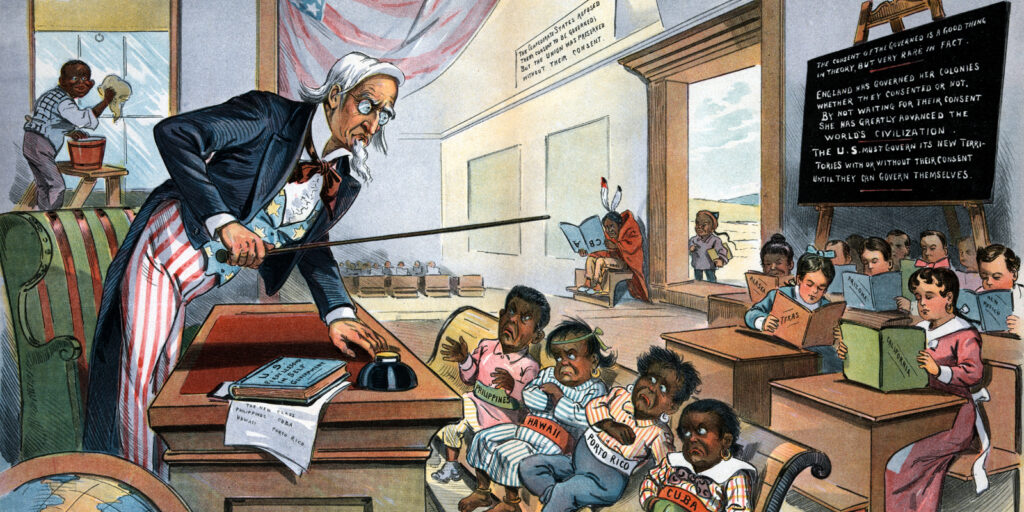
Although the United States had a long history of international economic, military, and cultural engagement that stretched back deep into the eighteenth century, the Spanish-American War and the Philippine-American War (1898–1902) marked a crucial turning point in American interventions abroad. In pursuing war with Spain and then engaging in counterrevolutionary conflict in the Philippines, the United States expanded the scope and strength of its global reach. Over the next two decades, the United States would become increasingly involved in international politics, particularly in Latin America. These new conflicts and the ensuing territorial problems forced Americans to confront the ideological elements of imperialism. Should the United States act as an empire? Or were foreign interventions and the taking of territory antithetical to its founding democratic ideals? What exactly would be the relationship between the United States and its territories? And could colonial subjects be successfully and safely incorporated into the body politic as American citizens? The Spanish-American War and the Philippine-American War brought these questions, which had always lurked behind discussions of American expansion, out into the open.
In 1898, Americans began in earnest to turn their attention southward to problems plaguing their neighbor Cuba. Since the middle of the nineteenth century, Cubans had tried unsuccessfully to gain independence from Spain. The latest uprising, and the one that would prove fatal to Spain’s colonial designs, began in 1895 and was still raging in the winter of 1898. By that time, in an attempt to crush the uprising, Spanish general Valeriano Weyler y Nicolau had been conducting a policy of reconcentration—forcing Cubans living in certain cities to relocate en masse to military camps—for about two years. Prominent newspaper publishers sensationalized Spanish atrocities. Cubans in the United States and their allies raised cries of Cuba Libre! And while the US government proclaimed a wish to avoid armed conflict with Spain, President McKinley became increasingly concerned about the safety of American lives and property in Cuba. He ordered the battleship Maine to Havana Harbor in January 1898.
The Maine sat undisturbed in the harbor for about two weeks. Then, on the evening of February 15, a titanic explosion tore open the ship and sent it to the bottom of the ocean. Three-quarters of the ship’s 354 occupants died. A naval board of inquiry immediately began an investigation to ascertain the cause of the explosion, but the loudest Americans had already decided that Spanish treachery was to blame. Capitalizing on the outrage, “yellow journals”—newspapers that promoted sensational stories, notoriously at the cost of accuracy—such as William Randolph Hearst’s New York Journal called for war with Spain. When urgent negotiations failed to produce a mutually agreeable settlement, Congress officially declared war on April 25.
Although America’s war effort began haphazardly, Spain’s decaying military crumbled. Military victories for the United States came quickly. In the Pacific, on May 1, Commodore George Dewey engaged the Spanish fleet outside Manila, the capital of the Philippines (another Spanish colonial possession), destroyed it, and proceeded to blockade Manila Harbor. Two months later, American troops took Cuba’s San Juan Heights in what would become the iconic battle of the war, winning fame not only for regular soldiers but also for the irregulars, especially Theodore Roosevelt and his Rough Riders, the 1st United States Volunteer Cavalry. Roosevelt had been the assistant secretary of the navy but had resigned his position in order to see action in the war. His actions in Cuba made him a national celebrity. As disease began to eat away at American troops, the Spanish suffered the loss of Santiago de Cuba on July 17, effectively ending the war. The two nations agreed to a ceasefire on August 12 and formally signed the Treaty of Paris in December. The terms of the treaty stipulated, among other things, that the United States would acquire Spain’s former holdings of Guam, Puerto Rico, and the Philippines.
Secretary of State John Hay memorably referred to the conflict as a “splendid little war,” and at the time it certainly appeared that way. Fewer than four hundred Americans died in battle in a war that lasted about fifteen weeks. Contemporaries celebrated American victories as the providential act of God. The influential Brooklyn minister Lyman Abbott, for instance, declared that Americans were “an elect people of God” and saw divine providence in Dewey’s victory at Manila.33 Some, such as Senator Albert J. Beveridge of Indiana, took matters one step further, seeing in American victory an opportunity for imperialism. In Beveridge’s view, America had a “mission to perform” and a “duty to discharge” around the world.34 What Beveridge envisioned was nothing less than an American empire.
But the question of whether the United States should become an empire was sharply debated across the nation in the aftermath of the Spanish-American War and the acquisition of Hawaii in July 1898. At the behest of American businessmen who had overthrown the Hawaiian monarchy, the United States annexed the Hawaiian Islands and their rich plantations. Between Hawaii and a number of former Spanish possessions, many Americans coveted the economic and political advantages that increased territory would bring. Those opposed to expansion, however, worried that imperial ambitions did not accord with the nation’s founding ideals. American actions in the Philippines brought all of these discussions to a head.
The Philippines were an afterthought of the Spanish-American War, but when the smoke cleared, the United States found itself in possession of a key foothold in the Pacific. After Dewey’s victory over the Spanish fleet in the Battle of Manila Bay, conversations about how to proceed occupied the attentions of President McKinley, political leaders from both parties, and the popular press. American and Philippine forces (under the leadership of Emilio Aguinaldo) were in communication: Would the Americans offer their support to the Filipinos and their ongoing efforts against the Spanish? Or would the Americans replace the Spanish as a colonial occupying force? American forces were instructed to secure Manila without allowing Philippine forces to enter the Walled City (the seat of the Spanish colonial government), hinting, perhaps, at things to come. Americans wondered what would happen next. Perhaps a good many ordinary Americans shared the bewildered sentiments of Mr. Dooley, the fictional Irish-American barkeeper whom humorist Finley Peter Dunne used to satirize American life: “I don’t know what to do with th’ Ph’lippeens anny more thin I did las’ summer, befure I heerd tell iv thim. . . . We can’t sell thim, we can’t ate thim, an’ we can’t throw thim into the th’ alley whin no wan is lookin’.”35
As debates about American imperialism continued against the backdrop of the upcoming presidential election, tensions in the Philippines escalated. Emilio Aguinaldo was inaugurated as president of the First Philippine Republic (sometimes called the Malolos Republic) in late January 1899; fighting between American and Philippine forces began in early February; and in April 1899, Congress ratified the 1898 Treaty of Paris, which concluded the Spanish-American War and gave Spain $20 million in exchange for the Philippine Islands.36
Like the Cubans, Filipinos had waged a long war against their Spanish colonizers. The United States could have given them the independence they had long fought for, but, instead, at the behest of President McKinley, the United States occupied the islands and from 1899 to 1902 waged a bloody series of conflicts against Filipino insurrectionists that cost far more lives than the war with Spain. Under the leadership of Aguinaldo, Filipinos who had fought for freedom against the Spanish now fought for freedom against the very nation that had claimed to have liberated them from Spanish tyranny.37
The Philippine Insurrection, or the Philippine-American War, was a brutal conflict of occupation and insurgency. Contemporaries compared the guerrilla-style warfare in challenging and unfamiliar terrain to American experiences in the “Indian Wars” of the late nineteenth century. Many commented on its brutality and the uncertain mission of the American troops. An April 1899 dispatch from a Harper’s Weekly correspondent began, “A week has passed—a week of fighting and marching, of jungles and rivers, of incident and adventure so varied and of so rapid transition that to sit down to write about it makes one feel as if he were trying to describe a dream where time, space, and all the logical sequences of ordinary life are upset in the unrelenting brutality of war.”38 John Bass described his experiences in detail, and his reportage, combined with accounts that came directly from soldiers, helped shape public knowledge about the war. Reports of cruelty on both sides and a few high-profile military investigations ensured continued public attention to events across the Pacific.
Amid fighting to secure the Philippine Islands, the federal government sent two Philippine Commissions to assess the situation in the islands and make recommendations for a civilian colonial government. A civilian administration, with William Howard Taft as the first governor-general (1901–1903), was established with military support. Although President Theodore Roosevelt declared the war to be over in 1902, resistance and occasional fighting continued into the second decade of the twentieth century.37

Debates about American imperialism dominated headlines and tapped into core ideas about American identity and the proper role of the United States in the larger world. Should a former colony, established on the principles of freedom, liberty, and sovereignty, become itself a colonizer? What was imperialism, anyway? Many framed the Filipino conflict as a Protestant, civilizing mission. Others framed American imperialism in the Philippines as nothing new, as simply the extension of a never-ending westward American expansion. It was destiny, in short. Some saw imperialism as a way to reenergize the nation by asserting national authority and power around the globe. Others baldly recognized the opportunities the Philippine Islands presented for access to Asian markets. But critics grew loud. The American Anti-Imperialist League, founded in 1899 and populated by such prominent Americans as Mark Twain, Andrew Carnegie, and Jane Addams, protested American imperial actions and articulated a platform that decried foreign subjugation and upheld the rights of all to self-governance. Still others embraced anti-imperialist stances because of concerns about immigration and American racial identity, afraid that American purity stood imperiled by contact with strange and foreign peoples. For whatever reason, however, the onset or acceleration of imperialism was a controversial and landmark moment in American history. America had become a preeminent force in the world.
X. Theodore Roosevelt and American Imperialism
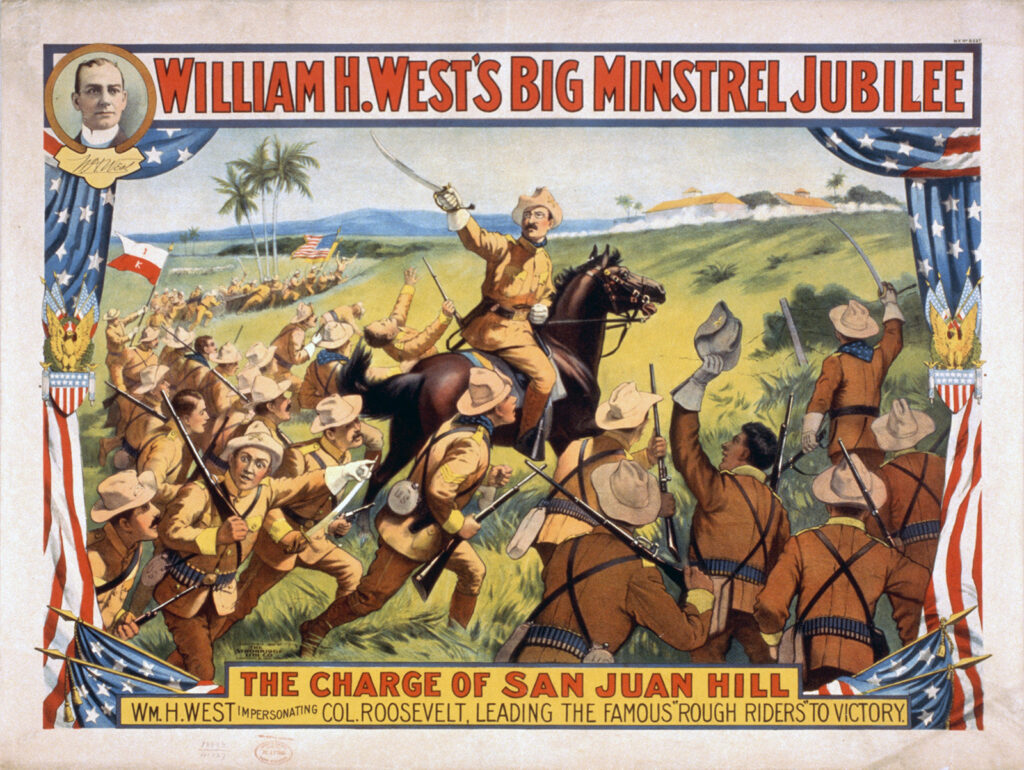
Under the leadership of President Theodore Roosevelt, the United States emerged from the nineteenth century with ambitious designs on global power through military might, territorial expansion, and economic influence. Though the Spanish-American War had begun under the administration of William McKinley, Roosevelt—the hero of San Juan Hill, assistant secretary of the navy, vice president, and now president—was arguably the most visible and influential proponent of American imperialism at the turn of the century. Roosevelt’s emphasis on developing the American navy and on Latin America as a key strategic area of US foreign policy would have long-term consequences.
In return for Roosevelt’s support of the Republican nominee, William McKinley, in the 1896 presidential election, McKinley appointed Roosevelt as assistant secretary of the navy. The head of the department, John Long, had a competent but lackadaisical managerial style that allowed Roosevelt a great deal of freedom, which he used to network with such luminaries as military theorists Alfred Thayer Mahan and naval officer George Dewey and politicians such as Henry Cabot Lodge and William Howard Taft. During his tenure he oversaw the construction of new battleships and the implementation of new technology and laid the groundwork for new shipyards, all with the goal of projecting America’s power across the oceans. Roosevelt wanted to expand American influence. For instance, he advocated for the annexation of Hawaii for several reasons: it was within the American sphere of influence, it would deny Japanese expansion and limit potential threats to the West Coast, it had an excellent port for battleships at Pearl Harbor, and it would serve as a fueling station on the way to pivotal markets in Asia.39
Roosevelt, after winning headlines in the war, ran as vice president under McKinley and rose to the presidency after McKinley’s assassination by the anarchist Leon Czolgosz in 1901. Among his many interventions in American life, Roosevelt acted with vigor to expand the military, bolstering naval power especially, to protect and promote American interests abroad. This included the construction of eleven battleships between 1904 and 1907. “Speak softly and carry a big stick,” he said. Alfred Thayer Mahan’s naval theories, described in his book The Influence of Sea Power upon History, influenced Roosevelt a great deal. In contrast to theories that advocated for commerce raiding, coastal defense, and small “brown water” ships, Mahan argued that the imperative to control the sea required battleships and a “blue water” navy that could engage and win decisive battles with rival fleets. As president, Roosevelt continued the policies he established as assistant secretary of the navy and expanded the US fleet. The mission of the Great White Fleet, sixteen all-white battleships that sailed around the world between 1907 and 1909, exemplified America’s new power.40
Roosevelt insisted that the “big stick” and the persuasive power of the US military could ensure US hegemony over strategically important regions in the Western Hemisphere. The United States used military intervention in various circumstances to further its objectives, but it did not have the ability or the inclination to militarily impose its will on the entirety of South and Central America. As a result, the United States pivoted to informal methods of empire, often called “dollar diplomacy,” to assert dominance over the hemisphere.
The United States actively intervened again and again in Latin America. Throughout his time in office, Roosevelt exerted US control over Cuba (even after it gained formal independence in 1902) and Puerto Rico, and he deployed naval forces to ensure Panama’s independence from Colombia in 1903 in order to acquire the US Canal Zone. Furthermore, Roosevelt pronounced the Roosevelt Corollary to the Monroe Doctrine in 1904, proclaiming US police power in the Caribbean. As articulated by President James Monroe in his annual address to Congress in 1823, the United States would treat any military intervention in Latin America by a European power as a threat to American security. Roosevelt reaffirmed the Monroe Doctrine and expanded it by declaring that the United States had the right to preemptive action through intervention in any Latin American nation in order to correct administrative and fiscal deficiencies.41
Roosevelt’s policy justified numerous and repeated police actions in “dysfunctional” Caribbean and Latin American countries by US Marines and naval forces and enabled the founding of the naval base at Guantanamo Bay, Cuba. This approach is sometimes referred to as “gunboat diplomacy,” wherein naval forces and Marines land in a national capital to protect American and Western personnel, temporarily seize control of the government, and dictate policies friendly to American business, such as the repayment of foreign loans. For example, in 1905 Roosevelt sent the Marines to occupy the Dominican Republic and established financial supervision over the Dominican government. Imperialists often framed such actions as something close to humanitarian. They celebrated white Anglo-Saxon societies such as those found in the United States and the British Empire as advanced practitioners of nation-building and civilization, helping to uplift debtor nations in Latin America that lacked the manly qualities of discipline and self-control. Roosevelt, for instance, preached that it was the “manly duty” of the United States to exercise an international police power in the Caribbean and to spread the benefits of Anglo-Saxon civilization to inferior states populated by inferior peoples. The president’s language, for instance, contrasted debtor nations’ “impotence” with the United States’ civilizing influence, articulating new ideas that associated self-restraint and social stability with Anglo-Saxon manliness.42
Dollar diplomacy offered a less costly method of empire and avoided the troubles of military occupation. Washington worked with bankers to provide loans to Latin American nations in exchange for some level of control over their national fiscal affairs. Roosevelt first implemented dollar diplomacy on a vast scale, while Presidents Taft and Wilson continued the practice in various forms during their administrations. All confronted instability in Latin America. Rising debts to European and American bankers allowed for the inroads of modern life but destabilized much of the region. Bankers, beginning with financial houses in London and New York, saw Latin America as an opportunity for investment. Lenders took advantage of the region’s newly formed governments’ need for cash and exacted punishing interest rates on massive loans, which were then sold off in pieces on the secondary bond market. American economic interests were now closely aligned with the region but also further undermined by the chronic instability of the region’s newly formed governments, which were often plagued by mismanagement, civil wars, and military coups in the decades following their independence. Turnover in regimes interfered with the repayment of loans, as new governments often repudiated the national debt or forced a renegotiation with suddenly powerless lenders.43
Creditors could not force settlements of loans until they successfully lobbied their own governments to get involved and forcibly collect debts. The Roosevelt administration did not want to deny the Europeans’ rightful demands of repayment of debt, but it also did not want to encourage European policies of conquest in the hemisphere as part of that debt collection. US policy makers and military strategists within the Roosevelt administration determined that this European practice of military intervention posed a serious threat to American interests in the region. Roosevelt reasoned that the United States must create and maintain fiscal and political stability within strategically important nations in Latin America, particularly those affecting routes to and from the proposed Panama Canal. As a result, US policy makers considered intervention in places like Cuba and the Dominican Republic a necessity to ensure security in the region.44
The Monroe Doctrine provided the Roosevelt administration with a diplomatic and international legal tradition through which it could assert a US right and obligation to intervene in the hemisphere. The Roosevelt Corollary to the Monroe Doctrine asserted that the United States wished to promote stable, prosperous states in Latin America that could live up to their political and financial obligations. Roosevelt declared that “wrongdoing, or an impotence which results in a general loosening of the ties of civilized society, may finally require intervention by some civilized nation, and in the Western Hemisphere the United States cannot ignore this duty.”45 President Monroe declared what Europeans could not do in the Western Hemisphere; Roosevelt inverted his doctrine to legitimize direct US intervention in the region.46
Though aggressive and bellicose, Roosevelt did not necessarily advocate expansion by military force. In fact, the president insisted that in dealings with the Latin American nations, he did not seek national glory or expansion of territory and believed that war or intervention should be a last resort when resolving conflicts with problematic governments. According to Roosevelt, such actions were necessary to maintain “order and civilization.”47 Then again, Roosevelt certainly believed in using military power to protect national interests and spheres of influence when absolutely necessary. He also believed that the American sphere included not only Hawaii and the Caribbean but also much of the Pacific. When Japanese victories over Russia threatened the regional balance of power, he sponsored peace talks between Russian and Japanese leaders, earning him the Nobel Peace Prize in 1906.
XI. Women and American Imperialism
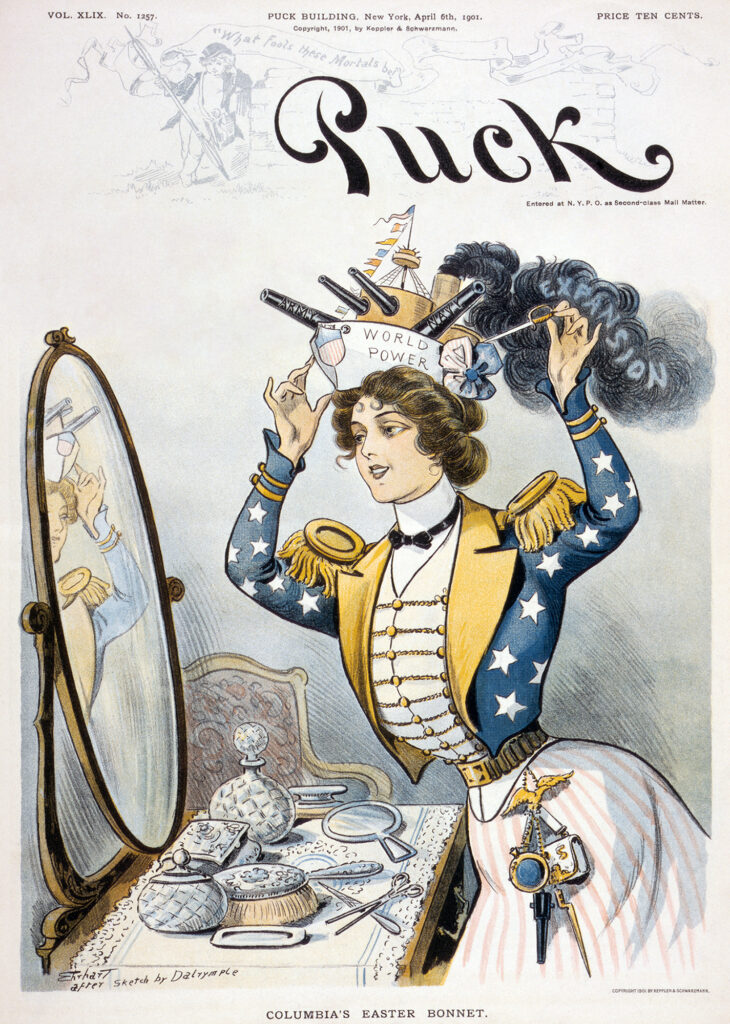
Debates over American imperialism revolved around more than just politics and economics and national self-interest. They also included notions of humanitarianism, morality, religion, and ideas of “civilization.” And they included significant participation by American women.
In the fall of 1903, Margaret McLeod, age twenty-one, originally of Boston, found herself in Australia on family business and in need of income. Fortuitously, she made the acquaintance of Alexander MacWillie, the top salesman for the H. J. Heinz Company, who happened to be looking for a young lady to serve as a “demonstrator” of Heinz products to potential consumers. McLeod proved to be such an attractive purveyor of India relish and baked beans that she accompanied MacWillie on the rest of his tour of Australia and continued on to South Africa, India, and Japan. Wherever she went, this “dainty young girl with golden hair in white cap and tucker” drew attention to Heinz’s products, but, in a much larger sense, she was also projecting an image of middle-class American domesticity, of pure womanhood. Heinz saw itself not only as purveying economical and healthful foodstuffs—it was bringing the blessings of civilization to the world.48
When commentators such as Theodore Roosevelt in his speech on “the strenuous life” spoke of America’s overseas ventures, they generally gave the impression that this was strictly a masculine enterprise—the work of soldiers, sailors, government officials, explorers, businessmen, and scientists. But in fact, US imperialism, which focused as much on economic and cultural influence as on military or political power, offered a range of opportunities for white, middle-class, Christian women. In addition to working as representatives of American business, women could serve as missionaries, teachers, and medical professionals; as artists and writers they were also inspired by and helped transmit ideas about imperialism.
Moreover, the rhetoric of civilization that underlay imperialism was itself a highly gendered concept. According to the racial theory of the day, humans progressed through hierarchical stages of civilization in an orderly, linear fashion. Only Europeans and Americans had attained the highest level of civilization, which was superficially marked by whiteness but also included an industrial economy and a gender division in which men and women had diverging but complementary roles. Social and technological progress had freed women of the burdens of physical labor and elevated them to a position of moral and spiritual authority. White women thus potentially had important roles to play in US imperialism, both as symbols of the benefits of American civilization and as vehicles for the transmission of American values.49
Civilization, while often cloaked in the language of morality and Christianity, was very much an economic concept. The stages of civilization were primarily marked by their economic character (hunter-gatherer, agricultural, industrial), and the consumption of industrially produced commodities was seen as a key moment in the progress of “savages” toward civilized life. Over the course of the nineteenth century, women in the West, for instance, had become closely associated with consumption, particularly of those commodities used in the domestic sphere. Thus it must have seemed natural for Alexander MacWillie to hire Margaret McLeod to “demonstrate” ketchup and chili sauce at the same time that she “demonstrated” white middle-class domesticity. By adopting the use of such progressive products in their homes, consumers could potentially absorb the very virtues of American civilization.50
In some ways, women’s work in support of imperialism can be seen as an extension of the kind of activities many of them were already engaged in among working-class, immigrant, and Native American communities in the United States. Many white women felt that they had a duty to spread the benefits of Christian civilization to those less fortunate than themselves. American overseas ventures, then, merely expanded the scope of these activities—both literally, in that the geographical range of possibilities encompassed practically the entire globe, and figuratively, in that imperialism significantly raised the stakes of women’s work. No longer only responsible for shaping the next generation of American citizens, white women now had a crucial role to play in the maintenance of civilization itself. They too would help determine whether civilization would continue to progress.
Of course, not all women were active supporters of US imperialism. Many actively opposed it. Although the most prominent public voices against imperialism were male, women made up a large proportion of the membership of organizations like the Anti-Imperialist League. For white women like Jane Addams and Josephine Shaw Lowell, anti-imperialist activism was an outgrowth of their work in opposition to violence and in support of democracy. Black female activists, meanwhile, generally viewed imperialism as a form of racial antagonism and drew parallels between the treatments of African Americans at home and, for example, Filipinos abroad. Indeed, Ida B. Wells viewed her anti-lynching campaign as a kind of anti-imperialist activism.
XII. Conclusion
While American imperialism abroad flared most brightly for a relatively brief time at the turn of the century, new imperial patterns perpetuated old practices and lived on into the twentieth century. The United States had concluded its long expansion of continental sovereignty, and the nation suddenly embraced its cultural, economic, and religious influence in the world, that, coupled with a newfound military power, exercised varying degrees of control over nations and peoples. Whether as formal subjects or unwilling partners on the receiving end of Roosevelt’s “big stick,” those who experienced US expansionist policies confronted new American ambitions. At home, debates over immigration and imperialism demonstrated how imperial actions, practices, and ideas were now intertwined in questions surrounding American culture and American politics. The geographies of empire were everywhere.
XIII. Reference Material
This chapter was edited by Ellen Adams and Amy Kohout, with content contributions by Ellen Adams, Alvita Akiboh, Simon Balto, Jacob Betz, Lauren Brand, Carole Butcher, Tizoc Chavez, Morgan Deane, Dan Du, Josh Garrett-Davis, Pamela Gossin, Tracey Hanshew, Hidetaka Hirota, Amy Kohout, K. Tsianina Lomawaima, Lindsay Stallones Marshall, Jose Juan Perez Melendez, Erik Moore, Gregory Moore, Nick Roland, David Schley, Emma Teitelman, and Alyce Webb.
Recommended Reading
• Cahill, Cathleen. Federal Fathers and Mothers: A Social History of the United States Indian Service, 1869–1933. Chapel Hill: University of North Carolina Press, 2011.
• Cronon, William. Nature’s Metropolis: Chicago and the Great West. New York: Norton, 1991.
• Estes, Nick. Our History Is the Future: Standing Rock Versus the Dakota Access Pipeline, and the Long Tradition of Indigenous Resistance. New York: Verso, 2019.
• Gordon, Linda. The Great Arizona Orphan Abduction. Cambridge, MA: Harvard University Press, 1999.
• Greene, Julie. The Canal Builders: Making America’s Empire at the Panama Canal. New York: Penguin, 2009.
• Hämäläinen, Pekka. The Comanche Empire. New Haven, CT: Yale University Press, 2008.
• Hoganson, Kristin L. Fighting for American Manhood: How Gender Politics Provoked the Spanish-American and Philippine-American Wars. New Haven, CT: Yale University Press, 1998.
• Huhndorf, Shari M. Going Native: Indians in the American Cultural Imagination. Ithaca, NY: Cornell University Press, 2001.
• Isenberg, Andrew C. The Destruction of the Bison: An Environmental History, 1750–1920. Cambridge, UK: Cambridge University Press, 2000.
• Jacobs, Margaret D. White Mother to a Dark Race: Settler Colonialism, Maternalism, and the Removal of Indigenous Children in the American West and Australia, 1880–1940. Lincoln: University of Nebraska Press, 2009.
• Jacobson, Matthew Frye. Barbarian Virtues: The United States Encounters Foreign People at Home and Abroad, 1876–1917. New York: Hill and Wang, 2001.
• Kaplan, Amy. The Anarchy of Empire in the Making of U.S. Culture. Cambridge, MA: Harvard University Press, 2002.
• Kramer, Paul A. The Blood of Government: Race, Empire, the United States, and the Philippines. Chapel Hill: University of North Carolina Press, 2006.
• Lafeber, Walter. The New Empire: An Interpretation of American Expansion, 1860–1898. Ithaca, NY: Cornell University Press, 1963.
• Lears, T. J. Jackson. Rebirth of a Nation: The Making of Modern America, 1877–1920. New York: HarperCollins, 2009.
• Limerick, Patricia Nelson. The Legacy of Conquest: The Unbroken Past of the American West. New York: Norton, 1987.
• Love, Eric T. L. Race over Empire: Racism and U.S. Imperialism, 1865–1900. Chapel Hill: University of North Carolina Press, 2004.
• Marks, Paula Mitchell. In a Barren Land: American Indian Dispossession and Survival. New York: Morrow, 1998.
• Montejano, David. Anglos and Mexicans in the Making of Texas, 1836–1986. Austin: University of Texas Press, 1987.
• Pascoe, Peggy. Relations of Rescue: The Search for Female Moral Authority in the American West, 1874–1939. New York: Oxford University Press, 1990.
• Perez, Louis A., Jr. The War of 1898: The United States and Cuba in History and Historiography. New Haven, CT: Yale University Press, 2000.
• Prucha, Francis Paul. The Great Father: The United States Government and the American Indians. Lincoln: University of Nebraska Press, 1984.
• Silbey, David. A War of Frontier and Empire: The Philippine-American War, 1899–1902. New York: Hill and Wang, 2007.
• Smith, Henry Nash. Virgin Land: The American West as Symbol and Myth. New York: Vintage Books, 1957.
• Taylor, Quintard. In Search of the Racial Frontier: African Americans in the American West, 1528–1990. New York: Norton, 1999.
• Warren, Louis S. Buffalo Bill’s America: William Cody and the Wild West Show. New York: Knopf, 2005.
• Wexler, Laura. Tender Violence: Domestic Visions in an Age of US Imperialism. Chapel Hill: University of North Carolina Press, 2000.
• White, Richard. “It’s Your Misfortune and None of My Own”: A New History of the American West. Norman: University of Oklahoma Press, 1991.
• Williams, William Appleman. The Tragedy of American Diplomacy, 50th Anniversary Edition. New York: Norton, 2009 [1959].
Notes
- Based on U.S. Census figures from 1900. See, for instance, Donald Lee Parman, Indians and the American West in the Twentieth Century (Bloomington: Indiana University Press, 1994), ix.[↩]
- On “settler colonialism,” see especially Margaret Jacobs, White Mother to a Dark Race: Settler Colonialism, Maternalism, and the Removal of Indigenous Children in the American West and Australia, 1880–1940 (University of Nebraska Press, 2009), 1–24.[↩]
- Richard White, It’s Your Misfortune and None of My Own: A New History of the American West (Norman: University of Oklahoma Press, 1991), 216–220.[↩]
- On the Comanche, see especially Pekka Hämäläinen, The Comanche Empire (New Haven, CT: Yale University Press, 2008).[↩]
- Jeffrey Ostler, The Plains Sioux and U.S. Colonialism from Lewis and Clark to Wounded Knee (New York: Cambridge University Press, 2004).[↩]
- Robert Utley, The Indian Frontier 1846–1890 (Albuquerque: University of New Mexico Press, 1984).[↩]
- Boyd Cothran, Remembering the Modoc War: Redemptive Violence and the Making of American Innocence (Chapel Hill: University of North Carolina Press, 2014).[↩]
- Report of the Secretary of War, Being Part of the Message and Documents Communicated to the Two Houses of Congress, Beginning of the Second Session of the Forty-Fifth Congress, Volume I (Washington, DC: U.S. Government Printing Office 1877), 630.[↩]
- Paul Conrad, The Apache Diaspora: Four Centuries of Displacement and Survival (Philadelphia: University of Pennsylvania Press, 2021).[↩]
- Rachel St. John, Line in the Sand: A History of the Western U.S.-Mexico Border (Princeton, NJ: Princeton University Press, 2011), 50–62.[↩]
- Conrad, Apache Diaspora.[↩]
- K. Tsianina Lomawaima, They Called it Prairie Light: The Story of Chilocco Indian School (Lincoln: University of Nebraska Press, 1994).[↩]
- Alfred D. Chandler Jr., The Visible Hand: The Managerial Revolution in American Business (Cambridge, MA: Belknap Press, 1977).[↩]
- Richard White, Railroaded: The Transcontinentals and the Making of Modern America (New York: Norton, 2011), 107.[↩]
- Walter Licht, Working on the Railroad: The Organization of Work in the Nineteenth Century (Princeton, NJ: Princeton University Press, 2014), chap. 5.[↩]
- John F. Stover, The Routledge Historical Atlas of the American Railroads (New York: Routledge, 1999), 15, 17, 39, 49.[↩]
- Richard W. Slatta, Cowboys of the Americas (New Haven, CT: Yale University Press, 1994).[↩]
- Patricia Nelson Limerick, The Legacy of Conquest: The Unbroken Past of the American West (New York: Norton, 1987), 195–199; White, It’s Your Misfortune, 115.[↩]
- Alexandra Witkin, “To Silence a Drum: The Imposition of United States Citizenship on Native Peoples,” Historical Reflections/Reflexions Historiques 21, no. 2 (Spring 1995): 374.[↩]
- On the Ghost Dance Religion, see especially Louis S. Warren, God’s Red Son: The Ghost Dance Religion and the Making of Modern America (New York: Basic, 2017).[↩]
- See, for instance, Oliver Knight, Following the Indian Wars (Norman: University of Oklahoma Press, 1960).[↩]
- Dee Brown, Bury My Heart at Wounded Knee: An Indian History of the American West (New York: Holt, Rinehart and Winston, 1970).[↩]
- Joy S. Kasson, Buffalo Bill’s Wild West: Celebrity, Memory, and Popular History (New York: Macmillan, 2001).[↩]
- Frederick Jackson Turner, The Frontier in American History (New York: Holt, 1921), 12.[↩]
- Kasson, Buffalo Bill’s Wild West, 117.[↩]
- Elliott West, Catarino Garza’s Revolution on the Texas-Mexico Border (Durham: Duke University Press, 2004).[↩]
- Tyler Dennett, Americans in Eastern Asia: A Critical Study of the Policy of the United States with Reference to China, Japan and Korea in the 19th Century (New York: Macmillan, 1922), 580.[↩]
- Robert E. Hannigan, The New World Power: American Foreign Policy, 1898–1917 (Philadelphia: University of Pennsylvania Press, 2002).[↩]
- Jimmy M. Skaggs, The Great Guano Rush: Entrepreneurs and American Overseas Expansion (New York: Macmillan, 1994); Robert A. Wines, Fertilizer in America: From Waste Recycling to Resource Exploitation (Philadelphia: Temple University Press, 1985).[↩]
- Elvi Whittaker, The Mainland Haole: The White Experience in Hawaii (New York: Columbia University Press, 1986).[↩]
- Mark Twain, The Innocents Abroad, or The New Pilgrims’ Progress (Hartford, CT: American, 1869), 379.[↩]
- Ussama Makdisi, Artillery of Heaven: American Missionaries and the Failed Conversion of the Middle East (Ithaca, NY: Cornell University Press, 2008).[↩]
- Lyman Abbott, Inspiration for Daily Living: Selections from the Writings of Lyman Abbott (Boston: Pilgrim Press, 1919), 175.[↩]
- Albert J. Beveridge, The Meaning of the Times: And Other Speeches (Indianapolis: Bobbs-Merrill, 1908), 48.[↩]
- Finley Peter Dunne, Mr. Dooley in the Hearts of His Countrymen (Boston: Small, Maynard, 1899), 6.[↩]
- Susan K. Harris, God’s Arbiters: Americans and the Philippines, 1898–1902 (New York: Oxford University Press, 2011); Paul A. Kramer, The Blood of Government: Race, Empire, the United States, and the Philippines (Chapel Hill: University of North Carolina Press, 2006).[↩]
- Harris, God’s Arbiters; Kramer, Blood of Government.[↩][↩]
- John F. Bass, compiled in Marrion Wilcox, Harper’s History of the War in the Philippines (New York: Harper, 1900), 162.[↩]
- William Henry Harbaugh, The Life and Times of Theodore Roosevelt (London: Oxford University Press, 1961); Morton Keller, Theodore Roosevelt: A Profile (New York: Hill and Wang, 1967).[↩]
- R. A. Hart, The Great White Fleet: Its Voyage Around the World, 1907–1909 (New York: Little, Brown, 1965).[↩]
- Richard Collin, Theodore Roosevelt’s Caribbean: The Panama Canal, The Monroe Doctrine, and the Latin American Context (Baton Rouge: LSU Press, 1990).[↩]
- Ibid.[↩]
- Emily S. Rosenberg, Financial Missionaries to the World: The Politics and Culture of Dollar Diplomacy, 1900–1930 (Cambridge, MA: Harvard University Press, 1999), 3.[↩]
- William Everett Kane, Civil Strife in Latin America: A Legal History of U.S. Involvement (Baltimore: Johns Hopkins University Press, 1972), 73.[↩]
- Theodore Roosevelt to Elihu Root, May 20, 1904, in Elting E. Morrison, ed., The Letters of Theodore Roosevelt, vol. 4 (Cambridge, MA: Harvard University Press, 1951), 801.[↩]
- Hannigan, New World Power.[↩]
- Theodore Roosevelt to William Bayard Hale, February 26, 1904, in Morrison, ed., Letters of Theodore Roosevelt, vol. 4, 740.[↩]
- Mona Domosh, American Commodities in an Age of Empire (New York: Routledge, 2006).[↩]
- Kristin L. Hoganson, Fighting for American Manhood: How Gender Politics Provoked the Spanish-American and Philippine-American Wars (New Haven, CT: Yale University Press, 1998).[↩]
- Domosh, American Commodities.[↩]