
*The American Yawp is an evolving, collaborative text. Click here to help improve this chapter.*
I. Introduction
The United States transformed itself in the decades after the Civil War. “My country in 1900 is something totally different from my own country of 1860. I am wholly a stranger in it,” the patrician-historian Henry Adams wrote that year. “Neither I, nor anyone else, understands it.”1 The rise of cities, the acceleration of American immigration, the transformation of American labor, the making of a mass culture, the creation of great concentrated wealth, the growth of vast city slums, the conquest of the West, the emergence of the middle class, the problem of poverty, the triumph of big business, widening inequalities, battles between capital and labor, the final destruction of independent farming, breakthrough technologies, environmental destruction: a new America plowed its way headlong into the twentieth century. But Americans struggled to navigate a world that, while rushing forward into “modernity,” was nevertheless encumbered by the heavy baggage of its history. Immigrants struggled to fashion new lives in a new nation with increasingly nativistic attitudes, Black Americans pushed back against a country sliding into the “nadir” of its race relations, and women fought to carve out ever greater freedoms and opportunities. An increasingly popular national culture of play and amusement, meanwhile, threatened to smash Victorian Era norms.
II. A Nation of Immigrants
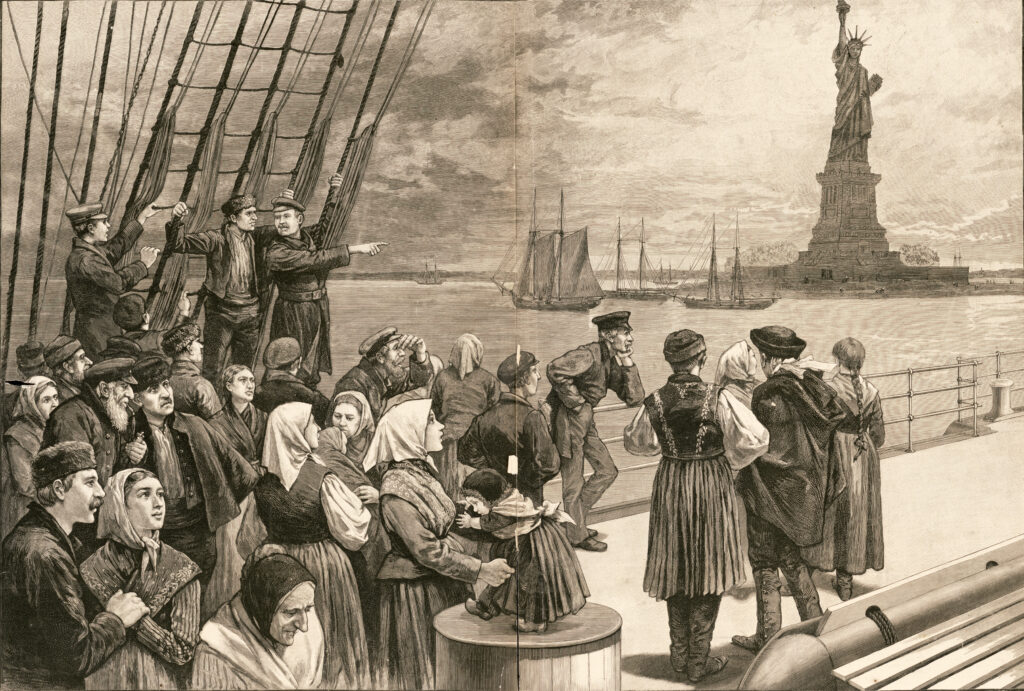
To support fundraising efforts for the construction of the Statue of Liberty’s pedestal in 1883, Emma Lazarus, a Jewish American poet from New York, wrote a sonnet, “The New Colossus,” which described the statue, busy being constructed piece by piece in France, as the “Mother of Exiles” bearing “world-wide welcome.” Lazarus finished the short poem with the lines:
“Keep, ancient lands, your storied pomp!” cries she
With silent lips. “Give me your tired, your poor,
Your huddled masses yearning to breathe free,
The wretched refuse of your teeming shore.
Send these, the homeless, tempest-tost to me,
I lift my lamp beside the golden door!”
Between 1870 and 1920, over twenty-five million immigrants arrived in the United States. The earliest decades reflected demographic patterns established before the Civil War, but by the turn of the twentieth century, new immigrant groups such as Italians, Poles, and Eastern European Jews made up a larger percentage of arrivals than the Irish and Germans.
The specific reasons that immigrants left their particular countries and the reasons they came to the United States (what historians call push and pull factors) varied. For example, a young husband and wife living in Sweden in the 1880s and unable to purchase farmland might read an advertisement for inexpensive land in the American Midwest and immigrate to the United States to begin a new life. A young Italian man might simply hope to labor in a steel factory long enough to save up enough money to return home and purchase land for a family. A Russian Jewish family persecuted in European pogroms might look to the United States as a sanctuary. Small-scale Mexican farmers, pushed off communal lands by Porfirio Díaz’s modernization laws, might travel to the American Southwest to labor in railroad construction or commercial farmwork. Or a Japanese migrant struggling to navigate his country’s modernization might hear of fertile farming land on the West Coast and choose to sail for California. If many factors pushed people away from their home countries, by far the most important factor drawing immigrants was economics. Immigrants came to the United States looking for work.
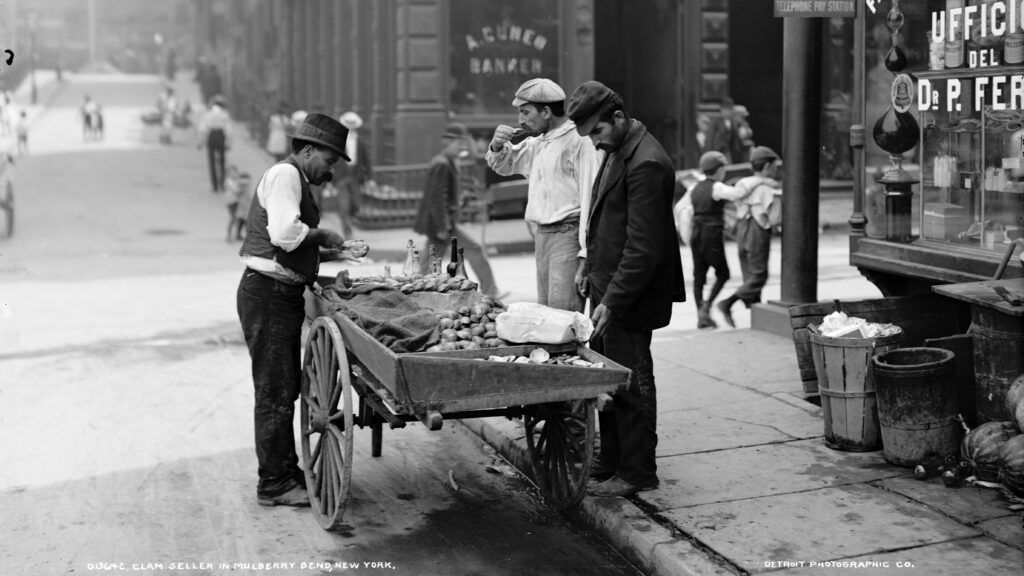
Industrial capitalism was the most important factor that drew immigrants to the United States between 1880 and 1920. Immigrant workers labored in large industrial complexes producing goods such as steel, textiles, and food products, replacing smaller and more local workshops. The influx of immigrants, alongside a large movement of Americans from the countryside to the city, helped propel the rapid growth of cities like New York, Pittsburgh, Cleveland, Milwaukee, and St. Louis. By 1890, immigrants and their children accounted for roughly 60 percent of the population in most large northern cities (and sometimes as high as 80 or 90 percent). Many immigrants, especially from Italy and the Balkans, always intended to return home with enough money to purchase land. But what about those who stayed? Did the new arrivals assimilate together in the American melting pot—shedding their cultural heritage to mirror the lives of those already in the United States—or did they retain, and sometimes even strengthen, their traditional ethnic identities? The answer lies somewhere in between. Immigrants from specific countries—and often even specific communities—often clustered together in ethnic neighborhoods. They formed vibrant organizations and societies, such as Italian workmen’s clubs, Eastern European Jewish mutual aid societies, and Polish Catholic churches, to ease the transition to their new American home. Immigrant communities published newspapers in dozens of languages and purchased spaces to keep their arts, languages, and traditions alive. And from these foundations they facilitated even more immigration: after staking out a claim to some corner of American life, they wrote home and encouraged others to follow them (historians call this chain migration).

As immigrants built urban enclaves that bridged their home countries and the United States, many struggled to find adequate housing amid low wages and severe housing shortages. In 1890, New York City journalist Jacob Riis published How the Other Half Lives, a scathing indictment of the living and working conditions in the city’s slums. Riis not only vividly described the squalor he saw, he documented it with photography, giving readers an unflinching view of urban poverty. Riis’s book led to housing reform in New York and other cities and helped instill the idea that society bore at least some responsibility for alleviating poverty.2 Others, however, rejected the new Americans altogether.
Native-born Americans greeted the new arrivals with trepidation. Nativists opposed mass immigration for various reasons. Some felt that the new arrivals were unfit for American democracy and that Irish or Italian immigrants used violence or bribery to corrupt municipal governments. Others (often earlier immigrants themselves) worried that the arrival of even more immigrants would result in fewer jobs and lower wages. Such fears combined and resulted in anti-Chinese protests on the West Coast in the 1870s. Still others worried that immigrants brought with them radical ideas such as socialism, anarchism, and communism. These fears multiplied after the Chicago Haymarket affair in 1886, in which immigrants were accused of killing police officers in a bomb blast.3
In September 1876, Franklin Benjamin Sanborn, a member of the Massachusetts Board of State Charities, gave an address in support of the introduction of regulatory federal immigration legislation at an interstate conference of charity officials in Saratoga, New York. Immigration might bring some benefits, but “it also introduces disease, ignorance, crime, pauperism and idleness.” Sanborn thus advocated federal action to stop “indiscriminate and unregulated immigration.”4
Sanborn’s address was aimed at restricting only the immigration of paupers from Europe to the East Coast, but the idea of immigration restrictions was common across the United States in the late nineteenth century, when many variously feared that the influx of foreigners would undermine the racial, economic, and moral integrity of American society. From the 1870s to the 1920s, the federal government passed a series of laws limiting or discontinuing the immigration of particular groups, and the United States remained committed to regulating the kind of immigrants who would join American society. To critics, regulations legitimized racism, class bias, and ethnic prejudice as formal national policy.
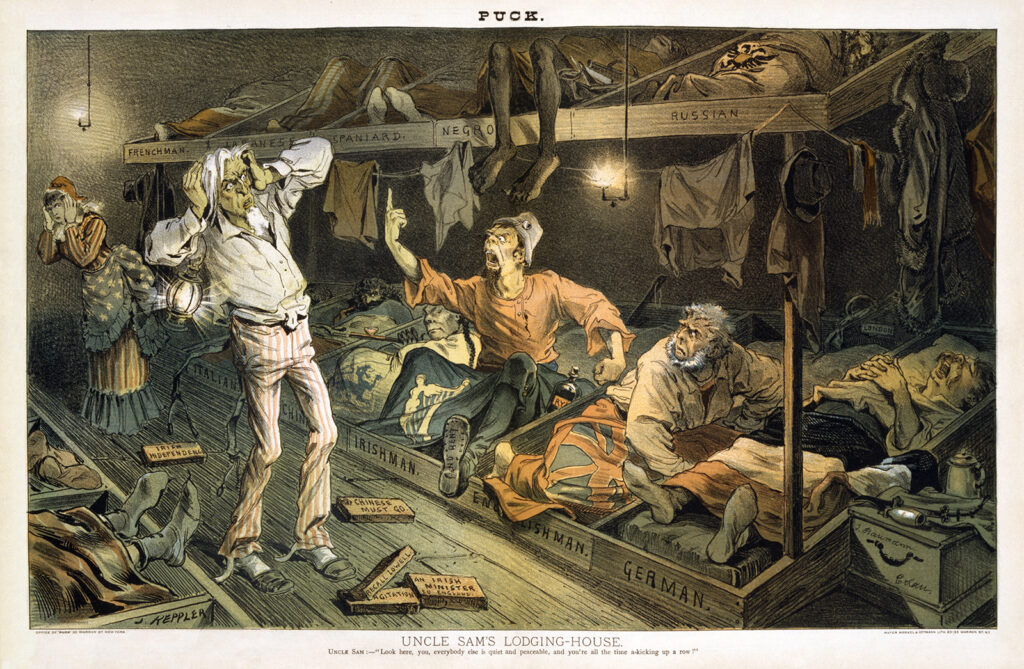

The first move for federal immigration control came from California, where racial hostility toward Chinese immigrants had mounted since the mid-nineteenth century. In addition to accusing Chinese immigrants of racial inferiority and unfitness for American citizenship, opponents claimed that they were also economically and morally corrupting American society with cheap labor and immoral practices, such as prostitution. Immigration restriction was necessary for the “Caucasian race of California,” as one anti-Chinese politician declared, and for European Americans to “preserve and maintain their homes, their business, and their high social and moral position.” In 1875, the anti-Chinese crusade in California moved Congress to pass the Page Act, which banned the entry of convicted criminals, Asian laborers brought against their will, and women imported “for the purposes of prostitution,” a stricture designed chiefly to exclude Chinese women. Then, in May 1882, Congress suspended the immigration of all Chinese laborers with the Chinese Exclusion Act, making the Chinese the first immigrant group subject to admission restrictions on the basis of race. A year before Emma Lazarus penned her paean to America’s “Mother of Exiles,” US law created America’s first illegal immigrants.5
On the other side of the country, Atlantic Seaboard states also facilitated the formation of federal immigration policy. Since the colonial period, East Coast states had regulated immigration through their own passenger laws, which prohibited the landing of destitute foreigners unless shipmasters prepaid certain amounts of money in support of those passengers. State-level control of pauper immigration developed into federal policy in the early 1880s. In August 1882, the same year it passed the Chinese Exclusion Act, Congress passed the Immigration Act, denying admission to people who were not able to support themselves and those, such as people with mental illnesses or convicted criminals, who might otherwise threaten the security of the nation.
The category of excludable people expanded continuously after 1882. In 1885, in response to American workers’ complaints about cheap immigrant labor, Congress added foreign workers migrating under labor contracts with American employers to the list of excludable people. Six years later, the federal government included people who seemed likely to become wards of the state, people with contagious diseases, and polygamists, and made all groups of excludable people deportable. In 1903, those who would pose ideological threats to American republican democracy, such as anarchists and socialists, also became the subject of new immigration restrictions.
Many immigration critics were responding to the shifting demographics of American immigration. The center of immigrant-sending regions shifted from northern and western Europe to southern and eastern Europe and Asia. These “new immigrants” were poorer, were less likely to speak English, and were often Catholic or Jewish. White Protestant Americans typically regarded them as inferior, and American immigration policy began to reflect more explicit prejudice than ever before. One restrictionist declared that these immigrants were “races with which the English-speaking people have never hitherto assimilated, and who are most alien to the great body of the people of the United States.” The increased immigration of people from southern and eastern Europe, such as Italians, Jews, Slavs, and Greeks, led directly to calls for tighter restrictive measures. In 1907, the immigration of Japanese laborers was practically suspended when the American and Japanese governments reached the so-called Gentlemen’s Agreement, according to which Japan would stop issuing passports to working-class emigrants. In its forty-two-volume report of 1911, the US Immigration Commission highlighted the impossibility of incorporating these new immigrants into American society. The report stressed their supposed innate inferiority, asserting that they were the causes of rising social problems in America, such as poverty, crime, prostitution, and political radicalism.6
The assault on many immigrants’ Catholicism provides an excellent example of the challenges immigrant groups faced in the United States. By 1900, Catholicism in the United States had grown dramatically in size and diversity, from 1 percent of the population a century earlier to the largest religious denomination in America (though still outnumbered by Protestants as a whole). As a result, Catholics in America faced two intertwined challenges: one external, related to Protestant anti-Catholicism, and the other internal, having to do with the challenges of assimilation.
Externally, the Church and its members remained an “outsider” religion in a nation that continued to see itself as culturally and religiously Protestant. Torrents of anti-Catholic literature and scandalous rumors maligned Catholics. Many Protestants doubted whether Catholics could ever make loyal Americans because they supposedly owed primary allegiance to the pope.
Internally, Catholics in America faced the question every immigrant group has had to answer: to what extent should they become more like native-born Americans? This question was particularly acute, as Catholics encompassed a variety of languages and customs. Beginning in the 1830s, Catholic immigration to the United States had exploded with the increasing arrival of Irish and German immigrants. Subsequent Catholic arrivals from Italy, Poland, and other Eastern European countries chafed at Irish dominance over the Church hierarchy. Mexican and Mexican American Catholics, whether recent immigrants or incorporated into the nation after the Mexican-American War, expressed similar frustrations. Could all these different Catholics remain part of the same Church?
Catholic clergy approached this situation from a variety of perspectives. Some bishops advocated rapid assimilation into the English-speaking mainstream. These “Americanists” advocated an end to “ethnic parishes”—the unofficial practice of permitting separate congregations for Poles, Italians, Germans, and so on—in the belief that such isolation only delayed immigrants’ entry into the American mainstream. They anticipated that the Catholic Church could thrive in a nation that espoused religious freedom—if only they assimilated. Meanwhile, however, more conservative clergy cautioned against assimilation. While they conceded that the United States had no official religion, they felt that Protestant notions of the separation of church and state and of licentious individual liberty posed a threat to the Catholic faith. They further saw ethnic parishes as an effective strategy protecting immigrant communities and worried that Protestants would use public schools to attack the Catholic faith. Eventually, the head of the Catholic Church, Pope Leo XIII, weighed in on the controversy. In 1899, he sent a special letter (an encyclical) to an archbishop in the United States. Leo reminded the Americanists that the Catholic Church was a unified global body and that American liberties did not give Catholics the freedom to alter church teachings. The Americanists denied any such intention, but the conservative clergy claimed that the pope had sided with them. The tension between Catholicism and American life, however, would continue well into the twentieth century.7
The American encounter with Catholicism—and Catholicism’s encounter with America—testified to the tense relationship between native-born and foreign-born Americans and to the larger ideas Americans used to situate themselves in a larger world, a world of empire and immigrants.
In the US-Mexico borderlands, Mexicans and Mexican Americans navigated this new world. By 1900, roughly five hundred thousand individuals of Mexican descent lived in the United States, primarily in the border states of California and Texas and, prior to statehood in 1912, the Territories of New Mexico and Arizona. Many had arrived in recent decades, attracted by employment with the railroads or the new commercial farms and ranches rapidly sweeping through the borderlands (perhaps more than a million came during the turmoil of the Mexican Revolution that gripped the country beginning in 1910). But others had deep roots in the land stretching back to the Mexican Republic and the Spanish Empire. They had not crossed the border, the saying goes: the border had crossed them.
As more and more Anglos poured into the borderlands, Mexican Americans navigated a new racial regime that segregated ethnic Mexican communities, especially those who were poorer, those who had darker skin, and Spanish-speakers. In Texas, for instance, Jim Crow met the US-Mexico borderlands. Anti-Mexican segregation—referred to by some historians as “Juan Crow”—was not nearly as systematic and totalizing as anti-Black Jim Crow segregation, but it nevertheless hit communities up and down the Rio Grande and all along the broader US-Mexico border. Ethnic Mexicans resisted. Like immigrant communities in American cities, they formed mutual aid societies (mutualistas), such as the Alianza Hispano-Americana, across the American Southwest. They organized against acts of violence, fought in court, and otherwise maneuvered to assert their political and economic rights, rooting a twentieth-century civil rights struggle.
As the experience of native-born Mexican Americans showed, historical claims to the land were no guarantor of rights. In 1911, a group of highly educated Native Americans organized the Society of American Indians.8 SAI’s primary goal was US citizenship—full, modern, and dynamic participation in American life alongside freedom from abusive federal and state powers.9 SAI members included Zitkála-Šá, or Gertrude Bonnin (Yankton Dakota), Sherman Coolidge (Arapaho), Dr. Carlos Montezuma (Yavapai Apache), and others.10 And yet, not all Native peoples sought inclusion through American citizenship: opponents included Clinton Rickard (Tuscarora) and Isleta Pueblo leader Pablo Abeita, who feared further erosion of Native sovereignty. Their battles would ultimately shape the Indian Citizenship Act of 1924, granting birthright citizenship to Native American while protecting communal property holdings.
III: Urbanization

British author Rudyard Kipling visited Chicago in 1889. He described a city captivated by technology and blinded by greed. It was a rushed and crowded city, a “huge wilderness” with “scores of miles of these terrible streets” and their “hundred thousand of these terrible people.” “The show impressed me with a great horror,” he wrote. “There was no color in the street and no beauty—only a maze of wire ropes overhead and dirty stone flagging under foot.” He took a cab, and “the cabman said that these things were the proof of progress.” Kipling visited a “gilded and mirrored” hotel “crammed with people talking about money, and spitting about everywhere.” He went to extravagant churches and spoke with their congregants. “I listened to people who said that the mere fact of spiking down strips of iron to wood, and getting a steam and iron thing to run along them was progress, that the telephone was progress, and the network of wires overhead was progress. They repeated their statements again and again.” Kipling said American newspapers report “that the snarling together of telegraph-wires, the heaving up of houses, and the making of money is progress.”11
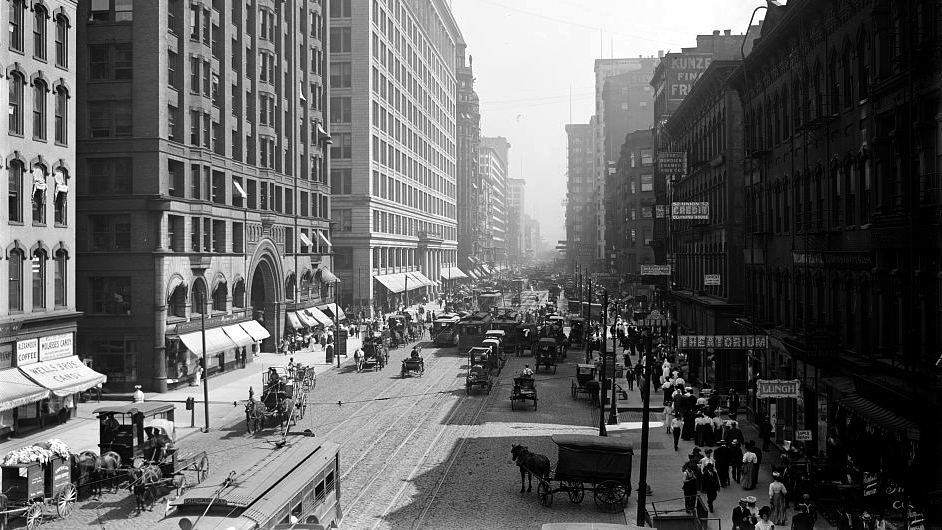
Chicago embodied the triumph of American industrialization. Its meatpacking industry typified the sweeping changes occurring in American life. The last decades of the nineteenth century, a new era for big business, saw the formation of large corporations, run by trained bureaucrats and salaried managers, doing national and international business. Chicago, for instance, became America’s butcher. The Chicago meat processing industry, a cartel of five firms, produced four-fifths of the meat bought by American consumers. Kipling described in intimate detail the Union Stock Yards, the nation’s largest meat processing zone, a square mile just southwest of the city whose pens and slaughterhouses linked the city’s vast agricultural hinterland to the nation’s dinner tables. “Once having seen them,” he concluded, “you will never forget the sight.” Like other notable Chicago industries, such as agricultural machinery and steel production, the meatpacking industry was closely tied to urbanization and immigration. In 1850, Chicago had a population of about thirty thousand. Twenty years later, it had three hundred thousand. Nothing could stop the city’s growth. The Great Chicago Fire leveled 3.5 square miles and left a third of its residents homeless in 1871, but the city quickly recovered and resumed its spectacular growth. By the turn of the twentieth century, the city was home to 1.7 million people.
Chicago’s explosive growth reflected national trends. In 1870, a quarter of the nation’s population lived in towns or cities with populations greater than 2,500. By 1920, a majority did. But if many who flocked to Chicago and other American cities came from rural America, many others emigrated from overseas. Mirroring national immigration patterns, Chicago’s newcomers had at first come mostly from Germany, the British Isles, and Scandinavia, but, by 1890, Poles, Italians, Czechs, Hungarians, Lithuanians, and others from southern and eastern Europe made up a majority of new immigrants. Chicago, like many other American industrial cities, was also an immigrant city. In 1900, nearly 80 percent of Chicago’s population was either foreign-born or the children of foreign-born immigrants.12
Kipling visited Chicago just as new industrial modes of production were revolutionizing the United States. Industry pulled ever more Americans into cities. Manufacturing needed the labor pool and the infrastructure, so cities exploded with growth. America’s urban population increased sevenfold in the half century after the Civil War. Soon the United States had more large cities than any country in the world.
Many cities’ politics adapted to their soaring immigrant populations. The infamous urban political machines often operated as a kind of mutual aid society. New York City’s Democratic Party machine, popularly known as Tammany Hall, drew the greatest ire from critics and seemed to embody all of the worst of city machines, but it also responded to immigrant needs. In 1903, journalist William Riordon published a book, Plunkitt of Tammany Hall, which chronicled the activities of ward heeler George Washington Plunkitt. Plunkitt elaborately explained to Riordon the difference between “honest graft” and “dishonest graft”: “I made my pile in politics, but, at the same time, I served the organization and got more big improvements for New York City than any other livin’ man.” While exposing corruption, Riordon also revealed the hard work Plunkitt undertook on behalf of his largely immigrant constituency. On a typical day, Riordon wrote, Plunkitt was awakened at 2 a.m. to bail out a saloonkeeper who stayed open too late, was awakened again at 6 a.m. because of a fire in the neighborhood and spent time finding lodgings for the families displaced by the fire, and, after spending the rest of the morning in court to secure the release of several of his constituents, found jobs for four unemployed men, attended an Italian funeral, visited a church social, and dropped in on a Jewish wedding. He returned home at midnight.13
Tammany Hall’s corruption, especially under the reign of William “Boss” Tweed, was legendary, but the public works projects that funded Tammany Hall’s graft also provided essential infrastructure and public services for the city’s rapidly expanding population. Water, sewer, and gas lines; schools, hospitals, civic buildings, and museums; police and fire departments; roads, parks (notably Central Park), and bridges (notably the Brooklyn Bridge): all could, in whole or in part, be credited to Tammany’s reign. Still, machine politics could never be enough. As the urban population exploded, many immigrants found themselves trapped in crowded, crime-ridden slums. Americans eventually took notice of this urban crisis and proposed municipal reforms but also grew concerned about the declining quality of life in rural areas.
While cities boomed, rural worlds languished. Some Americans scoffed at rural backwardness and reveled in the countryside’s decay, but many romanticized the countryside, celebrated rural life, and wondered what had been lost in the cities. Sociologist Kenyon Butterfield, concerned by the sprawling nature of industrial cities and suburbs, regretted the eroding social position of rural citizens and farmers: “Agriculture does not hold the same relative rank among our industries that it did in former years.” Butterfield saw “the farm problem” as part of “the whole question of democratic civilization.”14 He and many others thought the rise of the cities and the fall of the countryside threatened traditional American values. Many proposed conservation. Liberty Hyde Bailey, a botanist and rural scholar selected by Theodore Roosevelt to chair the federal Commission on Country Life in 1907, believed that rural places and industrial cities were linked: “Every agricultural question is a city question.”15
Many longed for a middle path between the cities and the country. New suburban communities on the outskirts of American cities defined themselves in opposition to urban crowding. Americans contemplated the complicated relationships between rural places, suburban living, and urban spaces. Los Angeles became a model for the suburban development of rural places. Dana Barlett, a social reformer in Los Angeles, noted that the city, stretching across dozens of small towns, was “a better city” because of its residential identity as a “city of homes.”16 This language was seized upon by many suburbs that hoped to avoid both urban sprawl and rural decay. In Glendora, one of these small towns on the outskirts of Los Angeles, local leaders were “loath as anyone to see it become cosmopolitan.” Instead, in order to have Glendora “grow along the lines necessary to have it remain an enjoyable city of homes,” they needed to “bestir ourselves to direct its growth” by encouraging not industry or agriculture but residential development.17
IV. Black Life and “The New South”
At the turn of the twentieth century, roughly 90 percent of African Americans in the United States lived in the South. The Black community consisted of two groups in the Gilded Age and Progressive Era: a large working class and a smaller segment of middle-class professionals often referred to as “colored society.” In the South the majority of African Americans worked in agriculture, although 85 percent did not own their own land. The options for farming included share tenantry, where an individual or family paid a portion of the crop as rent; sharecropping, where the farmer would labor for a share of profits minus cost-of-living expenses; or as a basic wage laborer. Outside of agriculture, the options for Black working-class men were limited to jobs that white men refused to do. For example, they found jobs as street cleaners, porters on trains, barbers for a white clientele, and laborers in industries such as lumber, mining, iron, or steel.18 It was not unusual for children or teenagers to supplement family income by doing odd jobs for white people. Author Richard Wright, who grew up in Mississippi, Tennessee, and Arkansas in the early twentieth century, recalled working as a small child to help pay his mother’s rent and alleviate the gnawing hunger that plagued him throughout his childhood. He carted wood to feed hot stoves in restaurants, delivered pressed clothing to hotel guests, swept floors in retail stores, carried lunches to men who labored on the railroad, and performed a variety of chores for white women in their homes, among other things. The social rules of the Jim Crow South, or what is called “racial etiquette,” required that African Americans always be deferential toward white people. This included never questioning whites’ authority, claiming superior knowledge to a white person, laughing at whites’ behavior, or suggesting that white people were lying. Wright remembered how mentally exhausting he found it to work in a white home, noting, “I was tense each moment, trying to anticipate their wishes and avoid a curse”; over time, “the nervous strain, the fear that my actions would call down upon my head a storm of curses was even more damaging.”19
Employment opportunities for African American women were more limited. In Atlanta, Georgia, for example, 90 percent of Black women served as domestics in the early twentieth century. Working-class Black women toiled as cooks, housekeepers, and child nursemaids in white homes seven days a week, from sunup to sundown, for exceedingly low wages. Occasionally, they might find domestic employment in boarding houses, hotels, and other commercial settings. Inside the white home, southerners expected that Black women, like their male counterparts, would follow “racial etiquette.” But unlike Black men, women had to contend with sexual harassment and assault by men in white households. Beginning in the 1870s and 1880s, a Black woman who desired to avoid the dangers and unpleasantness of white homes could work as a laundress. Before the age of industrial laundry, this job was incredibly grueling. It involved hauling water and firewood, making soap from lye, using batting sticks to move the laundry, scrubbing clothing on washboards, and collecting beeswax to use on heavy irons. Because laundresses did not live inside white homes, they retained freedom over their personhood. In 1881 three thousand laundresses in Atlanta formed the Washing Society and defiantly initiated a strike for higher wages and a uniform rate. Despite arrests and fines, they succeeded in their quest. The washerwoman strike inspired other working-class Black men and women to go on strike, including Black waiters at the National Hotel in Atlanta.20
Middle-class African Americans also encountered limitations. Because Black men had been excluded from politics by disfranchisement and both Black men and women faced social restrictions imposed by de jure (by law) and de facto (by custom or tradition) segregation, they retreated into their own world. Ironically, the Jim Crow era created new opportunities for middle-class African Americans to build their own companies and businesses designed to serve a segregated Black community. They established funeral homes, insurance companies, banks, and mercantile stores in cities across the South. Black men frequently served as educators, journalists, and clergymen. In 1887 Isaiah Montgomery and his cousins, who had been formerly enslaved, founded an all-Black town in Mississippi known as Mound Bayou. With a community of four thousand, it was a remarkable, if unusual, accomplishment. One resident of the town proudly noted, “Everything here was Negro from the symbols of law and authority and the man who ran the bank down to the fellow who drove the road scraper. That gave us kids a sense of security and power and pride that colored kids didn’t get anywhere else.”21
Many prominent white southerners, hungry for northern investments, pretended that the South’s “racial problem” had been solved. “There was a South of slavery and secession,” Atlanta Constitution editor Henry Grady proclaimed in an 1886 speech in New York. “That South is dead.”22 Grady captured the sentiment of many white southern business and political leaders who imagined a New South that could turn its back on the past by embracing industrialization and diversified agriculture. He promoted the region’s economic possibilities and mutual future prosperity through an alliance of northern capital and southern labor. Grady and other New South boosters hoped to shape the region’s economy in the North’s image. They wanted industry and they wanted infrastructure. But the past could not be escaped. Economically and socially, the “New South” would still be much like the old.

A “New South” seemed an obvious need. The Confederacy’s failed insurrection wreaked havoc on the southern economy and crippled southern prestige. Property was destroyed. Lives were lost. Political power vanished. And four million enslaved Americans—representing the wealth and power of the antebellum white South—threw off their chains and walked proudly forward into freedom.
Emancipation unsettled the southern social order. When Reconstruction regimes attempted to grant freedpeople full citizenship rights, anxious whites struck back. From their fear, anger, and resentment they lashed out, not only in organized terrorist organizations such as the Ku Klux Klan but in political corruption, economic exploitation, and violent intimidation. White southerners took back control of state and local governments and used their reclaimed power to disenfranchise African Americans and pass Jim Crow laws segregating schools, transportation, employment, and various public and private facilities. The reestablishment of white supremacy after the “redemption” of the South from Reconstruction contradicted the proclamations of a “New” South. Perhaps nothing harked so forcefully back to the barbaric southern past than the wave of lynchings—the extralegal murder of individuals by vigilantes—that washed across the South after Reconstruction. Whether for actual crimes or fabricated crimes or for no crimes at all, white mobs murdered roughly five thousand African Americans between the 1880s and the 1950s.
Lynching was not just murder, it was a ritual rich with symbolism. Victims were not simply hanged, they were mutilated, burned alive, and shot. Lynchings could become carnivals, public spectacles attended by thousands of eager spectators. Rail lines ran special cars to accommodate the rush of participants. Vendors sold goods and keepsakes. Perpetrators posed for photos and collected mementos. And it was increasingly common. One notorious example occurred in Georgia in 1899. Accused of killing his white employer and raping the man’s wife, Sam Hose was captured by a mob and taken to the town of Newnan. Word of the impending lynching quickly spread, and specially chartered passenger trains brought some four thousand visitors from Atlanta to witness the gruesome affair. Members of the mob tortured Hose for about an hour. They sliced off pieces of his body as he screamed in agony. Then they poured a can of kerosene over his body and burned him alive.23
At the barbaric height of southern lynching, in the last years of the nineteenth century, southerners lynched two to three African Americans every week. In general, lynchings were most frequent in the Cotton Belt of the Lower South, where southern Black people were most numerous and where the majority worked as tenant farmers and field hands on the cotton farms of white landowners. The states of Mississippi and Georgia had the greatest number of recorded lynchings: from 1880 to 1930, Mississippi lynch mobs killed over five hundred African Americans; Georgia mobs murdered more than four hundred.
Throughout the late nineteenth and early twentieth centuries, a number of prominent southerners openly supported lynching, arguing that it was a necessary evil to punish Black rapists and deter others. In the late 1890s, Georgia newspaper columnist and noted women’s rights activist Rebecca Latimer Felton—who would later become the first woman to serve in the US Senate—endorsed such extrajudicial killings. She said, “If it takes lynching to protect women’s dearest possession from drunken, ravening beasts, then I say lynch a thousand a week.”24 When opponents argued that lynching violated victims’ constitutional rights, South Carolina governor Coleman Blease angrily responded, “Whenever the Constitution comes between me and the virtue of the white women of South Carolina, I say to hell with the Constitution.”25
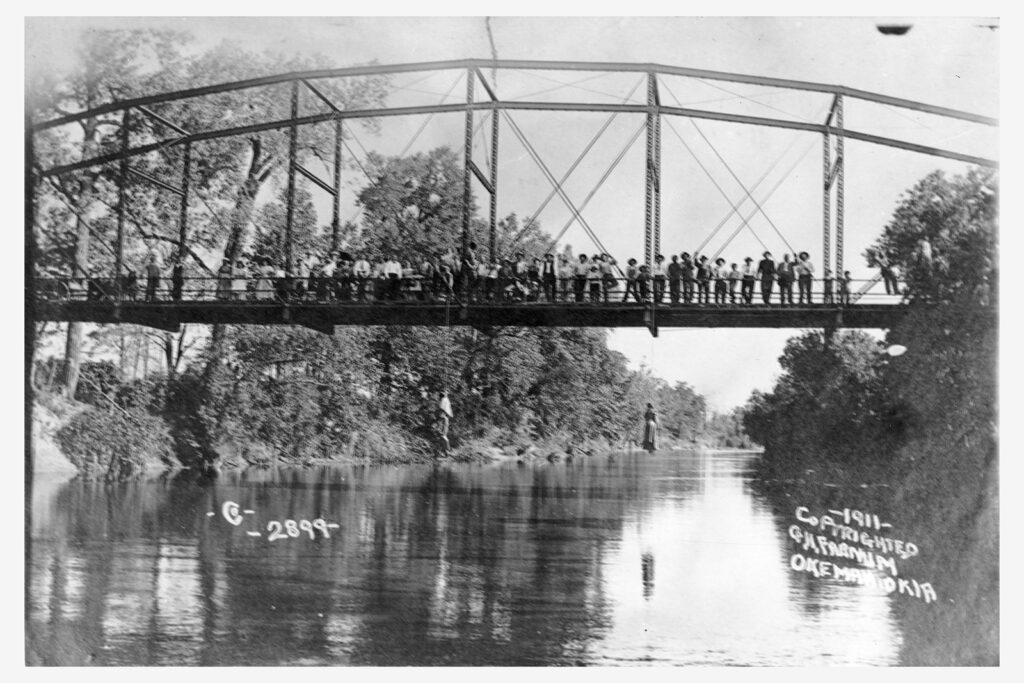

Black activists and white allies worked to outlaw lynching. Ida B. Wells, an African American woman born in the last years of slavery and a pioneering anti-lynching advocate, lost three friends to a lynch mob in Memphis, Tennessee, in 1892. That year, Wells published Southern Horrors: Lynch Law in All Its Phases, a groundbreaking work that documented the South’s lynching culture and exposed the myth of the Black rapist.26 The Tuskegee Institute and the National Association for the Advancement of Colored People (NAACP) both compiled and publicized lists of every reported lynching in the United States. In 1918, Representative Leonidas Dyer of Missouri introduced federal anti-lynching legislation that would have made the local counties where lynchings took place legally liable for such killings. Throughout the early 1920s, the Dyer Bill was the subject of heated political debate, but, fiercely opposed by southern congressmen and unable to win enough northern champions, the proposed bill was never enacted.
Lynching was not the only form of racial violence that survived Reconstruction. White political violence continued to follow African American political participation and labor organization, however severely circumscribed. When the Populist insurgency created new opportunities for Black political activism, white Democrats responded with terror. In North Carolina, Populists and Republicans “fused” together and won stunning electoral gains in 1896. Shocked White Democrats formed “Red Shirt” groups—paramilitary organizations dedicated to eradicating Black political participation and restoring Democratic rule through violence and intimidation. Launching a self-described “white supremacy campaign” of violence and intimidation against Black voters and officeholders during the 1898 state elections, the Red Shirts effectively took back state government. But municipal elections were not held that year in Wilmington, North Carolina, where Fusionists controlled the city government. After manning armed barricades blocking Black voters from entering the town to vote in the state elections, the Red Shirts drafted a “White Declaration of Independence” which declared “that that we will no longer be ruled and will never again be ruled, by men of African origin.” Four hundred and fifty-seven white Democrats signed the document. They also issued a twelve-hour ultimatum that the editor of the city’s Black daily paper flee the city. The editor left, but it wasn’t enough. Twelve hours later, hundreds of Red Shirts raided the city’s armory and ransacked the newspaper office anyway. The mob swelled and turned on the city’s Black neighborhood, destroying homes and businesses and opening fire on any Black person they found. Dozens were killed and hundreds more fled the city. The mob then forced the mayor, the city’s aldermen, and the police chief, at gunpoint, to immediately resign. To ensure their gains, the Democrats rounded up prominent fusionists, placed them on railroad cars, and, under armed guard, sent them out of the state. The mob installed and swore in their own replacements. It was a full-blown coup.
Lynching and organized terror campaigns were only the violent worst of the South’s racial world. Discrimination in employment and housing and the legal segregation of public and private life also reflected the rise of the new segregationist South. Jim Crow laws legalized what custom had long dictated. Southern states and municipalities enforced racial segregation in public places and in private lives. Separate coach laws were some of the first such laws to appear, beginning in Tennessee in the 1880s. Soon schools, stores, theaters, restaurants, bathrooms, and nearly every other part of public life were segregated. So, too, were social lives. The sin of racial mixing also had to be heavily guarded against. Marriage laws regulated against interracial couples, and white men, ever anxious of relationships between Black men and white women, passed miscegenation laws and justified lynching as an appropriate extralegal tool to police the racial divide.
In politics, de facto limitations of Black voting had suppressed Black voters since Reconstruction. Whites stuffed ballot boxes and intimidated Black voters with physical and economic threats. And then, from roughly 1890 to 1908, southern states put these new codes on the books, implementing de jure disfranchisement. They passed laws requiring voters to pass literacy tests (which could be judged arbitrarily) and pay poll taxes (which hit poor white and poor Black Americans alike), effectively denying Black men the franchise that was supposed to have been guaranteed by the Fifteenth Amendment. Those responsible for such laws posed as reformers and justified voting restrictions as for the public good, a way to clean up politics by purging purportedly corrupt African Americans from the voting rolls.
With white supremacy secured, prominent white southerners looked outward for support. New South boosters hoped to confront post-Reconstruction uncertainties by rebuilding the South’s economy and convincing the nation that the South could be more than an economically backward, race-obsessed backwater. And as they did, they began to retell the history of the recent past. A kind of civic religion known as the “Lost Cause” glorified the Confederacy and romanticized the Old South. White southerners looked forward while simultaneously harking back to a mythic imagined past inhabited by contented and loyal slaves, benevolent and generous masters, chivalric and honorable men, and pure and faithful southern belles. Secession, they said, had little to do with the institution of slavery, and soldiers had fought only for home and honor, not the continued ownership of human beings. The New South, then, would be built physically with new technologies, new investments, and new industries, but undergirded by political and social custom.
Henry Grady might have declared the Confederate South dead, but its memory pervaded the thoughts and actions of white southerners. Lost Cause champions overtook the South. Women’s groups, such as the United Daughters of the Confederacy, joined with Confederate veterans to preserve a pro-Confederate past. They built Confederate monuments and celebrated Confederate veterans on Memorial Day. Across the South, towns erected statues of General Robert E. Lee and other Confederate figures. By the turn of the twentieth century, the idealized Lost Cause past was entrenched not only in the South but across the country. In 1905, for instance, North Carolinian Thomas F. Dixon published a novel, The Clansman, that depicted the Ku Klux Klan as heroic defenders of the South against the corruption of African American and northern “carpetbag” misrule during Reconstruction. In 1915, acclaimed film director D. W. Griffith adapted Dixon’s novel into the groundbreaking blockbuster film The Birth of a Nation, which almost singlehandedly rejuvenated the Ku Klux Klan. The romanticized version of the antebellum South and the distorted version of Reconstruction dominated popular imagination.27
While Lost Cause defenders mythologized their past, New South boosters struggled to wrench the South into the modern world. The railroads became their focus. The region had lagged behind the North in the railroad building boom of the mid-nineteenth century, and postwar expansion facilitated connections between the most rural segments of the population and the region’s rising urban areas. Boosters campaigned for the construction of new hard-surfaced roads as well, arguing that improved roads would further increase the flow of goods and people and entice northern businesses to relocate to the region. The rising popularity of the automobile after the turn of the century only increased pressure for the construction of reliable roads between cities, towns, county seats, and the vast farmlands of the South.
Along with new transportation networks, New South boosters continued to promote industrial growth. The region witnessed the rise of various manufacturing industries, predominantly textiles, tobacco, furniture, and steel. While agriculture—cotton in particular—remained the mainstay of the region’s economy, these new industries provided new wealth for owners, new investments for the region, and new opportunities for the exploding number of landless farmers to finally flee the land. Industries offered low-paying jobs but also opportunities to the rural poor who could no longer sustain themselves through subsistence farming. Men, women, and children all moved into wage work. At the turn of the twentieth century, nearly one fourth of southern mill workers were children aged six to sixteen.
In most cases, as in most aspects of life in the New South, new factory jobs were racially segregated. Better-paying jobs were reserved for whites, while the most dangerous, labor-intensive, dirtiest, and lowest-paying positions were relegated to African Americans. African American women, shut out of most industries, found employment most often as domestic help for white families. As poor as white southern mill workers were, southern Black people were poorer. Some white mill workers could even afford to pay for domestic help in caring for young children, cleaning houses, doing laundry, and cooking meals. The mill villages that grew up alongside factories were whites-only, and African American families were pushed to the outer perimeter of the settlements.
That a “New South” emerged in the decades between Reconstruction and World War I is debatable. If measured by industrial output and railroad construction, the New South was a reality but if measured relative to the rest of the nation, the effect was limited. If measured in terms of racial discrimination, however, the New South looked much like the Old one. Boosters such as Henry Grady said the South was done with racial questions, but lynching and segregation and the institutionalization of Jim Crow exposed the South’s lingering racial obsessions. Meanwhile, most southerners still toiled in agriculture and still lived in poverty. Industrial development and expanding infrastructure, rather than re-creating the South, coexisted easily with white supremacy and an impoverished agricultural economy. The trains came, factories were built, and capital was invested, but the region remained mired in poverty and racial apartheid. Much of the “New South,” then, was anything but new.
V. Gender, Religion, and Culture
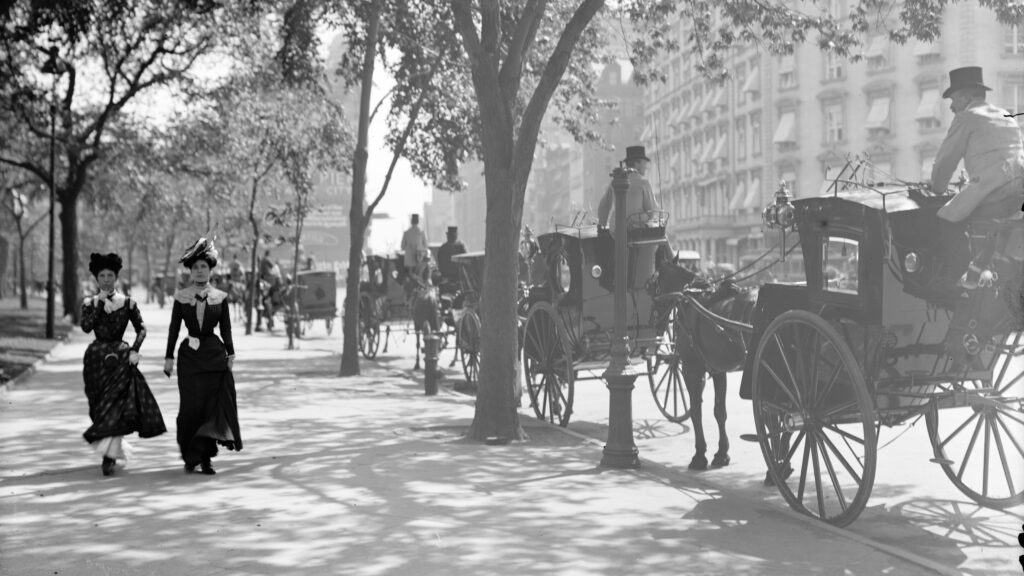
In 1905, Standard Oil tycoon John D. Rockefeller donated $100,000 (about $2.5 million today) to the American Board of Commissioners for Foreign Missions. Rockefeller was the richest man in America but also one of the most hated and mistrusted. Even his admirers conceded that he had achieved his wealth through often illegal and usually immoral business practices. Journalist Ida Tarbell had made waves describing Standard Oil’s long-standing ruthlessness and predilections for political corruption. Clergymen, led by reformer Washington Gladden, fiercely protested the donation. A decade earlier, Gladden had asked of such donations, “Is this clean money? Can any man, can any institution, knowing its origin, touch it without being defiled?” Gladden said, “In the cool brutality with which properties are wrecked, securities destroyed, and people by the hundreds robbed of their little all to build up the fortunes of the multi-millionaires, we have an appalling revelation of the kind of monster that a human being may become.”28
Despite widespread criticism, the board accepted Rockefeller’s donation. Board president Samuel Capen did not defend Rockefeller, arguing that the gift was charitable and the board could not assess the origin of every donation, but the dispute shook Capen. Was a corporate background incompatible with a religious organization? The “tainted money” debate reflected questions about the proper relationship between religion and capitalism. With rising income inequality, would religious groups be forced to support either the elite or the disempowered? What was moral in the new industrial United States? And what obligations did wealth bring? Steel magnate Andrew Carnegie popularized the idea of a “gospel of wealth” in an 1889 article, claiming that “the true antidote for the temporary unequal distribution of wealth” was the moral obligation of the rich to give to charity.29 Farmers and labor organizers, meanwhile, argued that God had blessed the weak and that new Gilded Age fortunes and corporate management were inherently immoral. As time passed, American churches increasingly adapted themselves to the new industrial order. Even Gladden came to accept donations from the Gilded Age elite, such as the Baptist John D. Rockefeller, who increasingly touted the morality of business.
Secular knowledge-seeking and Gilded Age dollars increasingly muscled out the traditional role of religion in American higher education as well. The Gilded Age elite funneled their fortunes into new elite private institutions. The Morrill Land Grants of 1862 and 1890 subsidized new schools that emphasized practical knowledge in science, engineering, and agriculture. The 1890 version of the legislation also provided for Black colleges in states with segregated universities, nine years after Booker T. Washington founded the Tuskegee Institute in Alabama, a model of Black vocational education that Washington championed across the South and much of the country. Daniel Coit Gilman, meanwhile, borrowed the models of research-based graduate education from German universities—a popular destination for elite Americans who studied abroad—when he presided over the newly established Johns Hopkins University in 1876. At Harvard, educational reformer Charles William Elliot advocated for and modeled for the nation the replacement of a strictly guided classical curriculum with a more open-ended and practical-minded elective system. At the same time, women occupied a larger and larger percentage of American college students, either as students at separate women’s colleges or, increasingly, at coeducational institutions. Such trends, in many ways, mirrored emerging social and cultural forces in America, and women’s greater presence in American life—as typified by higher education—became sites for public discussion over the fate of traditional American masculinity.30
The economic and social changes of the late nineteenth and early twentieth centuries—including increased urbanization, immigration, advancements in science and technology, patterns of consumption and the new availability of goods, and new awareness of economic, racial, and gender inequalities—challenged traditional gender norms. At the same time, urban spaces and shifting cultural and social values presented new opportunities to challenge traditional gender and sexual norms. Many women, carrying on a campaign that stretched long into the past, vied for equal rights. They became activists: they targeted municipal reforms, launched labor rights campaigns, and, above all, bolstered the suffrage movement.
Urbanization and immigration fueled anxieties that the old social mores were being subverted and that old forms of social and moral policing were becoming increasingly inadequate. The anonymity of urban spaces presented an opportunity in particular for female sexuality and for male and female sexual experimentation along a spectrum of orientations and gender identities. Anxiety over female sexuality reflected generational tensions and differences, as well as racial and class ones. As young women pushed back against social mores through premarital sexual exploration and expression, social welfare experts and moral reformers labeled such girls feeble-minded, believing even that such unfeminine behavior could be symptomatic of clinical insanity rather than free-willed expression. Generational differences exacerbated the social and familial tensions provoked by shifting gender norms. Youths challenged the norms of their parents’ generations by donning new fashions and enjoying the delights of the city. Women’s fashion loosed its physical constraints: corsets relaxed and hemlines rose. The newfound physical freedom enabled by looser dress was also mimicked in the pursuit of other freedoms.

Victoria Woodhull was perhaps the most famous advocate of women’s rights in the years immediately following the war and emancipation. Woodhull, who made her name (and fortune) as the first woman to run a stock brokerage firm, became the first woman to address Congress in 1871. The previous year, women had been excluded from the Fifteenth Amendment (barring voter discrimination on the basis of race). In a speech before the House Judiciary Committee, she argued that, according to the Fourteenth and Fifteenth Amendments, women had a constitutional right to vote. After her electrifying talk, a delegation of women lobbied congressmen for suffrage “with a ferocity never known before.”31 One year later, Woodhull ran for president as the nominee of the Equal Rights Party, becoming the first woman to run for the office.
Woodhull also promoted “voluntary motherhood” for married women, who, she argued, had the right to plan and control their reproduction. But if wives could choose when to become pregnant, critics argued they had a right to refuse sex to their husbands. At a time when husbands were presumed to have unfettered access to their wives’ bodies and the modern concept of “marital rape” did not exist, this was a radical demand. “Perhaps it may be denied that women are slaves, sexually, sold and delivered to man. But I tell you, as a class, that they are,” Woodhull wrote. “Refuse to yield to the sexual demands of your legal master, and ten to one he will turn you into the street, or in lieu of this, perhaps, give you personal violence, even compelling you to submit by force.”32 For many Gilded Age women, control over their sexual and reproductive lives constituted an important part of their push for social and political rights.
A moral panic surrounding birth control and pornography, exacerbated by women’s push for greater political and sexual rights, sparked the passage of the Comstock Act in 1873, named after Anthony Comstock, a Christian moral reformer who won broad powers as a special agent of the US Postal Service to censor the mail for “obscene” material. The law punished the senders of any material with hard labor and heavy fines—Comstock specifically targeted Victoria Woodhull, for instance, who was arrested for disseminating information on birth control. Comstock, a zealous defender of his law, defined “obscene” broadly as anything from pornography to pamphlets for women with information on how to control their reproductive processes. The Comstock Law testified to dueling forces in American life: a push for greater women’s political and reproductive rights and the newfound power of a repressive “moral politics.”
While many women worked to liberate themselves, many, sometimes simultaneously, worked to uplift others. Women’s work against alcohol propelled temperance into one of the foremost moral reforms of the period. Middle-class, typically Protestant women based their assault on alcohol on the basis of their feminine virtue, Christian sentiment, and their protective role in the family and home. Others, like Jane Addams and settlement house workers, sought to impart a middle-class education on immigrant and working-class women through the establishment of settlement homes. Other reformers touted “scientific motherhood”: the new science of hygiene was deployed as a method of both social uplift and moralizing, particularly of working-class and immigrant women.
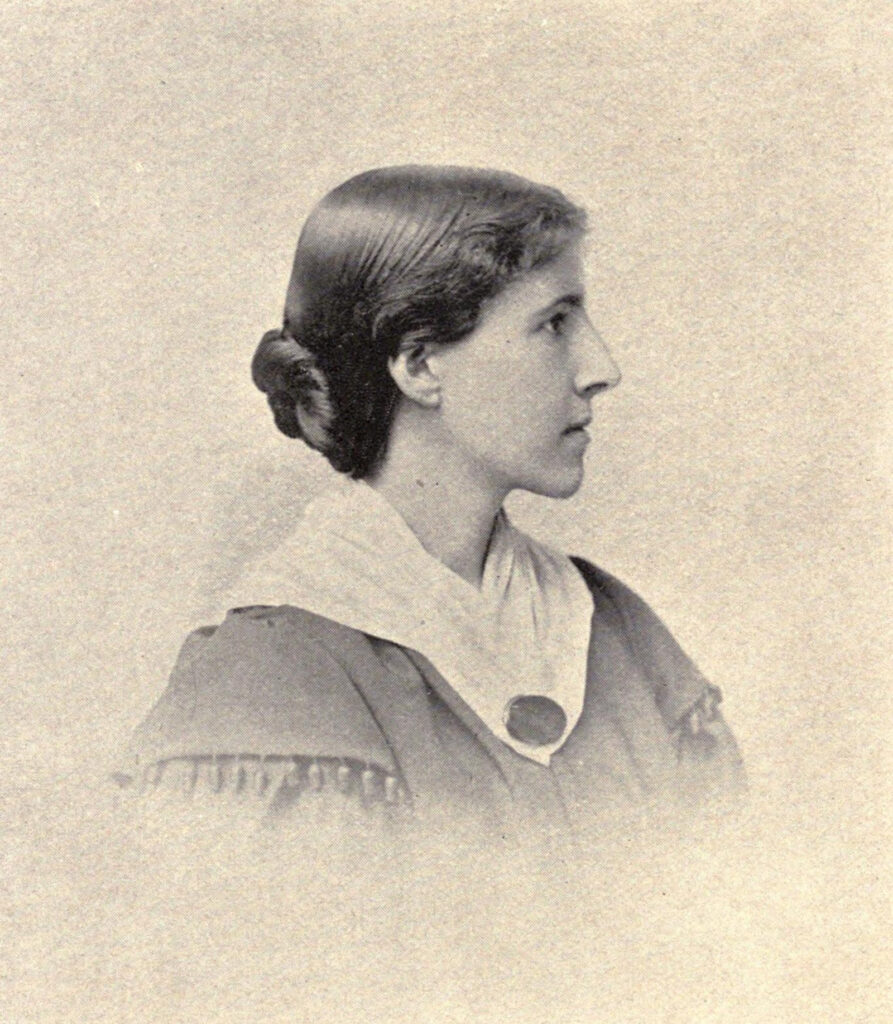

Women vocalized new discontents through literature. Charlotte Perkins Gilman’s short story “The Yellow Wallpaper” attacked the “naturalness” of feminine domesticity and critiqued Victorian psychological remedies administered to women, such as the “rest cure.” Kate Chopin’s The Awakening, set in the American South, likewise criticized the domestic and familial role ascribed to women by society and gave expression to feelings of malaise, desperation, and desire. Such literature directly challenged the status quo of the Victorian era’s constructions of femininity and feminine virtue, as well as established feminine roles.
While many men worried about female activism, they worried too about their own masculinity. To many anxious observers, industrial capitalism was withering American manhood. Rather than working on farms and in factories, where young men formed physical muscle and spiritual grit, new generations of workers labored behind desks, wore white collars, and, in the words of Supreme Court Justice Oliver Wendell Holmes, appeared “black-coated, stiff-jointed, soft-muscled, [and] paste-complexioned.”33 Neurologist George Beard even coined a medical term, neurasthenia, for a new emasculated condition marked by depression, indigestion, hypochondria, and extreme nervousness. The philosopher William James called it simply “Americanitis.” Academics increasingly warned that America had become a nation of emasculated men.
Churches too worried about feminization. Women had always comprised a clear majority of church memberships in the United States, but now, Washington Gladden said, “A preponderance of female influence in the Church or anywhere else in society is unnatural and injurious.” Many feared that the feminized church had feminized Christ himself. Rather than a rough-hewn carpenter, Jesus had been made “mushy” and “sweetly effeminate,” in the words of Baptist minister Walter Rauschenbusch. Advocates of a so-called muscular Christianity sought to stiffen young men’s backbones by putting them back in touch with their primal manliness. Pulling from contemporary developmental theory, they believed that young men ought to evolve as civilization evolved, advancing from primitive nature-dwelling to modern industrial enlightenment. To facilitate “primitive” encounters with nature, muscular Christians founded summer camps and outdoor boys’ clubs like the Woodcraft Indians, the Sons of Daniel Boone, and the Boy Brigades—all precursors of the Boy Scouts. Other champions of muscular Christianity, such as the newly formed Young Men’s Christian Association, built gymnasiums, often attached to churches, where youths could strengthen their bodies as well as their spirits. It was a YMCA leader who coined the term bodybuilding; others invented the sports of basketball and volleyball.34
Muscular Christianity, though, was about even more than building strong bodies and minds. Many advocates also ardently championed Western imperialism, cheering on attempts to civilize non-Western peoples. Gilded Age men were encouraged to embrace a particular vision of masculinity connected intimately with the rising tides of nationalism, militarism, and imperialism. Contemporary ideals of American masculinity at the turn of the century developed in concert with the United States’ imperial and militaristic endeavors in the West and abroad. During the Spanish-American War in 1898, Teddy Roosevelt and his Rough Riders embodied the idealized image of the tall, strong, virile, and fit American man that simultaneously epitomized the ideals of power that informed the United States’ imperial agenda. Roosevelt and others like him believed that a reinvigorated masculinity would preserve the American race’s superiority against foreign foes and the effeminizing effects of overcivilization.
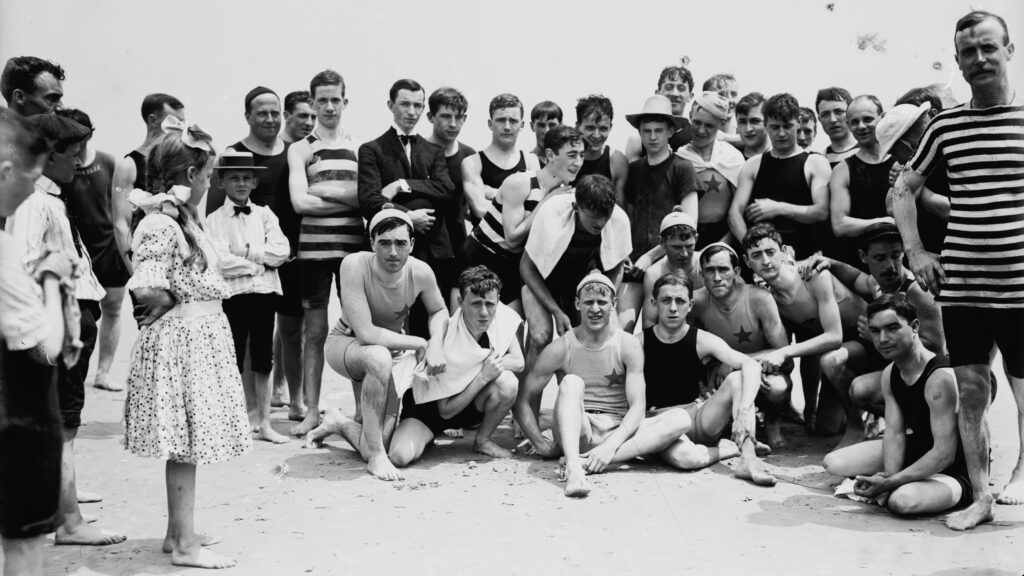
But while many fretted about traditional American life, others lost themselves in new forms of mass culture. Vaudeville heralded a new world of American popular culture. Comprising a variety of stage entertainments, these traveling circuit shows first appeared during the Civil War, peaking between 1880 and 1920. Vaudeville shows featured comedians, musicians, actors, jugglers, and other talents that could captivate an audience. Unlike earlier rowdy acts meant for a male audience that included alcohol, vaudeville was considered family-friendly, “polite” entertainment, though the acts involved offensive ethnic and racial caricatures of African Americans and recent immigrants. Vaudeville performances were often small and quirky, though venues such as the renowned Palace Theatre in New York City signaled true stardom for many performers. Popular entertainers such as silent film star Charlie Chaplin and magician Harry Houdini made names for themselves on the vaudeville circuit. But if live entertainment still captivated audiences, others looked to entirely new technologies.

By the turn of the century, two technologies pioneered by Edison—the phonograph and motion pictures—stood ready to revolutionize leisure and help create the mass entertainment culture of the twentieth century. The phonograph was the first reliable device capable of recording and reproducing sound. But it was more than that. The phonograph industry could create multiple copies of recordings, sparking a great expansion of the market for popular music. Although the phonograph was a technical success, Edison at first had trouble developing commercial applications for it. He thought it might be used for dictation: recording audio letters, preserving the speeches and dying words of great men, or teaching elocution. He did not anticipate that its greatest use would be in the field of mass entertainment, but Edison’s sales agents soon reported that many phonographs were being used for just that, especially in so-called phonograph parlors, where customers could pay a nickel to hear a piece of music. By the turn of the century, Americans were purchasing phonographs for home use. Entertainment became the phonograph’s major market.
Inspired by the success of the phonograph as an entertainment device, Edison decided in 1888 to develop “an instrument which does for the Eye what the phonograph does for the Ear.” In 1888, he patented the concept of motion pictures. By 1891, he was exhibiting a motion-picture camera (a kinetograph) and a viewer (a kinetoscope). By 1894, the Edison Company had produced about seventy-five films suitable for sale and viewing. They could be viewed through a small eyepiece in an arcade or parlor. They were short, typically about three minutes long. Many of the early films depicted athletic feats and competitions. One 1894 film, for example, showed a six-round boxing match. The catalog description gave a sense of the appeal it had for male viewers: “Full of hard fighting, clever hits, punches, leads, dodges, body blows and some slugging.” Other early kinetoscope subjects included Indian dances, nature and outdoor scenes, re-creations of historical events, and humorous skits. By 1896, the Edison Vitascope could project film, shifting audiences away from arcades and pulling them into theaters. Edison’s film catalog meanwhile grew in sophistication. He sent filmmakers to distant and exotic locales like Japan and China. Long-form fictional films created a demand for “movie stars,” such as the glamorous Mary Pickford, the swashbuckling Douglas Fairbanks, the acrobatic comedian Buster Keaton, who began to appear in the popular imagination beginning around 1910. Alongside professional boxing and baseball, the film industry was creating the modern culture of celebrity that would characterize twentieth-century mass entertainment.35
VI. Conclusion
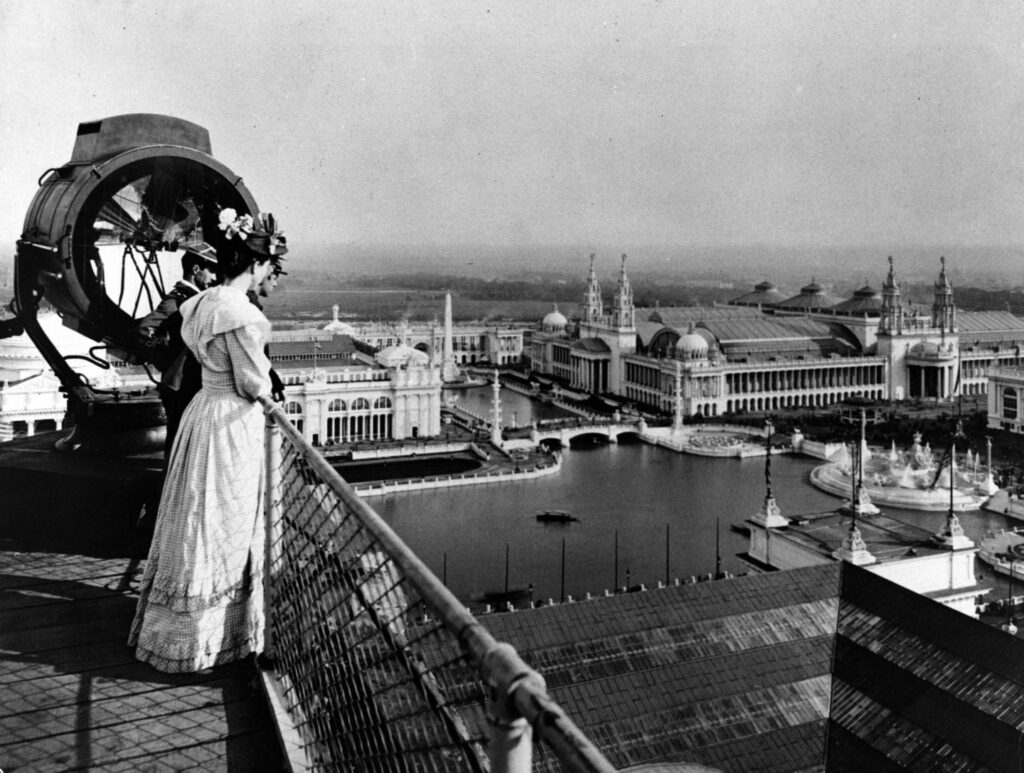
The 1893 World’s Columbian Exposition in Chicago was a sensation. A grand concourse of more than a dozen stately Beaux Arts–style buildings showcasing American industrial, artistic, and scientific achievements lined the beautifully manicured fairgrounds alongside Lake Michigan. A midway, flush with amusements, featured the world’s first Ferris Wheel.36 Nearly two hundred other buildings brought the world to America’s doorstep. Meanwhile, Buffalo Bill set up his popular Wild West show just outside the fairgrounds. The fair embodied dreams of American power and progress. The Auditorium Theatre’s America pageant traced a heroic arc of American history: It recreated Columbus’s voyage, the Plymouth Plantation, and the Revolutionary War before showing a “Grand Ballet of Arts and Sciences” and a “Grand Ballet of American Inventions.” And it embodied its limits: the fair’s exhibits trafficked in racial stereotypes, and Black Americans’ poor representation at the fair infuriated Frederick Douglass and other Black leaders. And yet, the fair captured the imagination of millions: over twenty-million visitors came to Chicago for it. Its extravagance, its amusements, its social failings: the Exposition embodied the United States on the eve of the twentieth century.

After enduring four bloody years of warfare and a strained, decade-long effort to reconstruct the defeated South, the United States abandoned itself to industrial development. Businesses expanded in scale and scope. The nature of labor shifted. A middle class rose. Wealth concentrated. Immigrants crowded into the cities, which grew upward and outward. The Jim Crow South stripped away the vestiges of Reconstruction, and New South boosters papered over the scars. Industrialists hunted profits. Evangelists appealed to people’s morals. Consumers lost themselves in new goods and new technologies. Women emerging into new urban spaces embraced new social possibilities. By the turn of the twentieth century, the United States, in all of its many facets, had been radically transformed. And the transformations continued to ripple outward into the West and overseas, and inward into radical protest and progressive reforms. For Americans at the twilight of the nineteenth century and the dawn of the twentieth, a bold new world loomed.
VII. Reference Material
This chapter was edited by David Hochfelder, with content contributions by Jacob Betz, Anne Gray Fischer, David Hochfelder, Gerard Koeppel, Scott Libson, Kyle Livie, K. Tsianina Lomawaima, Paul Matzko, Isabella Morales, Natalie J. Ring, Andrew Robichaud, Kate Sohasky, Joseph Super, Susan Thomas, Shawn Varghese, Kaylynn Washnock, and Kevin Young.
Recommended Reading
• Aarim, Najia. Chinese Immigrants, African Americans, and Racial Anxiety in the United States, 1848–1882. Champaign: University of Illinois Press, 2006.
• Ayers, Edward. The Promise of the New South. New York: Oxford University Press, 1992.
• Beckert, Sven. Monied Metropolis: New York City and the Consolidation of the American Bourgeoisie, 1850–1896. Cambridge, UK: Cambridge University Press, 2001.
• Bederman, Gail. Manliness and Civilization: A Cultural History of Gender and Race in the United States, 1880–1917. Chicago: University of Chicago Press, 1995.
• Blight, David. Race and Reunion: The Civil War in American Memory. Cambridge, MA: Harvard University Press, 2001.
• Briggs, Laura. “The Race of Hysteria: ‘Overcivilization’ and the ‘Savage’ Woman in Late Nineteenth-Century Obstetrics and Gynecology.” American Quarterly 52 (June 2000): 246–273.
• Chauncey, George. Gay New York: Gender, Urban Culture, and the Making of the Gay Male World, 1890–1940. New York: Basic Books, 1995.
• Cole, Stephanie, and Natalie J. Ring, eds. The Folly of Jim Crow: Rethinking the Segregated South. College Station: Texas A&M University Press, 2012.
• Cott, Nancy. The Grounding of Modern Feminism. New Haven, CT: Yale University Press, 1987.
• Cronon, William. Nature’s Metropolis: Chicago and the Great West. New York: Norton, 1991.
• Edwards, Rebecca. New Spirits: Americans in the Gilded Age, 1865–1905. New York: Oxford University Press, 2005.
• Gilmore, Glenda Elizabeth. Gender and Jim Crow: Women and the Politics of White Supremacy in North Carolina, 1896–1920. Chapel Hill: University of North Carolina Press, 1996.
• Gutman, Herbert. Work, Culture, and Society in Industrializing America: Essays in American Working-Class and Social History. New York: Knopf, 1976.
• Hale, Grace Elizabeth. Making Whiteness: The Culture of Segregation in the South, 1890–1940. New York: Pantheon Books, 1998.
• Hicks, Cheryl. Talk with You Like a Woman: African American Women, Justice, and Reform in New York, 1890–1935. Chapel Hill: University of North Carolina Press, 2010.
• Higham, John. Strangers in the Land: Patterns of American Nativism, 1860–1925. New Brunswick, NJ: Rutgers University Press, 1988.
• Hirota, Hidetaka. Expelling the Poor: Atlantic Seaboard States and the Nineteenth-Century Origins of American Immigration Policy. New York: Oxford University Press, 2016.
• Hoganson, Kristin L. Consumers’ Imperium: The Global Production of American Domesticity, 1865–1920. Chapel Hill: University of North Carolina Press, 2007.
• Jacobson, Matthew Frye. Whiteness of a Different Color: European Immigrants and the Alchemy of Race. Cambridge, MA: Harvard University Press, 1999.
• Kasson, John F. Amusing the Million: Coney Island at the Turn of the Century. New York: Hill and Wang, 1978.
• Leach, William. Land of Desire: Merchants, Power, and the Rise of a New American Culture. New York: Random House, 1993.
• Lears, T. J. Jackson. No Place of Grace: Antimodernism and the Transformation of American Culture, 1880–1920. Chicago: University of Chicago Press, 1981.
• Odem, Mary. Delinquent Daughters: Protecting and Policing Adolescent Female Sexuality in the United States, 1885–1920. Chapel Hill: University of North Carolina Press, 1995.
• Pascoe, Peggy. What Comes Naturally: Miscegenation Law and the Making of Race in America. New York: Oxford University Press, 2009.
• Peiss, Kathy. Cheap Amusements. Working Women and Leisure in Turn-of-the-Century New York. Philadelphia: Temple University Press, 1986.
• ———. Hope in a Jar: The Making of America’s Beauty Culture. Philadelphia: University of Pennsylvania Press, 1999.
• Putney, Clifford. Manhood and Sports in Protestant America, 1880–1920. Cambridge, MA: Harvard University Press, 2001.
• Silber, Nina. The Romance of Reunion: Northerners and the South, 1865–1900. Chapel Hill: University of North Carolina Press, 1997.
• Trachtenberg, Alan. The Incorporation of America: Culture and Society in the Gilded Age. New York: Hill and Wang, 1982.
• Woodward, C. Vann. Origins of the New South, 1877–1913. Baton Rouge: LSU Press, 1951.
Notes
- Henry Adams to Charles Milmes Gaskell, March 29, 1900, in Worthington Chauncey Ford, ed., Letters of Henry Adams 1892–1918 (New York: Houghton Mifflin Company, 1938).[↩]
- Jacob A. Riis, How the Other Half Lives: Studies Among the Tenements of New York (New York: Scribner, 1890).[↩]
- Matthew Frye Jacobson, Barbarian Virtues: The United States Encounters Foreign Peoples at Home and Abroad, 1876–1917 (New York: Hill and Wang, 2000).[↩]
- Massachusetts Board of State Charities, Annual Report of the State Board of Charity of Massachusetts (Boston: Wright, 1877), xlvii.[↩]
- Jacobson, Barbarian Virtues.[↩]
- Roger Daniels, The Politics of Prejudice: The Anti-Japanese Movement in California and the Struggle for Japanese Exclusion (Berkeley: University of California Press, 1999).[↩]
- James M. O’Toole, The Faithful: A History of Catholics in America (Cambridge, MA: Harvard University Press, 2009).[↩]
- Society of American Indians (SAI) published a journal known as the Quarterly Journal of the Society of American Indians from 1913 to 1915; and as The American Indian Magazine from 1916 to 1920. The journals are available on microfiche in many university libraries. The Papers of the Society of American Indians, edited by John W. Larner Jr., are published on ten rolls of microfilm (Wilmington, DE: Scholar Resources, 1987). The Papers contain fifty-six hundred items of SAI-relevant materials (correspondence, organizational documents, publications, and programs from the annual meetings) from forty-five repositories, dated from 1906 to 1946. The Papers do not include the journal publications.[↩]
- Lucy Maddox, Citizen Indians: Native American Intellectuals, Race, and Reform (Ithaca, NY: Cornell University Press, 2005).[↩]
- Chadwick Allen and Beth H. Piatote, eds., Special Combined Issue: The Society of American Indians and Its Legacies. Studies in American Indian Literatures 25, no. 2/American Indian Quarterly 37, no. 3 (2013).[↩]
- Rudyard Kipling, The Works of Rudyard Kipling, Volume II (New York: Doubleday, 1899), 141.[↩]
- On the transformation of Chicago, see William Cronon’s defining work, Nature’s Metropolis: Chicago and the West (New York: Norton, 1991).[↩]
- William L. Riordon, Plunkitt of Tammany Hall: A Series of Very Plain Talks on Very Practical Politics (New York: McClure, Phillips, 1905).[↩]
- Kenyon L. Butterfield, Chapters in Rural Progress (Chicago: University of Chicago Press, 1908), 15.[↩]
- L. H. Bailey, The Harvest of the Year to the Tiller of the Soil (New York: Macmillan, 1927), 60.[↩]
- Oscar Osburn Winther, “The Rise of Metropolitan Los Angeles, 1870–1900,” Huntington Library Quarterly 10 (August 1947): 391–405.[↩]
- “Chamber Meeting,” Glendora Gleaner, September 28, 1923.[↩]
- Leon Litwack, Trouble in Mind: Black Southerners in the Age of Jim Crow (New York: Alfred A. Knopf, 1998), 114–178, 326–403.[↩]
- Richard Wright, Black Boy: A Record of Childhood and Youth (New York: World Publishing Company, Forum Books Edition, 1947), 73, 127–131, quote on 131.[↩]
- Tera W. Hunter, To ’Joy My Freedom: Southern Black Women’s Lives and Labors After the Civil War (Cambridge, MA: Harvard University Press, 1997).[↩]
- J. Saunders Redding, No Day of Triumph (New York: Harper & Row Publishers, 1942), 300–301.[↩]
- Henry Grady, The Complete Orations and Speeches of Henry Grady, ed. Edwin DuBois Shurter (New York: Hinds, Noble and Eldredge, 1910), 7.[↩]
- William Fitzhugh Brundage, Lynching in the New South: Georgia and Virginia, 1880–1930 (Champaign: University of Illinois Press, 1993), 82–84.[↩]
- Grace Elizabeth Hale, Making Whiteness: The Culture of Segregation in the South, 1890–1940 (New York: Pantheon Books, 1998), 201.[↩]
- Jacquelyn Dowd Hall, Revolt Against Chivalry: Jessie Daniel Ames and the Women’s Campaign Against Lynching (New York: Columbia University Press, 1993), 195.[↩]
- Ida B. Wells, Crusade for Justice: The Autobiography of Ida B. Wells (Chicago: University of Chicago Press, 1970).[↩]
- Charles Reagan Wilson, Baptized in Blood: The Religion of the Lost Cause, 1865–1920 (Athens: University of Georgia Press, 1980).[↩]
- Washington Gladden, The New Idolatry and Other Discussions (New York: McClure, Phillips, 1905), 21.[↩]
- Andrew Carnegie, “Wealth,” North American Review 391 (June 1889): 656, 660.[↩]
- George M. Marsden, The Soul of the American University: From Protestant Establishment to Established Nonbelief (New York: Oxford University Press, 1994); Julie A. Reuben, The Making of the Modern University: Intellectual Transformation and the Marginalization of Morality (Chicago: University of Chicago Press, 1996); John R. Thelin, A History of American Higher Education, 3rd ed. (Baltimore: Johns Hopkins University Press, 2019).[↩]
- Linda K. Kerber, Jane Sherron De Hart, Cornelia Hughes Dayton, and Karissa Haugeberg, eds., Women’s America: Refocusing the Past, 9th ed. (New York: Oxford University Press, 2019), 223.[↩]
- Anne M. Boylan, Women’s Rights in the United States: A History in Documents (New York: Oxford University Press, 2015), 115.[↩]
- Michael S. Kimmel, Manhood in America: A Cultural History (New York: Oxford University Press, 2006), 41.[↩]
- Norman Vance, The Sinews of the Spirit: The Ideal of Christian Manliness in Victorian Literature and Religious Thought (New York: Cambridge University Press, 1985).[↩]
- Hochfelder, “Edison and the Age of Invention,” 499–517.[↩]
- Catherine Cocks, Doing the Town: The Rise of Urban Tourism in the United States, 1859–1915 (Berkeley: University of California Press, 2001), 161–63, 189–90; Erik Larson, The Devil in the White City: Murder, Magic, and Madness at the Fair That Changed America (New York: Crown, 2003); Kathy Peiss, Cheap Amusements: Working Women and Leisure in Turn-of-the-Century New York (Philadelphia: Temple University Press, 1986).[↩]