
*The American Yawp is an evolving, collaborative text. Click here to help improve this chapter.*
I. Introduction
Mired in the depths of the Great Depression, the United States looked on warily as the world exploded into a paroxysm of war. The post–World War I order had fully collapsed, and a global economic crisis gave way to the deadliest and most destructive war in human history. Perhaps eighty million individuals lost their lives during World War II, which the United States joined after December 7, 1941. The war saw industrialized genocide and unleashed the most fearsome technology ever unleashed in war. And when it ended, the United States found itself standing more powerful than ever as the world’s greatest superpower. Armed with the world’s most vibrant economy, it looked forward to the fruits of a prosperous consumers’ economy. But the war, which raised as many questions as it settled, unleashed new social forces at home and abroad that would confront generations of Americans to come.
II. The Collapse of the Post–World War I Order
In his last radio address, delivered on the eve of Armistice Day in 1923, a dying Woodrow Wilson reflected on the First World War. “The stimulating memories of that happy time of triumph,” he said, “are forever marred and embittered for us by the shameful fact that when the victory was won . . . we turned our backs upon our associates and refused to bear any responsible part in the administration of peace.” The United States “withdrew into a sullen and selfish isolation,” he said.1
The United States had joined Europe in war but abandoned it in peace—the United States never joined the League of Nations and never ratified the Treaty of Versailles. The “war to end all wars” stoked resentments and exacerbated international tensions, even among the victors: Italy resented its second-tier national status granted by the vittoria mutilita (mutilated victory), a grievance harnessed by Benito Mussolini’s fascist movement in the 1920s, and Japan resented its denial of its own sphere of influence over the Pacific. In Germany, meanwhile, the resentments of the vanquished would prove fertile soil for the Nazi propaganda machine.
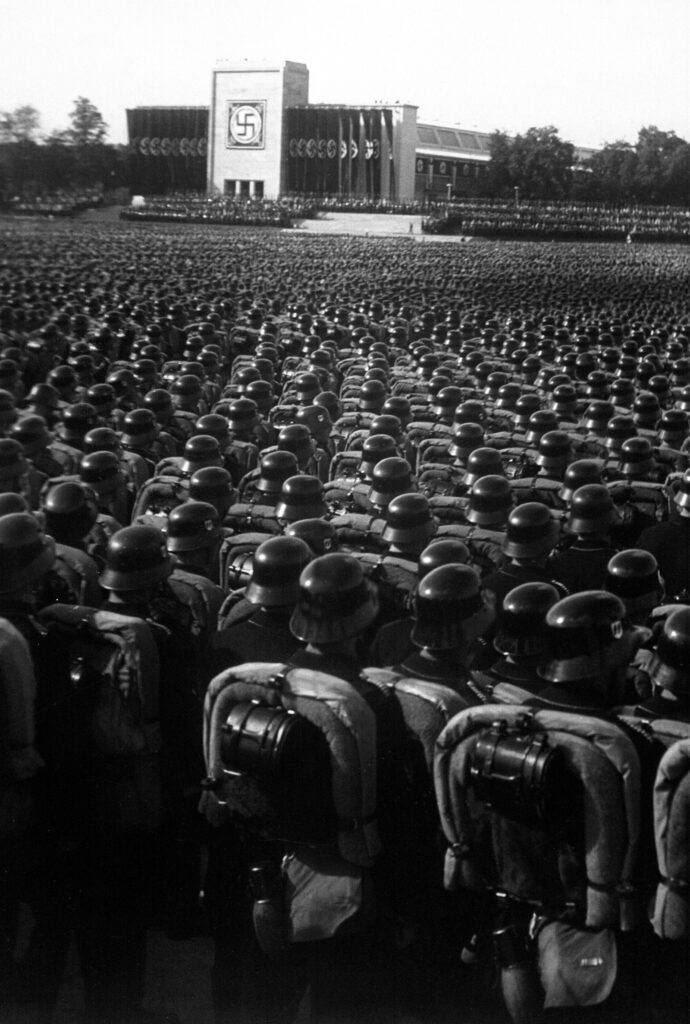
Still, the tenuous postwar order might have persevered if not for the global economic calamity of the 1930s. In Europe, the continent’s major powers were still struggling with the aftereffects of World War I when the global economic crisis threw much of the continent into chaos. Germany’s Weimar Republic followed the collapsing economy into obliteration, and out of the ashes emerged Adolf Hitler’s National Socialist Party (the Nazis). Championing German racial supremacy, fascist government, and military expansionism, Hitler rose to power and, after aborted attempts to take power in Germany, became chancellor in 1933. The Nazis smashed democratic traditions and swiftly conquered German institutions. Leftist groups were purged. Hitler repudiated the punitive damages and strict military limitations of the Treaty of Versailles. He rebuilt the German military and navy. German soldiers reoccupied the Rhineland, the demilitarized region along the border with France. Mussolini had already, in defiance of the League of Nations, ordered the invasion of Ethiopia in 1935, and, when the Spanish Civil War broke out in 1936, he and Hitler intervened on behalf of the Spanish fascists, toppling the communist Spanish Republican Party. Britain and France stood warily by and began to rebuild their militaries, anxious in the face of a renewed Germany but still unwilling to draw Europe into another bloody war.2
On the other side of the globe, Japan marched to war. On September 18, 1931, a small explosion tore up railroad tracks controlled by the Japanese-owned South Manchuria Railway near the city of Shenyang (Mukden) in the Chinese province of Manchuria. Under the pretense of protecting Japanese citizens and investments, the Japanese Imperial Army ordered a full-scale invasion of Manchuria. The invasion was swift. Without having to face a united Chinese army, the Japanese quickly defeated isolated Chinese warlords; by the end of February 1932, all of Manchuria was firmly under Japanese control. Japan established the nation of Manchukuo out of the former province of Manchuria.3
This seemingly small skirmish—known by the Chinese as the September 18 Incident and the Japanese as the Manchurian Incident—sparked a war that would last thirteen years and claim the lives of over thirty-five million people. Comprehending Japanese motivations for attacking China and the grueling stalemate of the ensuing war is crucial for understanding Japan’s seemingly unprovoked attack on Pearl Harbor, Hawaii, on December 7, 1941, and, therefore, for understanding the involvement of the United States in World War II as well.
Despite their rapid advance into Manchuria, the Japanese put off the full invasion of China for nearly three years. Japan occupied a precarious domestic and international position after the September 18 Incident. At home, Japan was riven by political factionalism due to its stagnating economy. Leaders were torn as to whether to address modernization and the lack of natural resources through unilateral expansion (which would require the conquest of resource-rich areas such as Manchuria to export raw materials to domestic Japanese industrial bases such as Hiroshima and Nagasaki) or international cooperation (they could have chosen a philosophy of pan-Asianism in an anti-Western coalition that would push the colonial powers out of Asia). Ultimately, after a series of political crises and assassinations inflamed tensions, prowar elements within the Japanese military triumphed over the more moderate civilian government. Japan committed itself to aggressive military expansion.
Chinese leaders Chiang Kai-shek and Zhang Xueliang appealed to the League of Nations for assistance against Japan. The United States supported the Chinese protest, giving rise to the Stimson Doctrine in January 1932, a refusal to recognize any state established as the result of Japanese aggression. Meanwhile, the League of Nations sent Englishman Victor Bulwer-Lytton to investigate the September 18 Incident. After a six-month investigation, Bulwer-Lytton found the Japanese guilty of inciting the event and demanded the return of Manchuria to China. Japan opted to withdraw from international diplomacy and officially left the League of Nations in March 1933. Its diplomatic isolation empowered radical military leaders who could point to the Japanese military success in Manchuria against the domestic political failures of the civilian government. The military took over Japanese policy. And in the military’s eyes, the conquest of China would not only provide for Japan’s industrial needs, it would secure Japanese supremacy in East Asia.
As militarism loomed over Europe and Asia, America stood idly by. After the gut-wrenching carnage of World War I, many Americans retreated toward isolationism and opposed any involvement in the conflagrations burning across Europe and Asia. Significant numbers of Americans regretted the nation’s entry into World War I, believing the country either had been actively manipulated into war—congressional investigations, for instance, probed whether American business interests had deliberately provoked American entry—or had simply blundered its way in. Congress worked to preempt all of the economic and political entanglements that had pushed the US down the path to war between 1914 and 1917. Consumed by the economic crisis of the Great Depression and anxious over the looming dangers posed by spiraling international conflicts, Congress passed the first of several neutrality acts in 1935 by banning American businesses from selling war materials to belligerent nations. The same year, the Senate rejected a treaty that would allow the United States to join the World Court. And yet, whatever distance the United States put between itself and the world, the shadow of war loomed over the American public. “The epidemic of world lawlessness is spreading,” Roosevelt observed in 1937. The United States would attempt to insulate itself, but “war is a contagion,” he warned, that “can engulf states and peoples remote from the original scene of hostilities.”4
III. The World at War
That year, Japan launched its full-scale invasion of China. It assaulted the Marco Polo Bridge on July 7 and routed the forces of the Chinese National Revolutionary Army. The broken Chinese army gave up Beijing on August 8, Shanghai on November 26, and the capital, Nanjing (Nanking), on December 13. Between 250,000 and 300,000 people were killed, and tens of thousands of women were raped when the Japanese besieged and then sacked Nanjing. The Western press called it the Rape of Nanking (using the common spelling of the era). To halt the invading enemy, Chiang adopted a scorched-earth strategy of “trading space for time.” His Nationalist government retreated inland, burning villages and destroying dams, and established a new capital at the Yangtze River port of Chongqing (Chungking). Although the Nationalists’ radical policy hurt the Japanese military effort, it alienated scores of dislocated Chinese civilians and became a potent propaganda tool of the emerging Chinese Communist Party (CCP).5
Americans read about the brutal fighting in China, but the United States lacked both the will and the military power to oppose the Japanese invasion. The Japanese army was a technologically advanced force consisting of 4,100,000 men and 900,000 Chinese collaborators—and that was in China alone. The Japanese military was armed with modern rifles, artillery, armor, and aircraft. By 1940, the Japanese navy was the third-largest, and among the most technologically advanced, in the world.
Still, Chinese Nationalists lobbied Washington for aid. Chiang Kai-shek’s wife, Soong May-ling—known to the American public as Madame Chiang—led the effort. Born into a wealthy Chinese merchant family in 1898, Madame Chiang spent much of her childhood in the United States and graduated from Wellesley College in 1917 with a major in English literature. In contrast to her gruff husband, Madame Chiang was charming and able to use her knowledge of American culture and values to garner support for her husband and his government. The United States denounced Japanese aggression, but it took no action during the 1930s.
As Chinese Nationalists fought for survival, the Communist Party was busy collecting people and supplies in the northwestern Shaanxi Province. China had been at war with itself when the Japanese came. Nationalists battled a stubborn communist insurgency. In 1935 the Nationalists threw the communists out of the fertile Chinese coast, but an ambitious young commander named Mao Zedong recognized the power of the Chinese peasant population. In Shaanxi, Mao recruited from the local peasantry, building his force from a meager seven thousand survivors at the end of the Long March in 1935 to a robust 1.2 million members by the end of the war.
Although Japan had conquered much of the country, the Nationalists regrouped and the communists rearmed. An uneasy truce paused the country’s civil war and refocused efforts on the invaders. The Chinese could not dislodge the Japanese, but they could stall their advance. The war was mired in stalemate.
Germany, too, moved toward war. In his autobiographical manifesto, Mein Kampf, Hitler advocated for the unification of Europe’s German peoples under one nation and that nation’s need for Lebensraum (living space), particularly in Eastern Europe, to supply Germans with the land and resources needed for future prosperity. The Untermenschen (lesser humans) would have to go. Once in power, Hitler worked toward the twin goals of unification and expansion.
In 1938, Germany annexed Austria and set its sights on the Sudetenland, a large and ethnically German area of Czechoslovakia. Britain and France, alarmed but still anxious to avoid war, agreed—without Czechoslovakia’s input—that Germany could annex the region in return for a promise to stop all future German aggression. They thought that Hitler could be appeased, but it became clear that he would continue pushing German expansion. In March 1939, Hitler took the rest of Czechoslovakia and began to make demands on Poland. Britain and France promised war. And war came.
Hitler signed a secret agreement—the Molotov-Ribbentrop Pact—with the Soviet Union that coordinated the splitting of Poland between the two powers and promised nonaggression thereafter. The European war began when the German army, called the Wehrmacht, invaded Poland on September 1, 1939. Britain and France declared war two days later and mobilized their armies. Britain and France hoped that the Poles could hold out for three or four months, enough time for the Allies to intervene. In the event, Poland lasted three weeks. The German army, anxious to avoid the rigid, grinding war of attrition that took so many millions in the stalemate of World War I, built their new modern army for speed and maneuverability. German doctrine emphasized the use of tanks, planes, and motorized infantry (infantry that used trucks for transportation instead of marching) to concentrate forces, smash front lines, and wreak havoc behind the enemy’s defenses. It was called Blitzkrieg—lightning war.
IV. The Loosening of American Neutrality
The moral horrors of the Nazi regime—the fascist overthrow of democratic norms and institutions, the persecution of Jews and other political and religious “undesirables,” and its unchecked, often brutal militarism—alienated much of the American public, and Germany’s invasion of Poland in 1939 accelerated the nation’s slow turn away from isolationism. After Germany’s invasion of Poland sparked the Second World War in Europe, Roosevelt pushed to loosen America’s neutrality and facilitate the sale of arms and provisions through a new “cash and carry” policy that required the Allies to pay cash and carry supplies on their own ships, avoiding the loss of American lives that enflamed passions in the lead-up to World War I. “I hope the United States will keep out of this war,” Roosevelt told the nation. “I believe that it will.”6
“This nation will remain a neutral nation,” Roosevelt said, “but I cannot ask that every American remain neutral in thought as well. Even a neutral has a right to take account of facts. Even a neutral cannot be asked to close his mind or his conscience.” And yet American conscience provoked minimal humanitarian effort. The State Department and most US embassies did relatively little to aid European Jews before American entry into the war. Roosevelt publicly spoke out against the persecution and even withdrew the US ambassador to Germany after Kristallnacht, in 1938. That year he pushed for the Evian Conference in France, in which international leaders discussed the Jewish refugee problem and worked to expand Jewish immigration quotas by tens of thousands of people per year. But the conference came to nothing, and the United States turned away countless Jewish refugees who requested asylum in the United States.
The 1924 Johnson-Reed Act shut down most European immigration to the United States, and the US barred its doors to Jewish refugees fleeing Nazi persecution. In 1939, the German ocean liner St. Louis carried over nine hundred Jewish refugees. It could not find a country that would take them. The passengers could not receive visas under the US quota system. A State Department wire to one passenger read that all must “await their turns on the waiting list and qualify for and obtain immigration visas before they may be admissible into the United States.” The ship cabled the president for special privilege, but the president did nothing. The ship was forced to return to Europe. Hundreds of the St. Louis’s passengers would perish in the Holocaust.
Antisemitism still permeated the United States. In 1938 and 1939, the US Congress debated the Wagner-Rogers Bill, an act to exempt twenty thousand German-Jewish children from the quota system. First Lady Eleanor Roosevelt endorsed the measure, but the president remained publicly silent. The bill, opposed by roughly two-thirds of the American public, never made it out of committee. Historians speculate that Roosevelt, anxious to protect the New Deal and his rearmament programs, was unwilling to expend political capital to protect foreign groups that the American public had little interest in protecting.7
Meanwhile, German military victories and the horrors of the Nazi regime increasingly provoked American outrage, and the United States took increasingly proactive steps not only to build up its own military capacity but also to support the Allies with arms and matériel and strangle the Axis powers economically. At the same time, the cruelties of the Japanese invasion of China enflamed American attitudes.
In 1939 the United States dissolved its trade treaties with Japan and the following year cut off supplies of war materials by embargoing oil, steel, rubber, and other vital goods. It was hoped that economic pressure would shut down the Japanese war machine. Instead, Japan’s resource-starved military launched invasions across the Pacific to sustain its war effort. The Japanese called their new empire the Greater East Asia Co-Prosperity Sphere and, with the cry of “Asia for the Asians,” made war against European powers and independent nations throughout the region. Diplomatic relations between Japan and the United States collapsed. The United States demanded that Japan withdraw from China; Japan considered the oil embargo a de facto declaration of war.8
Germany, meanwhile, pushed on. After the fall of Poland, France and its British allies braced for an inevitable German attack. Throughout the winter of 1939–1940, fighting was mostly confined to smaller fronts in Norway. Belligerents called it the Sitzkrieg (sitting war). But in May 1940, Hitler launched his attack into Western Europe. Mirroring the German’s Schlieffen Plan of 1914 in the previous war, Germany attacked through the Netherlands and Belgium to avoid the prepared French defenses along the French-German border. Poland had fallen in three weeks; France lasted only a few weeks more. By June, Hitler was posing for photographs in front of the Eiffel Tower. Germany split France in half. Germany occupied and governed the north, and the south would be ruled under a puppet government in Vichy.
With France under heel, Hitler turned to Britain. Operation Sea Lion—the planned German invasion of the British Isles—required air superiority over the English Channel. From June until October the German Luftwaffe fought the Royal Air Force (RAF) for control of the skies. Despite having fewer planes, British pilots won the so-called Battle of Britain, saving the islands from immediate invasion and prompting the new prime minister, Winston Churchill, to declare, “Never before in the field of human conflict has so much been owed by so many to so few.”
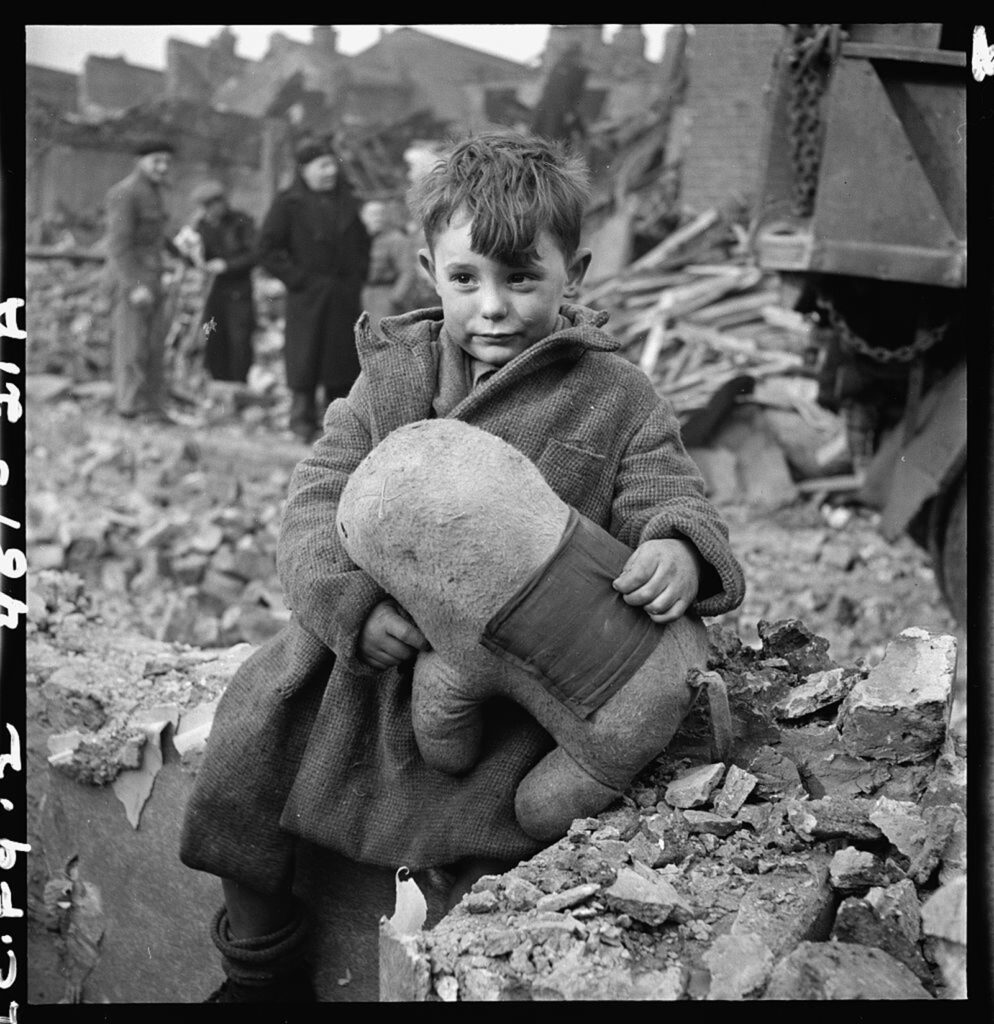
If Britain was safe from invasion, it was not immune from additional air attacks. Stymied in the Battle of Britain, Hitler began the Blitz—a bombing campaign against cities and civilians. Hoping to crush the British will to fight, the Luftwaffe bombed the cities of London, Liverpool, and Manchester every night from September to the following May. Children were sent far into the countryside to live with strangers in order to shield them from the bombings. Remaining residents took refuge in shelters and subway tunnels, emerging each morning to put out fires and bury the dead.
More and more Americans advocated for direct involvement in Europe as public opinion in the United States shifted from fierce isolationism to grudging acceptance of a perhaps inevitable war. In the fall of 1940, Roosevelt signed the Selective Training Service Act, the nation’s first peacetime military draft. Meanwhile, convinced that only he could steer the nation through the global crisis, Roosevelt ran for and won an unprecedented third presidential term.
The United States readied itself for war. American journalist Dorothy Thompson called for “the full economic, financial, commercial and machine power of the United States” to be used against the Nazis for the establishment of “a world fit for human beings.”9 Roosevelt readied the American war machine. “I want to make it clear that it is the purpose of the nation to build now with all possible speed every machine, every arsenal, every factory that we need to manufacture our defense material,” he told the nation in December 1940. “We have the men, the skill, the wealth, and above all, the will.”10
In January 1941, Congress passed the Lend-Lease Act, allowing the United States to support the Allied war effort through not only food and provisions but weapons and military equipment. The United States still claimed neutrality—American soldiers were not yet fighting—but the country was now providing direct material support for the Allies. “We must be the great arsenal of democracy,” Roosevelt had said a few weeks earlier.
Turning tides provoked more pointed isolationist rhetoric. The America First Committee denounced foreign interventionism and championed a “Fortress America.” While many non-interventionists simply sought to avoid entanglement in another devastating war, some within the movement—including its popular spokesman, the hero pilot Charles Lindbergh—promoted antisemitic conspiracy theories alleging Jews were purposely trying to steer the country into the conflict.
Then, in 1941, Hitler, having failed to win the Battle of Britain but confident it had knocked Britain temporarily out of the fight, launched Operation Barbarossa—the invasion of the Soviet Union. Hoping to capture agricultural lands, seize oil fields, and break the military threat of Joseph Stalin’s Soviet Union, Hitler broke the two powers’ 1939 nonaggression pact and, on June 22, invaded the Soviet Union. It was the largest land invasion in history. France and Poland had fallen in weeks, and German officials hoped to break Russia before the winter. And initially, the Blitzkrieg worked. The German military quickly conquered enormous swaths of land and netted hundreds of thousands of prisoners. But Russia was too big, and the Soviets were willing to sacrifice millions to stop the fascist advance. After recovering from the initial shock of the German invasion, Stalin moved his factories east of the Urals, out of range of the Luftwaffe. He ordered his retreating army to adopt a scorched-earth policy, to move east and destroy food, the railway, and dwellings to stymie the advancing German army. The German army slogged forward. It split up into three pieces and stood at the gates of Moscow, Stalingrad, and Leningrad, but its supply lines now stretched thousands of miles, existing Soviet infrastructure had been destroyed, partisans harried German lines, and the brutal Russian winter arrived. Germany had won massive gains but the winter found Germany exhausted and overextended. In the north, the German army starved Leningrad during an interminable siege; in the south, at Stalingrad, the two armies bled themselves to death in the destroyed city; and in the center, on the outskirts of Moscow, in sight of the capital city, the German army faltered and fell back. It was the Soviet Union that broke Hitler’s army. Twenty-five million Soviet soldiers and civilians died during the “Great Patriotic War,” as the Russians called it; roughly 80 percent of all German casualties during the war came on the Eastern Front. The German army and its various conscripts suffered 850,000 casualties at the Battle of Stalingrad alone.11
In August 1941, as new American embargoes went into effect on Japan, Roosevelt met with Winston Churchill off the coast of Newfoundland on the USS Augusta to hammer out the Atlantic Charter, a statement of shared commitments—including “the final destruction of Nazi tyranny” and a disavowal of territorial seizures—that laid out a general vision for a cooperative, economically connected postwar world.
V. America at War
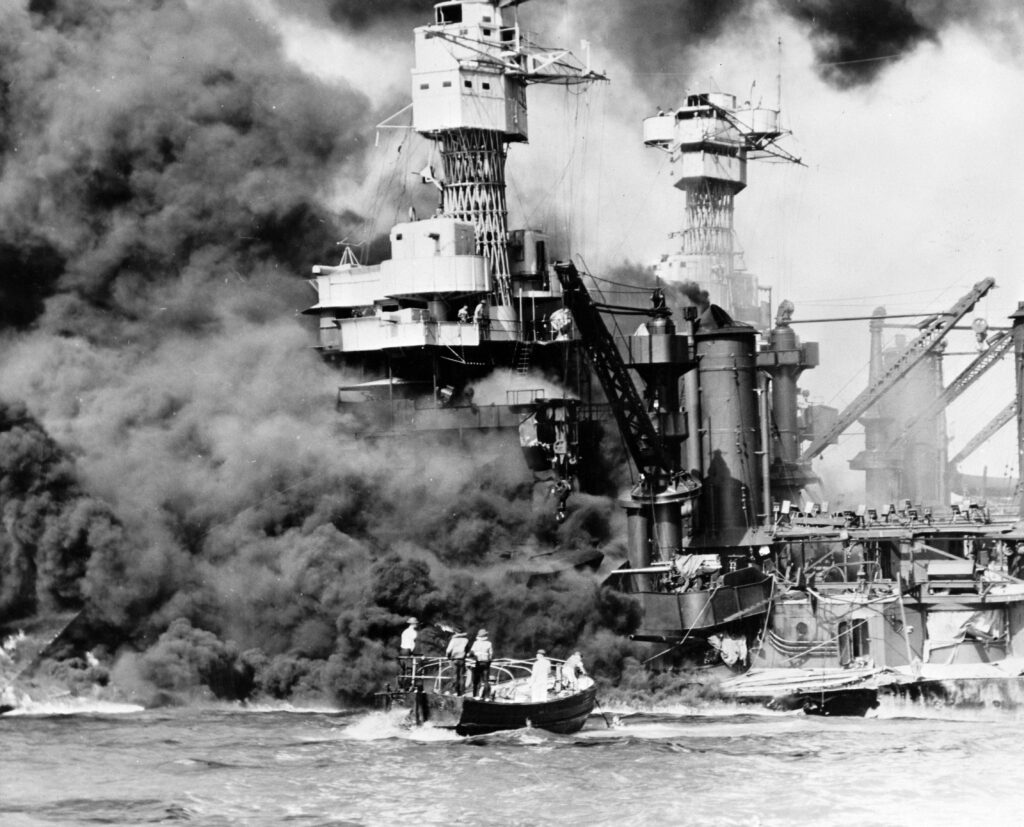
Japanese military planners, convinced that American intervention in the Pacific was inevitable, planned a coordinated Pacific offensive to preemptively neutralize the United States and other European powers and provide time for Japan to complete its conquests and fortify its positions. On the morning of December 7, 1941, the Japanese military launched a surprise attack on the American naval base at Pearl Harbor, Hawaii. Japanese military planners hoped to destroy enough battleships and aircraft carriers to cripple American naval power for years. Twenty-four hundred Americans were killed in the attack.
American isolationism fell at Pearl Harbor. Japan also assaulted Hong Kong, the Philippines, and American holdings throughout the Pacific, but it was the attack on Hawaii that threw the United States into a global conflict. Franklin Roosevelt called December 7 “a date which will live in infamy” and demanded a declaration of war, which Congress answered within hours. Within a week of Pearl Harbor the United States was at war with the Axis in Europe and Asia, uniting separate conflicts into a single world war.

Americans poured into the armed forces. Almost eighteen million men served in World War II. Volunteers rushed to join the military after Pearl Harbor, but the majority—over ten million—were drafted into service. Volunteers could express their preference for assignment, and many preempted the draft by volunteering. Regardless, recruits judged I-A, “fit for service,” were moved into basic training, where soldiers were developed physically and trained in the basic use of weapons and military equipment. Soldiers were indoctrinated into the chain of command and introduced to military life. After “basic,” soldiers moved on to more specialized training. For example, combat infantrymen received additional weapons and tactical training, and radio operators learned transmission codes and the operation of field radios. Afterward, an individual’s experience varied depending on what service he entered and to what theater he was assigned.12
American service members (“G.I.s”) came from all segments of the population—“old stock” Yankee Protestants served alongside Jewish immigrants and Italian Catholics, farmhands alongside factory workers and accountants. Half a million Latinos—the majority Mexican Americans—served, as did thousands of Japanese, Chinese, and Filipino Americans. They were joined by over twenty thousand Native Americans. For many, the military was a kind of melting pot. More than a million Black service members, meanwhile, served in segregated units—the US military remained a Jim Crow institution.13
The American war began slowly. After Pearl Harbor, the American-controlled Philippine archipelago fell to Japan. After running out of ammunition and supplies, the garrison of American and Filipino soldiers surrendered. The prisoners were marched eighty miles to their prisoner-of-war camp without food, water, or rest. Ten thousand died on the Bataan Death March, as it became known.14 But as Americans mobilized their armed forces, the tide turned. In the summer of 1942, American naval victories at the Battle of the Coral Sea and the aircraft carrier duel at the Battle of Midway crippled Japan’s Pacific naval operations and paved the way for the United States’s “island-hopping” campaign: to dislodge Japan’s hold over the Pacific, the US military began attacking island after island, bypassing the strongest but seizing those capable of holding airfields to continue pushing Japan out of the region. Combat was vicious. At Guadalcanal, American soldiers saw Japanese soldiers launch suicidal charges rather than surrender. Many Japanese soldiers refused to be taken prisoner or to take prisoners themselves. Such tactics, coupled with American racial prejudice, turned the Pacific Theater into a more brutal and barbarous conflict than the European Theater.15
In November 1942, the first American combat troops entered the European war by landing in French Morocco and began pushing the Germans east as the British pushed west from Egypt. By 1943, the Allies had pushed Axis forces out of Africa. In January President Roosevelt and Prime Minister Churchill met at Casablanca to discuss the next step of the European war. Churchill convinced Roosevelt to chase the Axis up Italy, into the “soft underbelly” of Europe. Afterward, Roosevelt announced to the press that the Allies would accept nothing less than unconditional surrender.16
Soldiers and Marines bore the brunt of on-the-ground combat. After transportation to the front by trains, ships, and trucks, they could expect to march carrying packs weighing anywhere from twenty to fifty pounds containing rations, ammunition, bandages, tools, clothing, and miscellaneous personal items in addition to their weapons. Sailors, once deployed, spent months at sea operating their assigned vessels. Larger ships, particularly aircraft carriers, were veritable floating cities. In most, sailors lived and worked in cramped conditions, often sleeping in bunks stacked in rooms housing dozens of sailors. Senior officers received small rooms of their own. Sixty thousand American sailors lost their lives in the war.
Meanwhile, the Army Air Force (AAF) sent hundreds—eventually thousands—of bombers to England in preparation for a massive strategic bombing campaign against Germany. The plan was to bomb Germany around the clock. American bombers hit German ball-bearing factories, rail yards, oil fields, and manufacturing centers during the day, while the British RAF carpet-bombed German cities at night. Flying in formation, they initially flew unescorted, since many believed that bombers equipped with defensive firepower flew too high and too fast to be attacked. However, advanced German technology allowed fighters to easily shoot down the lumbering bombers. On some disastrous missions, the Germans shot down almost 50 percent of American aircraft. However, the advent and implementation of a long-range escort fighter let the bombers hit their targets more accurately while fighters confronted opposing German aircraft.

During World War II, the Air Force was still a branch of the US Army, and soldiers served in ground and air crews. World War II saw the institutionalization of massive bombing campaigns against cities and industrial production. Large bombers like the B-17 Flying Fortress required pilots, navigators, bombardiers, radio operators, and four dedicated machine gunners. Airmen on bombing raids left from bases in England or Italy or from Pacific islands and endured hours of flight before approaching enemy territory. At high altitude, and without pressurized cabins, crews used oxygen tanks to breathe, and on-board temperatures plummeted. Once in enemy airspace, crews confronted enemy fighters and anti-aircraft flak from the ground. While fighter pilots flew as escorts, the Air Corps suffered heavy casualties. Tens of thousands of airmen lost their lives.

In the wake of the Soviets’ victory at Stalingrad, the “Big Three” Allied leaders (Roosevelt, Churchill, and Stalin) met in Tehran in November 1943. Dismissing Africa and Italy as a sideshow, Stalin demanded that Britain and the United States invade France to relieve pressure on the Eastern Front. Churchill was hesitant, but Roosevelt was eager. The invasion was tentatively scheduled for 1944.
Back in Italy, the “soft underbelly” turned out to be much tougher than Churchill had imagined. Italy’s narrow, mountainous terrain gave the defending Axis the advantage. Movement up the peninsula was slow, and in some places conditions returned to the trenchlike warfare of World War I. Americans attempted to land troops behind them at Anzio on the western coast of Italy, but, surrounded, they suffered heavy casualties. Still, the Allies pushed up the peninsula, Mussolini’s government revolted, and the new Italian government quickly made peace.
On the day the American army entered Rome, American, British, and Canadian forces launched Operation Overlord, the long-awaited invasion of France. D-Day, as it became popularly known, was the largest amphibious assault in history. American general Dwight D. Eisenhower was uncertain enough of the attack’s chances that the night before the invasion he wrote two speeches: one for success and one for failure. The Allied landings at Normandy were successful, and although progress across France was much slower than had been hoped, Paris was liberated roughly two months later. Allied bombing expeditions meanwhile continued to level German cities and industrial capacity. Perhaps four hundred thousand German civilians were killed by Allied bombing.17
For American soldiers on the ground, conditions varied. GIs in Europe endured freezing winters, impenetrable French hedgerows, Italian mountain ranges, and dense forests. Germans fought with a Western way of war familiar to Americans. Soldiers in the Pacific endured heat and humidity, monsoons, jungles, and tropical diseases. And they confronted an unfamiliar foe. Americans, for instance, could understand surrender as prudent; many Japanese soldiers saw it as cowardice. What Americans saw as a fanatical waste of life, the Japanese saw as brave and honorable. Moreover, American soldiers and American military leadership brought their historical anti-Asian prejudices to bear against the Japanese. Atrocities flourished in the Pacific at a level unmatched in Western Europe.
Japanese defenders fought tenaciously. Japanese soldiers bled the Americans in their advance across the Pacific. At Iwo Jima, an eight-square-mile island of volcanic rock, seventeen thousand Japanese soldiers held the island against seventy thousand Marines for over a month in 1945. At the cost of nearly their entire force, they inflicted almost thirty thousand casualties before the island was lost.
The Nazis, meanwhile, were crumbling on both fronts. Hitler was unable to turn the war in his favor in the west. The Battle of the Bulge failed to drive the Allies back to the English Channel, but the delay cost the Allies the winter. The invasion of Germany would have to wait, while the Soviet Union continued its relentless push westward, ravaging German populations in retribution for German war crimes.18
German counterattacks in the east failed to dislodge the Soviet advance, destroying any last chance Germany might have had to regain the initiative. The year 1945 dawned with the end of European war in sight. The Big Three met again at Yalta in the Soviet Union, where they reaffirmed the demand for Hitler’s unconditional surrender and began to plan for postwar Europe.
The Axis was crumbling. In the Pacific, American bombers were in range of the mainland of Japan by February 1945. Bombers hit Japan’s industrial facilities but suffered high casualties. To spare bomber crews from dangerous daylight raids and to achieve maximum effect against Japan’s wooden cities, many American bombers dropped incendiary weapons that created massive firestorms and wreaked havoc on Japanese cities. Over sixty Japanese cities were firebombed. American firebombs killed one hundred thousand civilians in Tokyo alone
in March 1945.
The Soviet Union had already reached Germany in January, and the Americans finally crossed the Rhine in March. President Roosevelt died in April, mere weeks before American and Soviet troops met at the Elbe River. The Soviets, pushed relentlessly by Stalin to reach Berlin first, took the capital city in May, days after Hitler and his high command died by suicide in a city bunker. Germany was conquered. The European war was over. Allied leaders met again, this time at Potsdam, Germany, where it was decided that Germany would be divided into pieces according to current Allied occupation, with Berlin likewise divided, pending future elections. Stalin also agreed to join the fight against Japan three months later.19
After Americans celebrated V-E (Victory in Europe) Day, they redirected their full attention to the still-raging Pacific War. In June 1945, after eighty days of fighting and tens of thousands of casualties, the Americans captured the island of Okinawa. The mainland of Japan was open before them. It was a viable base from which to launch a full invasion of the Japanese homeland and end the war.
Estimates varied, but given the tenacity of Japanese soldiers fighting on islands far from their home, some officials estimated that an invasion of the Japanese mainland could cost half a million American casualties—and perhaps millions of Japanese civilians. Historians debate the many motivations that ultimately drove the Americans to use atomic weapons against Japan, and many American officials criticized the decision.20
Early in the war, fearing that the Germans might develop an atomic bomb, the US government launched the Manhattan Project, a hugely expensive and ambitious program to harness atomic energy and create a single weapon capable of leveling entire cities. The Americans successfully exploded the world’s first nuclear device, Trinity, in New Mexico in July 1945. (Physicist J. Robert Oppenheimer, the director of the Los Alamos Laboratory, where the bomb was designed, later recalled that the event reminded him of Hindu scripture: “Now I am become death, the destroyer of worlds.”) Two more bombs—Fat Man and Little Boy—were built and detonated over two Japanese cities in August. Hiroshima was hit on August 6. Over one hundred thousand civilians were killed. Nagasaki followed on August 9. Perhaps eighty thousand civilians were killed.

Emperor Hirohito announced the surrender of Japan on August 15. On September 2, aboard the battleship USS Missouri, delegates from the Japanese government formally signed their surrender. World War II was finally over.
VI. The Wartime Economy
Economies win wars no less than militaries. The war converted American factories to wartime production, reawakened Americans’ economic might, equipped Allied belligerents and the American armed forces, effectively pulled America out of the Great Depression, and ushered in an era of unparalleled economic prosperity.21

Roosevelt’s New Deal had ameliorated the worst of the Depression, but the economy still limped its way through the 1930s. But then Europe fell into war, and, despite its isolationism, America was glad to sell the Allies arms and supplies. And then Pearl Harbor changed everything. The United States drafted the economy into war service. The “sleeping giant” mobilized its unrivaled economic capacity to wage worldwide war. Governmental entities such as the War Production Board and the Office of War Mobilization and Reconversion managed economic production for the war effort, and economic output exploded. An economy that was unable to provide work for a quarter of the workforce less than a decade earlier now struggled to fill vacant positions.

Government spending during the four years of war doubled all federal spending in all of American history up to that point. The budget deficit soared, but, just as Depression-era economists had counseled, the government’s massive intervention annihilated unemployment and propelled growth. The economy that came out of the war looked nothing like the one that had begun it.
Military production came at the expense of the civilian consumer economy. Appliance and automobile manufacturers converted their plants to produce weapons and vehicles. Consumer choice was foreclosed. Every American received rationing cards and, legally, goods such as gasoline, coffee, meat, cheese, butter, processed food, firewood, and sugar could not be purchased without them. The housing industry was shut down, and the cities became overcrowded.
But the wartime economy boomed. The Roosevelt administration urged citizens to save their earnings or buy war bonds to prevent inflation. Bond drives were held nationally and were headlined by Hollywood celebrities. Such drives were hugely successful. They not only funded much of the war effort, they helped tame inflation as well. So too did tax rates. The federal government raised income taxes and boosted the top marginal tax rate to 94 percent.

With the economy booming and twenty million American workers placed into military service, unemployment virtually disappeared. More and more African Americans continued to leave the agrarian South for the industrial North. Over sixty-five thousand Native Americans left reservations to work in wartime industries.22 And as more and more men joined the military and more and more positions went unfilled, women joined the workforce en masse. Other American producers looked southward, to Mexico, to fill its labor force. Starting in 1942, the United States contracted thousands of Mexican nationals to work in American agriculture and railroads in the Bracero Program. Jointly administered by the State Department, the Department of Labor, and the Department of Justice, the binational agreement secured five million contracts across twenty-four states.23
With factory work proliferating across the country and agricultural labor experiencing severe labor shortages, the presidents of Mexico and the United States signed an agreement in July 1942 to bring the first group of legally contracted workers to California. Discriminatory policies toward people of Mexican descent prevented bracero contracts in Texas until 1947. The Bracero Program survived the war, enshrined in law until the 1960s, when the United States liberalized its immigration laws. Though braceros suffered exploitative labor conditions, for the men who participated, the program was a mixed blessing. Interviews with ex-braceros captured the complexity. “They would call us pigs . . . they didn’t have to treat us that way,” one said of his employers, while another said, “For me it was a blessing, the United States was a blessing. . . . it is a nation I fell in love with because of the excess work and good pay.”24 After the exodus of Mexican migrants during the Depression, the program helped reestablish Mexican migration, institutionalized migrant farm work across much of the country, and further planted a Mexican presence in the southern and western United States.
VII. Women and World War II
President Franklin D. Roosevelt and his administration had encouraged all able-bodied American women to help the war effort. He considered the role of women in the war critical for American victory, and the public expected women to assume various functions to free men for active military service. While most women opted to remain at home or volunteer with charitable organizations, many went to work or donned a military uniform.
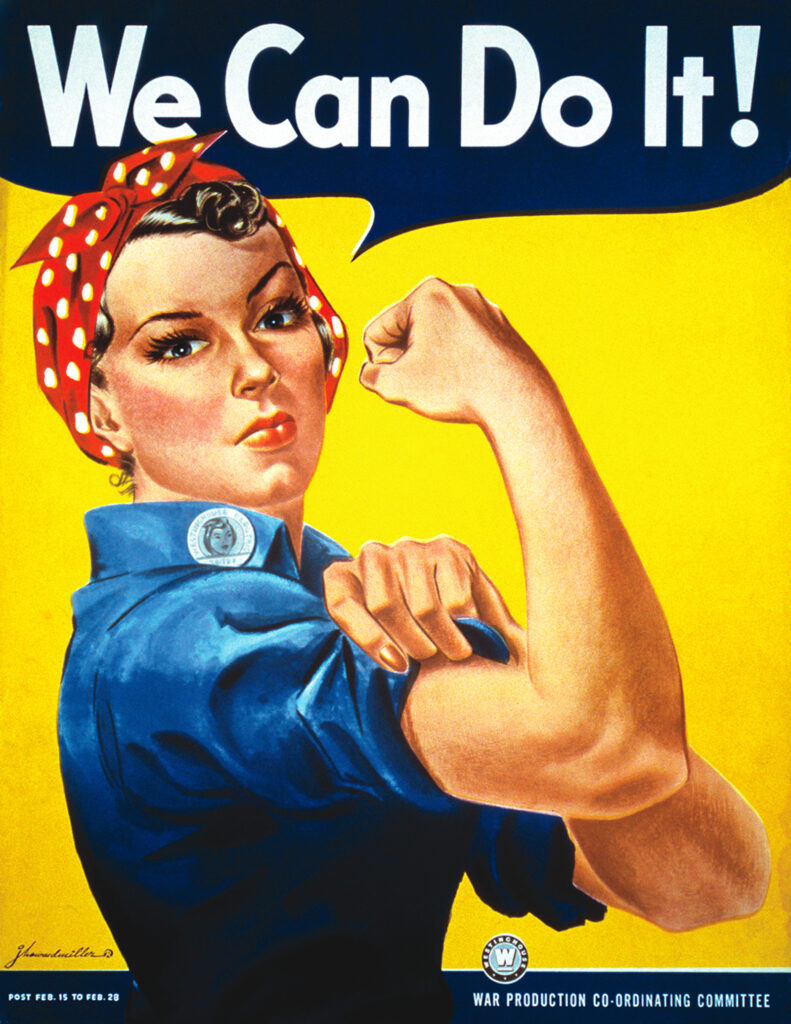
World War II brought unprecedented labor opportunities for American women. Industrial labor, an occupational sphere dominated by men, shifted in part to women for the duration of wartime mobilization. Women applied for jobs in converted munitions factories. The iconic illustrated image of Rosie the Riveter, a muscular woman dressed in coveralls with her hair in a kerchief and inscribed with the phrase We Can Do It!, came to stand for female factory labor during the war. But women also worked in various auxiliary positions for the government. Over a million administrative jobs at the local, state, and national levels were transferred from men to women for the duration of the war.25
For women who elected not to work, many volunteer opportunities presented themselves. The American Red Cross, the largest charitable organization in the nation, encouraged women to volunteer with local city chapters. Millions of women organized community social events for families, packed and shipped almost half a million tons of medical supplies overseas, and prepared twenty-seven million care packages of nonperishable items for American and other Allied prisoners of war. The American Red Cross further required all female volunteers to certify as nurse’s aides, providing an extra benefit and work opportunity for hospital staffs that suffered severe personnel losses. Other charity organizations, such as church and synagogue affiliates, benevolent associations, and social club auxiliaries, gave women further outlets for volunteer work.
Military service was another option for women who wanted to join the war effort. Over 350,000 women served in several all-female units of the military branches. The Army and Navy Nurse Corps Reserves, the Women’s Army Auxiliary Corps, the Navy’s Women Accepted for Volunteer Emergency Service, the Coast Guard’s SPARs (named for the Coast Guard motto, Semper Paratus, “Always Ready”), and Marine Corps units gave women the opportunity to serve as either commissioned officers or enlisted members at military bases at home and abroad. The Nurse Corps Reserves alone commissioned 105,000 army and navy nurses recruited by the American Red Cross. Military nurses worked at base hospitals, mobile medical units, and onboard hospital “mercy” ships.26
Jim Crow segregation in both the civilian and military sectors remained a problem for Black women who wanted to join the war effort. Even after President Roosevelt barred racial discrimination in the defense industry, factory supervisors still often relegated Black women to the most menial tasks. Segregation was further upheld in factory lunchrooms, and many Black women were forced to work at night to keep them separate from whites. In the military, only the Women’s Army Auxiliary Corps and the Nurse Corps Reserves accepted Black women for active service, and the army set a limited quota of 10 percent of total end strength for Black female officers and enlisted women and segregated Black units on active duty. The American Red Cross, meanwhile, recruited only four hundred Black nurses for the Army and Navy Nurse Corps Reserves, and Black army and navy nurses worked in segregated military hospitals on bases stateside and overseas.
And for all of the postwar celebration of Rosie the Riveter, after the war ended the men returned and most women voluntarily left the workforce or lost their jobs. Meanwhile, former military women faced a litany of obstacles in obtaining veteran’s benefits during their transition to civilian life. The nation that beckoned the call for assistance to millions of women during the four-year crisis hardly stood ready to accommodate their postwar needs and demands.
VIII. Race and World War II

World War II affected nearly every aspect of life in the United States, and America’s racial relationships were not immune. African Americans, Mexicans and Mexican Americans, Jews, and Japanese Americans were profoundly impacted.
In early 1941, months before the Japanese attack on Pearl Harbor, A. Philip Randolph, president of the Brotherhood of Sleeping Car Porters, the largest Black trade union in the nation, made headlines by threatening President Roosevelt with a march on Washington, D.C. In this “crisis of democracy,” Randolph said, many defense contractors still refused to hire Black workers, and the armed forces remained segregated. In exchange for Randolph calling off the march, Roosevelt issued Executive Order 8802, the Fair Employment Practice in Defense Industries Act, banning racial and religious discrimination in defense industries and establishing the Fair Employment Practices Committee (FEPC) to monitor defense industry hiring practices. While the armed forces remained segregated throughout the war and the FEPC had limited influence, the order showed that the federal government could stand against discrimination. The Black workforce in defense industries rose from 3 percent in 1942 to 9 percent in 1945.27
More than one million African Americans fought in the war. Most Black servicemen served in segregated noncombat units led by white officers. Some gains were made, however. The number of Black officers increased from five in 1940 to over seven thousand in 1945. The all-Black pilot squadrons, known as the Tuskegee Airmen, completed more than 1,500 missions, escorted heavy bombers into Germany, and earned several hundred merits and medals. Many bomber crews specifically requested the Red Tail Angels as escorts. And near the end of the war, the army and navy began integrating some of their units and facilities, before the US government finally ordered the full integration of its armed forces in 1948.28
While Black Americans served in the armed forces, on the home front they became riveters and welders, rationed food and gasoline, and bought victory bonds. And many Black Americans saw the war as an opportunity not only to serve their country but to improve it. The Pittsburgh Courier, a leading Black newspaper, spearheaded the “Double V” campaign. It called on African Americans to fight two wars: the war against Nazism and fascism abroad and the war against racial inequality at home. To achieve victory, to achieve “real democracy,” the Courier encouraged its readers to enlist in the armed forces, volunteer on the home front, and fight against racial segregation and discrimination.29
During the war, membership in the NAACP jumped tenfold, from fifty thousand to five hundred thousand. The Congress of Racial Equality (CORE), formed in 1942, spearheaded the method of nonviolent direct action to achieve desegregation. Between 1940 and 1950, some 1.5 million Black southerners, the largest number of any decade since the beginning of the Great Migration, also indirectly demonstrated their opposition to racism and violence by migrating out of the Jim Crow South to the North. But transitions were not easy. Racial tensions erupted in 1943 in a series of riots in cities such as Mobile, Alabama; Beaumont, Texas; and Harlem. The bloodiest race riot occurred in Detroit and resulted in the death of twenty-five Black and nine white Americans. Still, the war ignited in African Americans an urgency for equality that they would carry with them into the subsequent years. And they were not alone.30
Americans of all backgrounds joined the fight. Over half a million American Latinos—including 350,000 Mexican Americans and 50,000 Puerto Ricans—served in World War II. They often existed in a tenuous racial world that did not usually consign them to formal segregation in the military but often denied them the full benefits of citizenship outside of it. Felix Longoria, for instance, was killed in the Philippines in 1945 but was denied a funeral and burial in his hometown of Three Rivers, Texas. Soldiers on leave might not be able to eat in certain restaurants or socialize in USO clubs. Wartime employment shortages, meanwhile, provided opportunities for Mexican American workers on the home front while, in 1942, the Bracero Program formalized the legal importation of Mexican migrant workers.31 Racial tensions were palpable throughout the period, however. Anglo soldiers and sailors, for instance, attacked Mexican American youth in the 1943 Los Angeles “Zoot Suit Riots.” After the war, veterans would leverage their service to claim full citizenship rights, powering the postwar Mexican American civil rights movement.32
Native Americans, meanwhile, registered for the Selective Service and served in integrated units in every branch of the military. Some famously parlayed their knowledge of indigenous languages—although generally associated with the Navajo, speakers from fourteen distinct tribes took part—into work as “code talkers.” Hundreds of Native American women, meanwhile, volunteered in Women’s Army Corps (WACs) and the Women Accepted for Volunteer Emergency Service (WAVEs) programs. At home, wartime spending saw funding fall for payments to tribes and for the Bureau of Indian Affairs (BIA). Policy makers pursued policies of “Termination” and “Relocation,” aiming to cut costs by moving Native Americans off of reservations and terminating the distinct political relationship between tribal nations and the federal government. Native Americans residing on tribal lands, for instance, would not be eligible for the GI Bill.33)
Many Americans had to navigate American prejudice, and America’s entry into the war left foreign nationals from the belligerent nations in a precarious position. The FBI targeted many on suspicions of disloyalty for detainment, hearings, and possible internment under the Alien Enemy Act. Those who received an order for internment were sent to government camps secured by barbed wire and armed guards. Such internments were supposed to be for cause. Then, on February 19, 1942, President Roosevelt signed Executive Order 9066, authorizing the removal of any persons from designated “exclusion zones”—which ultimately covered the entirety of the West Coast—at the discretion of military commanders. Thirty thousand Japanese Americans fought for the United States in World War II, but wartime anti-Japanese sentiment built on historical prejudices, and under the order, people of Japanese descent, both immigrants and American citizens, were detained and placed under the custody of the War Relocation Authority, the civil agency that supervised their relocation to internment camps. They lost their homes and their jobs. Over ten thousand German nationals and a smaller number of Italian nationals were interned at various times in the United States during World War II, but American policies disproportionately targeted Japanese-descended populations, and individuals did not receive personalized reviews prior to their internment. This policy of mass exclusion and detention affected over 110,000 Japanese and Japanese-descended individuals. Seventy thousand were American citizens.34
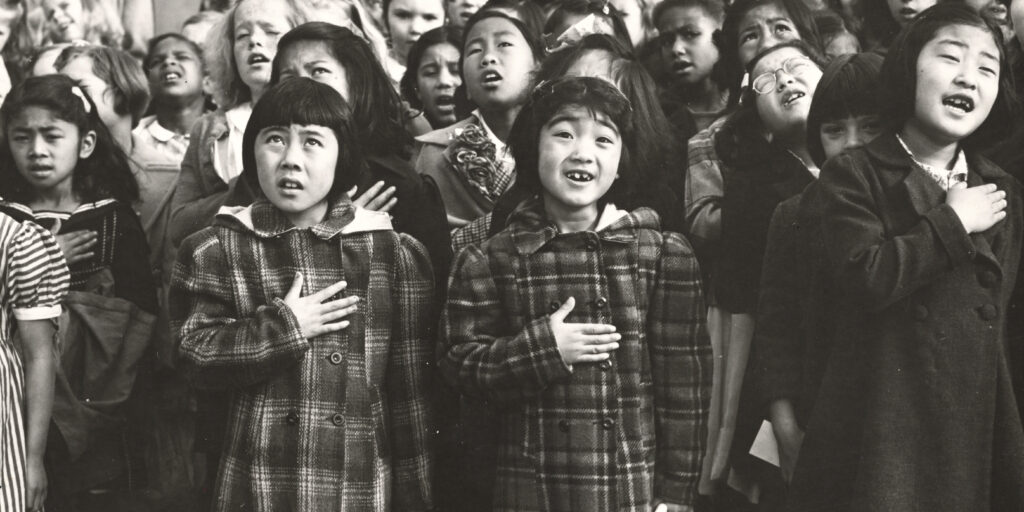
In its 1982 report Personal Justice Denied, the congressionally appointed Commission on Wartime Relocation and Internment of Civilians concluded that “the broad historical causes” shaping the relocation program were “race prejudice, war hysteria, and a failure of political leadership.”35 Although the exclusion orders were found to have been constitutionally permissible under the vagaries of national security, they were later judged, even by many military and judicial leaders of the time, to have been a grave injustice against people of Japanese descent. In 1988, President Reagan signed a law that formally apologized for internment and provided reparations to surviving internees.
Meanwhile, as the Allies pushed into Germany and Poland, they uncovered the full extent of Hitler’s genocidal atrocities. The Allies liberated massive camp systems set up for the imprisonment, forced labor, and extermination of all those deemed racially, ideologically, or biologically “unfit” by Nazi Germany. But the Holocaust—the systematic murder of eleven million civilians, including six million Jews—had been underway for years. How had the United States responded?
Knowledge of the full extent of the Holocaust had been slow in coming. Some American officials doubted the initial reports of industrial death camps, for instance. But as the war progressed and the horrors of the Holocaust were made clear, some Americans pushed against the currents of antisemitism, isolationism, and restrictionism to urge greater aid. Secretary of the Treasury Henry Morgenthau Jr., the son of a prosperous German American Jewish family, pushed through major changes in American policy. A passionate advocate for Jewish refugees, Morgenthau convinced Roosevelt to issue public statements condemning the Nazis’ persecutions and in 1944 helped form the War Refugee Board (WRB), a US civilian agency that saved the lives of over a hundred thousand people in Europe.36
As the US military pushed into Germany in 1944, the WRB and the World Jewish Congress petitioned the American government to bomb either the death camps or the railroads leading to them. Arguing that it would do little to stop deportations, would distract from the war effort, and would result in casualties among concentration camp prisoners, military and civilian officials rejected the idea. Whether bombing would have saved lives remains a hotly debated question.37 Regardless, as American officials argued, only Allied victory in Germany was able to bring about the true end of the Holocaust.
IX. Toward a Postwar World
Americans celebrated the end of the war. At home and abroad, the United States looked to create a postwar order that would guarantee global peace and domestic prosperity. Although the alliance of convenience with Stalin’s Soviet Union would quickly collapse, Americans nevertheless looked for the means to ensure postwar stability and economic security for returning veterans.
The inability of the League of Nations to stop German, Italian, and Japanese aggressions caused many to question whether any global organization or agreements could ever ensure world peace. This included Franklin Roosevelt, who, as Woodrow Wilson’s undersecretary of the navy, witnessed the rejection of this idea by both the American people and the Senate. In 1941, Roosevelt believed that postwar security could be maintained by an informal agreement between what he termed the “Four Policemen”—the United States, Britain, the Soviet Union, and China—instead of a rejuvenated League of Nations. But others, including Secretary of State Cordell Hull and British prime minister Winston Churchill, disagreed and convinced Roosevelt to push for a new global organization. As the war ran its course, Roosevelt came around to the idea. And so did the American public. Pollster George Gallup noted a “profound change” in American attitudes. The United States had rejected membership in the League of Nations after World War I, and in 1937 only a third of Americans polled supported such an idea. But as war broke out in Europe, half of Americans did. America’s entry into the war bolstered support, and by 1945, with the war closing, 81 percent of Americans favored the idea.38
Whatever his support, Roosevelt had long shown enthusiasm for the ideas later enshrined in the United Nations (UN) charter. In January 1941, he announced his Four Freedoms—freedom of speech, of worship, from want, and from fear—that all of the world’s citizens should enjoy. That same year he signed the Atlantic Charter with Churchill, reinforcing those ideas and also promising the right of self-determination and some sort of postwar economic and political cooperation. Roosevelt first used the term united nations to describe the Allied powers, not the subsequent postwar organization. But the name stuck. At Tehran in 1943, Roosevelt and Churchill convinced Stalin to send a Soviet delegation to a conference at Dumbarton Oaks in the Georgetown neighborhood of Washington, D.C., where in August 1944 they agreed on the basic structure of the new organization. It would have a Security Council—the original Four Policemen plus France—which would consult on how best to keep the peace and when to deploy the military power of the assembled nations. According to one historian, the organization demonstrated an understanding that “only the Great Powers, working together, could provide real security.” But the plan was a kind of hybrid between Roosevelt’s policemen idea and a global organization of equal representation. There would also be a General Assembly, made up of all nations; an International Court of Justice; and a council for economic and social matters. Dumbarton Oaks was a mixed success—the Soviets especially expressed concern over how the Security Council would work—but the powers agreed to meet again in San Francisco between April and June 1945 for further negotiations. There, on June 26, 1945, fifty nations signed the UN charter.39
Anticipating victory in World War II, leaders looked not only to the postwar global order but to the fate of returning American servicemen. American politicians and interest groups sought to avoid another economic depression—the economy had tanked after World War I—by gradually easing returning veterans back into the civilian economy. The brainchild of Harry Colmery, the former head of the American Legion, the G.I. Bill won support from progressives and conservatives alike. Passed in 1944, the G.I. Bill was a multifaceted, multi-billion-dollar entitlement program that rewarded honorably discharged veterans with numerous benefits.40
Faced with the prospect of over fifteen million members of the armed services (including approximately 350,000 women) suddenly returning to civilian life, the G.I. Bill offered a bevy of inducements to slow their influx into the civilian workforce as well as reward their service with public benefits. The legislation offered a year’s worth of unemployment benefits for veterans unable to secure work. About half of American veterans (eight million) received $4 billion in unemployment benefits over the life of the bill. The G.I. Bill also made postsecondary education a reality for many. The Veterans Administration (VA) paid the lion’s share of educational expenses, including tuition, fees, supplies, and even stipends for living expenses. The G.I. Bill sparked a boom in higher education. Enrollments at accredited colleges, universities, and technical and professional schools spiked, rising from 1.5 million in 1940 to 3.6 million in 1960. The VA disbursed over $14 billon in educational aid in just over a decade. Furthermore, the bill encouraged homeownership. Roughly 40 percent of Americans owned homes in 1945, but that figure climbed to 60 percent a decade after the close of the war. Because the bill did away with down payment requirements, veterans could obtain home loans for as little as $1 down. Close to four million veterans purchased homes through the G.I. Bill, sparking a construction bonanza that fueled postwar growth. In addition, the VA also helped nearly two hundred thousand veterans secure farms and offered thousands more guaranteed financing for small businesses.41
Not all Americans, however, benefited equally from the G.I. Bill. Indirectly, since the military limited the number of female personnel, men qualified for the bill’s benefits in far higher numbers. Colleges also limited the number of female applicants to guarantee space for male veterans. African Americans, too, faced discrimination. Segregation forced Black veterans into overcrowded “historically Black colleges” that had to turn away close to twenty thousand applicants. Meanwhile, residential segregation limited Black homeownership in various neighborhoods, denying Black homeowners the equity and investment that would come with homeownership. There were other limits and other disadvantaged groups. Veterans accused of homosexuality, for instance, were similarly unable to claim GI benefits. For many workers, meanwhile, the G.I. Bill did relatively little to address more immediate material concerns over pay and working conditions. The federal government loosened price controls and wage supports, and over five million Americans went on strike in the twelve months after the end of the war, demanding increased wages and improved working conditions.42
Despite clear limits, the effects of the G.I. Bill were nevertheless significant and long-lasting. It helped sustain the great postwar economic boom and, even if many could not attain it, it nevertheless established the hallmarks of American middle-class life.
At the same time, the United States anchored a new global economic system. Europe and Asia were devastated; the United States was an industrial superpower. In July 1944, at a conference held in Bretton Woods, New Hampshire, hundreds of delegates from forty-four allied nations signed agreements that created the International Monetary Fund and the World Bank, pegging the postwar global economy to the American dollar. Tariffs fell and trade increased as US banks funded much of the world’s economic recovery. The United States would stand at the center of a “free world” of industrialized nations stitched together by trade and finance, the backbone of a new postwar order.
X. Conclusion
The United States entered the war in a crippling economic depression and exited it amid an unparalleled economic boom. It came at great cost. Over sixteen million Americans served in World War II, and over four hundred thousand were killed. But the war had been won, the United States was more powerful than ever, and Americans looked forward to a prosperous future. Sustained by new international institutions it had helped to create, the country looked to remake the world in its own image (or, at the very least, to align the world with its own interests). And yet the war unleashed powerful forces that would reshape the United States at home and abroad. Americans who had fought a war for global democracy would find that very democracy betrayed in reestablished colonial regimes and denied at home through segregation and racial injustice, sparking revolutions at home and abroad. Meanwhile, a global rivalry with Stalin’s Soviet Union and the proliferation of nuclear weapons shattered postwar dreams of global harmony. The world had been forever changed, and the United States stepped forward into the new, unpreceded world it had helped to create.
XI. Reference Material
This chapter was edited by Joseph Locke, with content contributions by Mary Beth Chopas, Andrew David, Ashton Ellett, Paula Fortier, Rebecca Brenner Graham, Dan Johnson, Joseph Locke, Jennifer Mandel, Valerie Martinez, James McKay, Ryan Menath, Laura L. Oviedo, John E. Schmitz, Chris Thomas.
Recommended Reading
• Adams, Michael. The Best War Ever: America and World War II. Baltimore: Johns Hopkins University Press, 1994.
• Anderson, Karen. Wartime Women: Sex Roles, Family Relations, and the Status of Women During World War II. Westport, CT: Greenwood, 1981.
• Black, Gregory D. Hollywood Goes to War: How Politics, Profit, and Propaganda Shaped World War II Movies. New York: Free Press, 1987.
• Blum, John Morton. V Was for Victory: Politics and American Culture During World War II. New York: Marine Books, 1976.
• Borgwardt, Elizabeth. A New Deal for the World: America’s Vision for Human Rights. Cambridge, MA: Harvard University Press, 2005.
• Daniels, Roger. Prisoners Without Trial: Japanese Americans in World War II. New York: Hill and Wang, 1993.
• Dower, John. War Without Mercy: Race and Power in the Pacific War. New York: Pantheon, 1993.
• Honey, Maureen. Creating Rosie the Riveter: Class, Gender, and Propaganda During World War II. Amherst: University of Massachusetts Press, 1984.
• Hooks, Gregory Michael. Forging the Military-Industrial Complex: World War II’s Battle of the Potomac. Champaign: University of Illinois Press, 1991.
• Kaminski, Theresa. Angels of the Underground: The American Women Who Resisted the Japanese in the Philippines in World War II. New York: Oxford University Press, 2015.
• Keegan, John. The Second World War. New York: Viking, 1990.
• Kennedy, David. Freedom from Fear: America in Depression and War, 1929–1945. New York: Oxford University Press, 1999.
• Leonard, Kevin Allen. The Battle for Los Angeles: Racial Ideology and World War II. Albuquerque: University of New Mexico Press, 2006.
• Lichtenstein, Nelson. Labor’s War at Home: The CIO in World War II. New York: Cambridge University Press, 1982.
• Meyer, Leisa D. Creating G.I. Jane: The Regulation of Sexuality and Sexual Behavior in the Women’s Army Corps During World War II. New York: Columbia University Press, 1992.
• Murray, Alice Yang. Historical Memories of the Japanese American Internment and the Struggle for Redress. Palo Alto, CA: Stanford University Press, 2007.
• O’Neill, William L. A Democracy at War: America’s Fight at Home and Abroad in World War II. Cambridge, MA: Harvard University Press, 1995.
• Rhodes, Richard. The Making of the Atomic Bomb. New York: Simon and Schuster, 1988.
• Russell, Jan Jarboe. The Train to Crystal City: FDR’s Secret Prisoner Exchange Program and America’s Only Family Internment Camp During World War II. New York: Scribner, 2015.
• Schulman, Bruce J. From Cotton Belt to Sunbelt: Federal Policy, Economic Development, and the Transformation of the South, 1938–1980. New York: Oxford University Press, 1991.
• Sparrow, James T. Warfare State: World War II Americans and the Age of Big Government. New York: Oxford University Press, 2011.
• Spector, Ronald H. Eagle Against the Sun: The American War with Japan. New York: Random House, 1985
• Takaki, Ronald T. Double Victory: A Multicultural History of America in World War II. New York: Little, Brown, 2000.
• Wynn, Neil A. The African American Experience During World War II. Lanham, MD: Rowman and Littlefield, 2010.
• Zamora, Emilio. Claiming Rights and Righting Wrongs in Texas: Mexican Workers and Job Politics During World War II. College Station: Texas A&M University Press, 2009.
Notes
- Woodrow Wilson, “Text of Address by ex-President Wilson on ‘The Significance of Armistice Day,’” New York Times, November 11, 1923, 1.[↩]
- On the start of the conflict in Europe, see, for instance, P. M. H. Bell, The Origins of the Second World War in Europe (New York: Routledge, 1986).[↩]
- On the second Sino-Japanese War, see, for instance, Michael A. Barnhart, Japan Prepares for Total War: The Search for Economic Security, 1919–1941 (Ithaca, NY: Cornell University Press, 1987); Dick Wilson, When Tigers Fight: The Story of the Sino-Japanese War, 1937–1945 (New York: Viking, 1982); and Mark Peattie, Edward Drea, and Hans van de Ven, eds., The Battle for China: Essays on the Military History of the Sino-Japanese War of 1937–1945 (Palo Alto, CA: Stanford University Press, 2011).[↩]
- Franklin D. Roosevelt, “Quarantine Speech,” October 5, 1937, Presidential Speeches, Miller Center, https://millercenter.org/the-presidency/presidential-
speeches/october-5-1937-quarantine-speech.[↩] - See Joshua A. Fogel, The Nanjing Massacre in History and Historiography (Berkeley: University of California Press, 2000).[↩]
- Franklin D. Roosevelt, “Fireside Chat 14: On the European War,” September 3, 1939, Presidential Speeches, Miller Center, University of Virginia, https://millercenter.org/the-presidency/presidential-speeches/september-3-1939-
fireside-chat-14-european-war.[↩] - Richard Breitman and Allan J. Lichtman, FDR and the Jews (Cambridge, MA: Belknap Press, 2013), 149.[↩]
- Herbert Feis, The Road to Pearl Harbor: The Coming of the War Between the United States and Japan (Princeton, NJ: Princeton University Press, 1950).[↩]
- Dorothy Thompson, “Awakening,” Boston Daily Globe, May 20, 1940, 14.[↩]
- Franklin D. Roosevelt, “Fireside Chat 16: On the ‘Arsenal of Democracy,’” December 29, 1940, Presidential Speeches, Miller Center, University of Virginia, https://millercenter.org/the-presidency/presidential-speeches/december-29-1940-fireside-chat-16-arsenal-democracy.[↩]
- Antony Beevor, Stalingrad: The Fateful Siege, 1942–1943 (New York: Penguin, 1999); Omer Bartov, The Eastern Front, 1941–45: German Troops and the Barbarization of Warfare (New York: Palgrave Macmillan, 1986); Catherine Merridale, Ivan’s War: Life and Death in the Red Army, 1939–1945 (New York: Picador, 2006).[↩]
- There are countless works on the experiences of World War II soldiers. See, for instance, Stephen E. Ambrose’s Citizen Soldiers (New York: Simon and Schuster, 1997); and Eugene Sledge’s With the Old Breed: At Peleliu and Okinawa (New York: Presidio Press, 1981).[↩]
- David M. Kennedy, Freedom from Fear: The American People in Depression and War, 1929–1945 (New York: Oxford University Press, 1999), 710–712.[↩]
- For the Pacific War, see, for instance, Ronald Spector, Eagle Against the Sun: The American War with Japan (New York: Vintage Books, 1985); John Keegan, The Second World War (New York: Viking, 1990); John Costello, The Pacific War: 1941–1945 (New York: Harper, 2009); and John W. Dower, War Without Mercy: Race and Power in the Pacific War (New York: Pantheon Books, 1986).[↩]
- Dower, War Without Mercy.[↩]
- Rick Atkinson, An Army at Dawn: The War in North Africa, 1942–1943 (New York: Holt, 2002).[↩]
- Max Hastings, Overlord: D-Day and the Battle for Normandy (New York: Simon and Schuster, 1985).[↩]
- Richard Overy, Why the Allies Won (New York: Norton, 1997).[↩]
- Christopher Duffy, Red Storm on the Reich: The Soviet March on Germany, 1945 (New York: Da Capo Press, 1993).[↩]
- Michael J. Hogan, Hiroshima in History and Memory (New York: Cambridge University Press, 1996); Gar Alperovitz, The Decision to Use the Atomic Bomb (New York: Vintage Books, 1996).[↩]
- See, for instance, Michael Adams, The Best War Ever: America and World War II (Baltimore: Johns Hopkins University Press, 1994); Mark Harrison, ed., The Economics of World War II: Six Great Powers in International Comparison (Cambridge, UK: Cambridge University Press, 1998); and Kennedy, Freedom from Fear.[↩]
- Kasey Keeler, “Putting People Where They Belong: American Indian Housing Policy in the Mid-Twentieth Century,” Native American and Indigenous Studies 3, no. 2 (Fall 2016): 80.[↩]
- Deborah Cohen, Braceros: Migrant Citizens and Transnational Subjects in the Postwar United States and Mexico (Chapel Hill: University of North Carolina Press, 2011).[↩]
- Interview with Rogelio Valdez Robles by Valerie Martinez and Lydia Valdez, transcribed by Nancy Valerio, September 21, 2008, quoted in Valerie A. Martinez, “The Bracero Program in West Texas, 1951–1964,” M.A. thesis, Texas Tech University, 2009, 73; interview with Alvaro Hernández by Myrna Parra-Mantilla, February 5, 2003, Interview No. 33, Institute of Oral History, University of Texas at El Paso.[↩]
- Alecea Standlee, “Shifting Spheres: Gender, Labor, and the Construction of National Identity in U.S. Propaganda During the Second World War,” Minerva Journal of Women and War 4 (Spring 2010): 43–62.[↩]
- Major Jeanne Holm, U.S. Air Force (retired), Women in the Military: An Unfinished Revolution (Novato, CA: Presidio Press, 1982), 21–109; Portia Kernodle, The Red Cross Nurse in Action, 1882–1948 (New York: Harper & Bros., 1949), 406–453.[↩]
- William P. Jones, The March on Washington: Jobs, Freedom, and the Forgotten History of Civil Rights (New York: Norton, 2013).[↩]
- Stephen Tuck, Fog of War: The Second World War and the Civil Rights Movement (New York: Oxford University Press, 2012); Daniel Kryder, Divided Arsenal: Race and the American State During World War II (New York: Cambridge University Press, 2000).[↩]
- Andrew Buni, Robert L. Vann of the Pittsburgh Courier: Politics and Black Journalism (Pittsburgh, PA: University of Pittsburgh Press, 1974).[↩]
- Dominic J. Capeci Jr. and Martha Wilkerson, Layered Violence: The Detroit Rioters of 1943 (Jackson: University Press of Mississippi, 1991).[↩]
- Mireya Loza, Defiant Braceros: How Migrant Workers Fought for Racial, Sexual, and Political Freedom (Chapel Hill: University of North Carolina Press, 2016); Emilio Zamora, Claiming Rights and Righting Wrongs in Texas: Mexican Workers and Job Politics during World War II (College Station: Texas A&M University Press, 2009).[↩]
- Maggie Rivas-Rodriguez and Emilio Zamora, eds., Beyond the Latino WWII Hero: Social and Political Legacies of the Latino WWII Generation (Austin: University of Texas Press, 2009).[↩]
- Kenneth William Townsend, World War II and the American Indian (Albuquerque: University of New Mexico Press, 2002[↩]
- Greg Robinson, By Order of the President: FDR and the Internment of Japanese Americans (Cambridge, MA: Harvard University Press, 2001).[↩]
- Commission on Wartime Relocation and Internment of Civilians, Personal Justice Denied: Report of the Commission on Wartime Relocation and Internment of Civilians (Washington, DC: U.S. Government Printing Office, 1982), 18.[↩]
- David Mayers, Dissenting Voices in America’s Rise to Power (Cambridge, UK: Cambridge University Press, 2007), 274.[↩]
- Peter Novick, The Holocaust in American Life (New York: Houghton Mifflin, 1999).[↩]
- Fraser J. Harbutt, Yalta 1945: Europe and America at the Crossroads of Peace (Cambridge, UK: Cambridge University Press, 2010), 258; Mark Mazower, Governing the World: The History of a Modern Idea (New York: Penguin, 2012), 208.[↩]
- Paul Kennedy, The Parliament of Man: The Past, Present, and Future of the United Nations (New York: Random House, 2006).[↩]
- Kathleen Frydl, The G.I. Bill (New York: Cambridge University Press, 2009); Suzanne Mettler, Soldiers to Citizens: The G.I. Bill and the Making of the Greatest Generation (New York: Oxford University Press, 2005).[↩]
- Frydl, G.I. Bill; Mettler, Soldiers to Citizens.[↩]
- Lizabeth Cohen, A Consumer’s Republic: The Politics of Mass Consumption in Postwar America (New York: Knopf, 2003).[↩]