*The American Yawp is an evolving, collaborative text. Click here to help improve this chapter.*
I. Introduction
Perhaps no decade has been so immortalized in American popular memory as the 1960s. Couched in the colorful rhetoric of peace and love, complemented by stirring images of the civil rights movement, and fondly remembered for its music, art, and activism, the decade symbolized for many people the hope for a more inclusive, forward-thinking nation. But the decade was also plagued by strife, tragedy, and chaos. It was the decade not only of monumental civil rights legislation and cultural transformation but also the Vietnam War, inner-city riots, assassinations, and a political backlash that seemed to symbolize the crushing of a new generation’s idealism. A decade of struggle and disillusionment rocked by social, cultural, and political upheaval, the 1960s are remembered because so much changed—and because so much did not.
II. The Civil Rights Movement Accelerates
So much of the energy and character of the sixties emerged from the civil rights movement, which won its greatest victories in the early years of the decade. The movement itself was changing. Many of the civil rights activists pushing for desegregation in the 1950s were middle-class and middle-aged. By the 1960s, a new student movement arose whose members wanted swifter, broader, and more immediate changes in the segregated South. Confrontational protests, marches, boycotts, and sit-ins accelerated.1
The tone of the modern US civil rights movement changed at a North Carolina department store in 1960, when four African American students participated in a sit-in at a whites-only lunch counter. The 1960 Greensboro sit-ins established a formula: Black and white activists sat at segregated lunch counters in defiance of segregation practices, refusing to leave until being served and willing to be ridiculed, attacked, and arrested if they were not. Inaction perpetuated segregation: sit-ins and the broader array of direct action tactics that followed were designed to break apart the southern status quo by finally forcing the issue. Store owners facing sit-ins, for instance, could desegregate and incur the wrath of segregationists or refuse service and draw the ire of Black customers and white liberals—photographers captured violent counterprotests by white crowds, images that stirred sympathies across the nation—or close altogether, conceding profits. Many campaigns succeeded not only in their narrow aims but in proving the viability of direct action: Woolworth’s department stores desegregated within a month of the sit-ins, prompting copycat demonstrations across the South. Many Black southerners refused any longer to wait patiently for desegregation. Increasingly disenchanted with the seemingly distant, professionalized civil rights leadership of older southern ministers, Ella Baker left King’s Southern Christian Leadership Conference (SCLC) and helped organize the Student Nonviolent Coordinating Committee (SNCC, often pronounced “snick”) that year. She embraced the direct, grassroots action of student activists such as Julian Bond, Stokely Carmichael, Diane Nash, John Lewis, and countless others who would push the civil rights movement in a new, more confrontational direction.2
The following year, in 1961, activists innovated a variation of the sit-in by participating in what became known as the Freedom Rides. Members of the Congress of Racial Equality (CORE) organized interstate bus rides to test a Supreme Court ruling that outlawed segregation on public buses and trains, which many southern states had ignored. An interracial group of Freedom Riders boarded buses in Washington, D.C., with the intention of sitting in integrated patterns on the buses as they traveled through the Deep South. On the initial rides in May 1961, the riders encountered fierce resistance in Alabama. Angry mobs composed of KKK members and other locals stopped the buses in Anniston, firebombing one, and beating the activists who escaped. The remaining bus continued to Birmingham, where the local police department granted a mob composed of Klan members and other locals fifteen minutes of freedom to bloody the riders at the city’s Greyhound terminal. Additional Freedom Rides launched through the summer and generated national attention amid additional violent resistance. Ultimately, the Interstate Commerce Commission enforced integrated interstate buses and trains in November 1961.3
In the fall of 1961, civil rights activists descended on Albany, a small city in southwest Georgia. Albany may have seemed an unlikely place for the civil rights movement to rally, but the city, known for its entrenched segregation and racial violence, attracted local and regional civil rights activism that coalesced as the Albany Movement, a coalition of civil rights organizers that included locals as well as members of SNCC, the SCLC, and the NAACP. But the movement was stymied by Albany police chief Laurie Pritchett, who launched mass arrests but refused to engage in police brutality and bailed out leading activists, denying the movement the drama and the headlines that had buoyed them forward elsewhere. It was a lesson for civil rights activists.4
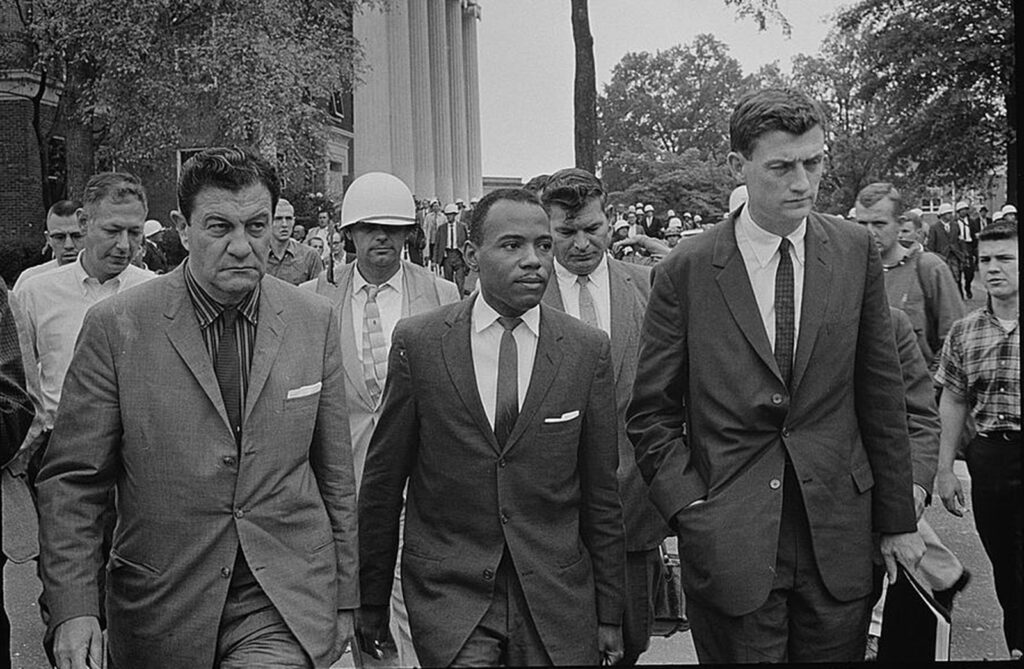
As the civil rights movement garnered more followers and more attention, white resistance stiffened. In October 1962, James Meredith became the first African American student to enroll at the University of Mississippi. Meredith’s enrollment sparked riots on the Oxford campus, prompting President Kennedy to send in US Marshals and National Guardsmen to maintain order. On an evening that became known as the Battle of Ole Miss, segregationists clashed with troops in the middle of campus, resulting in two deaths and hundreds of injuries. Violence served as a reminder of the strength of white resistance to the civil rights movement, particularly in the realm of education.2
The following year, 1963, was perhaps the decade’s most eventful year for civil rights. In April and May, the SCLC organized the Birmingham Campaign, a broad campaign of direct action aiming to topple segregation in what was widely considered America’s most segregated city. Activists deployed a relentless series of boycotts, sit-ins, and peaceful marches as part of “Project C” (for “confrontation”). SCLC leader Martin Luther King Jr. was jailed, prompting his famous handwritten letter urging not only his nonviolent approach but active confrontation to directly challenge injustice. Unlike in Albany, Birmingham’s police commissioner, Eugene “Bull” Connor, embraced all-out violence. Photographs and footage of overflowing jails and police officers using fire hoses and attack dogs on Black activists spread around the world. Multiple bombs targeted Black homes, Black businesses, and Black churches that summer, part of a larger pattern of bombings by Klan members and other whites in “Bombingham” during the civil rights era. Four young Black girls were killed when the 16th Street Baptist Church was bombed on September 15. Birmingham’s brutality shocked the moral conscience of many otherwise indifferent Americans, and public pressure yielded an agreement to desegregate public accommodations in the city: activists in Birmingham scored a victory for civil rights and drew international praise for the nonviolent approach in the face of police-sanctioned violence and bombings (King, already the face of the American civil rights movement, was awarded the Nobel Peace Prize the following year).5
The prominence of King and other Black pastors underscored the particular role that Black churches, the Black faith, and Black religious figures played in the civil rights movement. Protesters sang hymns and spirituals as they marched. Preachers rallied the people with messages of justice and hope. Churches hosted meetings, prayer vigils, and conferences on nonviolent resistance. Not all civil rights workers, of course, embraced the role of Black pastors—younger activists, who mocked King as “da lawd,” complained about what they often saw as the capricious, autocratic nature of the pastors who led the SCLC; for their part, many women in the movement chafed against the male-dominated leadership. Nevertheless, the overtly spiritual thrust of much of the movement not only propelled Black activists forward with visions of a prophetic faith in the face of often violent resistance, it confronted the broader postwar American society by framing segregation as a moral evil.6
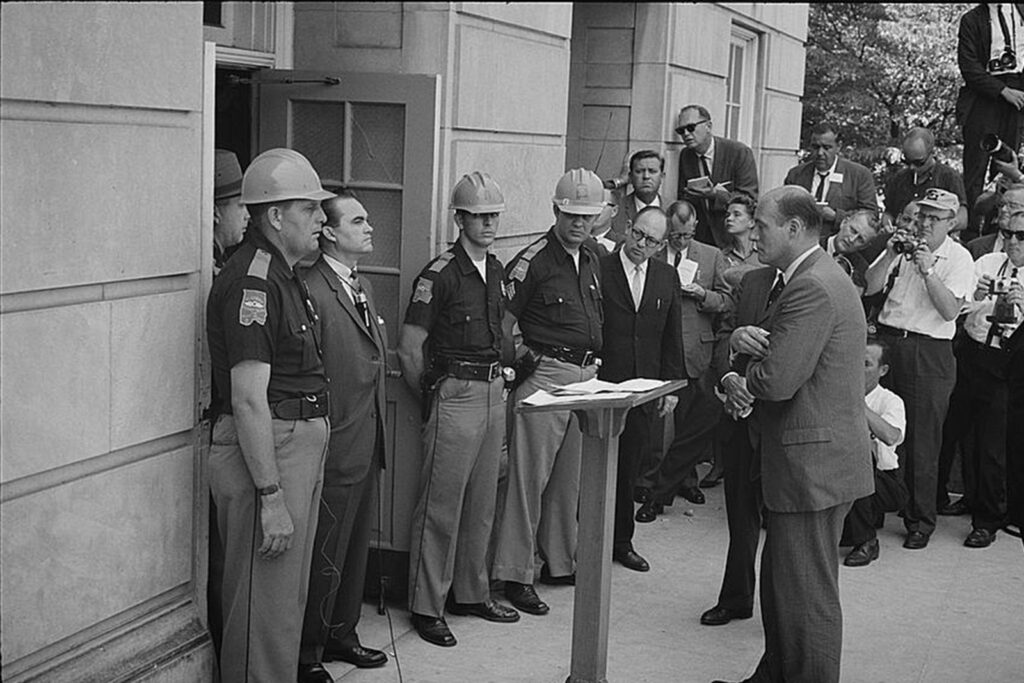
At the same time, white resistance in the South intensified. Few political figures in the decade embodied the working-class, conservative views held by millions of white Americans quite like George Wallace. Wallace’s vocal stance on segregation was immortalized in his 1963 inaugural address as Alabama governor with the infamous line “Segregation now, segregation tomorrow, segregation forever!” Just as the civil rights movement began to gain unprecedented strength, Wallace became a champion to the many white Americans—in and out of the South—who opposed the movement.7 Wallace loudly supported segregation as governor of Alabama. His efforts were largely symbolic, but they earned him national recognition as a political figure willing to fight for what many southerners saw as their traditional way of life. In June 1963, just five months after becoming governor, in his “Stand in the Schoolhouse Door,” Wallace famously blocked the door of Foster Auditorium to protest integration at the University of Alabama (he withdrew after President Kennedy federalized the Alabama National Guard). Kennedy addressed the nation that evening, criticizing Wallace and calling for a comprehensive civil rights bill. “This nation, for all its hopes and all its boasts, will not be fully free until all its citizens are free,” he said, adding that “Those who do nothing are inviting shame as well as violence.” A day later, civil rights leader Medgar Evers, a thirty-seven-year-old World War II veteran and Mississippi’s first NAACP field secretary, was assassinated at his home in Jackson, Mississippi.8

That summer, civil rights leaders organized the August 1963 March on Washington. The march called for, among other things, civil rights legislation, school integration, an end to discrimination by public and private employers, job training for the unemployed, and an increase in the minimum wage. On the steps of the Lincoln Memorial, King delivered his famous “I Have a Dream” speech, an internationally renowned call for civil rights that raised the movement’s profile to new heights and put unprecedented pressure on politicians to pass meaningful civil rights legislation.9

Kennedy offered support for a civil rights bill, but southern resistance was intense, and Kennedy was unwilling to expend much political capital on it. And so the bill stalled in Congress. The months passed by, and Kennedy, with his eye on the following year’s presidential election, traveled to Texas in the fall of 1963 to meet with fractious Democratic Party leaders there. On November 22, 1963, President Kennedy was assassinated in Dallas. The nation’s youthful, popular president was gone. Vice President Lyndon Johnson took the oath of office before he left Dallas.
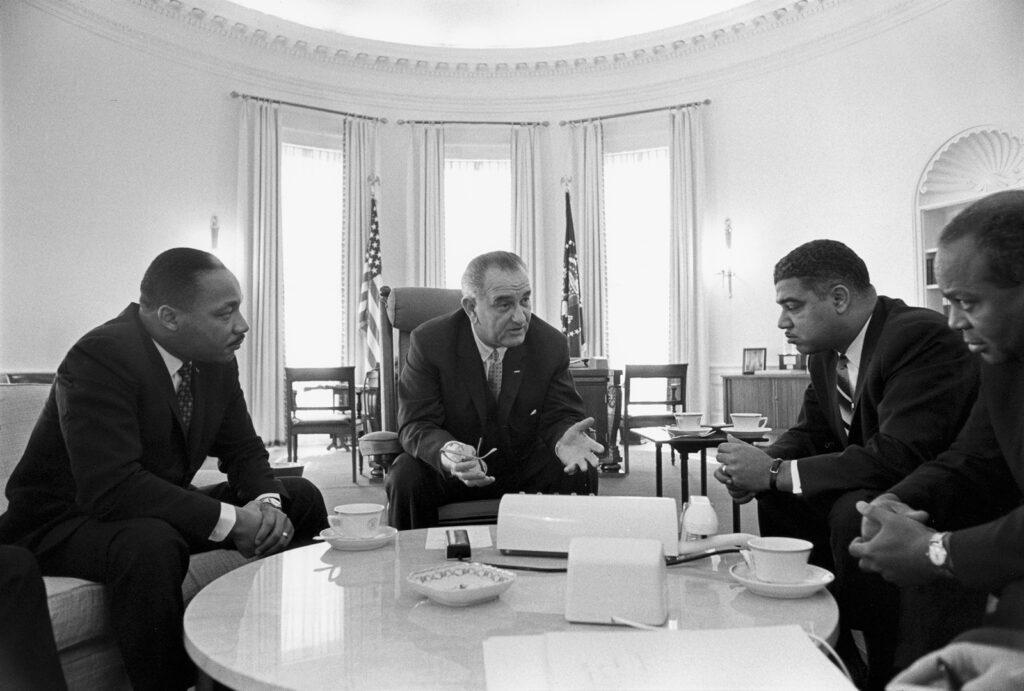
Johnson lacked Kennedy’s youth, his charisma, his popularity, and his aristocratic upbringing, but no one knew Washington better and no one before or since fought harder and more successfully to pass meaningful civil rights legislation. Raised in poverty in the Texas Hill Country, Johnson scratched and clawed his way up the political ladder. Both ruthlessly ambitious and keenly conscious of poverty and injustice, he idolized Franklin Roosevelt and the New Deal. Johnson, a fifty-five-year-old white southerner with a thick Texas drawl, embraced the civil rights movement. He took Kennedy’s stalled civil rights bill, ensured that it would have teeth, and navigated it through Congress. The following summer he signed the Civil Rights Act of 1964, widely considered to be among the most important pieces of civil rights legislation in American history. The comprehensive act barred segregation in public accommodations and outlawed discrimination based on race, ethnicity, gender, and national or religious origin.

The civil rights movement created space for political leaders to pass legislation, and the movement continued pushing forward. Direct action continued through the summer of 1964, as student-run organizations like SNCC and CORE helped with the Freedom Summer in Mississippi, a drive to register African American voters in a state with an ugly and extensive history of disenfranchisement. Freedom Summer campaigners set up schools for African American children. Even with progress, intimidation and violent resistance against civil rights continued, particularly in regions with long-standing traditions of segregation and discrimination. Three young CORE activists, James Chaney, Michael Schwerner, and Andrew Goodman, were murdered by local law enforcement officers and Klan members in Neshoba County, outside of Philadelphia, Mississippi.10 With Black voters barred from participating in the Mississippi Democratic Party primary, a coalition of civil rights groups in Mississippi organized the alternative Mississippi Freedom Democratic Party (MFDP); in August, over two thousand assembled in Jackson to select delegates. The MFDP demanded that its delegates be seated at the Democratic National Convention. Denied anything more than two at-large seats, the MFDP sprotested.11 “I question America,” co-founder Fannie Lou Hamer said in a nationally televised address. “Is this America, the land of the free and the home of the brave, where we have to sleep with our telephones off the hooks because our lives be threatened daily, because we want to live as decent human beings, in America?” she asked.
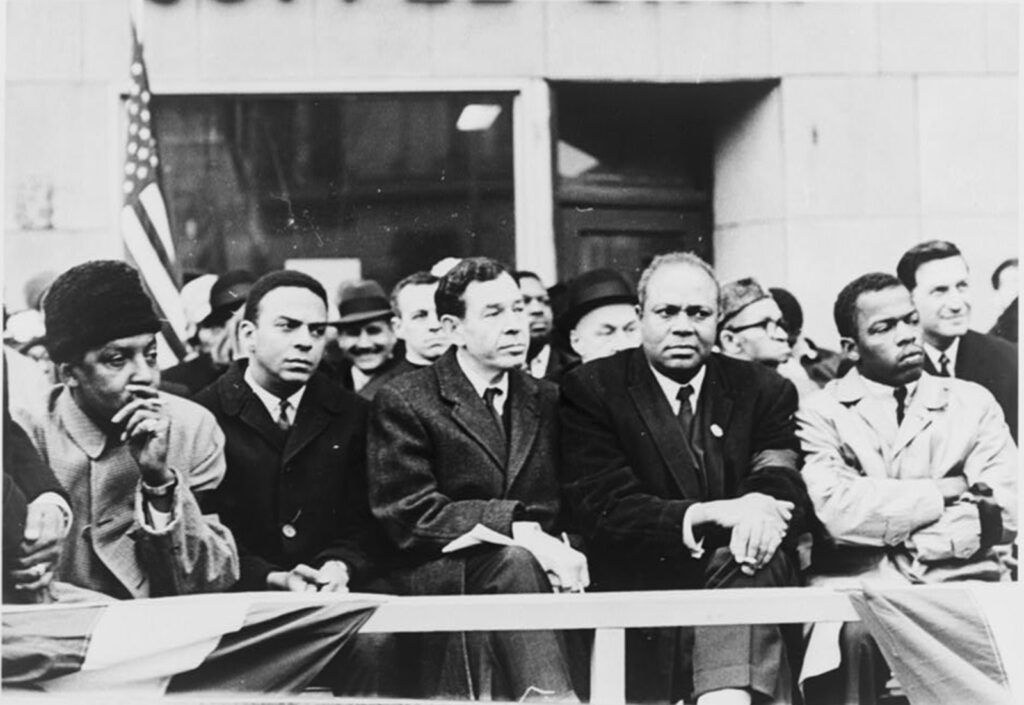
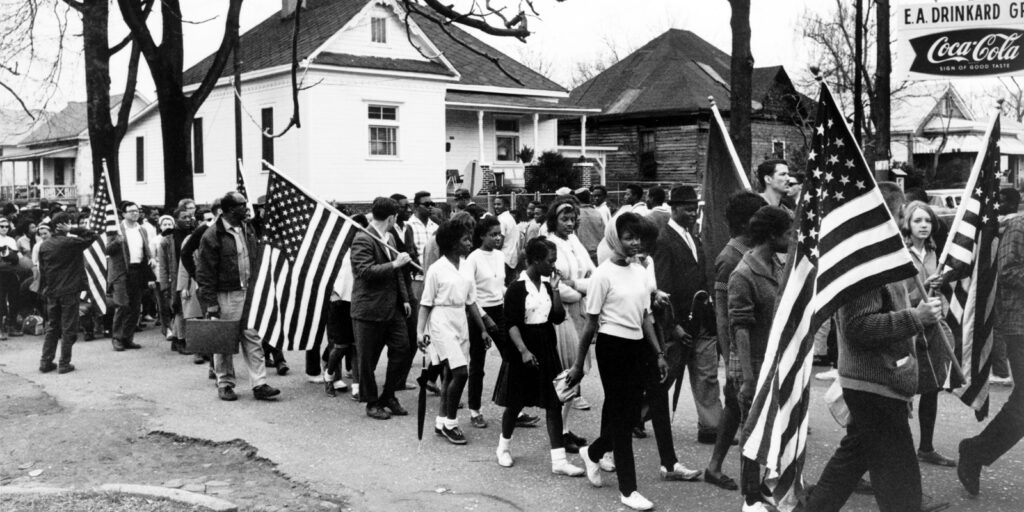
Activists kept fighting. In March 1965, activists attempted to march from Selma to Montgomery, Alabama, on behalf of African American voting rights. In a narrative that had become all too familiar, what became known as “Bloody Sunday”—Sunday, March 7, 1965—featured peaceful protesters being attacked by white law enforcement with batons and tear gas. After they were turned away violently a second time, marchers finally made the fifty-mile trek to the Alabama State Capitol later in the month. Coverage of the first march prompted President Johnson to present the bill that became the Voting Rights Act of 1965, an act that abolished voting discrimination in federal, state, and local elections. In two consecutive years, landmark pieces of legislation had assaulted de jure (by law) segregation and disenfranchisement.12
III. Lyndon Johnson’s Great Society
On a May morning in 1964, President Johnson laid out a sweeping vision for a package of domestic reforms known as the Great Society. Speaking before that year’s graduates of the University of Michigan, Johnson called for “an end to poverty and racial injustice” and challenged both the graduates and American people to “enrich and elevate our national life, and to advance the quality of our American civilization.” At its heart, he promised, the Great Society would uplift racially and economically disenfranchised Americans, too long denied access to federal guarantees of equal democratic and economic opportunity, while simultaneously raising all Americans’ standards and quality of life.13
The Great Society’s legislation was breathtaking in scope, and many of its programs and agencies are still with us today. The Civil Rights Act of 1964 and the Voting Rights Act of 1965 codified federal support for many of the civil rights movement’s goals by prohibiting job discrimination, abolishing the segregation of public accommodations, and providing vigorous federal oversight of southern states’ election laws to guarantee equal access to the ballot. Ninety years after Reconstruction, these measures effectively ended Jim Crow. Moreover, the Immigration and Nationality Act of 1965, or the Hart-Celler Act, abolished the national-origins quota regime established by the 1924 Reed-Johnson Act. American immigration, which had for more than four decades effectively barred legal immigration to the United States from anywhere other than Northern and Western Europe, finally opened the United States up to the world. Despite promises from Senator Ted Kennedy that “it will not upset the ethnic mix of our society,” the new law forever reshaped the demographics of the nation.14
In addition to civil rights and immigration, the Great Society took on a range of quality-of-life concerns that seemed suddenly solvable in a society of such affluence. The first federal food stamp program tackled hunger. Medicare and Medicaid would ensure access to quality medical care for the aged and the poor. In 1965, the Elementary and Secondary Education Act was the first sustained and significant federal investment in public education, totaling more than $1 billion. Federal funds were poured into colleges and universities. The Great Society also established the National Endowment for the Arts and the National Endowment for the Humanities, offering federal investments in the world of arts and letters.
While these programs persisted and even thrived, in the years immediately following this flurry of legislative activity, the national conversation surrounding Johnson’s domestic agenda largely focused on the $3 billion spent on War on Poverty programming within the Great Society’s Economic Opportunity Act (EOA) of 1964. No EOA program was more controversial than Community Action, considered the cornerstone antipoverty program. Johnson’s antipoverty planners felt that the key to uplifting disenfranchised and impoverished Americans was involving poor and marginalized citizens in the actual administration of poverty programs, what they called “maximum feasible participation.” Community Action Programs would give disenfranchised Americans a seat at the table in planning and executing federally funded programs that were meant to benefit them—a significant sea change in the nation’s efforts to confront poverty, which had historically relied on local political and business elites or charitable organizations for administration.15
In fact, Johnson himself had never conceived of poor Americans running their own poverty programs. While the president’s rhetoric offered a stirring vision of the future, he had singularly old-school notions for how his poverty policies would work. In contrast to “maximum feasible participation,” the president imagined a second New Deal: local elite-run public works camps that would instill masculine virtues in unemployed young men. Community Action Agencies almost entirely bypassed local administrations and sought to build grassroots civil rights and community advocacy organizations, many of which had originated in the broader civil rights movement. Despite widespread support for most Great Society programs, the War on Poverty increasingly became the focal point of domestic criticisms from the left and the right. On the left, frustrated Americans recognized the president’s resistance to further empowering disenfranchised communities and assailed the growing American commitment to the war in Vietnam, the cost of which undercut domestic poverty spending. As racial unrest and violence swept across urban centers, critics from the right lambasted federal spending for “unworthy” citizens.
Johnson had secured a series of meaningful civil rights laws, but then things began to stall. Days after the ratification of the Voting Rights Act, race riots broke out in the Watts neighborhood of Los Angeles. Rioting in Watts, triggered by an act of police violence, stemmed from local African American frustrations with residential segregation, police brutality, and racial profiling. Waves of riots rocked American cities every summer thereafter. Particularly destructive riots occurred in 1967—two summers later—in Newark and Detroit. Each resulted in deaths, injuries, arrests, and millions of dollars in property damage. In spite of Black achievements, struggles persisted for many African Americans. The phenomenon of “white flight”—when whites in metropolitan areas fled city centers for the suburbs—often resulted in resegregated residential patterns, the economic collapse of urban centers, and the decimation of tax bases and city services. Limited economic and social opportunities for those left behind bred despair. In addition to reminding the nation that the civil rights cause was a complex, ongoing movement without any concrete political endpoint, the unrest in northern cities reinforced the notion that the struggle was not occurring solely in the South. Many Americans also viewed the riots as an indictment of the Great Society, President Johnson’s sweeping agenda of domestic programs that sought to remedy inner-city ills by offering better access to education, jobs, medical care, housing, and other forms of social welfare. The civil rights movement would never be the same.16
The Civil Rights Acts, the Voting Rights Acts, and the War on Poverty provoked conservative resistance and catalyzed the rise of the Republican Party in the South and the West. However, subsequent presidents and Congresses left intact the bulk of the Great Society, including Medicare and Medicaid, food stamps, federal spending for arts and literature, and Head Start. Even Community Action Programs, so fraught during their few short years of activity, empowered future generations of community activists who had never before felt, as one put it, that “this government is with us.” For all of their many accomplishments, Johnson’s domestic programs frustrated both ends of American political spectrum and suffered neglect when Johnson turned his attention to the international stage.17
IV. The Origins of the Vietnam War
American involvement in the Vietnam War began during the postwar period of decolonization. The Soviet Union backed many nationalist movements across the globe, but the United States feared the expansion of communist influence and pledged to confront any revolutions aligned against Western capitalism. The Domino Theory—the idea that if a country fell to communism, then neighboring states would soon follow—governed American foreign policy. After the communist takeover of China in 1949, the United States financially supported the French military’s effort to retain control over its colonies in Vietnam, Cambodia, and Laos.
Between 1946 and 1954, France fought a counterinsurgency campaign against the nationalist Viet Minh forces, led by Ho Chi Minh, fighting for an independent Vietnam. The United States assisted the French war effort with funds, arms, and advisors, but it was not enough. On the eve of the Geneva Peace Conference in 1954, Viet Minh forces defeated the French army at Dien Bien Phu. The conference temporarily divided Vietnam into two separate states until UN-monitored elections occurred. But the United States, fearing a communist electoral victory, blocked the elections. The temporary partition became permanent. The United States established the Republic of Vietnam, or South Vietnam, with the US-backed Ngo Dinh Diem as prime minister. Diem, who had lived in the United States, was a committed anticommunist.
Diem’s government, however, and its Army of the Republic of Vietnam (ARVN) could not contain the communist insurgency seeking the reunification of Vietnam. The Americans provided weapons and support, but despite a clear numerical and technological advantage, South Vietnam stumbled before insurgent Vietcong (VC) units. Diem, a corrupt leader propped up by the American government with little domestic support, was assassinated in 1963. A merry-go-round of military dictators followed as the situation in South Vietnam continued to deteriorate. The American public, though, remained largely unaware of Vietnam in the early 1960s, even as President Kennedy deployed some sixteen thousand military advisors to help South Vietnam suppress a domestic communist insurgency.18
This all changed in 1964. On August 2 of that year, the USS Maddox reported incoming fire from North Vietnamese ships in the Gulf of Tonkin. Although the details of the incident are controversial, the Johnson administration exploited the event to provide a pretext for escalating American involvement in Vietnam. Congress passed the Gulf of Tonkin Resolution, granting President Johnson the authority to deploy the American military to defend South Vietnam. US Marines landed in Vietnam in March 1965, and the American ground war began.
American forces under General William Westmoreland were tasked with defending South Vietnam against the insurgent VC and the regular North Vietnamese Army (NVA). But no matter how many troops the Americans sent or how many bombs they dropped, they could not win. This was a different kind of war. Progress was not measured by cities won or territory taken but by body counts and kill ratios. Although American officials like Westmoreland and Secretary of Defense Robert McNamara claimed a communist defeat was on the horizon, by 1968 half a million American troops were stationed in Vietnam, nearly twenty thousand had been killed, and the war was still no closer to being won. Protests, which provided the backdrop for the American counterculture, erupted across the country.
V. Culture and Activism

The 1960s wrought enormous cultural change. The United States that entered the decade looked and sounded not much like the one that left it. Rebellion rocked the supposedly hidebound conservatism of the 1950s as the youth counterculture became mainstream. Native Americans, Chicanos, women, and environmentalists participated in movements demonstrating that rights activism could be applied to ethnicity, gender, and nature. In each instance, the decade brought substantial progress, and activism remained fluid and unfinished.
Much of the American counterculture was filtered through popular culture and consumption. The consumer culture of the 1950s still saturated the country, and advertisers continued to appeal to teenagers and the expanding youth market. During the 1960s, though, advertisers looked to a growing counterculture to sell their products. Popular culture and popular advertising in the 1950s had promoted an ethos of “fitting in” and buying products to conform. The new countercultural ethos touted “individuality” and “rebellion.” Some advertisers were subtle; ads for Volkswagens acknowledged the flaws and strange look of their cars. One VW ad perversely presented “America’s slowest fastback,” an automobile that “won’t go over 72 mph” even if “the speedometer shows a wildly optimistic top speed of 90.” Another stated, “If you run out of gas, it’s easy to push.” By marketing the car’s flaws and reframing them as positive qualities, the advertisers commercialized young people’s resistance to commercialism, while simultaneously positioning the Volkswagen as a car for those wanting to stand out in a crowd. A more obviously countercultural ad for the VW Bug showed two cars: one black and one painted in a messy, multicolor, hippie style; the contrasting captions read, “We do our thing,” and “You do yours.”
Companies marketed their products as countercultural in and of themselves. One of the more obvious examples was a 1968 ad from Columbia Records, a hugely successful record label since the 1920s. The ad pictured a group of stock rebellious characters—a shaggy-haired white hippie, a buttoned-up Beat, two biker types, and a Black jazz man sporting an Afro—in a jail cell. The counterculture had been busted, the ad states, but “The Man can’t bust our music.” Merely buying records from Columbia was an act of rebellion, one that brought the buyer closer to the counterculture figures portrayed in the ad.19
But it wasn’t just advertising: the culture was changing and changing rapidly. Conservative cultural norms were falling everywhere. The dominant style of women’s fashion in the 1950s, for instance, was the poodle skirt and the sweater, tight-waisted and buttoned up. The 1960s ushered in an era of much less restrictive clothing. Capri pants became popular casual wear. Skirts became shorter. When Mary Quant invented the miniskirt in 1964, she said it was a garment “in which you could move, in which you could run and jump.”20 By the late 1960s, the hippies’ more androgynous look became trendy. Such trends bespoke the new popular ethos of the 1960s: freedom, rebellion, and individuality.
In a decade plagued by social and political instability, the American counterculture also sought psychedelic drugs as its remedy for alienation. For middle-class white teenagers, society had become stagnant and bureaucratic. The New Left, for instance, arose on college campuses frustrated with the lifeless bureaucracies that they believed strangled true freedom. Lysergic acid diethylamide (LSD) began its life as a drug used primarily in psychological research before trickling down into college campuses and out into the society at large. The counterculture’s notion that American stagnation could be remedied by a spiritual-psychedelic experience drew heavily from psychologists and sociologists. The popularity of these drugs also spurred a political backlash. By 1966, enough incidents had been connected to LSD to spur a Senate hearing on the drug, and newspapers were reporting that hundreds of LSD users had been admitted to psychiatric wards.
The counterculture conquered popular culture. Rock ’n’ roll, liberalized sexuality, an embrace of diversity, recreational drug use, new age spiritualism, unalloyed idealism, and pure earnestness marked the new generation. Criticized by conservatives as culturally dangerous and by leftists as empty hedonistic narcissism, the youth culture nevertheless dominated headlines and steered American culture. Perhaps one hundred thousand youth descended on San Francisco for the utopic promise of 1967’s Summer of Love. 1969’s Woodstock concert in upstate New York became shorthand for the new youth culture and its mixture of politics, protest, and personal fulfillment. While the ascendance of the hippies would be both exaggerated and short-lived, and while Vietnam and Richard Nixon shattered much of its idealism, the counterculture’s liberated social norms and its embrace of personal fulfillment still define much of American culture.
VI. Beyond Civil Rights

Despite substantial legislative achievements, frustrations grew with the slow pace of change not just in civil rights law but in addressing broader racial inequalities. Racial tensions continued to mount in cities, and the tone of the civil rights movement changed yet again. Activists became less conciliatory in their calls for progress. Many embraced the more militant message of the burgeoning Black Power movement and Malcolm X, a Nation of Islam (NOI) minister who encouraged African Americans to pursue freedom, equality, and justice “by any means necessary.” Prior to his assassination in 1965, Malcolm X and the NOI emerged as the radical alternative to the racially integrated, largely Protestant approach of Martin Luther King Jr. Malcolm X advocated armed resistance in defense of the safety and well-being of Black Americans, stating, “I don’t call it violence when it’s self-defense, I call it intelligence.” Even a less militant Black nationalism rejected the promises of racial integration, believing that only a Black-centric program of racial uplift would offer liberation through economic self-determination, Afrocentric cultural expression, and collective uplift. For his part, King and the leaders of more mainstream organizations like the NAACP and the Urban League criticized both Malcolm X and the NOI for what they perceived to be racial demagoguery. King believed Malcolm X’s speeches were a “great disservice” to Black Americans, claiming that they lamented the problems of African Americans without offering solutions. The differences between King and Malcolm X represented a core ideological tension that would inhabit Black political thought throughout the 1960s and beyond.21
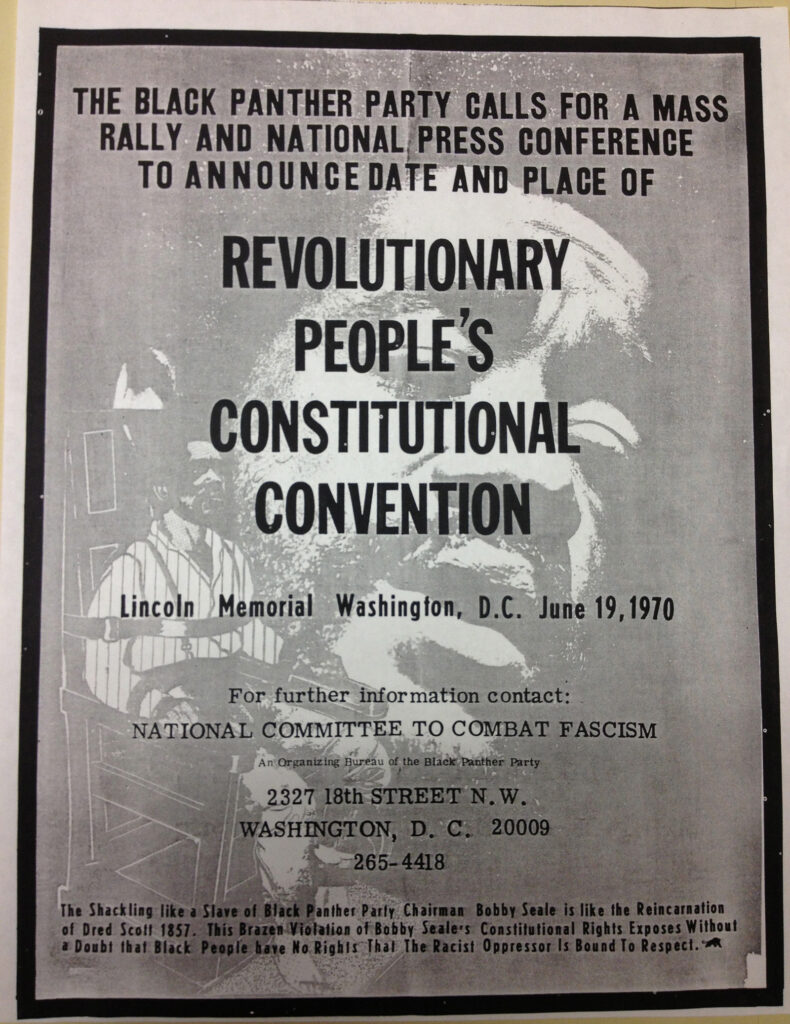

By the late 1960s, SNCC, led by figures such as Stokely Carmichael, had expelled its white members and shunned the interracial effort in the rural South, focusing instead on injustices in northern urban areas. After President Johnson refused to take up the cause of the Black delegates in the Mississippi Freedom Democratic Party at the 1964 Democratic National Convention, SNCC activists became frustrated with institutional tactics and turned away from the organization’s founding principle of nonviolence (the organization later changed its name from the Student Nonviolent Coordinating Committee to the Student National Coordinating Committee). This evolving, more assertive movement called for African Americans to play a dominant role in cultivating Black institutions and articulating Black interests rather than relying on more moderate, interracialist approaches. At a June 1966 civil rights march, Carmichael told the crowd, “What we gonna start saying now is black power!”22 The slogan not only resonated with audiences, it also stood in direct contrast to King’s “Freedom Now!” campaign. The political slogan of Black power could encompass many meanings, but at its core it stood for the self-determination of Black people in political, economic, cultural, and social organizations.
Carmichael asserted that “black power means black people coming together to form a political force.”23 For others it meant armed self-defense. Even in the South, groups such as the Deacons for Defense and Justice, which emerged in Louisiana in 1964, began arming themselves to protect Black activists against racial violence.24 But Black armed resistance would find its most popular expression outside of the South. In 1966, Huey Newton and Bobby Seale formed the Black Panther Party for Self Defense in Oakland, California. The Black Panthers became the standard-bearers for direct action and self-defense, using the concept of decolonization in their drive to liberate Black communities from white power structures. The revolutionary organization also sought reparations and exemptions for Black men from the military draft. Citing police brutality and racist governmental policies, the Black Panthers aligned themselves with the “other people of color in the world” against whom America was fighting abroad. Although many white Americans were most struck by the Panthers’ open display of weapons, military-style dress, and Black nationalist beliefs, the Party was committed to racial uplift: their 10-Point Plan included employment, housing, and education. The Black Panthers worked in local communities to run “survival programs” that provided food, clothing, medical treatment, Afrocentric education, and drug rehabilitation. They focused on modes of resistance that empowered Black activists on their own terms.25
But African Americans weren’t the only Americans working to assert themselves in the 1960s. The successes of the civil rights movement and growing grassroots activism inspired countless new movements. In the summer of 1961, for instance, frustrated Native American university students founded the National Indian Youth Council (NIYC) to draw attention to the plight of Indigenous Americans. In the Pacific Northwest, the council advocated for tribal fisherman to retain immunity from conservation laws on reservations and in 1964 held a series of “fish-ins”: activists and celebrities cast nets and waited for the police to arrest them.26 The NIYC’s militant rhetoric and use of direct action marked the beginning of what was called the Red Power movement, an intertribal movement designed to draw attention to Native issues and to protest discrimination. The American Indian Movement (AIM) and other activists staged dramatic demonstrations. In November 1969, dozens began a year-and-a-half-long occupation of the abandoned Alcatraz Island in San Francisco Bay. In 1973, hundreds occupied the town of Wounded Knee, South Dakota, site of the infamous 1890 massacre, for several months.27
Meanwhile, the Chicano movement in the 1960s emerged out of the broader Mexican American civil rights movement of the post–World War II era. The word Chicano was initially considered a derogatory term for Mexican immigrants, until activists in the 1960s reclaimed the term and used it as a catalyst to campaign for political and social change among Mexican Americans. The Chicano movement confronted discrimination in schools, politics, agriculture, and other formal and informal institutions. Organizations like the Mexican American Political Association (MAPA) and the Mexican American Legal Defense Fund (MALDF) buoyed the Chicano movement and patterned themselves after similar influential groups in the African American civil rights movement.28
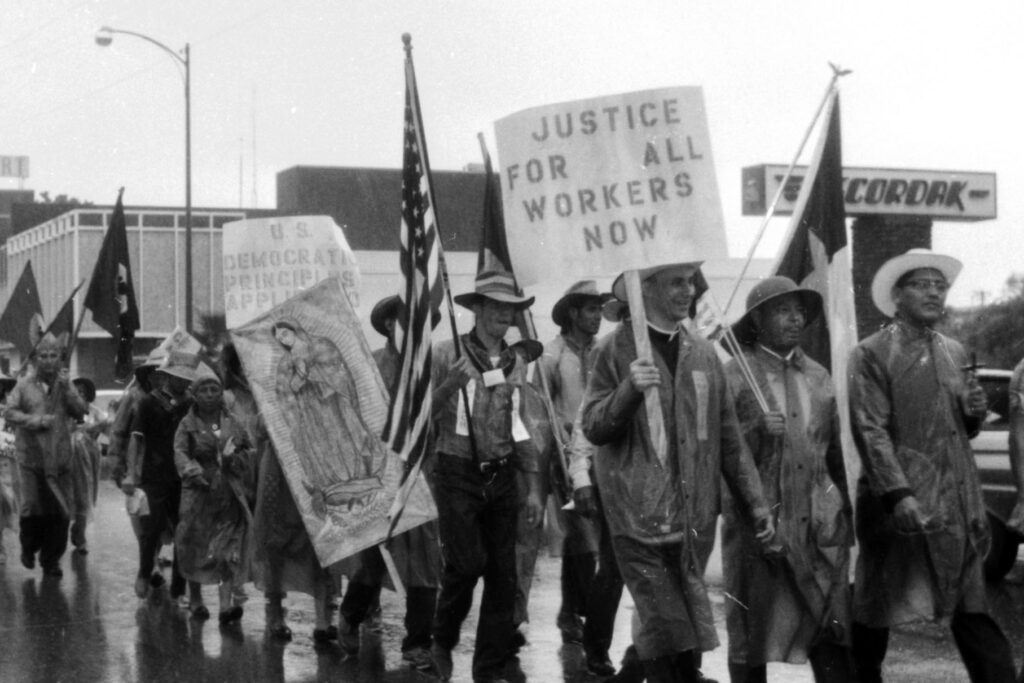
Cesar Chavez became the most well-known figure of the Chicano movement, using nonviolent tactics to campaign for workers’ rights in the grape fields of California. Chavez and activist Dolores Huerta founded the National Farm Workers Association, which eventually merged and became the United Farm Workers of America (UFWA). The UFWA fused the causes of Chicano and Filipino activists protesting the subpar working conditions of California farmers on American soil. In addition to embarking on a hunger strike and a boycott of table grapes, Chavez led a three-hundred-mile march in March and April 1966 from Delano, California, to the state capital of Sacramento. The pro-labor campaign garnered the national spotlight and the support of prominent political figures such as Robert Kennedy. Today, Chavez’s birthday, March 31, is observed as a federal holiday in California, Colorado, and Texas.
Rodolfo “Corky” Gonzales was another activist whose calls for Chicano self-determination resonated long past the 1960s. A former boxer and Denver native, Gonzales founded the Crusade for Justice in 1966, an organization that would establish the first annual Chicano Liberation Day at the National Chicano Youth Conference. The conference also yielded the Plan Espiritual de Aztlán, a Chicano nationalist manifesto that reflected Gonzales’s vision of Chicanos as a unified, historically grounded, all-encompassing group fighting against discrimination in the United States. By 1970, the Texas-based La Raza Unida political party had a strong foundation for promoting Chicano nationalism and continuing the campaign for Mexican American civil rights.29
The feminist movement also grew in the 1960s. Rooted in activism that stretched back to the suffragists and the quest for the Equal Rights Amendment, American women advanced new causes during the 1960s. Soon the country felt the groundswell of a rising feminist consciousness.30
An older generation of women who preferred to work within state institutions figured prominently in the early part of the decade. When John F. Kennedy established the Presidential Commission on the Status of Women in 1961, former first lady Eleanor Roosevelt headed the effort. The commission’s official report, a self-declared “invitation to action,” was released in 1963. Finding discriminatory provisions in the law and practices of industrial, labor, and governmental organizations, the commission advocated for “changes, many of them long overdue, in the conditions of women’s opportunity in the United States.”31 Change was recommended in employment practices, federal tax and benefit policies affecting women’s income, labor laws, and services for women as wives, mothers, and workers. This call for action, if heeded, would ameliorate the types of discrimination primarily experienced by middle- and upper-class white working women, all of whom were used to advocating through institutional structures like government agencies and unions.32 The specific concerns of poor and nonwhite women lay largely beyond the scope of the report.
Betty Friedan’s The Feminine Mystique hit bookshelves in 1963, the same year the commission released its report. Friedan had been active in the union movement and was by this time a mother in the new suburban landscape of postwar America. In her book, Friedan called it “the problem that has no name,” and the action helped many a white middle-class American woman come to see her dissatisfaction as a housewife not as “something . . . wrong with her marriage, or with herself,” but as a social problem experienced by millions of American women. Friedan observed that there was “a strange discrepancy between the reality of our lives as women and the image to which we were trying to conform, the image that I came to call the feminine mystique.” No longer would women allow society to blame “the problem that has no name” on a loss of femininity, too much education, too much independence, or too much equality. In fact, Friedan’s book sparked a “second wave” of American feminism that underlay much of the women’s movement of the 1960s and 1970s.33
In 1966, frustrated by the toothlessness of the Equal Opportunity Commission—job ads were still largely segregated by sex and American firms often explicitly designated lower pay for women345—and the inabilities of existing organizations to address those frustrations, Friedan and other feminist leaders spearheaded the creation of the National Organization for Women (NOW) in the belief that “the time has come for a new a new movement toward true equality for all women in America.”35
Many feminists joined consciousness-raising groups. These groups met in women’s homes and at women’s centers, providing a safe environment for women to discuss everything from sex discrimination to women’s self-image. The goals of consciousness-raising were to increase self-awareness and to validate the experiences of women. Women involved in the New Left and civil rights movement, for instance, found that while male organizers were eager to address issues of race and social class equality, discussion of sexism were often met with ridicule.36 In 1965, for instance, Casey Hayden and Mary King circulated a memo on sexism in the civil rights movement, in which they captured the reaction of men to their call for women’s equality, pointing out that “very few men can respond non-defensively, since the whole idea is either beyond their comprehension or threatens and exposes them. The usual response is laughter.”37
Groups such as the Redstockings, formed in 1969 “to defend and advance the Women’s Liberation Agenda,” rejected the idea that women were responsible for their own oppression and instead pointed to larger societal powers and cultural forces. Groups framed such individual experiences as examples of society-wide sexism and insisted that “the personal is political.”38 Consciousness-raising groups created a wealth of personal stories that feminists could use in other forms of activism and crafted networks of women from which activists could mobilize support for protests.
The variety of lived experiences in the United States meant that different women experienced the world in different ways; the women’s “movement,” if it can be so termed, in the 1960s was necessarily a complex constellation of ideas, goals, and organizations that approached women’s inequality from different points of view. Mothers on welfare, for instance, began to form local advocacy groups in addition to the National Welfare Rights Organization, founded in 1966. Mostly Black, these activists fought for greater benefits and more control over welfare policy and implementation. Women like Johnnie Tillmon successfully advocated for larger grants for school clothes and household equipment in addition to gaining due process and fair administrative hearings prior to termination of welfare entitlements. In response to the whiteness of many prominent feminist organizations (and the perceived narrowness of its imagination of “women’s issues”), Black, Chicana, Asian, and Indigenous women often formed their own groups, existing alongside more prominent white-led organizations but operating with fewer resources and with much less attention. But they labored nonetheless.

The end of the decade was marked by the Women’s Strike for Equality, celebrating the fiftieth anniversary of women’s right to vote. Sponsored by NOW, the 1970 protest focused on employment discrimination, political equality, abortion, free childcare, and equality in marriage. All of these issues foreshadowed the backlash against feminist goals in the 1970s. Not only would feminism face opposition from other women who valued the traditional homemaker role to which feminists so strenuously objected, the feminist movement would also fracture internally as women of color challenged white feminists’ racism and lesbians vied for more prominence within feminist organizations.
American environmentalism’s significant gains during the 1960s emerged, in part, from Americans’ recreational use of nature. Postwar Americans backpacked, went to the beach, fished, and joined birding organizations in greater numbers than ever before. These experiences, along with increased formal education, made Americans more aware of threats to the environment and, consequently, to themselves. Many of these threats increased in the postwar years as developers bulldozed open space for suburbs and new hazards emerged from industrial and nuclear pollutants.
By the time biologist Rachel Carson published her landmark book Silent Spring in 1962, a nascent environmentalism had emerged in America. Silent Spring stood out as an unparalleled argument for the interconnectedness of ecological and human health. Pesticides, Carson argued, also posed a threat to human health, and their overuse threatened the ecosystems that supported food production. Carson’s argument was compelling to many Americans, including President Kennedy, but was virulently opposed by chemical industries that suggested the book was the product of an emotional woman, not a scientist. A new environmental movement would emerge in the 1960s, rally the public to its cause, and, in the early 1970s, usher forth a bevy of bipartisan environmental legislation.39
VII. Conclusion
In 1969, Americans hailed the moon landing as a profound victory in the space race against the Soviet Union. This landmark achievement fulfilled the promise of the late John F. Kennedy, who had declared in 1961 that the United States would put a man on the moon by the end of the decade. But while Neil Armstrong said his steps marked “one giant leap for mankind,” and Americans marveled at the achievement, the brief moment of wonder only punctuated years of turmoil. The Vietnam War disillusioned a generation, riots rocked cities, protests hit campuses, and assassinations robbed the nation of many of its leaders. The forward-thinking spirit of a complex decade had waned. Uncertainty loomed.
VIII. Reference Material
This chapter was edited by Samuel Abramson and Kerry Goldmann, with content contributions by Samuel Abramson, Moisés Acuña-Gurrola, Marsha Barrett, Brent Cebul, Michell Chresfield, William Cossen, Jenifer Dodd, Michael Falcone, Leif Fredrickson, Jean-Paul de Guzman, Jordan Hill, Travis B. Hill, William Kelly, Lucie Kyrova, Zeb Larson, Maria Montalvo, Emily Prifogle, Ansley Quiros, Jo Reger, Sarah Riva, Tanya Roth, and Robert Thompson.
Recommended Reading
• Branch, Taylor. Parting the Waters: America in the King Years, 1954–1963. New York: Simon and Schuster, 1988.
• ———. Pillar of Fire: America in the King Years, 1963–65. New York: Simon and Schuster, 1998.
• Breines, Winifred. The Trouble Between Us: An Uneasy History of White and Black Women in the Feminist Movement. New York: Oxford University Press, 2006.
• Brick, Howard. The Age of Contradictions: American Thought and Culture in the 1960s. Ithaca, NY: Cornell University Press, 2000.
• Brown-Nagin, Tomiko. Courage to Dissent: Atlanta and the Long History of the Civil Rights Movement. New York: Oxford University Press, 2011.
• Carson, Clayborne. In Struggle: SNCC and the Black Awakening of the 1960s. Cambridge, MA: Harvard University Press, 1981.
• Chafe, William. Civilities and Civil Rights: Greensboro, North Carolina, and the Black Struggle for Freedom. New York: Oxford University Press, 1980.
• Dallek, Robert. Flawed Giant: Lyndon Johnson and His Times, 1961–1973. New York: Oxford University Press, 1993.
• D’Emilio, John. Sexual Politics, Sexual Communities: The Making of a Homosexual Minority in the United States, 1940–1970. Chicago: University of Chicago Press, 1983.
• Echols, Alice. Daring to Be Bad: Radical Feminism in America, 1967–1975. Minneapolis: University of Minnesota Press, 1989.
• Gitlin, Todd. The Sixties: Years of Hope, Days of Rage. New York: Bantam Books, 1987.
• Hall, Jacquelyn Dowd. “The Long Civil Rights Movement and the Political Uses of the Past.” Journal of American History 91 (March 2005): 1233–1263.
• Isserman, Maurice. If I Had a Hammer: The Death of the Old Left and the Birth of the New Left. Champaign: University of Illinois Press, 1987.
• Johnson, Troy R. The American Indian Occupation of Alcatraz Island: Red Power and Self-Determination. Lincoln: University of Nebraska Press, 2008.
• Joseph, Peniel. Waiting ’til the Midnight Hour: A Narrative History of Black Power in America. New York: Holt, 2006.
• Kazin, Michael, and Maurice Isserman. America Divided: The Civil War of the 1960s. New York: Oxford University Press, 2007.
• McGirr, Lisa. Suburban Warriors: The Origins of the New American Right. Princeton, NJ: Princeton University Press, 2001.
• Orleck, Annelise. Storming Caesar’s Palace: How Black Mothers Fought Their Own War on Poverty. New York: Beacon Books, 2005.
• Patterson, James T. America’s Struggle Against Poverty in the Twentieth Century. Cambridge, MA: Harvard University Press, 1981.
• ———. Grand Expectations: The United States, 1945–1974. New York: Oxford University Press, 1996.
• Perlstein, Rick. Before the Storm: Barry Goldwater and the Unmaking of the American Consensus. New York: Hill and Wang, 2001.
• Ransby, Barbara. Ella Baker and the Black Freedom Movement: A Radical Democratic Vision. Chapel Hill: University of North Carolina Press, 2000.
• Robnett, Belinda. How Long? How Long? African American Women in the Struggle for Civil Rights. New York: Oxford University Press, 2000.
• Sugrue, Thomas. The Origins of the Urban Crisis: Race and Inequality in Postwar Detroit. Princeton, NJ: Princeton University Press, 2005.
Notes
- For an overview of the major events of the civil rights movement, see especially Taylor Branch’s America in the King Years trilogy: Parting the Waters: America in the King Years, 1954–63 (New York: Simon and Schuster, 1988); Pillar of Fire: America in the King Years, 1963–65 (New York: Simon and Schuster, 1998); and At Canaan’s Edge: America in the King Years, 1965–68 (New York: Simon and Schuster, 2007).[↩]
- Branch, Parting the Waters.[↩][↩]
- Raymond Arsenault, Freedom Riders: 1961 and the Struggle for Racial Justice (New York: Oxford University Press, 2006).[↩]
- Clayborne Carson, In Struggle: SNCC and the Black Awakening of the 1960s (Cambridge, MA: Harvard University Press, 1980); Adam Fairclough, To Redeem the Soul of America: The Southern Christian Leadership Conference and Martin Luther King (Athens: University of Georgia Press, 1987).[↩]
- Maurice Isserman and Michael Kazin, America Divided: The Civil War of the 1960s (New York: Oxford University Press, 2000).[↩]
- David L. Chappell, A Stone of Hope: Prophetic Religion and the Death of Jim Crow (Chapel Hill: University of North Carolina Press, 2005).[↩]
- Dan T. Carter, The Politics of Rage: George Wallace, the Origins of the New Conservatism, and the Transformation of American Politics (Baton Rouge: LSU Press, 2000).[↩]
- Michael Vinson Williams, Medgar Evers: Mississippi Martyr (Fayetteville: University of Arkansas Press, 2013).[↩]
- Branch, Parting the Waters.[↩]
- Branch, Pillar of Fire.[↩]
- Charles M. Payne, I’ve Got the Light of Freedom: The Organizing Tradition and the Mississippi Freedom Struggle (Los Angeles: University of California Press, 1995).[↩]
- Branch, At Canaan’s Edge.[↩]
- Lyndon Baines Johnson, “Remarks at the University of Michigan,” May 22, 1964, Public Papers of the Presidents of the United States: Lyndon B. Johnson, 1964 (Washington, DC: U.S. Government Printing Office, 1965), 704.[↩]
- Margaret Sands Orchowski, The Law That Changed the Face of America: The Immigration and Nationality Act of 1965 (Lanham, MD: Rowman & Littlefield, 2015).[↩]
- See, for instance, Wesley G. Phelps, A People’s War on Poverty: Urban Politics and Grassroots Activists in Houston (Athens: University of Georgia Press, 2014).[↩]
- Ibid.[↩]
- Guian A. McKee, “‘This Government Is with Us’: Lyndon Johnson and the Grassroots War on Poverty,” in The War on Poverty: A New Grassroots History, 1964–1980, ed. Annelise Orleck and Lisa Gayle Hazirjian (Athens: University of Georgia Press, 2011).[↩]
- Michael P. Sullivan, The Vietnam War: A Study in the Making of American Foreign Policy (Lexington: University Press of Kentucky, 1985), 58.[↩]
- Thomas Frank, The Conquest of Cool: Business Culture, Counterculture, and the Rise of Hip Consumerism (Chicago: University of Chicago Press, 1998), 7.[↩]
- Brenda Polan and Roger Tredre, The Great Fashion Designers (New York: Berg, 2009), 103–104.[↩]
- Manning Marable, Malcolm X: A Life of Reinvention (New York: Penguin, 2011).[↩]
- Peniel E. Joseph, ed., The Black Power Movement: Rethinking the Civil Rights–Black Power Era (New York: Routledge, 2013), 2.[↩]
- Gordon Parks, “Whip of Black Power,” Life, May 19, 1967, 82.[↩]
- Lance Hill, The Deacons for Defense: Armed Resistance and the Civil Rights Movement (Chapel Hill: University of North Carolina Press, 2004).[↩]
- Joshua Bloom and Waldo E. Martin Jr., Black Against Empire: The History and Politics of the Black Panther Party (Berkeley: University of California Press, 2012).[↩]
- In 1974, fishing rights activists and tribal leaders reached a legal victory in United States v. Washington, otherwise known as the Boldt Decision, which declared that Native Americans were entitled to up to 50 percent of the fish caught in the “usual and accustomed places,” as stated in 1850s treaties.[↩]
- Paul Chaat Smith and Robert Allen Warrior, Like a Hurricane: The Indian Movement from Alcatraz to Wounded Knee (New York: New Press, 1997).[↩]
- See, for instance, Juan Gómez-Quiñones and Irene Vásquez, Making Aztlán: Ideology and Culture of the Chicana and Chicano Movement, 1966–1977 (Albuquerque: University of New Mexico Press, 2014).[↩]
- Armando Navarro, Mexican American Youth Organization: Avant-Garde of the Movement in Texas (Austin: University of Texas Press, 1995); Ignacio M. Garcia, United We Win: The Rise and Fall of La Raza Unida Party (Tucson: University of Arizona Mexican American Studies Research Center, 1989).[↩]
- Lelia J. Rupp and Verta Taylor, Survival in the Doldrums: The American Women’s Rights Movement, 1945 to the 1960s (New York: Oxford University Press, 1999).[↩]
- American Women: Report of the President’s Commission the Status of Women (U.S. Department of Labor: 1963), 2, https://www.dol.gov/wb/American%20Women%20Report.pdf, accessed June 7, 2018.[↩]
- Flora Davis, Moving the Mountain: The Women’s Movement in America Since 1960 (Champaign: University of Illinois Press, 1999); Cynthia Ellen Harrison, On Account of Sex: The Politics of Women’s Issues, 1945–1968 (Berkeley: University of California Press, 1988).[↩]
- Betty Friedan, The Feminine Mystique (New York: Norton, 1963), 50.[↩]
- Allison Elias, “Women, Gender, and Feminism,” in Nevertheless, They Persisted: Feminism and Continued Resistance in the U.S. Women’s Movement, ed. Jo Reger (New York: Routledge, 2019), 204–220.[↩]
- Katherine Turk, The Women of NOW: How Feminists Built an Organization That Transformed America (New York: Farrar, Straus and Giroux, 2023).[↩]
- Sara M. Evans. Personal Politics: The Roots of Women’s Liberation in the Civil Rights Movement and New Left (New York: Knopf, 1979).[↩]
- Casey Hayden and Mary King, “A Kind of Memo from Casey Hayden and Mary King to a Number of Other Women in the Peace and Freedom Movements,” in Women Together: A History in Documents of the Women’s Movement in the United States, ed. Judith Papachristou (New York: Knopf, 1976), 227.[↩]
- Carol Hanisch, “The Personal Is Political,” in Notes from the Second Year: Women’s Liberation, ed. Shulamith Firestone and Anne Koedt (New York: Radical Feminism, 1970).[↩]
- Rachel Carson, Silent Spring (New York: Houghton Mifflin, 1962); Linda Lear, Rachel Carson: Witness for Nature (New York: Holt, 1997).[↩]