
*The American Yawp is an evolving, collaborative text. Click here to help improve this chapter.*
I. Introduction
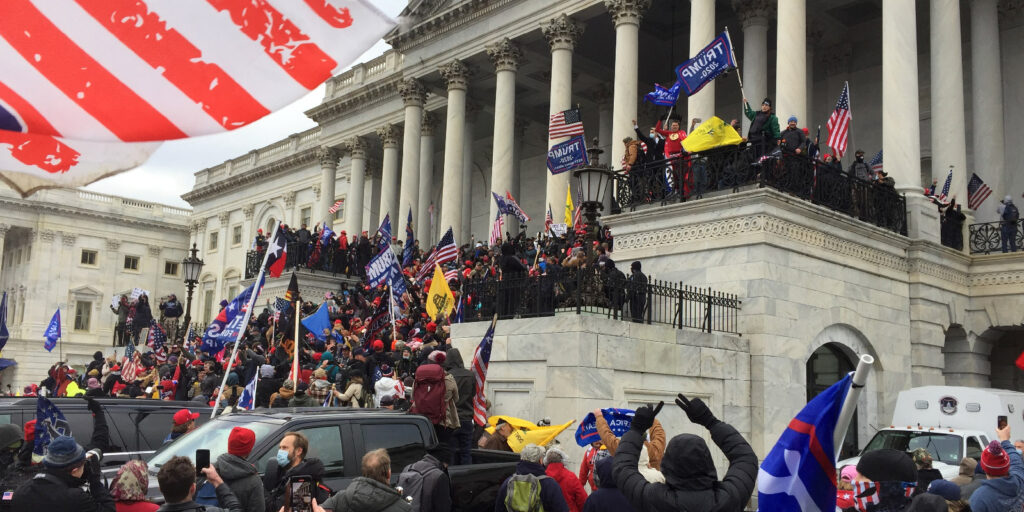
On January 6, 2021, thousands of right-wing protestors stormed the US Capitol Building. Fueled by an unprecedented onslaught of lies and fabrications and conspiracy theories surrounding the November 2020 elections, they had rallied that morning in front of the White House to “Stop the Steal.” Repeating a familiar litany of easily disproven falsehoods about the election,1 the sitting president of the United States urged them to march on the Capitol and stop the certification of the November election. “You’ll never take back our country with weakness,” he said. “Fight like hell,” he said. “If you don’t fight like hell, you’re not going to have a country anymore.”2 And so they did. They marched on the Capitol, armed themselves with metal pipes, baseball bats, hockey sticks, pepper spray, stun guns, and flagpoles, and attacked the police officers barricading the building.
“It was like something from a medieval battle,” Capitol Police Officer Aquilino Gonell recalled.3 The mob pulled D.C. Metropolitan Police Officer Michael Fanone into the crowd, beat him with flagpoles, and tasered him. “Kill him with his own gun,” Fanone remembered the mob shouting just before he lost consciousness. “I can still hear those words in my head today,” he testified a few months later.4
The mob breached the outside barriers and, as legislators cowered in their chambers and fumbled with gas masks, poured into the building and attacked hastily built barriers, occupying the Capitol rotunda, the Senate chamber, and legislative offices, including that of Speaker of the House Nancy Pelosi. In all of American history, nothing like it had ever happened. Perhaps the greatest domestic assault on the American federal government and its democratic institutions since the Civil War, the events of January 6 were nevertheless rooted in a historical context.
Revolutionary technological change, unprecedented global flows of goods and people and capital, an amorphous decades-long War on Terror, accelerating inequality, growing demographic diversity, a changing climate, political gridlock, declining faith in institutions: our present is not an island of circumstance but a product of history. Time marches forever on, but, as William Faulkner put it, “The past is never dead. It’s not even past.”5 The last several decades of American history have culminated in an era not only of stunning technological innovation but also of stark partisan division, racial and ethnic tension, protests, gender divides, uneven economic growth, widening inequalities, military interventions, bouts of mass violence, and pervasive anxieties about the present and future of the United States. Through boom and bust, national tragedy, foreign wars, and the maturation of new generations, a new chapter of American history is still being written.
II. September 11 and the War on Terror

On the morning of September 11, 2001, nineteen operatives of the al-Qaeda terrorist organization hijacked four passenger planes on the East Coast. American Airlines Flight 11 crashed into the North Tower of the World Trade Center in New York City at 8:46 a.m. Eastern Daylight Time (EDT). United Airlines Flight 175 crashed into the South Tower at 9:03. American Airlines Flight 77 crashed into the western façade of the Pentagon at 9:37. At 9:59, the South Tower of the World Trade Center collapsed. At 10:03, United Airlines Flight 93 crashed in a field outside Shanksville, Pennsylvania, brought down by passengers who had received news of the earlier hijackings. At 10:28, the North Tower collapsed. In less than two hours, nearly three thousand Americans had been killed.

The attacks stunned Americans. That night, President Bush addressed the nation and assured the country that “the search is under way for those who are behind these evil acts.” At Ground Zero three days later, Bush thanked first responders for their work. A worker said he couldn’t hear him. “I can hear you,” Bush shouted back. “The rest of the world hears you. And the people who knocked these buildings down will hear all of us soon.”
American intelligence agencies quickly identified the radical Islamic militant group al-Qaeda, led by the wealthy Saudi Osama bin Laden, as the perpetrator of the attack. Sheltered in Afghanistan by the Taliban, the country’s radical Islamic government, al-Qaeda was responsible for the 1993 bombing of the World Trade Center and a string of attacks at US embassies and military bases across the world. Bin Laden’s Islamic radicalism and his anti-American aggression attracted supporters across the region; by 2001, al-Qaeda was active in over sixty countries.
Although in his presidential campaign Bush had denounced foreign nation-building, he populated his administration with neoconservatives, firm believers in the expansion of American democracy and American interests abroad. Bush advanced what was sometimes called the Bush Doctrine, a policy in which the United States would have the right to unilaterally and preemptively make war on any regime or terrorist organization that posed a threat to the United States or to US citizens. It would lead the United States into protracted conflicts in Afghanistan and Iraq and entangle the United States in nations across the world. Journalist Dexter Filkins called it a “forever war,” a perpetual conflict waged against an amorphous and undefeatable enemy.6 The geopolitical realities of the twenty-first century world were transformed.
More immediately, September 11 led to war. The United States, of course, had a history in Afghanistan. When the Soviet Union invaded Afghanistan in December 1979 to quell an insurrection that threatened to topple Kabul’s communist government, the United States financed and armed anti-Soviet insurgents, the mujahideen. In 1981, the Reagan administration authorized the CIA to provide the mujahideen with weapons and training to strengthen the insurgency. Bin Laden also fought with and funded the mujahideen during this period. And they began to win. Afghanistan bled the Soviet Union dry. The costs of the war, coupled with growing instability at home, convinced the Soviets to withdraw from Afghanistan in 1989.7
Bin Laden relocated al-Qaeda to Afghanistan after the country fell to the Taliban in 1996. Under Bill Clinton, the United States launched cruise missiles at al-Qaeda camps in Afghanistan in retaliation for al-Qaeda bombings on American embassies in Africa.
After September 11, with a broad authorization of military force, Bush administration officials made plans for military action against al-Qaeda and the Taliban. What would become the longest war in American history began with the launching of Operation Enduring Freedom in October 2001. Air and missile strikes hit targets across Afghanistan. US Special Forces joined with fighters in the anti-Taliban Northern Alliance. Major Afghan cities fell in quick succession. The capital, Kabul, fell on November 13. Bin Laden and al-Qaeda operatives retreated into the rugged mountains along the border of Pakistan in eastern Afghanistan. The American occupation of Afghanistan continued.
As American troops struggled to contain the Taliban in Afghanistan, the Bush administration set its sights on Iraq. After the conclusion of the Gulf War in 1991, American officials established economic sanctions, weapons inspections, and no-fly zones. By mid-1991, American warplanes were routinely patrolling Iraqi skies and coming under periodic fire from Iraqi missile batteries. The overall cost to the United States of maintaining the two no-fly zones over Iraq was roughly $1 billion a year. Related military activities in the region added almost another $500 million to the annual bill. On the ground in Iraq, meanwhile, Iraqi authorities clashed with UN weapons inspectors. Iraq had suspended its program for weapons of mass destruction, but Saddam Hussein fostered ambiguity about the weapons in the minds of regional leaders to forestall any possible attacks against Iraq.
In 1998, a standoff between Hussein and the United Nations over weapons inspections led President Bill Clinton to launch punitive strikes aimed at debilitating what was thought to be a developed chemical weapons program. Attacks began on December 16, 1998. More than two hundred cruise missiles fired from US Navy warships and Air Force B-52 bombers flew into Iraq, targeting suspected chemical weapons storage facilities, missile batteries, and command centers. Airstrikes continued for three more days, unleashing in total 415 cruise missiles and 600 bombs against 97 targets. The number of bombs dropped was nearly double the number used in the 1991 conflict.
The United States and Iraq remained at odds throughout the 1990s and the early 2000s, when Bush administration officials began championing “regime change.” The administration publicly denounced Saddam Hussein’s regime and its alleged weapons of mass destruction. Deceptively tying Saddam Hussein to international terrorists was strikingly effective—a majority of Americans linked Hussein to the 9/11 attack despite the total lack of evidence for such a link.8 The administration’s push for war was in full swing. Protests broke out across the country and all over the world, but majorities of Americans supported military action. On October 16, Congress passed the Authorization for Use of Military Force Against Iraq resolution, giving Bush the power to make war in Iraq. Iraq began cooperating with UN weapons inspectors in late 2002, but the Bush administration pressed on. On February 6, 2003, Secretary of State Colin Powell, who had risen to public prominence as chairman of the Joint Chiefs of Staff during the Persian Gulf War in 1991, presented allegations of a robust Iraqi weapons program to the UN. Protests continued.
The first American bombs hit Baghdad on March 20, 2003. Several hundred thousand troops moved into Iraq, and Hussein’s regime quickly collapsed. Baghdad fell on April 9. On May 1, 2003, aboard the USS Abraham Lincoln, beneath a banner reading Mission Accomplished, George W. Bush announced that “major combat operations in Iraq have ended.”9 No evidence of weapons of mass destruction were ever found. And combat operations had not ended, not really. The Iraqi insurgency had begun, and the United States would spend the next ten years struggling to contain it.

Efforts by various intelligence gathering agencies led to the capture of Saddam Hussein, found hiding in an underground compartment near his hometown, on December 13, 2003. The new Iraqi government found him guilty of crimes against humanity and he was hanged on December 30, 2006. But the war in Iraq was not over.
III. The End of the Bush Years
The War on Terror was a centerpiece in the race for the White House in 2004. The Democratic ticket, headed by Massachusetts senator John Kerry, a Vietnam War hero who entered the public consciousness for his 1971 testimony against the conflict, attacked Bush for the ongoing inability to contain the Iraqi insurgency or to find weapons of mass destruction, the revelation and photographic evidence that American soldiers had abused prisoners at the Abu Ghraib prison outside Baghdad, and the inability to find Osama bin Laden. Moreover, many enemy combatants who had been captured in Iraq and Afghanistan were “detained” indefinitely at a military prison in Guantanamo Bay in Cuba. “Gitmo” became infamous for its harsh treatment, indefinite detentions, and torture of prisoners. Bush defended the War on Terror, and his allies attacked critics for failing to support the troops. Moreover, Kerry had voted for the war—and now had to attack the very thing he had authorized.
Bush also harnessed post-9/11 cultural anxieties in 2004, using abortion and same-sex marriage (“gay marriage”) as “wedge issues” to rally key constituencies. The Supreme Court, for instance, had struck down “sodomy laws”—the criminalization of gay sex—in Lawrence v. Texas (2003), but majorities still told pollsters that gay and lesbian relationships were “morally wrong.”10 Bush—an evangelical who had relied upon the religious right throughout his 2000 presidential campaign—used the specter of same-sex marriage—which gay rights advocates were busy building support for, as Democratic allies awkwardly embraced “civil unions”—to appeal to religious conservatives. Such issues spoke to widespread social divisions: popular media outlets increasingly focused on a cultural divide between a “blue America”—urban, Democratic, secular, younger, diverse, liberal—and a “red America”—rural, Republican, religious, older, native-born, conservative. Books such as Thomas Frank’s What’s the Matter with Kansas? captured the exasperation of some political observers that cultural issues were dividing Americans, but in an increasingly impotent political system, culture and group identity increasingly defined politics and motivated voters. In November, Bush won a close but clear victory.
The second Bush term saw the continued deterioration of the wars in Iraq and Afghanistan, but Bush’s presidency would take a bigger hit from his perceived failure to respond to the domestic tragedy that followed Hurricane Katrina’s devastating hit on the Gulf Coast. Katrina had been a Category 5 hurricane. It was, the New Orleans Times-Picayune reported, “the storm we always feared.”11

New Orleans suffered a direct hit, the levees broke, and the bulk of the city was flooded. Thousands of refugees flocked to the Superdome—where supplies and medical treatment and evacuation were slow to come. Individuals died in the heat. Bodies wasted away. Americans saw poor Black Americans abandoned. Katrina became a symbol of a broken administrative system, a devastated coastline, and irreparable social structures that allowed escape and recovery for some and not for others. Critics charged that Bush had staffed his administration with incompetent supporters and had ignored the displaced poor and Black residents of New Orleans.12
Immigration, meanwhile, had become an increasingly potent political issue amid the wave of nativism and nationalistic paranoia unleashed by 9/11. George W. Bush fanned widespread anti-immigration sentiment to win reelection and Republicans used it in the 2006 midterms, passing legislation—with bipartisan support from Democrats such as Senators Joe Biden, Hillary Clinton, and Barack Obama—that provided for a border “fence.” Seven hundred miles of towering steel barriers sliced through border towns and deserts. Many immigrants and their supporters tried to fight back. The spring and summer of 2006 saw waves of protests across the country. Hundreds of thousands marched in Chicago, New York, and Los Angeles, and tens of thousands marched in smaller cities around the country. Legal change, however, went nowhere. Moderate conservatives feared upsetting business interests’ demand for cheap, exploitable labor and alienating large voting blocs by stifling immigration, and moderate liberals feared upsetting anti-immigrant groups by pushing too hard for liberalization of immigration laws. The fence was built and the border was tightened.
At the same time, Iraq descended further into chaos as insurgents battled against American troops and groups such as Abu Musab al-Zarqawi’s al-Qaeda in Iraq bombed civilians and released video recordings of beheadings. In 2007, twenty-seven thousand additional US forces deployed to Iraq under the command of General David Petraeus. The effort, known as “the surge,” employed more sophisticated anti-insurgency strategies and, combined with Sunni efforts, pacified many of Iraq’s cities and provided cover for the withdrawal of American forces. On December 4, 2008, the Iraqi government approved the US-Iraq Status of Forces Agreement, and US combat forces withdrew from Iraqi cities before June 30, 2009. The last US combat forces left Iraq on December 18, 2011. Violence and instability continued to rock the country.
Afghanistan, meanwhile, had also continued to deteriorate. In 2006, the Taliban reemerged, as the Afghan government proved both highly corrupt and incapable of providing social services or security for its citizens. The Taliban began reacquiring territory. Money and American troops continued to prop up the Afghanistan government until American forces withdrew hastily in August 2021. The Taliban immediately took over the remainder of the country, outlasting America’s twenty-year occupation.
IV. The Great Recession
The Great Recession began, as most American economic catastrophes begin, with the bursting of a speculative bubble. Throughout the 1990s and into the new millennium, home prices continued to climb, and financial services firms looked to cash in on what seemed to be a safe but lucrative investment. After the dot-com bubble burst, investors searched for a secure investment rooted in clear value, rather than in trendy technological speculation. What could be more secure than real estate? But mortgage companies began writing increasingly risky loans and then bundling them together and selling them over and over again, sometimes so quickly it became difficult to determine exactly which financial services entity had an interest in what tranche of loans.
Decades of financial deregulation had rolled back Depression-era restraints and again allowed risky business practices to dominate the world of American finance. It was a bipartisan agenda. In the 1990s, for instance, Bill Clinton signed the Gramm-Leach-Bliley Act, repealing provisions of the 1933 Glass-Steagall Act separating commercial and investment banks, and the Commodity Futures Modernization Act, which exempted credit-default swaps—perhaps the key financial mechanism behind the crash—from regulation.
Mortgages had been so heavily leveraged that when American homeowners began to default on their loans, the whole system collapsed. Major financial services firms such as Bear Stearns and Lehman Brothers disappeared almost overnight. In order to prevent the crisis from spreading, President Bush signed the Emergency Economic Stabilization Act and the federal government immediately began pouring billions of dollars into the industry, propping up hobbled banks. Massive giveaways to bankers created shock waves of resentment throughout the rest of the country, contributing to Obama’s 2008 election. But Obama oversaw the program after his inauguration. Thereafter, conservative members of the Tea Party decried the cronyism of an incoming Obama administration filled with former Wall Street executives. The same energies also motivated the Occupy Wall Street movement of 2011, in which young, left-leaning New Yorkers protested an American economy that seemed overwhelmingly tilted toward “the one percent.”13
The Great Recession only magnified already rising income and wealth inequalities. According to the chief investment officer at JPMorgan Chase, the largest bank in the United States, “profit margins have reached levels not seen in decades,” and “reductions in wages and benefits explain the majority of the net improvement.”14 A study from the Congressional Budget Office found that since the late 1970s, after-tax benefits of the wealthiest 1 percent grew by over 300 percent. The “average” American’s after-tax benefits had grown 35 percent. Economic trends have disproportionately and objectively benefited the wealthiest Americans. Still, despite political rhetoric, American frustration failed to generate anything like the social unrest of the early twentieth century. A weakened labor movement and a strong conservative bloc continue to stymie serious attempts at reversing or even slowing economic inequalities. Occupy Wall Street managed to generate a fair number of headlines and shift public discussion away from budget cuts and toward inequality, but its membership amounted to only a fraction of the far more influential (and money-driven) Tea Party. Its presence on the public stage was fleeting.
The Great Recession, however, was not. While American banks quickly recovered and recaptured their steady profits and the American stock market climbed again to new heights, American workers continued to drift. Job growth was slow and unemployment rates would remain stubbornly high for years. Wages froze, meanwhile, and the well-paying full-time jobs that were lost were too often replaced by low-paying, part-time work. A generation of workers coming of age within the crisis, moreover, had been savaged by the economic collapse. Unemployment among young Americans hovered for years at rates nearly double the national average.
V. The Obama Years
By the 2008 election, with Iraq still in chaos, the ever-cautious Democrats, finally ready to embrace the antiwar position, chose a candidate who had consistently opposed military action in Iraq. Senator Barack Obama had been a member of the Illinois Senate when Congress debated the war actions, but he had publicly denounced the war, predicting the sectarian violence that would ensue, and remained critical of the invasion through his 2004 campaign for the US Senate. He began running for president almost immediately after arriving in Washington.
A former law professor and community activist, Obama became the first African American candidate to capture the nomination of a major political party.15 During the election, Obama won the support of an increasingly antiwar electorate. When the already fragile economy finally collapsed in 2007 and 2008, Bush’s policies were widely blamed. Obama’s opponent, Republican senator John McCain, was tied to those policies and struggled to fight off the nation’s desire for a new political direction. Obama won a convincing victory in the fall and became the nation’s first African American president.

President Obama’s first term was marked by domestic affairs, especially his efforts to combat the Great Recession and to pass a national healthcare law. Obama came into office as the economy continued to deteriorate. He continued the bank bailout begun under his predecessor and launched a limited economic stimulus plan to provide government spending to reignite the economy.
Despite Obama’s dominant electoral victory, national politics fractured, and a conservative Republican firewall quickly arose against the Obama administration. “The Tea Party” became a catchall term for a diffuse movement of fiercely conservative and politically frustrated American voters. Typically whiter, older, and richer than the average American, flush with support from wealthy backers, and clothed in the iconography of the founding fathers, Tea Party activists registered their deep suspicions of the federal government.16 Tea Party protests dominated the public eye in 2009, and activists steered the Republican Party far to the right, capturing primary elections all across the country.
Obama’s most substantive legislative achievement proved to be a national healthcare law, the Patient Protection and Affordable Care Act, otherwise known as Obamacare. Presidents since Theodore Roosevelt had striven to pass national healthcare reform and failed. Obama’s plan forsook liberal models of a national healthcare system and instead adopted a heretofore conservative model of subsidized private care (similar plans had been put forward by Republicans Richard Nixon, Newt Gingrich, and Obama’s 2012 opponent, Mitt Romney). Beset by conservative protests, Obama’s healthcare reform narrowly passed through Congress. It abolished preexisting conditions as a cause for denying care, scrapped junk plans, provided for state-run healthcare exchanges (allowing individuals without healthcare to pool their purchasing power), offered states funds to subsidize an expansion of Medicaid, and required all Americans to provide proof of a health insurance plan that measured up to government-established standards (those who did not purchase a plan would pay a penalty tax, and those who could not afford insurance would be eligible for federal subsidies). The number of uninsured Americans remained stubbornly high, however, and conservatives spent most of the next decade attacking the bill.

Meanwhile, in 2009, President Barack Obama deployed seventeen thousand additional troops to Afghanistan as part of a counterinsurgency campaign that aimed to “disrupt, dismantle, and defeat” al-Qaeda and the Taliban. US Special Forces and CIA drones targeted al-Qaeda and Taliban leaders. In May 2011, US Navy Sea, Air and Land Forces (SEALs) conducted a raid deep into Pakistan that led to the killing of Osama bin Laden. The United States and NATO began a phased withdrawal from Afghanistan in 2011, with the aim of removing all combat troops by 2014. Although weak militarily, the Taliban had not been defeated. They remained politically influential in southern and eastern Afghanistan. Al-Qaeda remained active in Pakistan but shifted its bases to Yemen and the Horn of Africa. Through December 2013, the war in Afghanistan had claimed the lives of 3,397 US service members.
VI. Stagnation
In 2012, Barack Obama won a second term by defeating Republican Mitt Romney, the former governor of Massachusetts. However, Obama’s inability to control Congress and the ascendancy of Tea Party Republicans stunted the passage of meaningful legislation. Obama was a lame duck before he ever won reelection, and gridlocked government came to represent an acute sense that much of American life—whether in politics, economics, or race relations—had grown stagnant.
The economy continued its halfhearted recovery from the Great Recession. The Obama administration campaigned on little to specifically address the crisis and, faced with congressional intransigence, accomplished even less. While corporate profits climbed and stock markets soared, wages stagnated and employment sagged for years after the Great Recession. By 2016, the statistically average American worker had not received a raise in almost forty years. The average worker in January 1973 earned $4.03 an hour. Adjusted for inflation, that wage was about two dollars per hour more than the average American earned in 2014. Working Americans were losing ground. Moreover, most income gains in the economy had been largely captured by a small number of wealthy earners. Between 2009 and 2013, 85 percent of all new income in the United States went to the top 1 percent of the population.17
But if money no longer flowed to American workers, it saturated American politics. In 2000, George W. Bush raised a record $172 million for his campaign. In 2008, Barack Obama became the first presidential candidate to decline public funds (which had the effect of removing all applicable caps to his total fundraising) and raised nearly three quarters of a billion dollars for his campaign. The average House seat, in the meantime, cost about $1.6 million, and the average Senate Seat over $10 million.18 The Supreme Court, meanwhile, removed barriers to outside political spending. In 2002, Senators John McCain and Russ Feingold crossed party lines to pass the Bipartisan Campaign Reform Act, bolstering campaign finance laws passed in the aftermath of the Watergate scandal in the 1970s. But political organizations—particularly PACs—exploited loopholes to raise large sums of money, and in 2010, the Supreme Court ruled in Citizens United v. FEC that no limits could be placed on political spending by corporations, unions, and nonprofits. Money flowed even deeper into politics.
The influence of money in politics only heightened partisan gridlock, further blocking bipartisan progress on particular political issues. Climate change, for instance, has failed to transcend partisan barriers. In the 1970s and 1980s, experts substantiated the theory of anthropogenic (human-caused) global warming. Eventually, the most influential of these panels, the UN’s Intergovernmental Panel on Climate Change (IPCC) concluded in 1995 that there was a “discernible human influence on global climate.”19 This conclusion, though stated conservatively, was by that point essentially the scientific consensus. By 2007, the IPCC considered the evidence “unequivocal” and warned that “unmitigated climate change would, in the long term, be likely to exceed the capacity of natural, managed and human systems to adapt.”20
Climate change became a permanent and major topic of public discussion and policy in the twenty-first century. Fueled by popular coverage—most notably, perhaps, the documentary An Inconvenient Truth, based on Al Gore’s book and presentations of the same name—addressing climate change became a plank of the American left and a point of denial for the American right. American public opinion and political action still lagged far behind the scientific consensus on the dangers of global warming. Conservative politicians, conservative think tanks, and energy companies waged war to sow questions in the minds of Americans, who remained divided on the question, as they did on so many others.21
Some of the resistance to addressing climate change was rooted in national economic anxieties. As Americans looked over their shoulder at China, many refused to sacrifice immediate economic growth for long-term environmental security. Twenty-first-century relations with China remained characterized by contradictions and interdependence. After the collapse of the Soviet Union, China reinvigorated its efforts to modernize its country. By liberating and subsidizing much of its economy and drawing enormous foreign investments over the last several decades, China posted massive growth rates. Enormous cities rose by the day. US-China cultural exchange increased as students, immigrants, and tourists traveled between nations. China, meanwhile, emerged as a manufacturing hub for US (and global) trade. In 2000, China had a GDP around an eighth the size of US GDP, but, based on growth rates and trends, many analysts predicted that China’s economy would soon bypass United States’s. The US defied prognosticators by maintaining its global lead, but American concerns about China’s rising global power persisted alongside ever-increasing consumption of Chinese goods.
VII. American Carnage

By 2016, American voters were fed up. In that year’s presidential race, Republicans spurned their political establishment and nominated a real estate developer and celebrity billionaire, Donald Trump, who, decrying the tyranny of political correctness and promising to “Make America Great Again,” vowed to build a wall to keep out Mexican immigrants and bar Muslim immigrants. Democrats, meanwhile, flirted with the candidacy of Senator Bernie Sanders, a self-described democratic socialist from Vermont, before ultimately nominating Hillary Clinton, who, after eight years as first lady in the 1990s, had served eight years in the Senate and four more as secretary of state. Voters despaired: Trump and Clinton were the most unpopular nominees in modern American history. Majorities of Americans viewed each candidate unfavorably, and majorities in both parties said, early in the election season, that they were motivated more by voting against their rival candidate than for their own.22 With incomes frozen, politics gridlocked, race relations tense, and headlines full of violence, such frustrations only channeled a larger sense of stagnation, upsetting traditional political allegiances. In the end, despite winning nearly three million more votes nationwide, Clinton failed to carry key Midwestern battlegrounds where frustrated white working-class voters abandoned the Democratic Party—a Republican presidential candidate had not carried Wisconsin, Michigan, or Pennsylvania since the 1980s—and swung their support to the Republicans. Donald Trump won the presidency.
Political divisions only deepened after the election. A nation already deeply split by income, culture, race, geography, and ideology continued to come apart. Trump’s presidency consumed national attention. Traditional print media and the consumers and producers of social media could not help but throw themselves at the ins and outs of Trump’s norm-smashing first years while seemingly refracting every major event through the prism of the Trump presidency. Robert Mueller’s investigation of Russian election-meddling and the alleged collusion of campaign officials in that effort produced countless headlines, if not that much else.
New policies, meanwhile, enflamed widening cultural divisions. Migration from Central America spiked between 2007 and 2015, and border apprehensions and deportations reached record levels under the Obama administration. Trump pushed even farther. Anti-immigration politics suffused his campaign. He pushed for a massive wall along the border to supplement the fence built under the Bush administration. He began ordering the deportation of so-called Dreamers—students who were born elsewhere but grew up in the United States—and immigration officials forcibly separated refugee-status-seeking parents and children at the border. Trump’s border policies heartened his base and aggravated his opponents. While Trump stoked America’s enduring culture war, his narrowly passed 2017 tax cut continued the redistribution of American wealth toward corporations and wealthy individuals. The tax cut grew the federal deficit and further exacerbated America’s widening economic inequality.
In his inaugural address, Donald Trump promised to end what he called “American carnage”—a nation ravaged, he said, by illegal immigrants, crime, and foreign economic competition. But, under his presidency, the nation only spiraled deeper into cultural and racial divisions, domestic unrest, and growing anxiety about the nation’s future. Trump represented an aggressive, pugilistic anti-liberalism, and as president, he never missed an opportunity to fuel the fires of right-wing rage. Refusing to settle for the careful statement or defer to bureaucrats, Trump smashed many of the norms of the presidency and raged on his personal Twitter account. And he refused to be governed by the truth.
Few Americans, especially after the Johnson and Nixon administrations, believed that presidents never lied. Liberal critics, for instance, repeatedly derided the Bush administration for what comedian Stephen Colbert mocked as its “truthiness” (Merriam-Webster’s word of the year for 2006). But perhaps no president ever lied so boldly, so compulsively, or so often as Donald Trump, who made, according to a 2021 Washington Post tally, 30,573 “false or misleading claims” during his first term, roughly twenty-one per day.23 What proved so perplexing was the obvious absurdity of so many of them. On the administration’s very first day in office, for instance, the White House Press Secretary made verifiably false claims about the size of its inauguration crowds. Rather than retreat, a White House spokeswoman defended the administration’s “alternative facts.” By the latter years of his first term, only about a third of Americans counted him as trustworthy.24 Long decades of blatant and sustained political cynicism had undermined much faith in the integrity of politicians and political media, but Trump—and the larger world of online misinformation in which he had long trafficked—seemingly broke apart whatever remained of an expectation for a basic shared reality among Americans. And that shattered reality led directly to January 6, 2021.
In November 2020, Joseph R. Biden, a longtime senator from Delaware and former vice president under Barack Obama, running alongside Kamala Harris, a California senator who would become the nation’s first female vice president, convincingly defeated Donald Trump at the polls: Biden won the popular vote by a margin of 4 percent and the electoral vote by a margin of seventy-four votes, marking the first defeat for an incumbent president in nearly thirty years. But Trump refused to concede the election. He said it had been stolen. He said votes had been manufactured. He said it was all rigged. The claims were easily debunked, but it didn’t seem to matter: months after the election, somewhere between one-half and two-thirds of self-identified Republicans judged the election stolen.25 So when, on the afternoon of January 6, 2021, the president again articulated a litany of lies about the election and told the crowd of angry conspiracy-minded protestors to march to the Capitol and “fight like hell,” they did.
Thousands of Trump’s followers converged on the Capitol. Roughly one in seven of the more than five hundred rioters first arrested were affiliated with extremist groups organized around conspiracy theories, white supremacy, and the right-wing militia movement.26 They waved American and Confederate flags, displayed conspiracy theory slogans and white supremacist icons, carried Christian iconography, and, above all, bore flags, hats, shirts, and other garb emblazoned with the name of Donald Trump.27 Arming themselves for hand-to-hand combat, they pushed past barriers and battled barricaded police officers. The Capitol attackers injured about 150 of them. Officers suffered concussions, burns, bruises, stab wounds, and broken bones.28 One suffered a nonfatal heart attack after being shocked repeatedly by a stun gun. Capitol Police Officer Brian D. Sicknick was killed, either by repeated attacks with a fire extinguisher or from mace or bear spray. Four other officers later died by suicide.
As the rioters breached the building, officers inside the House chamber moved furniture to barricade the doors as House members huddled together on the floor, waiting for a breach. Ashli Babbitt, a thirty-five-year-old Air Force veteran consumed by social-media conspiracy theories and wearing a Trump flag around her neck, was shot and killed by a Capitol Police officer when she attempted to storm the chamber (“I’m a big fan of Ashli Babbitt, okay,” President Trump said in 2025). The House Chamber held, but attackers breached the Senate Chamber on the opposite end of the building. The lawmakers had, by then, been evacuated.
The rioters held the Capitol for several hours before the National Guard cleared them out that evening. Congress, refusing to back down, stayed into the night to certify the results of the election. And yet, despite everything that had happened the day, the president’s unfounded claims of election fraud kept their grip on Republican lawmakers: eleven Republican senators and 150 of the House’s 212 Republicans lodged objections to the certification. And a little more than a month later, they refused to convict Donald Trump during his quickly organized second impeachment trial, this time for “incitement of insurrection.”
When he returned to office following the 2024 election, Trump, on January 20, 2025, the first day of his second term in office, granted “a full, complete and unconditional pardon” to the more than fifteen hundred January 6 rioters.
VIII. The Pandemic
In the winter of 2019 and 2020, a new respiratory virus, Covid-19, emerged in Wuhan, China. It was a coronavirus, named after its spiky, crown-like appearance under a microscope. Other coronaviruses had been identified and contained in previous years, but, by December, Chinese doctors were treating dozens of cases, and, by January, hundreds. Wuhan shut down to contain the outbreak, but the virus escaped. In January, the United States confirmed its first case. Deaths were reported in the Philippines and in France. Outbreaks struck Italy and Iran. And the American case counts grew. Countries began locking down. Air travel slowed.
The virus was highly contagious and could be spread before the onset of symptoms. Many who had the virus were asymptomatic: they didn’t exhibit any symptoms at all. But others, especially the elderly and those with “comorbidities,” were struck down. The virus attacked their airways, suffocating them. Doctors didn’t know what they were battling. They struggled to procure oxygen and respirators and incubated the worst cases with what they had. But the deaths piled up.
The virus hit New York City in the spring. The city was devastated. Hospitals overflowed as doctors struggled to treat a disease they barely understood. By April, thousands of patients were dying every day. The city couldn’t keep up with the bodies. Dozens of “mobile morgues” were set up to house bodies that wouldn’t be processed for months.29
With medical-grade masks in short supply, Americans made their own homemade cloth masks. Many right-wing Americans notably refused to wear them at all, further exposing workers and family members to the virus.
Failing to contain the outbreak, the country shut down. Flights stopped. Schools and restaurants closed. White-collar workers transitioned to working from home when offices shut down. But others weren’t so lucky. By April, 10 million Americans had lost their jobs.30
But the shutdowns were scattered and incomplete. States were left to fend for themselves, setting their own policies and competing with one another to acquire scarce personal protective equipment (PPE). Many workers couldn’t stay home. Hourly workers, lacking paid sick leave, often had to choose between a paycheck and reporting to work having been exposed or even when presenting symptoms. Mask-wearing, meanwhile, became politicized. By May, one hundred thousand Americans were dead. A new wave of cases hit the South in July and August, overwhelming hospitals across much of the region. But the worst came in the winter, when the outbreak went fully national. Hundreds of thousands tested positive for the virus every day, and nearly three thousand Americans died every day throughout January and much of February 2021.
The outbreak retreated in early 2021, and pharmaceutical labs, flush with federal dollars, released new, cutting-edge vaccines. By late spring, Americans were getting vaccinated by the millions. But many, variously swayed by conspiracy theories peddled on social media or simply politically radicalized into associating vaccinations or other mitigation measures with anti-Trump politics, refused them. By late summer, barely a majority of those eligible for vaccines were fully vaccinated. More contagious and elusive strains of the virus evolved and spread, and the virus continued churning through the population, sending many, especially the elderly, the chronically ill, and the unvaccinated, to hospitals and to early deaths. By the end of the summer of 2021, according to official counts, over six hundred thousand Americans had died from Covid-19. By May 2022, the official death toll in the United States crossed one million. Most Americans eventually acquired Covid—often multiple times—or had been vaccinated, mitigating mortality. At the same time, the new most dominant strain of the virus was more transmissible but less deadly. The pandemic became endemic, defined by seasonal patterns in a manner more consistent with the patterns of regular life. Covid never disappeared. In 2023, Covid was the tenth leading cause of death in the United States; in 2024, provisionally, it was the fifteenth.
IX. New Horizons
Americans looked anxiously to the future, and yet also, often, to new generations busy discovering, perhaps, that change was not impossible. Much public commentary in the early twenty-first century concerned “millennials” and “Generation Z,” the generations that came of age during the new millennium. Commentators, demographers, and political prognosticators continued to ask what the new generations would bring. A cheeky sub-headline on the cover of Time’s May 20, 2013, issue, for instance, read “Millennials are lazy, entitled narcissists who still live with their parents: Why they’ll save us all.” Pollsters focused on features that distinguish millennials and Gen Z from older Americans: millennials, the pollsters said, were more diverse, more liberal, less religious, and harder hit by economic insecurity. “They are,” as one 2014 Pew report read, “relatively unattached to organized politics and religion, linked by social media, burdened by debt, distrustful of people, in no rush to marry—and optimistic about the future.”31 Gen Z, meanwhile, attracted its own genre of generational definition, unleashing streams of polls and articles trying to nail down the unique outlooks of a new generation.
Changing attitudes toward homosexuality, gay marriage, and “queer” sexuality reflected one of the most dramatic changes in the popular attitudes of recent years. After decades of advocacy, American attitudes shifted rapidly. In 2006, a majority of Americans were still telling Gallup pollsters that “gay or lesbian relations” was “morally wrong.”32 But prejudice against homosexuality plummeted, and greater public acceptance of coming out opened up in the culture—in 2001, 73 percent of Americans said they knew someone who was gay, lesbian, or bisexual; in 1983, only 24 percent did. Gay characters—and in particular, gay characters with depth and complexity—could be found across the cultural landscape. Attitudes shifted such that, by the 2010s, polls registered majority support for the legalization of gay marriage. A writer for The Wall Street Journal called it “one of the fastest-moving changes in social attitudes of this generation.”33
Such change was, in many respects, a generational one: on average, younger Americans supported gay marriage in higher numbers than older Americans. The Obama administration, meanwhile, moved tentatively. Refusing to push for national interventions on the gay marriage front, Obama did, however, direct a review of Defense Department policies that repealed the Don’t Ask, Don’t Tell policy in 2011. Without the support of national politicians, gay marriage was left to the courts. Beginning in Massachusetts in 2003, state courts had begun slowly ruling against gay marriage bans. Then, in June 2015, the Supreme Court ruled 5–4 in Obergefell v. Hodges that same-sex marriage was a constitutional right. Nearly two thirds of Americans supported the position.34
While liberal social attitudes marked the younger generation, perhaps nothing defined young Americans more than the embrace of technology. The Internet in particular, liberated from desktop modems, shaped more of daily life than ever before. The release of the Apple iPhone in 2007 popularized the concept of smartphones for millions of consumers. By 2011, about a third of Americans owned a mobile computing device; four years later, two thirds did.35
Together with the advent of social media, Americans used their smartphones and their desktops to stay in touch with old acquaintances, chat with friends, share photos, and interpret the world—as newspaper and magazine subscriptions dwindled, Americans increasingly turned to their social media networks for news and information.36 Ambitious new online media companies, hungry for clicks and the ad revenue they represented, churned out provocatively titled, easy-to-digest stories that could be linked and tweeted and shared widely among like-minded online communities, but even traditional media companies, forced to downsize their newsrooms to accommodate shrinking revenues, fought to adapt to their new online consumers.37
The ability of individuals to share stories through social media apps revolutionized the media landscape—smartphone technology and the democratization of media reshaped political debates and introduced new political questions. The easy accessibility of video capturing and the ability for stories to go viral outside traditional media, for instance, brought new attention to the tense and often violent relations between municipal police officers and African Americans. The 2014 death of Michael Brown in Ferguson, Missouri, sparked protests and focused the issue. It perhaps became a testament to the power of social media platforms such as Twitter that a hashtag, #BlackLivesMatter, became a rallying cry for protesters and counterhashtags, #alllivesmatter and #bluelivesmatter, for critics.38 But a relentless number of videos documenting the deaths of Black men at the hands of police officers continued to circulated across social media networks. The deaths of Eric Garner, twelve-year-old Tamir Rice, and Philando Castile were captured on cell phone cameras and went viral. So too did the stories of Breonna Taylor and Botham Jean. “Say their names,” ran a popular chant at Black Lives Matters marches. And then, in the first weeks of the Covid-19 epidemic, George Floyd was murdered.

On May 25, 2020, a teenager, Darnella Frazier, filmed Minneapolis police officer Derek Chauvin with his knee on the neck of George Floyd. “I can’t breathe,” Floyd said. Despite his pleas and those of bystanders, Chauvin kept his knee on Floyd’s neck for nine minutes. Floyd’s body had long gone limp. The horrific footage shocked much of the country. Despite state and local lockdowns to slow the spread of Covid-19, spontaneous demonstrations broke out across the country. Protests erupted not only in major cities but in small towns and rural communities. The demonstrations dwarfed, in raw numbers, any comparable protest in American history up to that point. Taken together, as many as twenty-five million Americans may have participated in racial justice demonstrations that summer.39 And yet, despite the marches, no great national policy changes followed. The “system” resisted calls to address “systemic racism.” Localities made efforts, of course. Criminal justice reformers won elections as district attorneys. Police departments mandated that their officers carry body cameras. As cries of “defund the police” sounded among left-wing Americans, some cities experimented with alternative emergency services that emphasized mediation and mental health. Conservatives, however, recoiling at a post-2020 uptick in violent crime, re-dedicated themselves to a “law and order” politics that would be championed by Donald Trump in his successful 2024 election campaign. Meanwhile, in a symbolic gesture, Democratic-leaning towns and cities in the South pulled down their Confederate iconography. But the intractable racial injustices embedded deeply within American life had not been uprooted, and racial disparities in wealth, education, health, and other measures persevered, as they already had, in the United States, for hundreds of years.
As the Black Lives Matter movement captured national attention, another social media phenomenon, the #MeToo movement, began as the magnification of outrage against the past sexual crimes of notable male celebrities before injecting a greater social intolerance toward men accused of sexual harassment and sexual violence into much of the rest of American society. The sudden zero tolerance reflected the new political energies of many American women, sparked in large part by the candidacy and presidency of Donald Trump. The day after Trump’s first inauguration, between five hundred thousand and one million people descended on Washington, D.C., for the Women’s March, and millions more demonstrated in cities and towns around the country to show a broadly defined commitment toward the rights of women and others in the face of the Trump presidency. And with three appointments to the Supreme Court, Donald Trump’s legacy persisted past his presidency. On June 24, 2022, the new conservative majority decided Dobbs v. Jackson, overturning Roe v. Wade (1973) and Planned Parenthood v. Casey (1992), cases that established a constitutional right to abortion.
Meanwhile, other avenues of sexual politics opened up across the country. By the 2020s, culturally liberal Americans began to champion transgender rights and other expressions of “queer” sexuality. The broader American culture increasingly featured transgender individuals in media, and many Americans began making their preferred pronouns explicit to undermine fixed notions of gender. Many conservatives, however, fought back. State legislators around the country sponsored “bathroom bills” to keep transgender individuals out of the bathroom of their identified gender, alleging that they posed a violent sexual risk. In Texas, Attorney General Ken Paxton declared pediatric gender-affirming care to be “child abuse.” Others focused on the participation of trans women in women’s sports. Donald Trump harnessed these attitudes in his 2024 reelection campaign: “Kamala is for they/them,” declared one notable television ad, played as many as fifty thousand times on air. “President Trump is for you.”
As issues of race and gender captured much public discussion, immigration continued to be a potent political issue. Anti-immigrant initiatives like California’s Proposition 187 (1994) and Arizona’s SB1070 (2010) reflected the anxieties of many native-born Americans, but millennials proved far more comfortable with immigration and diversity (which makes sense, given that they are the most diverse American generation in living memory). Since Lyndon Johnson’s Great Society liberalized immigration laws in the 1960s, the demographics of the United States have been transformed. In 2012, nearly a quarter of all Americans were immigrants or the sons and daughters of immigrants. Half came from Latin America. The ongoing Hispanicization of the United States and the ever-shrinking proportion of non-Hispanic whites have been among the most talked-about trends among demographic observers. By 2013, 17 percent of the nation was Hispanic. In 2014, Latinos surpassed non-Latino whites to become the largest ethnic group in California. In Texas, the image of a white cowboy hardly captures the demographics of a minority-majority state in which Hispanic Texans will soon become the largest ethnic group. For the nearly 1.5 million people of Texas’s Rio Grande Valley, for instance, where most residents speak Spanish at home, a full three fourths of the population is bilingual.40
And yet, it is not clear whether dramatic cultural changes were pushing the nation forward in any particular direction or whether they simply accelerated affective polarization—division rooted in abstract group identity, rather than in policy or class affiliation—ever more. Increasing diversity, for instance, did not increase support for immigration. Gen Z—men, in particular—did not follow the millennials leftward but moved to the right culturally. The Rio Grande Valley did not embrace a more liberal and humane immigration policy—the region moved farther rightward as a percentage, politically, than any other part of the country in 2020 and 2024. Many Democrats, for instance, dismissed Donald Trump’s immigration rhetoric as the ugly product of a raw and vile racism, and yet he and the Republican Party captured areas such as Hidalgo County in South Texas, the largest county in America with a population that is more than 90 percent Hispanic.
Class dealignment rendered old political truths increasingly uncertain: the Democratic Party—the party of labor, the Rooseveltian “common man,” and the postwar civil rights movement—seemed often to respond to the narrow concerns of its well-educated, white-collar core; the Republican Party—the party of the chamber of commerce and the country club—appealed to an increasingly multiracial constituency of working-class voters. Neither attacked the economic roots of a widespread economic crisis: as acute bouts of inflation—attributed, variously, to the logistical disruptions of Covid, Covid-era infusions of government spending, runaway deficit spending, historically low interest rates, and corporate greed—devastated American purchasing power after 2020, more and more Americans simply despaired.
Donald Trump mounted his reelection campaign against President Joe Biden in 2024. After the octogenarian sitting president appeared befuddled at a July debate, following months of speculation about his physical and mental capacities, Biden stepped aside for his vice president, Kamala Harris, to run in his stead. Without a clear message and refusing to either repudiate President Biden’s policies or distinguish herself in any particularly meaningful way, Harris mounted a short and feeble campaign incapable of either countering conservatives’ culture war attacks on immigrants and trans rights or overcoming the widespread economic pessimism wrought by rampant inflation.
Whatever norms that had limited Donald Trump’s first-term ambitions fell quickly in his second term. Having already declared that the presidency came with “a no-conflict-of-interest provision,” President Trump took money, brazenly and unapologetically, seemingly wherever he could. A 2025 New Yorker investigation estimated that the president had personally profited no less than $3 billion from overseas construction projects, crypto-currency schemes, and other money-grabbing ventures. The office of the presidency had never seen anything like it. At the same time, he extracted direct payments through legal settlements from major media companies. Elon Musk, the world’s richest man, spent more than a quarter of a billion dollars on the campaign and was rewarded, for a time, with an extralegal political office.41 President Trump, meanwhile, staffed his cabinet with unalloyed loyalists, whatever their qualifications. Rejecting the sludge of bureaucracy or the constraints of established legality, Trump deployed the full weight of his office to advance his agenda, issuing a flurry of executive orders (many of which were insulated from contravening court orders by the Supreme Court and its rapid-fire, explanation-free “shadow docket”). He deployed plainclothes federal immigration officers into cities and won headlines with dramatic, terrorizing immigration raids. Few presidents had so boldly wielded executive power and, with a pliant Republican Congress and a conservative Supreme Court, few had been so unrestrained. And, throughout it all, of course, Trump extended the tax cuts passed during his first term, marking a signature legislative accomplishment that exploded the federal deficit to sustain tax breaks disproportionally benefiting wealthy Americans—again.
Liberals and left-leaning Americans despaired of Trump’s second presidency no less than the first, but pessimism was seemingly everywhere. Political commentators fretted about self-perpetuating social media bubbles fueling perpetual outrage machines; academics worried about the decline of recreational reading and revolutionary changes wrought by large language models; schoolteachers despaired of plummeting test scores and diminished student abilities; magazine writers raised alarms about the psychological devastations wrought by smartphones and the collapse of friendships, romantic relationships, and general socializing. Everything seemed to be degrading. Popular online rhetoric circled around ideas such as “brain rot,” “enshittification,” and “slop.” All the while, Americans remained squeezed by an economy whose rewards continued to flow disproportionately to those who needed them the least.
Americans entered the second quarter of their new century in despair. In 2023, only 23 percent said “life in America today is better than it was 50 years ago,” and, far from improving, vast majorities predicted that American life would continue to worsen.42 Americans entered the second quarter of their new century in despair. In December 2024, only 19 percent of Americans said they were “satisfied” with “the way things are going in the United States at this time.”43 All they could see, it seemed, was American carnage.
X. Conclusion
The attacks of September 11, 2001, plunged the United States into interminable conflicts around the world and unleashed cultural divisions that have raged for more than two decades. Economic recession, a slow recovery, stagnant wage growth, and general pessimism infected American life as contentious politics and cultural divisions poisoned social harmony, leading to unprecedented polarization and alienation that culminated in the January 6, 2021, attack on the US Capitol. And yet the stream of history changes course. Trends shift, things change, and events turn. Nothing is foreordained. The United States is the product of history. New generations, bringing with them new perspectives, rise to put their own weight upon history, sounding their own raw and distinctive American yawp as they forge futures yet unforeseen.
XI. Reference Material
This chapter was edited by Joseph Locke and Michael D. Hammond, with content contributions by Eladio Bobadilla, Andrew Chadwick, Elsa Devienne, Zach Fredman, Leif Fredrickson, Michael Hammond, Richara Hayward, Joseph Locke, Mark Kukis, Shaul Mitelpunkt, Michelle Reeves, Elizabeth Skilton, Bill Speer, Patrick T. Troester, and Ben Wright.
Recommended Reading
• Alexander, Michelle. The New Jim Crow: Mass Incarceration in the Age of Colorblindness. New York: New Press, 2012.
• Canaday, Margot. The Straight State: Sexuality and Citizenship in Twentieth-Century America. Princeton, NJ: Princeton University Press, 2011.
• Carter, Dan T. From George Wallace to Newt Gingrich: Race in the Conservative Counterrevolution, 1963–1994. Baton Rouge: LSU Press, 1996.
• Cowie, Jefferson. Capital Moves: RCA’s 70-Year Quest for Cheap Labor. New York: New Press, 2001.
• Ehrenreich, Barbara. Nickel and Dimed: On (Not) Getting By in America. New York: Metropolitan, 2001.
• Evans, Sara. Tidal Wave: How Women Changed America at Century’s End. New York: Free Press, 2003.
• Gardner, Lloyd C. The Long Road to Baghdad: A History of U.S. Foreign Policy from the 1970s to the Present. New York: Free Press, 2008.
• Hinton, Elizabeth. From the War on Poverty to the War on Crime. Cambridge, MA: Harvard University Press, 2016.
• Hollinger, David. Postethnic America: Beyond Multiculturalism. New York: Basic Books, 1995.
• Hunter, James D. Culture Wars: The Struggle to Define America. New York: Basic Books, 1992.
• Meyerowitz, Joanne. How Sex Changed: A History of Transsexuality in the United States. Cambridge, MA: Harvard University Press, 2004.
• Mittelstadt, Jennifer. The Rise of the Military Welfare State. Cambridge, MA: Harvard University Press, 2015.
• Moreton, Bethany. To Serve God and Walmart: The Making of Christian Free Enterprise. Cambridge, MA: Harvard University Press, 2009.
• Nadasen, Premilla. Welfare Warriors: The Welfare Rights Movement in the United States. New York: Routledge, 2005.
• Osnos, Evan. Age of Ambition: Chasing Fortune, Truth, and Faith in the New China. New York: Farrar, Straus and Giroux, 2014.
• Packer, George. The Unwinding: An Inner History of the New America. New York: Farrar, Straus and Giroux, 2013.
• Patterson, James T. Restless Giant: The United States from Watergate to Bush v. Gore. New York: Oxford University Press, 2005.
• Piketty, Thomas. Capital in the Twenty-First Century. Translated from the French by Arthur Goldhammer. Cambridge, MA: Belknap Press, 2013.
• Ricks, Thomas E. Fiasco: The American Military Adventure in Iraq. New York: Penguin, 2006.
• Schlosser, Eric. Fast Food Nation: The Dark Side of the All-American Meal. New York: Houghton Mifflin Harcourt, 2001.
• Stiglitz, Joseph. Freefall: America, Free Markets, and the Sinking of the World Economy. New York: Norton, 2010.
• Taylor, Paul. The Next America: Boomers, Millennials, and the Looming Generational Showdown. New York: Public Affairs, 2014.
• Wilentz, Sean. The Age of Reagan: A History, 1974–2008. New York: HarperCollins, 2008.
• Williams, Daniel K. God’s Own Party: The Making of the Christian Right. New York: Oxford University Press, 2007.
• Wright, Lawrence. The Looming Tower: Al-Qaeda and the Road to 9/11. New York: Knopf, 2006.
Notes
- Scott Bauer, Todd Richmond, Christina A. Cassidy, Marc Levy, and Ali Swenson, “Trump’s Drumbeat of Lies About the 2020 Election Keeps Getting Louder. Here Are the Facts,” Associated Press, December XX, 2021, updated August 27, 2023, https://apnews.com/article/trump-2020-election-lies-debunked-4fc26546b07962fdbf9d66e739fbb50d; Hope Yen, “AP Fact Check: Yes, Trump Lost Election Despite What He Says,” Associated Press, May 6, 2021, https://apnews.com/article/donald-trump-michael-pence-electoral-college-elections-health-2d9bd47a8bd3561682ac46c6b3873a10; Sarah Longwell, “Trump Supporters Explain Why They Believe the Big Lie,” The Atlantic, April 18, 2022, https://www.theatlantic.com/ideas/archive/2022/04/trump-voters-big-lie-stolen-election/629572/; Gary C. Jacobson, “Donald Trump’s Big Lie and the Future of the Republican Party,” Presidential Studies Quarterly 51, no. 2 (June 2021): 273–289; Philip Moniz and William B. Swann, “The Power of Trump’s Big Lie: Identity Fusion, Internalizing Misinformation, and Support for Trump,” PS: Political Science and Politics 58, no. 3 (2025): 363–368; Kevin Arceneaux and Rory Truex, “Donald Trump and the Lie,” Perspectives on Politics 21, no. 3 (2023): 863–879.[↩]
- Calvin Woodward, “AP Fact Check: Trump’s Team Glosses over His Jan. 6 Tirade,” Associated Press, February 12, 2021, https://apnews.com/article/ap-fact-check-donald-trump-capitol-siege-violence-elections-507f4febbadecb84e1637e
55999ac0ea.[↩] - Peter Hermann, “‘We Got to Hold This Door’: How Battered D.C. Police Made a Stand Against the Capitol Mob,” Washington Post, January 14, 2021, https://www.washingtonpost.com/dc-md-va/2021/01/14/dc-police-capitol-riot/.[↩]
- Luke Broadwater and Nicholas Fandos, “‘A Hit Man Sent Them’: Police at the Capitol Recount the Horrors of Jan. 6 as the Inquiry Begins,” New York Times, July 27, 2021, updated August 26, 2021, https://www.nytimes.com/2021/07/27/us/jan-6-inquiry.html.[↩]
- William Faulker, Requiem for a Nun (New York: Random House, 1954), 73.[↩]
- Dexter Filkins, The Forever War (New York: Vintage Books, 2009).[↩]
- See, for instance, Lawrence Wright, The Looming Tower: Al-Qaeda and the Road to 9/11 (New York: Knopf, 2006).[↩]
- Dana Milbank and Claudia Deane, “Hussein Link to 9/11 Lingers in Many Minds,” Washington Post, September 5, 2003, https://www.washingtonpost.com/archive/politics/2003/09/06/hussein-link-to-911-lingers-in-many-minds/7cd31079-21d1-42cf-8651-b67e93350fde/. The Bush administration began pushing for a “preemptive” war in the fall of 2002. The administration alleged that Hussein was trying to acquire uranium and that it had aluminum tubes used for nuclear centrifuges. Public opinion was divided. George W. Bush said in October, “Facing clear evidence of peril, we cannot wait for the final proof—the smoking gun—that could come in the form of a mushroom cloud.” See Thomas R. Mockaitis, The Iraq War: A Documentary and Reference Guide (Santa Barbara, CA: ABC-Clio, 2012), 26.[↩]
- Judy Keen, “Bush to Troops: Mission Accomplished,” USA Today, June 5, 2003.[↩]
- “LGBTQ+ Rights,” polling data, Gallup, https://news.gallup.com/poll/1651/gay-lesbian-rights.aspx.[↩]
- Bruce Nolan, “Katrina: The Storm We’ve Always Feared,” New Orleans Times-Picayune, August 30, 2005.[↩]
- Douglas Brinkley, The Great Deluge: Hurricane Katrina, New Orleans, and the Mississippi Gulf Coast (New York: HarperCollins, 2006).[↩]
- On the Great Recession, see Joseph Stiglitz, Freefall: America, Free Markets, and the Sinking of the World Economy (New York: Norton, 2010); and Michael Lewis, The Big Short: Inside the Doomsday Machine (New York: Norton: 2010).[↩]
- Harold Meyerson, “Corporate America’s Chokehold on Wages,” Washington Post, July 19, 2011.[↩]
- Thomas J. Sugrue, Not Even Past: Barack Obama and the Burden of Race (Princeton, NJ: Princeton University Press, 2012).[↩]
- Kate Zernike and Megan Thee-Brenan, “Poll Finds Tea Party Backers Wealthier and More Educated,” New York Times, April 14, 2010; Jill Lepore, The Whites of Their Eyes: The Tea Party’s Revolution and the Battle over American History (Princeton, NJ: Princeton University Press, 2011).[↩]
- Kerry Close, “The 1% Pocketed 85% of Post-Recession Income Growth,” Time, June 16, 2016, http://time.com/money/4371332/income-inequality-recession/. See also Justin Wolfers, “The Gains from the Economic Recovery Are Still Limited to the Top One Percent,” New York Times, January 27, 2015, http://www.nytimes.com/2015/01/28/upshot/gains-from-economic-recovery-still-limited-to-top-one-percent.html.[↩]
- Julia Queen and Christian Hilland, “2008 Presidential Campaign Financial Activity Summarized: Receipts Nearly Double 2004 Total,” Federal Election Commission, June 8, 2009, http://www.fec.gov/press/press2009/20090608PresStat.shtml; Andre Tartar and Eric Benson, “The Forever Campaign,” New York, October 14, 2012, http://nymag.com/news/politics/elections-2012/timeline-2012-10/.[↩]
- Intergovernmental Panel on Climate Change, Climate Change 2013: The Physical Science Basis (Cambridge, UK: Cambridge University Press, 2014).[↩]
- Intergovernmental Panel on Climate Change, Climate Change 2014: Impacts, Adaptation and Vulnerability: Global and Sectoral Aspects (Cambridge, UK: Cambridge University Press, 2014).[↩]
- Nathaniel Rich, Losing Earth: The Decade We Could Have Stopped Climate Change (London: Picador, 2019).[↩]
- Philip Bump, “A Quarter of Americans Dislike Both Major-Party Presidential Candidates,” Washington Post, July 14, 2016, https://www.washingtonpost.com/news/the-fix/wp/2016/07/14/a-quarter-of-americans-dislike-both-major-party-presidential-candidates/; Aaron Zitner and Julia Wolfe, “Trump and Clinton’s Popularity Problem,” Wall Street Journal, May 24, 2016, http://graphics.wsj.com/elections/2016/donald-trump-and-hillary-clintons-popularity-problem/.[↩]
- “In Four Years, President Trump Made 30,573 False or Misleading Claims,” Fact Checker feature, Washington Post, last updated January 20, 2021, https://www.washingtonpost.com/graphics/politics/trump-claims-database/. See also David Leonhardt and Stuart A. Thompson, “Trump’s Lies,” New York Times, updated December 14, 2017, https://www.nytimes.com/interactive/2017/06/23/opinion/trumps-lies.html.[↩]
- Megan Brenan, “Americans’ Views of Trump’s Character Firmly Established,” Gallup, June 18, 2020, https://news.gallup.com/poll/312737/americans-views-trump-character-firmly-established.aspx.[↩]
- See, for instance, “Trump’s Coattails,” press release, Reuters/Ipsos, April 2, 2021, https://www.ipsos.com/sites/default/files/ct/news/documents/2021-04/topline_write_up_reuters_ipsos_trump_coattails_poll_-_april_02_2021.pdf.[↩]
- Clare Hymes, Cassidy McDonald, Eleanor Watson, “What We Know About the ‘Unprecedented’ Capitol Riot Arrests,” CBS News, August 11, 2021, https://www.cbsnews.com/news/capitol-riot-arrests-latest-2021-07-27/.[↩]
- Matthew Rosenberg and Ainara Tiefenthäler, “Decoding the Far-Right Symbols at the Capitol Riot,” New York Times, January 13, 2021, https://www.nytimes.com/2021/01/13/video/extremist-signs-symbols-capitol-riot.html.[↩]
- Michael Kaplan and Cassidy McDonald, “At Least 17 Police Officers Remain Out of Work with Injuries from the Capitol Attack,” CBS News, June 4, 2021, https://www.cbsnews.com/news/capitol-police-injuries-riot/; Michael S. Schmidt and Luke Broadwater, “Officers’ Injuries, Including Concussions, Show Scope of Violence at Capitol Riot,” New York Times, February 11, 2021, updated July 12, 2021, https://www.nytimes.com/2021/02/11/us/politics/capitol-riot-police-officer-injuries.html.[↩]
- Alan Feuer and Andrea Salcedo, “New York City Deploys 45 Mobile Morgues as Virus Strains Funeral Homes,” New York Times, April 2, 2020, updated April 10, 2020, https://www.nytimes.com/2020/04/02/nyregion/coronavirus-new-york-bodies.html.[↩]
- Derrick Bryson Taylor, “A Timeline of the Coronavirus Pandemic,” New York Times, March 17, 2021, https://www.nytimes.com/article/coronavirus-timeline.html.[↩]
- Paul Taylor, The Next America: Boomers, Millennials, and the Looming Generational Showdown (New York: Public Affairs, 2014).[↩]
- “Gay and Lesbian Rights,” Gallup, December 5–7, 2003. http://www.gallup.com/poll/1651/gay-lesbian-rights.aspx.[↩]
- Janet Hook, “Support for Gay Marriage Hits All-Time High,” Wall Street Journal, March 9, 2015.[↩]
- Ibid.[↩]
- Monica Anders, “Technology Device Ownership: 2015,” Pew Research Center, October 29, 2015, http://www.pewglobal.org/2016/02/22/smartphone-ownership-and-internet-usage-continues-to-climb-in-emerging-economies/.[↩]
- Monica Anderson and Andrea Caumont, “How Social Media Is Reshaping News,” Pew Research Center, September 24, 2014, http://www.pewresearch.org/fact-tank/2014/09/24/how-social-media-is-reshaping-news/.[↩]
- See, for instance, Nicholas G. Carr, The Shallows: What the Internet Is Doing to Our Brains (New York: Norton, 2010).[↩]
- Bijan Stephen, “Social Media Helps Black Lives Matter Fight the Power,” Wired, November 2015, http://www.wired.com/2015/10/how-black-lives-matter-uses-social-media-to-fight-the-power/.[↩]
- Larry Buchanan, Quoctrung Bui, and Jugal K. Patel, “Black Lives Matter May Be the Largest Movement in U.S. History,” New York Times, July 3, 2020, https://www.nytimes.com/interactive/2020/07/03/us/george-floyd-protests-crowd-size.html.[↩]
- “2016 ACS 1-Year Estimates,” U.S. Census Bureau, https://www.census.gov/programs-surveys/acs/technical-documentation/table-and-geography-changes/2016/1-year.html.[↩]
- David D. Kirkpatrick, “The Number: How Much Is Trump Pocketing Off the Presidency?” The New Yorker, August 11, 2025, https://www.newyorker.com/magazine/2025/08/18/the-number. See also Peter Baker, “As Trumps Monetize Presidency, Profits Outstrip Protests,” New York Times Magazine, May 25, 2025, https://www.nytimes.com/2025/05/25/us/politics/trump-money-plane-crypto.html.[↩]
- Andrew Daniller, “Americans Take a Dim View of the Nation’s Future, Look More Positively at the Past,” Pew Research Center, April 24, 2023, https://www.pewresearch.org/short-reads/2023/04/24/americans-take-a-dim-view-of
-the-nations-future-look-more-positively-at-the-past/.[↩] - “Satisfaction With the United States,” polling data, Gallup, https://news .gallup.com/poll/1669/general-mood-country.aspx.[↩]