
*The American Yawp is an evolving, collaborative text. Click here to help improve this chapter.*
I. Introduction
Eighteenth-century American culture moved in competing, and at times contradictory, directions. Even as commercial, military, and social ties between Great Britain and the North American colonies tightened, a new, distinctly American culture began to form, binding together colonists from New Hampshire to Georgia. Meanwhile, immigrants from other European nations alongside Indigenous Americans and enslaved Africans created an increasingly diverse colonial population. All these different identities—women, men, and fluid people of all backgrounds, whether Indigenous American, European, and African—led distinct lives within different communities and sovereignties. While life in the thirteen colonies was shaped in part by European practices and participation in the larger Atlantic World, emerging cultural patterns increasingly transformed colonial North America into a society distinct from that of Great Britain.
II. Consumption and Trade in the British Atlantic
Transatlantic trade greatly enriched Britain, and it also created high standards of living for many North American colonists. This two-way relationship reinforced the colonial feeling of commonality with British culture. It was not until trade relations, disturbed by political changes and the demands of warfare, became strained in the 1760s that colonists began to question these ties.
During the seventeenth and eighteenth centuries, developments in manufacturing, transportation, and the availability of credit increased the opportunity for colonists to purchase consumer goods. Instead of making their own tools, clothes, and utensils, colonists increasingly purchased luxury items made by specialized artisans and manufacturers. As the incomes of Americans rose and the prices of these commodities fell, these items shifted from luxuries to common goods. The average person’s ability to spend money on consumer goods became a sign of their respectability. Historians have referred to this process as the “consumer revolution.”1
Britain relied on the colonies as a source of raw materials, such as lumber and tobacco. Both Anglo and Indigenous Americans engaged with new forms of trade and financing that increased their ability to buy or utilize British-made goods. But the ways in which colonists paid for these goods varied sharply from those in Britain. When settlers first arrived in North America, they typically carried very little British money with them. Discovering no precious metals (and lacking the Crown’s authority to mint coins), colonists relied on barter and nontraditional forms of exchange, including everything from nails to the wampum used by Indigenous American polities in the Northeast. To deal with the lack of currency, many colonies resorted to “commodity money,” which varied from place to place. In Virginia, for example, the colonial legislature stipulated a rate of exchange for tobacco, standardizing it as a form of money in the colony. Commodities could be cumbersome and difficult to transport, so a system of notes developed. These notes allowed individuals to deposit a certain amount of tobacco in a warehouse and receive a note bearing the value of the deposit that could be traded as money. In 1690, colonial Massachusetts became the first place in the Western Hemisphere to issue paper bills to be used as money.2 These notes, called bills of credit, were issued for finite periods of time on the colony’s credit and varied in denomination.
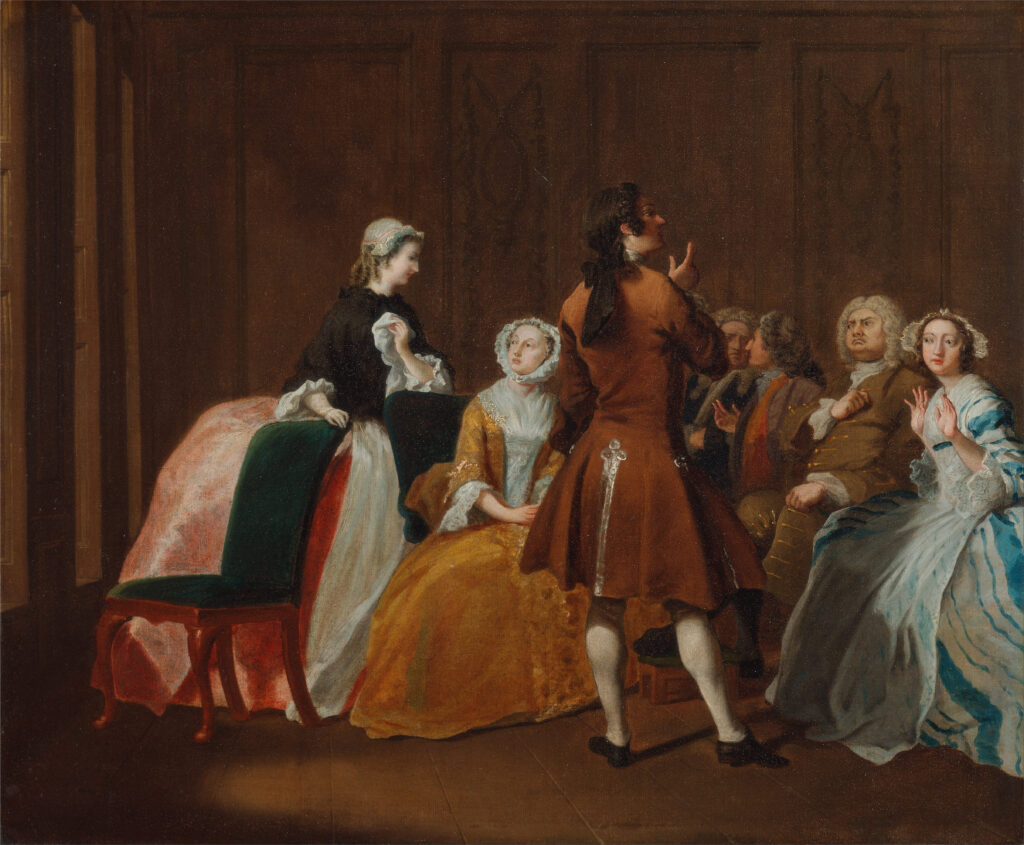
While this system of notes provided colonists with a much-needed medium for exchange, it was not without its problems. Currency that worked in Virginia might be worthless in Pennsylvania. Colonists and officials in Britain debated whether it was right or desirable to use mere paper, as opposed to gold or silver, as a medium of exchange. Paper money tended to lose value quicker than coins and was often counterfeited. These problems, as well as British merchants’ reluctance to accept depreciated paper notes, caused the Board of Trade to restrict the usage of paper money in the Currency Acts of 1751 and 1763. Paper money was not the only medium of exchange, however. Colonists also used metal coins. Barter and the extension of credit—which could take the form of bills of exchange, akin to modern-day personal checks—remained important forces throughout the colonial period. Still, trade between colonies was greatly hampered by the lack of standardized money.
Businesses on both sides of the Atlantic advertised both their goods and promises of obtaining credit. The consistent availability of credit allowed families of modest means to buy consumer items previously available only to elites. Cheap consumption allowed middle-class Americans to match many of the trends in clothing, food, and household decor that traditionally marked the wealthiest, aristocratic classes. Anglo Americans, often seen by their London peers as provincial or less cultivated, could present themselves as lords and ladies of their own communities by purchasing and displaying British-made goods. Visiting the home of a successful businessman in Boston, John Adams described “the Furniture, which alone cost a thousand Pounds sterling. A seat it is for a noble Man, a Prince. The Turkey Carpets, the painted Hangings, the Marble Table, the rich Beds with crimson Damask Curtains and Counterpins, the beautiful Chimney Clock, the Spacious Garden, are the most magnificent of any thing I have seen.”3 But many worried about the consequences of rising consumerism. A writer for the Boston Evening Post remarked on this new practice of purchasing status: “For ’tis well known how Credit is a mighty inducement with many People to purchase this and the other Thing which they may well enough do without.”4 Colonial Americans became more likely to find themselves in debt, whether to their local shopkeeper or a prominent London merchant, creating new feelings of dependence.
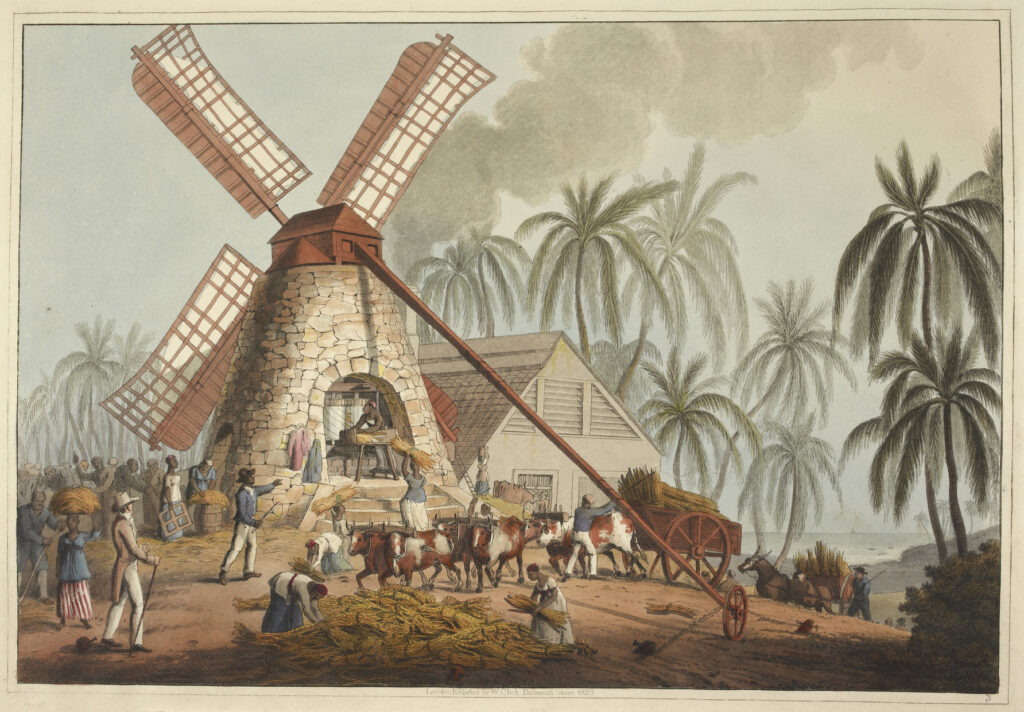
Of course, the thirteen continental colonies were not the only British colonies in the Western Hemisphere. In fact, they were considerably less important to the Crown than the sugar-producing islands of the Caribbean, including Jamaica, Barbados, the Leeward Islands, Grenada, St. Vincent, and Dominica. These British colonies were also inextricably connected to the continental colonies. Caribbean plantations dedicated nearly all of their land to the wildly profitable crop of sugarcane, so North American colonies sold surplus food and raw materials to these wealthy island colonies. Lumber was in high demand, especially in Barbados, where planters nearly deforested the island to make room for sugar plantations. To compensate for a lack of lumber, Barbadian colonists ordered house frames from New England. These prefabricated frames were sent via ships from which planters transported them to their plantations. Caribbean colonists also relied on the continental colonies for livestock, purchasing cattle and horses. The most lucrative exchange of all was the slave trade, with disastrous consequences.
Connections between the Caribbean and North America brought commercial benefits to both regions. Those living on the continent relied on the Caribbean colonists to satisfy their craving for sugar and other goods like mahogany. British colonists in the Caribbean began cultivating sugar in the 1640s, and sugar took the Atlantic World by storm. In fact, by 1680, sugar exports from the tiny island of Barbados were valued more than the total exports of all the continental colonies.5 Jamaica, acquired by the Crown in 1655, surpassed Barbados in sugar production toward the end of the seventeenth century. North American colonists, like Britons around the world, craved sugar to sweeten their tea and food. Colonial elites also sought to decorate their parlors and dining rooms with the silky, polished surfaces of rare mahogany as opposed to local wood. While the bulk of this in-demand material went to Britain and Europe, New England merchants imported the wood from the Caribbean, where it was then transformed into exquisite furniture for those who could afford it.
Women were integral to trade and consumption in eighteenth-century cities. Many were active in the marketplace, managing stalls, trading goods, utilizing credit, and placing advertisements for goods.6 For example, tavern owner Abigail Stoneman enticed guests by offering billiards tables, and she regularly bought and sold merchandise from Atlantic merchants, many of whom she boarded. Stoneman was an exceptionally successful businessperson, but women with smaller businesses also employed similar tactics.7
Trade with Indigenous people also enriched the empire. Indigenous people consumed European guns, alcohol, kettles, knives, woolen blankets, and other everyday items. Europeans, in turn, purchased furs, deer hides, handicrafts, copper, and food. By the 1750s, the horse trade fundamentally changed trade patterns among many Indigenous people, especially in the West, and allowed some tribal nations to subjugate those with fewer animals. For example, the Ute and Comanche alliance regularly raided Navajo, Pawnee, and Jicarilla Apache in Arizona and New Mexico.8 The horse also increased the gap between men’s and women’s work, and, in the case of the Oceti Sakowin, altered the lifestyle of its people from a matrilineal to a patrilineal society.9
These systems of trade all existed with the purpose of enriching Great Britain. To ensure that profits ended up in Britain, Parliament imposed taxes on trade under the Navigation Acts. These taxes intertwined consumption with politics. Prior to 1763, Britain found that enforcing the regulatory laws they passed was difficult and often cost them more than the duty revenue they would bring in. As a result, colonists found it relatively easy to violate the law and trade with foreign nations, pirates, or smugglers. Customs officials were bribed easily, and it was not uncommon to see Dutch, French, or West Indies ships laden with prohibited goods in American ports. When smugglers were caught, their American peers often acquitted them. British officials estimated that nearly £700,000 worth of illicit goods was brought into the American colonies annually.10 Pirates also helped to perpetuate the illegal trading activities by providing a buffer between merchants and foreign ships.
Beginning with the Sugar Act in 1764 and continuing with the Stamp Act and the Townshend Acts, Parliament levied taxes on sugar, paper, lead, glass, and tea, all products that contributed to colonists’ sense of gentility. In response, colonists organized nonimportation agreements and reverted to domestic products. Homespun cloth became a political statement by women such as the Daughters of Liberty as they boycotted British-made goods. A writer in the Essex Gazette in 1769 proclaimed, “I presume there never was a Time when, or a Place where, the Spinning Wheel could more influence the Affairs of Men, than at present.”11
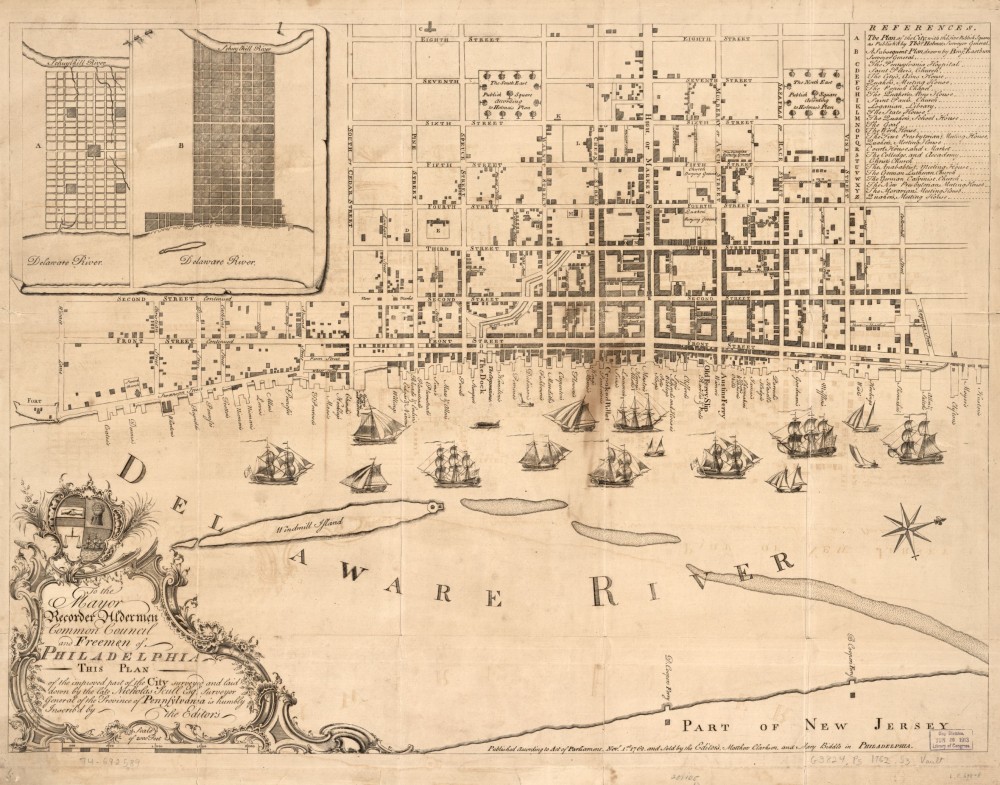
The consumer revolution fueled the growth of colonial cities. Cities in colonial America were crossroads for the movement of people and goods, and one in twenty colonists lived in cities by 1775.12 Some cities grew organically over time, while others were planned from the start. New York’s and Boston’s seventeenth-century street plans reflected the haphazard arrangement of medieval cities in Europe. In other cities like Philadelphia and Charleston, civic leaders laid out urban plans according to calculated systems of regular blocks and squares. Planners in Annapolis and Williamsburg also imposed regularity and order over their city streets through the placement of government, civic, and educational buildings.

By 1775, Boston, Newport, New York, Philadelphia, and Charleston were the five largest cities in British North America. Philadelphia, New York, Boston, and Charleston had populations of approximately 40,000, 25,000, 16,000, and 12,000 people, respectively.13 Urban society was highly stratified. At the base of the social ladder were the laboring classes, which included both enslaved and free people ranging from apprentices to master craftsmen. While the legal status and rights of enslaved people were more flexible in the seventeenth and early eighteenth centuries than after the establishment of the United States, their position was always more vulnerable than that of free working people. Next came the middling sort: shopkeepers, artisans, and skilled mariners. Above them stood the merchant elites, who tended to be actively involved in the city’s social and political affairs, as well as in the buying, selling, and trading of goods. Enslaved men and women had a visible presence in both Northern and Southern cities.
Many enslaved people lived in rural areas and performed agricultural labor, but not exclusively so. In port cities, enslaved laborers often worked as domestic servants and in skilled trades: distilleries, shipyards, lumberyards, and ropewalks. Between 1725 and 1775, slavery became increasingly significant in the Northern colonies as urban residents sought greater participation in the maritime economy. Massachusetts was the first slave-holding colony in New England. New York traced its connections to slavery and the slave trade back to the Dutch settlers of New Netherland in the seventeenth century.14 Philadelphia also became an active site of the Atlantic slave trade, and enslaved people accounted for nearly 8 percent of the city’s population in 1770.15 In Southern cities, including Charleston, urban slavery played an important role in the market economy. Enslaved people, both rural and urban, made up the majority of the working population on the eve of the American Revolution.
III. Slavery, Antislavery, and Atlantic Exchange
Slavery was a transatlantic institution, but it developed distinct characteristics in British North America. By 1750, slavery was legal in every North American colony, while local economic imperatives, demographic trends, and cultural practices all contributed to distinct experiences and structures, especially for those who lived under enslavement or participated directly in its practices.
Virginia, the oldest of the English mainland colonies, imported its first enslaved laborers in 1619. Virginia planters built larger and larger estates and guaranteed that these estates would remain intact by primogeniture (in which a family’s estate would descend to the eldest male heir) and entail (a gendered legal procedure that prevented the breakup and sale of estates).16 This distribution of property, which kept wealth and property consolidated, guaranteed that the great planters would dominate social and economic life in the Chesapeake. This system also fostered an economy dominated by tobacco. By 1750, there were approximately one hundred thousand enslaved Africans in Virginia, at least 40 percent of the colony’s total population.17 Most of these enslaved people worked on large estates under the gang system of labor, working from dawn to dusk in groups with close supervision by a white overseer or enslaved “driver” who could use physical force to compel labor.18
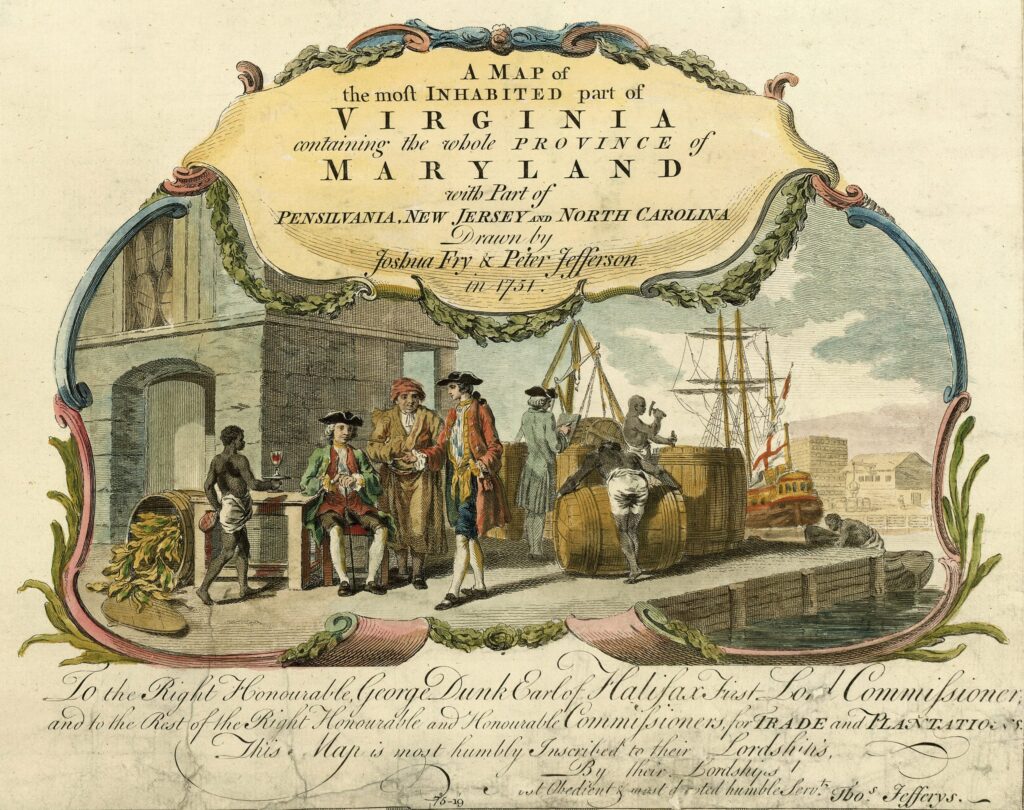
Virginians used the law to protect the interests of enslavers. In 1705 the House of Burgesses passed its first comprehensive slave code. Earlier laws had already guaranteed that the children of enslaved women would be born enslaved with the doctrine of partus sequiter ventrem (follows the womb), conversion to Christianity would not lead to freedom, and enslavers could not free their enslaved laborers unless they transported them out of the colony.19 Enslavers could not be convicted of murder for killing an enslaved person; conversely, any Black Virginian who merely struck a white colonist would be severely whipped. Virginia planters used the law to maximize the profitability of their enslaved laborers and invasively regulate every aspect of their daily lives.
In South Carolina and Georgia, slavery was also central to colonial life, but specific local conditions created a very different system. Georgia was founded by a philanthropic group that included James Oglethorpe. The trustees originally banned slavery from the colony. But by 1750, slavery was legal throughout the region. South Carolina had been a slave colony from its founding and, by 1750, was the only mainland colony with a majority enslaved African population. The Fundamental Constitutions of Carolina, coauthored by the philosopher John Locke in 1669, explicitly legalized slavery from the very beginning. Many early settlers in Carolina were enslavers from British Caribbean sugar islands, and they brought their brutal slave codes with them.20 Defiant enslaved people could be legally beaten, branded, mutilated, and even castrated. In 1740 a new law stated that killing a rebellious enslaved person was not a crime and even the murder of an enslaved person was treated as a minor misdemeanor. South Carolina also banned the freeing of enslaved laborers unless the freed person left the colony.21
Despite these brutal regimes, there were several factors that enabled enslaved people in South Carolina to claim more independence in their daily lives than in other parts of colonial North America. Rice, the staple crop underpinning the early Carolina economy, was widely cultivated in West Africa, and planters commonly requested that merchants sell them enslaved laborers skilled in the complex process of rice cultivation. Enslaved people from Senegambia were particularly prized.22 The expertise of these enslaved people contributed to one of the most lucrative economies in the colonies.23 The swampy conditions of rice plantations, however, fostered dangerous diseases. Malaria and other tropical diseases spread and caused many enslavers to live away from their plantations. These elites, who commonly owned a number of plantations, typically lived in Charleston townhouses to avoid the diseases of the rice fields. West Africans, however, were far more likely to have a level of immunity to malaria (due to a genetic trait that also contributes to higher levels of sickle cell anemia), reinforcing planters’ racist belief that Africans were particularly suited to labor in tropical environments.
With plantation owners often far from home, Carolina’s enslaved laborers had less direct oversight than those in the Chesapeake. Furthermore, many Carolina rice plantations used the task system to organize enslaved laborers. Under this system, enslaved laborers were given a number of specific tasks to complete in a day. Once those tasks were complete, enslaved people often had time to grow their own crops on garden plots allotted by their enslavers. Thriving underground markets allowed enslaved people here a degree of economic autonomy. Enslaved people in Carolina also had an unparalleled degree of cultural autonomy. This autonomy, coupled with the frequent arrival of African people, enabled a culture that retained many African practices.24 Syncretic languages like Gullah and Geechee contained many borrowed African terms, and traditional African basket weaving (often combined with Native American techniques) survives in the region to this day.
This unique Lowcountry culture contributed to the Stono Rebellion in September 1739. On a Sunday morning while planters attended church, a group of about eighty enslaved people set out for Spanish Florida under a banner that read “Liberty!,” burning plantations and killing at least twenty white settlers as they marched. They were headed for Fort Mose, a free Black settlement on the Georgia-Florida border, emboldened by the Spanish Empire’s offer of freedom to anyone enslaved by the English. The local militia defeated the rebels in battle, captured and executed many of the enslaved people, and sold others to the sugar plantations of the West Indies. Though the rebellion was ultimately unsuccessful, it was a violent reminder that enslaved people would fight for freedom.
Slavery was also an important institution in the Mid-Atlantic colonies. While New York, New Jersey, and Pennsylvania never developed plantation economies, enslaved laborers were often employed on larger farms growing cereal grains. Enslaved Africans worked alongside European tenant farmers on New York’s Hudson Valley patroonships, huge tracts of land granted to a few early Dutch families. As previously mentioned, enslaved people were integral to the daily life of Philadelphia, New York City, and other ports where they worked in the maritime trades and domestic service. New York City’s economy was so reliant on slavery that over 40 percent of its population was enslaved by 1700, while 15 to 20 percent of Pennsylvania’s colonial population was enslaved by 1750.25
In New York in particular, the high density of enslaved people and a particularly diverse European population increased the threat of rebellion because of unique opportunities for connection. A 1712 slave rebellion in New York City resulted in the deaths of 9 white colonists. In retribution, 21 enslaved people were executed and 6 others died by suicide before they could be burned alive. In 1741, authorities uncovered another planned rebellion by enslaved Africans and poor Black and white men. The panicked response only stopped after 32 Black men, both enslaved and free, were executed alongside 5 poor white men. Another 70 were deported, likely to the sugarcane fields of the West Indies.26

Increasingly disturbed by the growth of enslavement in the region, Quakers were the first group to turn against slavery. Quaker beliefs in radical nonviolence and the fundamental equality of all human souls made slavery hard to justify. Most commentators argued that slavery originated in war, where captives were enslaved rather than executed. To pacifist Quakers, then, the very foundation of slavery was illegitimate. Furthermore, Quaker belief in the equality of souls challenged the racial basis of slavery. By 1758, Quakers in Pennsylvania disowned members who engaged in the slave trade, and by 1772 slave-owning Quakers could be expelled from their meetings. These local activities in Pennsylvania had broad implications as the decision to ban slavery and slave trading was debated in Quaker meetings throughout the English-speaking world. The free Black population in Philadelphia and other Northern cities also continually advocated against slavery.
Slavery as a system of labor was more limited in Massachusetts, Connecticut, and New Hampshire, though it was present and legal throughout the region. The absence of cash crops like tobacco or rice minimized the economic use of slavery. In Massachusetts, only about 2 percent of the population was enslaved as late as the 1760s. The few enslaved people in the colony were concentrated in Boston along with a sizable free Black community that made up about 10 percent of the city’s population.27 While slavery itself never really took root in New England, the slave trade was a central element of the region’s economy. Every major port in the region participated to some extent in the transatlantic trade—Newport, Rhode Island, alone had at least 150 ships active in the trade by 1740—and New England also provided foodstuffs and manufactured goods to West Indian plantations.28
IV. Pursuing Political and Religious Freedoms
As consumption, trade, and their reliance on enslavement drew the colonies closer to Great Britain, civics and government gradually split them further apart. Democracy in Europe more closely resembled oligarchies rather than republics, with only elite members of society eligible to serve in elected positions. Most European states did not hold regular elections, with Britain and the Dutch Republic being two exceptions. However, even in these countries, only a tiny portion of males could vote. In the North American colonies, by contrast, white male suffrage was more widespread. In addition to having greater popular involvement, the colonial government also had more power in a variety of areas. Assemblies and legislatures regulated businesses, imposed new taxes, occasionally cared for the poor in their communities, built roads and bridges, and made most decisions concerning education. Colonial Americans sued often, which in turn led to more power for local judges and more prestige in jury service. Thus, lawyers became extremely important in American society and, in turn, played a greater role in American politics.
American society was less tightly controlled than European society. This led to the rise of various interest groups, each at odds with the other. These various interest groups arose based on commonalities in various areas. Some commonalities arose over class-based distinctions, while others were due to ethnic or religious ties. One of the major differences between modern politics and colonial political culture was the lack of distinct, continuous political parties. The most common disagreement in colonial politics was between the elected assemblies and the royal governor. Generally, the various colonial legislatures were divided into factions who either supported or opposed the current governor’s political ideology.
Political structures in the colonies fell under one of three main categories: provincial (New Hampshire, New York, Virginia, North Carolina, South Carolina, and Georgia), proprietary (Pennsylvania, Delaware, New Jersey, and Maryland), and charter (Massachusetts, Rhode Island, and Connecticut). Provincial colonies were the most tightly controlled by the Crown. The British king appointed all provincial governors, who could veto any decision made by their colony’s legislative assemblies. Proprietary colonies had a similar structure, with one important difference: governors were appointed by a lord proprietor, an individual who had purchased or received the rights to the colony from the Crown. Proprietary colonies, therefore, often had more freedoms and liberties than other North American colonies. Charter colonies had the most complex system of government: they were formed by political corporations or interest groups that drew up a charter clearly delineating powers between the executive, legislative, and judiciary branches of government. Rather than having appointed governors, charter colonies elected their own from among property-owning men in the colony.
After the governor, the colonial government was separated into two main divisions: the council and the assembly. The council was essentially the governor’s cabinet, often composed of prominent individuals within the colony, such as the head of the militia or the attorney general. The governor appointed these men, although the appointments were often subject to approval from Parliament. The assembly was composed of elected, property-owning men whose official goal was to ensure that colonial law conformed to English law. The colonial assemblies approved new taxes and the colonial budgets. However, many of these assemblies saw it as their duty to check the power of the governor and ensure that he did not take too much power within the colonial government. Unlike Parliament, most of the men who were elected to an assembly came from local districts, with their constituency able to hold their elected officials accountable to promises made.
An elected assembly was an offshoot of the idea of civic duty, the notion that men had a responsibility to support and uphold the government through voting, paying taxes, and service in the militia. Americans firmly accepted the idea of a social contract, the idea that government was put in place by the people. Philosophers such as Thomas Hobbes and John Locke pioneered this idea, and there is evidence to suggest that these writers influenced the colonists. While in practice, elites controlled colonial politics, in theory, many colonists believed in the notion of equality before the law and opposed special treatment for any members of colonial society.
Whether African Americans, Indigenous Americans, and women of all backgrounds would be included in this notion of equality before the law was far less clear. Women’s roles in the family became particularly complicated, as many historians view this period as a significant time of transition.29 Anglo-American families during the colonial period differed from their European counterparts. Widely available land and plentiful natural resources allowed for greater fertility and thus encouraged more people to marry earlier in life. Yet while young marriages and large families were common throughout the colonial period, family sizes started to shrink by the end of the 1700s as Anglo-American wives asserted more control over their own bodies.
New ideas governing romantic love helped change the nature of husband-wife relationships. Deriving from sentimentalism, a contemporary literary movement, and the increasing popularity of novels, especially among women, many Anglo-Americans began to view marriage as an emotionally fulfilling relationship rather than a strictly economic partnership. Referring to one another as “Beloved of my Soul” or “My More Than Friend,” newspaper editor John Fenno and his wife Mary Curtis Fenno illustrate what some historians refer to as the “companionate ideal.”30 While away from his wife, John felt a “vacuum in my existence,” a sentiment returned by Mary’s “Doting Heart.”31 Indeed, after independence, wives began to not only provide emotional sustenance to their husbands but also inculcate the principles of republican citizenship as “republican wives.”32
Marriage opened new emotional and practical realms for some but remained oppressive for others. For the millions of Americans bound in chattel slavery, marriage remained an informal arrangement rather than a codified legal relationship. For white Anglo-American women, the legal practice of coverture meant that women lost all their political and economic rights to their husbands after marriage. Divorce rates rose throughout the 1790s, as did less formal cases of abandonment. Newspapers published advertisements by deserted men and women denouncing their partners. Known as “elopement notices,” they cataloged the misbehaviors of deviant spouses, such as wives’ “indecent manner,” a way of implying sexual impropriety. As violence and inequality continued in many American marriages, wives in return highlighted their husbands’ “drunken fits” and violent rages. One woman chillingly noted that her partner “presented his gun at my breast . . . and swore he would kill me.”33
That couples would turn to newspapers as a source of expression illustrates the importance of what historians often call print culture.34 Print culture includes a wide range of factors contributing to how books and other printed objects are made, including the relationship between the author and the publisher, the technical constraints of the printer, and the tastes of readers. In colonial America, regional differences in daily life impacted the way colonists made and used printed matter. However, all the colonies dealt with threats of censorship and control from imperial supervision. In particular, content about imperial versus colonial government policy often stirred considerable controversy.
From the establishment of Virginia in 1607, printing was either regarded as an unnecessary luxury given such harsh living conditions or actively discouraged. The governor of Virginia, Sir William Berkeley, summed up the attitude of the ruling class in 1671: “I thank God there are no free schools nor printing . . . for learning has brought disobedience, and heresy . . . and printing has divulged them.”35 Ironically, the circulation of handwritten tracts contributed to Berkeley’s undoing. The popularity of Nathaniel Bacon’s uprising was in part due to widely circulated tracts questioning Berkeley’s competence. Berkeley’s harsh repression of Bacon’s Rebellion was equally well documented. It was only after Berkeley’s death in 1677 that the idea of printing in the Southern colonies was revived. William Nuthead, an experienced English printer, set up shop in 1682, although the next governor of the colony, Thomas Culpeper, forbade Nuthead from completing a single project. It was not until William Parks set up his printing shop in Annapolis in 1726 that the Chesapeake had a stable local trade in printing and books.
Print culture was very different in New England. Puritans had a longstanding respect for print, stemming from their belief that everyone should regularly read the Bible. Unfortunately, New England’s authors were content to publish in London, making the foundations of Stephen Daye’s first print shop in 1639 very shaky. Typically, printers made their money from printing sheets, not books to be bound. The case was similar in Massachusetts, where the first printed work was a “Freeman’s Oath” broadside.36 The first book was not issued until 1640, the Bay Psalm Book, of which eleven known copies survive. Daye’s contemporaries recognized the significance of his printing, and he was awarded 140 acres of land. The next large project, the first Bible to be printed in America, was undertaken by Samuel Green and Marmaduke Johnson and published in 1660. That same year, the Eliot Bible, named for its translator John Eliot, was printed in the Natick dialect of Algonquin nations as part of an effort to convert Native people to Christianity.

Massachusetts remained the center of colonial printing for a hundred years, until Philadelphia overtook Boston in 1770. Philadelphia’s rise as the printing capital of the colonies began with two important features: first, the arrival of Benjamin Franklin, a scholar and businessman, in 1723, and second, waves of German immigrants who created a demand for a German-language press. From the mid-1730s, Christopher Sauer, and later his son, met the demand for German-language newspapers and religious texts. Nevertheless, Franklin was singular in his influence, transforming the book trade in addition to creating public learning initiatives such as the Library Company and the Academy of Philadelphia. His Autobiography offers one of the most detailed glimpses of life in an eighteenth-century print shop. Franklin’s Philadelphia enjoyed a flurry of newspapers, pamphlets, and books for sale. The flurry would only grow in 1776 when the Philadelphia printer Robert Bell issued hundreds of thousands of copies of Thomas Paine’s revolutionary Common Sense.
Debates on religious expression continued throughout the eighteenth century. In 1711, a group of New England ministers published a collection of sermons titled Early Piety. The most famous minister, Increase Mather, wrote the preface. In it he asked the question, “What did our forefathers come into this wilderness for?”37 His answer was simple: to test their faith against the challenges of America and win. The grandchildren of the first settlers had been born into the comfort of well-established colonies and worried that their faith had suffered. This sense of inferiority sent colonists looking for a reinvigorated religious experience. The result came to be known as the Great Awakening, a series of religious revivals that had a leveling effect on colonists and led to a shared understanding of Protestantism. George Whitefield preached, “Father Abraham, whom have you in heaven? Any Episcopalians? No! Any Presbyterians? No! Any Independents or Methodists? No, No, No! Whom have you there? We don’t know those names here. All who are here are Christians.”38
Only with hindsight does the Great Awakening look like a unified movement. The first revivals began unexpectedly in the Congregational churches of New England in the 1730s and then spread through the 1740s and 1750s to Presbyterians, Baptists, and Methodists in the rest of the thirteen colonies. Different places at different times experienced revivals of different intensities. Yet in all of these communities, colonists discussed the same need to strip their lives of worldly concerns and return to a more pious lifestyle. The form it took was something of a contradiction. Preachers became key figures in encouraging individuals to find a personal relationship with God.
The first signs of religious revival appeared in Jonathan Edwards’s congregation in Northampton, Massachusetts. Edwards was a theologian who shared the faith of the early Puritan settlers. In particular, he believed in the idea of predestination, in which God had long ago decided who was damned and who was saved. However, Edwards worried that his congregation had stopped searching their souls and were merely doing good works to prove they were saved. With a missionary zeal, Edwards preached against worldly sins and called for his congregation to look inward for signs of God’s saving grace. His most famous sermon was “Sinners in the Hands of an Angry God.” Suddenly, in the winter of 1734, these sermons sent his congregation into violent convulsions. The spasms first appeared among known sinners in the community. Over the next six months the physical symptoms spread to half of the six-hundred-person congregation. Edwards shared the work of his revival in a widely circulated pamphlet.
Over the next decade itinerant preachers were more successful in spreading the spirit of revival around America. These preachers had the same spiritual goal as Edwards but brought with them a new religious experience. They abandoned traditional sermons in favor of outside meetings where they could whip the congregation into an emotional frenzy to reveal evidence of saving grace. Many religious leaders were suspicious of the enthusiasm and message of these revivals, but colonists flocked to the spectacle. Benjamin Franklin, upon hearing George Whitefield, shared how the sermon moved him. He wrote, “I perceived he intended to finish with a Collection, and I silently resolved he should get nothing from me. I had in my Pocket a Handful of Copper Money, three or four silver Dollars, and five Pistoles [Spanish coins] in Gold. As he proceeded I began to soften, and concluded to give the Coppers. Another Stroke of his Oratory made me asham’d of that, and determin’d me to give the Silver; and he finish’d so admirably, that I emptied my Pocket wholly into the Collector’s Dish, Gold and all.”39

George Whitefield was the most famous of the itinerant preachers. According to Whitefield, the only type of faith that pleased God was heartfelt. The established churches too often only encouraged apathy. “The Christian World is dead asleep,” he explained. “Nothing but a loud voice can awaken them out of it.”40 He would be that voice. Whitefield was a former actor with a dramatic style of preaching and a simple message. Thundering against sin and for Jesus Christ, Whitefield invited everyone to be born again. It worked. Through the 1730s, he traveled from New York to South Carolina, converting ordinary people of all ages. “I have seen upwards of a thousand people hang on his words with breathless silence,” wrote an elite woman in Philadelphia, “broken only by an occasional half suppressed sob.”41 A farmer recorded the powerful impact this rhetoric could have: “And my hearing him preach gave me a heart wound; by God’s blessing my old foundation was broken up, and I saw that my righteousness would not save me.”42 The number of people trying to hear Whitefield’s message was so large that he preached in the meadows at the edges of cities. Contemporaries regularly testified to crowds of thousands, and in one case over twenty thousand in Philadelphia. Whitefield and the other itinerant preachers had achieved what Edwards could not: making the revivals popular.
Ultimately the religious revivals became a victim of the preachers’ success. As itinerant preachers became more experimental, they alienated as many people as they converted. In 1742, one preacher from Connecticut, James Davenport, persuaded his congregation that he had special knowledge from God. To be saved, they had to dance naked in circles at night while screaming and laughing. Or they could burn the books he disapproved of. Either way, such extremism demonstrated for many that revivalism had gone wrong.43 A divide appeared by the 1740s and 1750s between “New Lights,” who still believed in a revived faith, and “Old Lights,” who thought it was deluded nonsense.

By the 1760s, the religious revivals had petered out; however, they left a profound impact on America. Leaders like Edwards and Whitefield encouraged individuals to question the world around them. This idea reformed religion in America and created a language of individualism that promised to change everything else. If you challenged the church, what other authority figures might you question? The Great Awakening provided a language of individualism, reinforced in print culture, which reappeared in the call for independence. While prerevolutionary America had profoundly oligarchical qualities, the groundwork was laid for a more republican society. However, society did not transform easily overnight. It would take intense, often physical, conflict to change colonial life.
V. Indigenous Nations Respond
Europeans continued to populate the American South (by the Spanish) and East (by the British and French), forcing Indigenous people into northern and westward migration. Despite the population growth in the colonies, Indigenous nations still held most of the power in North America. Native American migration, coupled with European conflicts, brought new opportunities for conflict and diplomacy between Indigenous nations and their European neighbors.
After the Tuscarora and Yamasee Wars in the early 1710s, the Tuscarora relocated to New York, joining the Haudenosaunee (Iroquois) League. The League consisted of six Iroquoian nations, the Mohawks, Onondaga, Oneidas, Cayuga, Seneca, and the last to join, the Tuscarora, forming one of the world’s oldest participatory democracies. They called themselves Haudenosaunee, meaning “people building the longhouse,” but were often referred to as the Iroquois, an Algonquian derogatory word meaning “real snakes.” They were also sometimes referred to as the League of Five (later Six) Nations.
The Haudenosaunee remained enemies with the French in the North and eventually entered into the Covenant Chain agreement in 1744 with the Northern British colonies. The Chain recognized trade agreements, established British sovereignty over the areas settled by the colonies, while also recognizing Haudenosaunee dominion over Indigenous peoples between the Hudson and Mississippi Rivers.44 Later, when the Mohawks announced they intended to end the agreement, British colonists acted quickly to secure alliances. In 1754, colonial delegates and 150 League delegates traveled to Albany to discuss a plan of alliance that was proposed by Benjamin Franklin, who admired their political system.45

In the Great Lakes region, French traders established trade routes among the Anishinaabe and Illinois before traveling south on the Mississippi River. They continued creating strong military relations with other Native nations and established New Orleans in 1718 using purchased enslaved laborers.46 However, the French plantation colony in Louisiana was outnumbered by the Natchez. Livestock trade disputes, the exploitation of Indigenous forced labor, and diplomatic disagreements between other small nations led the Natchez to expel the French in 1729. This conflict, called the Natchez War, ended when the French and their Choctaw allies finally defeated the Natchez. Despite the victory, the French scaled back their colonial plans after decades of the plantation’s unprofitability, and the continued costly warfare with the Chickasaws and other small nations that continued after the
Natchez War.47
To the south and west of Haudenosaunee territory, smaller groups of multiethnic Indigenous people established networks and alliances that protected their people and helped them survive. These groups often settled on the fringe of multinational Anglo towns to take advantage of economic opportunities.48
On the West Coast and in Alaska, Russian traders established contact with Aleut and Tlingit communities while establishing global trade routes. Their interest along the West Coast, coupled with French expansion in the South, sparked Spanish reinvigoration in their northern settlements.
By the second half of the eighteenth century, the Spanish had settlements in St. Augustine, San Antonio, Albuquerque, and Santa Fe. They used a combination of coercion, gifts, and trade to establish and strengthen relationships with Indigenous tribes, solidifying their hold over their northern claims, despite a small settler population. Outside these enclaves, however, control was in the hands of Indigenous people. Friar Juan Agustín Morfi noted in 1778, “Though we still call ourselves [Texas’s] masters, we do not exercise dominion over a foot of land beyond San Antonio.”49 This was true of the Southwest generally where a diversity of groups, including the Apache, Kiowa, Caddo, Karankawa, and Comanche, imposed their own rules on negotiations, gift giving, and trade.50 As early as the 1720s, the Comanche regularly raided settlements and ranches, limiting Spanish expansion.51
VI. Seven Years’ War
Of the eighty-seven years between the Glorious Revolution (1688) and the American War for Independence (1775), Britain was at war with France and French-allied Indigenous American nations for thirty-seven of them in what is sometimes referred to as the first world or global war. These were not encounters in which European soldiers exclusively fought other European soldiers. Anglo-American militiamen fought for the British against the French and their Indigenous allies in all these engagements. Warfare took a physical and spiritual toll on British colonists. Anglo-American towns located on the border between New England and New France experienced intermittent raiding by French-allied Native Americans. Raiding parties destroyed houses and burned crops, but they also took captives. They brought these captives to French Quebec, where some were ransomed back to their families in New England while others converted to Catholicism and remained in New France. In this sense, Catholicism threatened to capture Protestant lands and souls.
France and Britain feuded over the boundaries of their respective North American empires. The conflict turned bloody in 1754 when a force of British colonists and Native American allies, led by young George Washington, killed a French diplomat in what was called the Jumonville Affair. This incident led to a war, which would become known as the Seven Years’ War or, for the portion fought in North America, the French and Indian War.52 In North America, France and their allies achieved victory in the early portion of this war. They attacked and burned multiple British outposts, such as Fort William Henry in 1757. In addition, the French seemed to easily defeat British attacks, such as General Braddock’s attack on Fort Duquesne, and General Abercrombie’s attack on Fort Carillon (Ticonderoga) in 1758. These victories were often the result of alliances with Indigenous Americans.
In Europe, the war did not fully begin until 1756, when British-allied Frederick II of Prussia invaded the neutral state of Saxony. As a result of this invasion, a massive coalition of France, Austria, Russia, and Sweden attacked Prussia and the few German states allied with Prussia. In the European or continental war, the British monetarily supported the Prussians. However, as in North America, the early part of the land war went against the British, whose German allies suffered defeat to the French at the Battle of Hastenbeck in July 1757. Later, in December 1757, Frederick’s army defeated the Austrians at the Battle of Leuthen. Meanwhile, in India and throughout the world’s oceans, the British and their fleet consistently defeated the French. For instance, in June 1757, Robert Clive and his Indian allies defeated the French at the Battle of Plassey. With the sea firmly in their control, the British could deploy additional troops to North America.

These newly arrived soldiers allowed the British to launch new offensives. The large French port and fortress of Louisbourg, in present-day Nova Scotia, fell to the British in 1758. In 1759, British general James Wolfe defeated French general Louis-Joseph de Montcalm in the Battle of the Plains of Abraham, outside Quebec City. In Europe, 1759 saw the British defeat the French at the Battle of Minden and destroy large portions of the French fleet. The British referred to 1759 as the annus mirabilis or the year of miracles. These victories brought about the fall of French Canada, and war in North America ended in 1760 with the British capture of Montreal. The British continued to fight against the Spanish, who entered the war in 1762. In this war, the Spanish successfully defended Nicaragua against British attacks but were unable to prevent the conquest of Cuba and the Philippines.
The Seven Years’ War ended with the peace treaties of Paris and Hubertusburg in 1763. The British received much of Canada and North America from the French, while the Prussians retained the important province of Silesia. This gave the British a larger empire than they could easily control and contributed to tensions that would lead to calls for independence. In particular, it exposed divisions within the newly expanded empire, including language, national affiliation, and religious views. When the British captured Quebec in 1760, a newspaper distributed in the colonies to celebrate the event boasted: “The time will come, when Pope and Friar/Shall both be roasted in the fire/When the proud Antichristian whore/will sink, and never rise more.”53
Anglo-American colonists rejoiced over the defeat of Catholic France and felt secure that the Catholics in Quebec could no longer threaten them. Of course, some Anglo-American colonies had been a haven for religious minorities since the seventeenth century. Catholic Maryland, for example, evidenced early religious pluralism. But practical toleration of Catholics existed alongside virulent anti-Catholicism or antipopery in public and political arenas. It was a powerful and enduring rhetorical tool borne out of warfare and competition between Britain and France.
In part because of constant conflict with Catholic France, Britons on either side of the Atlantic rallied around Protestantism. British ministers in England called for a coalition to fight the French and Catholic empires. Missionary organizations such as the Society for Promoting Christian Knowledge and the Society for the Propagation of the Gospel were founded at the turn of the eighteenth century to evangelize Indigenous Americans and limit Jesuit conversions. The Protestant revivals of the Great Awakening crisscrossed the Atlantic and founded a participatory religious movement during the 1730s and 1740s that united British Protestant churches. Preachers and merchants alike urged greater Atlantic trade to bind the Anglophone Protestant Atlantic through commerce and religion.
VII. Pontiac’s War
Relationships between colonists and Indigenous Americans were complex and, in the face of Anglo-American encroachment, often violent. In 1761, Neolin, a prophet, received a vision from his religion’s main deity, known as the Master of Life. The Master of Life told Neolin that the only way to enter heaven would be to cast off the corrupting influence of Europeans by expelling the British: “This land where ye dwell I have made for you and not for others. Whence comes it that ye permit the Whites upon your lands. . . . Drive them out, make war upon them.”54 Neolin preached the avoidance of alcohol, a return to traditional rituals, and unity among Indigenous people to his disciples, including Pontiac, an Ottawa leader.
Pontiac took Neolin’s words to heart and sparked the beginning of what would become known as Pontiac’s War. At its height, the uprising included Indigenous peoples from the territory between the Great Lakes, the Appalachians, and the Mississippi River. Though Pontiac did not command all of those participating in the war, his actions were influential in its development. Pontiac and three hundred warriors sought to take the British Fort Detroit by surprise in May 1763, but the plan was foiled, resulting in a six-month siege. News of the siege quickly spread and inspired more attacks on British forts and settlers. In May, Pontiac and his allies captured Forts Sandusky, St. Joseph, and Miami. In June, a coalition of Ottawas and Ojibwes captured Fort Michilimackinac by staging a game of stickball (lacrosse) outside the fort. They chased the ball into the fort, gathered arms that had been smuggled in by a group of Indigenous American women, and killed almost half of the fort’s British soldiers.
Though Indigenous Americans were indeed responding to Neolin’s religious message, there were many other practical reasons for waging war on the British. After the Seven Years’ War, Britain gained control of formerly French territory because of the Treaty of Paris. Whereas the French had maintained a relatively stable relationship with their Indigenous allies through trade, the British hoped to profit from and impose “order.” For example, while the French empire engaged in many of the same extractive practices as the British, French diplomats more often engaged in the Indigenous practice of diplomatic gift giving. However, British general Jeffrey Amherst discouraged this practice and regulated the trade or sale of firearms and ammunition to Indigenous people. Most Indigenous Americans, including Pontiac, saw this not as frugal imperial policy but preparation for war.
Pontiac’s War lasted until 1766. Indigenous American warriors attacked British forts and frontier settlements, killing as many as four hundred soldiers and two thousand settlers.55 Disease and a shortage of supplies ultimately undermined the war effort, and in July 1766, Pontiac met with British official and diplomat William Johnson at Fort Ontario and settled for peace. Though they did not win Pontiac’s War, Indigenous Americans succeeded in fundamentally altering the British government’s policy. The war made British officials recognize that peace in the West would require royal recognition of Indigenous lands and heavy-handed regulation of Anglo-American trade activity in territory controlled by Indigenous Americans. As a result, the British Crown issued the Royal Proclamation of 1763, which created the Proclamation Line marking the Appalachian Mountains as the boundary between the British colonies and land held controlled by Indigenous Americans.
The effects of Pontiac’s War were substantial and widespread. The war proved that coercion was not an effective strategy for imperial control, though the British government would continue to employ this strategy to consolidate their power in North America, most notably through the various acts imposed on their colonies. Additionally, the prohibition of Anglo-American settlement in Indigenous American territory, especially the Ohio River Valley, sparked discontent. The French immigrant Michel-Guillaume St. Jean de Crèvecoeur articulated this discontent most clearly in his 1782 Letters from an American Farmer when he asked, “What then is the American, this new man?” In other words, why did colonists start thinking of themselves as Americans, not Britons? Crèvecoeur suggested that America was a melting pot of self-reliant individual landholders, fiercely independent in pursuit of their own interests, and free from the burdens of European class systems. It was an answer many wanted to hear and fit with self-conceptions of the new nation, albeit one that imagined itself as white, male, and generally Protestant.56
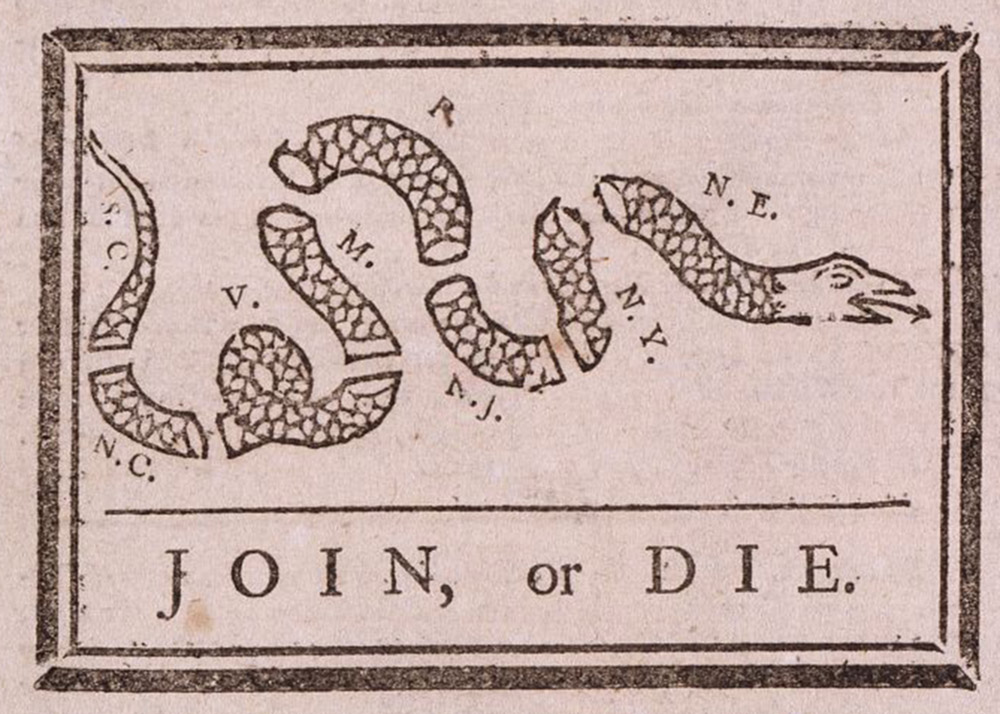
The Seven Years’ War pushed the thirteen American colonies closer together politically and culturally than ever before. In 1754, at the Albany Congress, Benjamin Franklin suggested a plan of union to coordinate defenses across the continent. Tens of thousands of colonial soldiers fought during the war. At the French surrender in 1760, 11,000 British soldiers joined 6,500 militia members drawn from every colony north of Pennsylvania.57 At home, many heard or read sermons that portrayed the war as a struggle between civilizations with liberty-loving Britons arrayed against tyrannical Frenchmen and “savage” Indigenous people. American colonists rejoiced in their collective victory as a moment of newfound peace and prosperity. After nearly seven years of warfare, colonists looked to the newly acquired lands west of the Appalachian Mountains as their reward, despite the fact that it belonged to Indigenous Americans.
The Seven Years’ War was tremendously expensive and precipitated imperial reforms on taxation, commerce, and politics that also impacted intercolonial alliances. Britain spent over £140 million, an astronomical figure for the day, and the expenses kept coming as new territory required new security obligations. Britain wanted to recoup some of its expenses and looked to the colonies to share the costs of their own security. To do this, Parliament started legislating over all the colonies in a way rarely done before. As a result, the thirteen Anglo-American colonies began seeing themselves as a collective group in addition to distinct entities. Different taxation schemes implemented across the colonies between 1763 and 1774 placed duties on items like tea, paper, molasses, and stamps for almost every kind of document. Consumption and trade, important bonds between Britain and the colonies, were being threatened. To enforce these unpopular measures, Britain implemented increasingly restrictive policies that eroded civil liberties like protection from unlawful searches and jury trials. Many colonists worried that imperial policy on slavery would soon be changed to limit or outright end its legality with the rise of an antislavery movement. The moratorium on new settlements west of the Proclamation Line after Pontiac’s War was yet another disappointment for colonists who believed they were entitled to Indigenous land. This led to resentment among colonists and a shift in power dynamics for Indigenous Americans who were accustomed to negotiating trade agreements from a position of strength, playing the English and French against one another. With the removal of the French from North America, balance was lost, and the British government began asserting more authority over Native people. The British no longer offered gifts but instead lowered the trade price for furs and claimed land previously outside their control. This shift in policy left little room for diplomacy rooted in trade between the British and Indian nations. General Amherst even suggested genocide by sending smallpox-infested blankets to the Delaware people.58
VIII. Conclusion
By 1763, Americans were increasingly united. In the wake of the Seven Years’ War, they fought and they celebrated together. But as imperial policy changed in the aftermath, Anglo-Americans slowly began to recognize that they were not considered full British subjects; instead, they were of a different commercial, political, and cultural status. Anglo-Americans across the colonies viewed imperial reforms as threats to the British liberties they saw as their birthright. The Stamp Act Congress of 1765 brought colonial leaders together in an unprecedented show of cooperation against taxes imposed by Parliament, and popular boycotts of British goods created a common narrative of sacrifice, resistance, and shared political identity. These different ingredients created a mixture that was ripe for dissent and even rebellion.
IX. Primary Sources
1. Boston trader Sarah Knight on her travels in Connecticut, 1704
2. Eliza Lucas letters, 1740-1741
3. Jonathan Edwards revives Enfield, Connecticut, 1741
4. Samson Occom describes his conversion and ministry, 1768
5. Extracts from Gibson Clough’s war journal, 1759
6. Pontiac calls for war, 1763
7. Alibamo Mingo, Choctaw leader, reflects on the British and French, 1765
8. Blueprint and photograph of Christ Church
Religion played an important role in each of the British colonies – for different reasons. In Virginia, the Anglican church was the official religion of the colonial government and colonists had to attend or be fined, so churches like Christ Church became important sites for political, economic, and social activity that reinforced the dominance of the planter elite. Robert “King” Carter built this church on the site of an earlier one built by his father. The Carter tombs belong to Robert Carter and his first and second wives. The colonial road that stopped at the door of the church went directly to the Carter family estate. Pews corresponded with social status: the highest ranking member of the gentry sat in the pew before the altar, across from the pulpit. Poor whites sat at the back, and enslaved men and women who came to church would have stood or taken the seats closest to the door – cold in winter, hot in summer, and farthest from the preacher. Many churches eventually built separate gallery seating for the enslaved who attended services. These churches were criticized during the Great Awakening, particularly by Baptists, who preached the equality of souls and felt the Anglican church was lacking in religiosity.
X. Reference Material
This chapter was edited by Nora Slonimsky, with content contributions by Emily Arendt, Ethan R. Bennett, John Blanton, Alexander Burns, Mary Draper, Jamie Goodall, Jane Fiegen Green, Hendrick Isom, Brenda Lakhani, Kathryn Lasdow, Allison Madar, Brooke Palmieri, Nora Slonimsky, Katherine Smoak, Christopher Sparshott, Ben Wright, Caroline Wright, and Garrett Wright.
Recommended Reading
• Anishanslin, Zara. Portrait of a Woman in Silk: Hidden Histories of the British Atlantic World. Yale University Press, 2016.
• Breen, T. H. The Marketplace of Revolution: How Consumer Politics Shaped American Independence. Oxford University Press, 2004.
• Bushman, Richard L. The Refinement of America: Persons, Houses, Cities. Vintage Books, 1992.
• Butler, Jon. Becoming America: The Revolution Before 1776. Harvard University Press, 2001.
• Carp, Benjamin L. Rebels Rising: Cities and the American Revolution. Oxford University Press, 2007.
• Carté-Engel, Katherine. Religion and Profit: Moravians in Early America. University of Pennsylvania Press, 2009.
• Demos, John P. The Unredeemed Captive: A Family Story from Early America. Vintage Books, 1994.
• Dowd, Gregory Evans. War Under Heaven: Pontiac, the Indian Nations, and British Empire. Johns Hopkins University Press, 2004.
• Ellis, Elizabeth. The Great Power of Small Nations: Indigenous Diplomacy in the Gulf South. University of Pennsylvania Press, 2023.
• Frey, Sylvia R., and Betty Wood. Come Shouting to Zion: African American Protestantism in the American South and British Caribbean to 1830. University of North Carolina Press, 1998.
• Hackel, Heidi Brayman, and Catherine E. Kelly, eds. Reading Women: Literacy, Authorship, and Culture in the Atlantic World, 1500–1800. University of Pennsylvania Press, 2009.
• Heyrman, Christine. Southern Cross: The Beginnings of the Bible Belt. Knopf, 1997.
• Holton, Woody. Forced Founders: Indians, Debtors, Slaves, and the Making of the American Revolution in Virginia. University of North Carolina Press, 1999.
• Klepp, Susan E. Revolutionary Conceptions: Women, Fertility, and Family Limitation in America, 1760–1820. University of North Carolina Press, 2009.
• Lepore, Jill. New York Burning: Liberty, Slavery, and Conspiracy in Eighteenth-Century Manhattan. Vintage Books, 2005.
• McConville, Brendan. The King’s Three Faces: The Rise and Fall of Royal America, 1688–1776. University of North Carolina Press, 2007.
• Merritt, Jane T. At the Crossroads: Indians and Empires on a Mid–Atlantic Frontier, 1700–1763. University of North Carolina Press, 2003.
• Podruchny, Carolyn. Making the Voyageur World: Travelers and Traders in the North American Fur Trade. University of Nebraska Press, 2006.
• Richter, Daniel K. Facing East from Indian Country: A Native History of Early America. Harvard University Press, 2003.
• Sensbach, Jon F. Rebecca’s Revival: Creating Black Christianity in the Atlantic World. Harvard University Press, 2006.
• Sheridan, Richard B. Sugar and Slavery: An Economic History of the British West Indies, 1623–1775. Johns Hopkins University Press, 1974.
• Taylor, Alan. The Divided Ground: Indians, Settlers, and the Northern Borderland of the American Revolution. Vintage Books, 2006.
• Ulrich, Laurel Thatcher. The Age of Homespun: Objects and Stories in the Creation of an American Myth. Knopf, 2001.
• Ulrich, Laurel Thatcher. A Midwife’s Tale: The Life of Martha Ballard, Based on Her Diary, 1785–1812. Knopf, 1990.
• Zabin, Serena R. Dangerous Economies: Status and Commerce in Imperial New York. University of Pennsylvania Press, 2011.
Notes
- Zara Anishanslin, Portrait of a Woman in Silk: Hidden Histories of the British Atlantic World (Yale University Press, 2016), 14.[↩]
- Mara Caden, “‘One Certain Standard’: Colonial Currencies and the Politics of Economic Knowledge in Late Stuart Britain,” Journal of British Studies 63, no. 4 (October 2024): 836–62, https://doi.org/10.1017/jbr.2024.119.[↩]
- T. H. Breen, “‘Baubles of Britain’: The American and Consumer Revolutions of the Eighteenth Century,” Past and Present 119, no. 1 (May 1988): 79, https://doi.org/10.1093/past/119.1.73.[↩]
- “To the Publisher of the Boston Evening Post,” Boston Evening Post, no. 150 (June 6, 1738): 1.[↩]
- Richard B. Sheridan, Sugar and Slavery: An Economic History of the British West Indies, 1623–1775 (Johns Hopkins University Press, 1974), 144.[↩]
- Ellen Hartigan-O’Connor, The Ties That Buy: Women and Commerce in Revolutionary America (University of Pennsylvania Press, 2009).[↩]
- Hartigan-O’Connor, The Ties That Buy, 1–2, 50–51.[↩]
- Pekka Hämäläinen, The Comanche Empire (Yale University Press, 2008), 27; Ned Blackhawk, The Rediscovery of America: Native Peoples and the Unmaking of U.S. History (Yale University Press, 2023), 111–13.[↩]
- Margot Liberty, “Hell Came with Horses: Plains Indian Women in the Equestrian Era,” Montana: The Magazine of Western History 32, no. 3 (1982): 10–19, http://www.jstor.org/stable/4518673.[↩]
- Archibald Paton Thornton, The Habit of Authority: Paternalism in British History (University of Toronto Press, 1966), 123. See also Mark G. Hana, Pirate Nests and the Rise of the British Empire, 1570–1740 (University of North Carolina Press, 2016).[↩]
- Cited in Laurel Thatcher Ulrich, The Age of Homespun: Objects and Stories in the Creation of an American Myth (Knopf, 2001), 37.[↩]
- Gary B. Nash, The Urban Crucible: The Northern Seaports and the Origins of the American Revolution, Abridged Edition (Harvard University Press, 2009), ix. See also Benjamin Carp, Rebels Rising: Cities and the American Revolution (Oxford University Press, 2009).[↩]
- Kenneth T. Jackson and Stanley K. Schultz, Cities in American History (Knopf, 1972), 45.[↩]
- Andrea C. Mosterman, Spaces of Enslavement: A History of Slavery and Resistance in Dutch New York (Cornell University Press, 2025).[↩]
- Gary B. Nash, “Slaves and Slave Owners in Colonial Philadelphia,” in African Americans in Pennsylvania: Shifting Historical Perspectives, ed. Joe Trotter and Eric Ledell Smith (Pennsylvania State University Press, 1997), 49–50.[↩]
- Kathleen Brown, Good Wives, Nasty Wenches, and Anxious Patriarchs: Gender, Race, and Power in Colonial Virginia (Omohundro Institute of Early American History and Culture and the University of North Carolina Press, 1996).[↩]
- Donald Matthews, Religion in the Old South (University of Chicago Press, 1977), 6.[↩]
- Randy M. Brown, The Driver’s Story: Labor and Power in the World of Atlantic Slavery (University of Pennsylvania Press, 2024).[↩]
- Jennifer L. Morgan, Laboring Women: Gender and Reproduction in the Making of New World Slavery (University of Pennsylvania Press, 2004). See also Jessica Marie Johnson, Wicked Flesh: Black Women, Intimacy, and Freedom in the Atlantic World (University of Pennsylvania Press, 2020).[↩]
- Edward B. Rugemer, Slave Law and the Politics of Resistance in the Early Atlantic World (Harvard University Press, 2018).[↩]
- Robert Olwell, Masters, Slaves, & Subjects: The Culture of Power in the South Carolina Lowcountry (Cornell University Press, 1998), 67.[↩]
- Daniel C. Littlefield, Rice and Slaves: Ethnicity and the Slave Trade in Colonial South Carolina (University of Illinois Press, 1991), 8.[↩]
- Paul S. Sutter and Christopher J. Manganiello, eds., Atlantic Environments and the American South (University of Georgia Press, 2009).[↩]
- Sylvia R. Frey and Betty Wood, Come Shouting to Zion: African American Protestantism in the American South and British Caribbean to 1830 (University of North Carolina Press, 1998). See also Anne C. Bailey, African Voices of the Atlantic Slave Trade: Beyond the Silence and the Shame (Beacon, 2006).[↩]
- See Appendix D of Dorothy Schneider and Carl J. Schneider, Slavery in America (Infobase, 2007).[↩]
- Serena Zabin, Dangerous Economies: Status and Commerce in Imperial New York (University of Pennsylvania, 2012). See also Thomas Joseph Davis, A Rumor of Revolt: The “Great Negro Plot” in Colonial New York (Free Press, 1985).[↩]
- US Census Bureau, Colonial and Pre-Federal Statistics, http://www2.census.gov/prod2/statcomp/documents/CT1970p2-13.pdf; James Oliver Horton and Lois E. Horton, Black Bostonians: Family Life and Community Struggle in the Antebellum North (Holmes and Meier, 1999), xiv.[↩]
- Elaine F. Crane, “‘The First Wheel of Commerce’: Newport, Rhode Island and the Slave Trade, 1760–1776,” Slavery and Abolition 1, no. 2 (1980): 178–98, https://doi.org/10.1080/01440398008574813.[↩]
- Rosemarie Zagarri, Revolutionary Backlash: Women and Politics in the Early American Republic (University of Pennsylvania Press, 2007).[↩]
- Lucia McMahon, Mere Equals: The Paradox of Educated Women in the Early American Republic (Cornell University Press, 2012).[↩]
- Fenno-Hoffman Family Papers, Clements Library, University of Michigan, Ann Arbor; Anya Jabour, Marriage in the Early Republic: Elizabeth and William Wirt and the Companionate Ideal (Johns Hopkins University Press, 1998).[↩]
- Jan Lewis, “The Republican Wife: Virtue and Seduction in the Early Republic,” William and Mary Quarterly 44, no. 4 (1987): 689–721, https://doi.org/10.2307/1939741.[↩]
- New York Packet, January 9, 1790; New-Jersey Journal, January 20, 1790; Mary Beth Sievens, Stray Wives: Marital Conflict in Early National New England (New York University Press, 2005).[↩]
- Trish Loughran, The Republic in Print: Print Culture in the Age of U.S. Nation-Building, 1770–1870 (Columbia University Press, 2007).[↩]
- Cited in David D. Hall, Cultures in Print: Essays in the History of the Book (University of Massachusetts Press, 1996), 99.[↩]
- Hugh Amory and David D. Hall, A History of the Book in America: Volume 1, The Colonial Book in the Atlantic World (Cambridge University Press, 2000), 111.[↩]
- John Gillies, Historical Collections Relating to the Remarkable Success of the Gospel and Eminent Instruments Employed in Promoting It, Volume II (Glasgow, 1754), 19.[↩]
- Martin Luther King Jr. “An Appraisal of the Great Awakening.” Essay, November 17, 1950.[↩]
- Benjamin Franklin on the Great Awakening, from His Autobiography. https://www.digitalhistory.uh.edu/disp_textbook.cfm?smtID=3&psid=1278.[↩]
- George Whitefield, The Works of the Reverend George Whitefield, Vol. I (London, 1771), 73.[↩]
- William G. McLoughlin, Revivals, Awakenings, and Reform (University of Chicago Press, 1978), 62.[↩]
- Thomas S. Kidd, George Whitefield: America’s Spiritual Founding Father (Yale University Press, 2014), 131.[↩]
- Leigh Eric Schmidt, “‘A Second and Glorious Reformation’: The New Light Extremism of Andrew Croswell,” William and Mary Quarterly 43, no. 2 (April 1986): 214–44, https://doi.org/10.2307/1922383.[↩]
- Bruce Morito, An Ethic of Mutual Respect: The Covenant Chain and Aboriginal-Crown Relations (University of British Columbia Press, 2012).[↩]
- Alan Craig Houston, Benjamin Franklin and the Politics of Improvement (Yale University Press, 2008).[↩]
- Dianne Guenin-Lelle, The Story of French New Orleans: History of a Creole City (University Press of Mississippi, 2016); Rashauna Johnson, Slavery’s Metropolis: Unfree Labor in New Orleans During the Age of Revolutions (Cambridge University Press, 2016); Elizabeth N. Ellis, The Great Power of Small Nations: Indigenous Diplomacy in the Gulf South (University of Pennsylvania Press, 2023), 141.[↩]
- Elizabeth Ellis, “The Natchez War Revisited: Violence, Multinational Settlements, and Indigenous Diplomacy in the Lower Mississippi Valley,” The William and Mary Quarterly 77, no. 3 (2020): 441–72, https://doi.org/10.5309/willmaryquar.77.3.0441.[↩]
- Ellis, The Great Power of Small Nations, 4–5; David Henkin and Rebecca M. McLennan, Becoming America: A History for the 21st Century (McGraw-Hill, 2022), 98.[↩]
- Juliana Barr, Peace Came in the Form of a Woman: Indians and Spaniards in the Texas Borderlands (University of North Carolina Press, 2007), 3.[↩]
- Barr, Peace Came, 289.[↩]
- Hämäläinen, The Comanche Empire, 69.[↩]
- Robert S. G. Fletcher and Alec Zuercher Reichardt, eds., Inlands: Empires, Contested Interiors, and the Connection of the World (Columbia University Press, 2024).[↩]
- “Canada Subjected: A New Song” (1760[?]), quoted in Thomas Kidd, God of Liberty: A Religious History of the American Revolution (Basic Books, 2010), 29.[↩]
- Daniel K. Richter, Before the Revolution: America’s Ancient Pasts (Harvard University Press, 2011), 403.[↩]
- Gregory Evans Dowd, War Under Heaven: Pontiac, the Indian Nations, and British Empire (Johns Hopkins University Press, 2004).[↩]
- Read de Crèvecoeur’s Letters from an American Farmer at Avalon Project, Yale Law School, https://avalon.law.yale.edu/subject_menus/letters.asp.[↩]
- Fred Anderson, Crucible of War: The Seven Years’ War and the Fate of Empire in British North America, 1754–1766 (Knopf Doubleday, 2007), 410.[↩]
- Henkin and McLennan, Becoming America, 111–12; Blackhawk, The Rediscovery of America, 136, 149.[↩]