*The American Yawp is an evolving, collaborative text. Click here to help improve this chapter.*
I. Introduction
If the War of 1812 was a military rematch with Great Britain, it was also an opportunity to imagine a fresh start for the American nation. Indeed, by the end of the next decade, some aspects of life in the United States would seem unrecognizable to the members of the old revolutionary generation. That included the ways many people made a living, took part in politics, and conceptualized what it meant to be an American woman, man, or child.
During these years, the country continued to seize Indigenous lands in the West and South. Between 1816 and 1821, the United States grew by a state per year, adding Indiana, Mississippi, Illinois, Alabama, Maine, and Missouri. Twenty-four states graced the union in the 1820s, and the United States had thousands of miles of waterfront along the Mississippi River and the Gulf Coast—not to mention half a billion acres of Native American territory that already had been claimed in the Louisiana Purchase in 1803. For some younger white Americans, it was easy to imagine that national progress was inevitable. Some optimistically—and prematurely—proclaimed the decade after the war to be an “era of good feelings” in political life.
Other Americans were not so confident. “A free government,” John Adams wrote anxiously to Thomas Jefferson in 1821, “is necessarily a complicated piece of machinery”—one that is not well understood by politicians, “and still less by the people.”1 Current events both at home and abroad gave these aging founders cause to worry about the future.
The postwar years were also a time of American economic expansion. The Second National Bank of the United States, chartered in 1816, helped stabilize the American economy by regulating state banks, issuing a uniform national currency, and facilitating trade and economic growth. But the expansion of the national economy, and the westward spread of statehood, also meant the entrenchment—contrary to many people’s earlier expectations—of the brutality of plantation slavery. By the late 1820s, it became much harder to imagine the end of racialized human bondage in the United States.
National growth, both geographic and economic, brought major changes to the ways that Americans lived their lives and imagined their futures.
II. The Market Revolution
In the early years of the nineteenth century, Americans’ economic drive—what one Baltimore newspaper in 1815 called an “almost universal ambition to get forward”—remade the nation.2 Water and steam power changed the way Americans could manufacture and move their products. Americans experienced what one influential historian dubbed a “Market Revolution.”3
Americans had previously led a mostly local existence, but the technologies of the international Industrial Revolution created a new national commercial economy. Americans increasingly produced goods for sale across long distances, and more aspects of daily life involved the exchange of cash.
After 1815, more and more farmers grew crops for profit, rather than local consumption. Vast factories and cities arose in the North. Enormous fortunes materialized. The American middle class ballooned. And as more men and women worked in the cash economy, some found freedom from servitude.
Thanks to the busy pace of Northern textile factories, however, the demand for cotton fiber grew, so plantation slavery spread westward across new cotton-growing regions in the South. Meanwhile, some free Northern farmers became wage laborers bound to the whims of markets and employers. A series of devastating economic depressions called “panics” devastated many. And all of this contributed to sweeping changes in the way Americans experienced their political life.
The Transportation Revolution
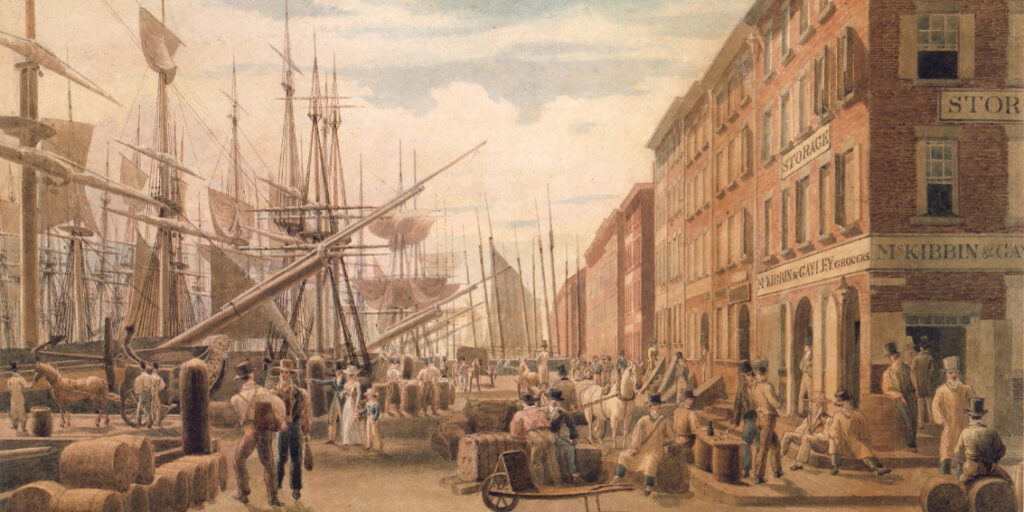
Between the American Revolution and the War of 1812, American trade had grown haltingly. American farmers had been exporting food to Europe at a low cost. This translated into high profit margins. But exorbitant internal transportation costs, kept high by bad (or nonexistent) roads, hindered substantial economic development inside the United States.
In 1816, a merchant could move a ton of goods across the Atlantic Ocean for $9, but the same fee would move the same ton of goods only thirty miles over land. That year, a Senate committee report concluded that “the price of land carriage is too great” to allow profitable American manufacturing. In the wake of the War of 1812, therefore, Americans rushed to build a new national infrastructure of “internal improvements”: new networks of roads, canals, and, eventually, railroads.

In his 1815 annual message to Congress, President James Madison stressed “the great importance of establishing throughout our country the roads and canals which can best be executed under national authority.”4 Although state governments continued to sponsor more of this kind of building project, the federal government’s annual expenditures on internal improvements would climb to a yearly average of $1,323,000 during Andrew Jackson’s presidency, which would end in 1837.5
Much of this so-called Transportation Revolution took place on the water. Robert Fulton had laid the groundwork even before the war by establishing the first commercial steamboat service on the Hudson River in New York in 1807. Soon, steamboats filled the Mississippi and Ohio Rivers as well. By 1830, more than two hundred steamboats moved up and down Western waterways.
And some of the Transportation Revolution’s waterways were human-made. The most important moment in the revolution came when New York State completed the Erie Canal in 1825. This grand 363-mile-long “artificial river” linked the Great Lakes with the Hudson River, the New York City harbor, and the Atlantic Ocean. Now, crops grown in the Great Lakes region could be transported to eastern cities, and goods from eastern ports and factories could make the reverse journey to Midwestern farmers. The success of New York’s infrastructure project launched a canal-building boom in other regions. By 1840, Ohio would create two navigable, all-water links from Lake Erie to the Ohio River, extending the Erie traffic deep into the continent.

With the development of canals, improved roads, and later railroads, the Transportation Revolution brought new settlers into the Native lands west of the Appalachian Mountains. The journeys taken by two women less than two decades apart show how rapidly this Western landscape changed.
In 1810, Margaret Dwight left Connecticut in a wagon headed for Ohio Territory. Her trip was less than five hundred miles, but it took six weeks to complete. She found the journey a terrible ordeal. The roads were “so rocky & so gullied,” she complained, that they were “almost impassable.” Ten days into the journey, at Bethlehem, Pennsylvania, it appeared to Margaret that she and her caravan “had come to the end of the habitable part of the globe.” She concluded that “the reason so few are willing to return [to the East] from the Western country, is not that the country is so good, but because the journey is so bad.”6
Less than twenty years later, the English traveler Frances Trollope made a similar journey in reverse, crossing the Allegheny Mountains from Cincinnati to the East Coast. At Wheeling, Virginia, her coach rolled onto the National Road, the first federally funded interstate infrastructure project. This road was smooth, and Trollope’s journey across the Alleghenies in 1829 was a scenic delight. “I really can hardly conceive a higher enjoyment than a botanical tour among the Alleghany Mountains,” she declared. The ninety miles of the National Road were to her “a garden.”7
In the years after Frances Trollope’s journey, the pace of change only accelerated. If the Transportation Revolution began with road networks and waterways, it soon involved even greater changes in the ways people earned their living. It would be felt in family relationships, in the social status of different kinds of people, and in politics, as well.
Manufacturing
The changes that took place during the Market Revolution were directly related to a shift that was taking place in how workers made things for sale. This change started even before the Transportation Revolution began, but the increased flow of trade on roads and canals made it more significant.
As early as the 1790s, merchants in New England began experimenting with powered machines, by borrowing—or stealing—a new model of factory work from Great Britain. In 1789, a textile mill in Pawtucket, Rhode Island, contracted a twenty-one-year-old British immigrant, Samuel Slater, to build machines to clean, combine, and spin yarn. Slater had apprenticed in an English mill, and he succeeded in mimicking the design of English machinery, thwarting the British government’s attempts to prevent the export of this valuable technology.
American industrial espionage was even more successful decades later when, in 1813, Francis Cabot Lowell and Paul Moody recreated the powered loom used in the mills of Manchester, England. Lowell had spent two years in Britain observing and touring mills. He had committed the design of the powered loom to memory, so no matter how many times British customs officials searched his luggage, they could not prevent him from smuggling England’s industrial know-how into New England.
Francis Cabot Lowell’s contribution to American industrialism was organizational as well as technological. Lowell helped reorganize and centralize the American manufacturing process. A new approach, the Waltham-Lowell System, created the textile mill that defined New England and American industrialism before the Civil War. In 1821, four years after Lowell himself died, the modern American textile mill was fully realized in a planned factory town named in his honor. Powered by the Merrimack River and operated by local farm girls, the mills of Lowell, Massachusetts, centralized the process of textile manufacturing under one roof. The modern American factory was born.

Before long, ten thousand workers labored in Lowell alone. Sarah Rice, who worked at the nearby Millbury factory, found it “a noisy place” that was “more confined than I like to be.”8 Working conditions were harsh for the many desperate “mill girls,” who operated the factories relentlessly from sunup to sundown. One worker complained that “a large class of females are, and have been, destined to a state of servitude.”9
In one famous incident at Lowell, workers went on strike, lobbying for better working hours. But the lure of steady wages—and freedom from parental oversight—was too much to keep new applicants away. As another worker wrote, “Very many Ladies . . . have given up millinery, dressmaking & school keeping for work in the mill.”10 With a large supply of eager workers, Lowell’s vision brought a rush of capital and entrepreneurs into New England. The first American manufacturing boom was under way.
The Market Revolution shook other industries as well, with similar effects on workers. Some shoemakers, for instance, abandoned the traditional method of producing custom-built shoes at their home workshops and instead began producing larger quantities in an assortment of ready-made sizes to be shipped to urban centers. To increase production, they abandoned the old personal approach of relying on live-in apprentices for labor. Instead, they hired unskilled wage laborers. Factories slowly replaced shops.
Middle-Class Ideals
During the first half of the nineteenth century, whole families in the northern United States increasingly participated in the cash economy created by the Market Revolution, even as industrial work shifted away from the home. Together, these realities transformed Americans’ definitions of work itself—and what they thought it should mean to be a woman, man, or child.
In colonial America, nearly all children had worked within their parent’s profession. During the Market Revolution, however, more children were able to postpone employment. Middle-class Americans aspired to provide a “romantic childhood”—a period when boys and girls were sheltered in the home and nurtured through primary schooling.11 Of course, this ideal was available only to families that could survive without their children’s wages.
In such families, just as children were expected to be shielded from the adult world of work, an ideology of “separate spheres” set apart a masculine public realm—the outside world of men’s economic production and political life—from the world of women, who were supposed to spend their time in consumption and domesticity . Granted, the women of the middle class were working. They kept busy producing food and clothing, cleaning, teaching children, and purchasing goods for the household, among many other activities. But such tasks did not bring money into the household, even though they, too, were essential to the home’s economic viability.
Though the Market Revolution remade many women’s economic roles, laws maintained their inferior status. Upon marriage, women were rendered legally dead under the doctrine of “coverture,” the legal fiction that counted married couples as a single unit represented by the husband. In most cases, this meant married women’s money and property belonged by law to their husbands. Women shopped on their husbands’ credit, and, at any time, husbands could terminate their wives’ access to the market. Although a handful of states made divorce available, it remained expensive, difficult, and rare. Marriage was typically a permanently binding contract—but men had greater power to break their part of the deal without consequences.
Meanwhile, even as the middle and upper classes tried to keep their women from the harsh realities of wage labor, lower-class women had to make money. In poorer households, women earned wages as factory workers, keepers of taverns and inns, and domestic servants. Many of their tasks were the same as the household tasks of richer women. The key difference was whether they performed these jobs for cash in the market economy.
Working-class children, too, worked to supplement the low wages of their adult family members. Around age eleven or twelve, for example, boys could take jobs as office runners or waiters, earning perhaps a dollar a week. The ideal of an innocent and protected childhood was a privilege for middle- and upper-class families, who might look down upon these young earners.
Joseph Tuckerman, a Unitarian minister who served poor Bostonians, sounded a typical note when he lamented the lack of discipline and regularity that supposedly characterized poor children: “At one hour they are kept at work to procure fuel, or perform some other service; in the next are allowed to go where they will, and to do what they will.”12 Prevented from attending school, poor children served as economic assets for their families and as a source of anxiety for the rich.

Meanwhile, the education received by middle-class children provided a foundation for future economic privilege. Formal schooling beyond basic literacy was especially important for young men who desired apprenticeships in retail or commercial work. Enterprising teachers established schools to assist “young gentlemen preparing for mercantile and other pursuits, who may wish for an education superior to that usually obtained in the common schools,” such as the one organized in 1820 by Warren Colburn of Boston.13 In response to the same need, the Boston School Committee created their city’s English High School, which could “give a child an education that shall fit him for active life, and shall serve as a foundation for eminence in his profession, whether Mercantile or Mechanical” beyond that “which our public schools can now furnish.”14
Education could equip young women, as well, with the tools to live sophisticated, genteel lives. After sixteen-year-old Elizabeth Davis left home in 1816 to attend school, her father explained that the experience would “lay a foundation for your future character & respectability.”15 After touring the United States in the 1830s, Alexis de Tocqueville praised the independence granted to the young American woman, who had “the great scene of the world . . . open to her” and whose education prepared her to exercise both reason and moral sense.16
Middling young women also used their education to take positions as schoolteachers in the expanding common school system. For instance, Bristol Academy in Taunton, Massachusetts, advertised “instruction . . . in the art of teaching” for female pupils.17 In 1825, Nancy Denison left Concord Academy with references indicating that she was “qualified to teach with success and profit” and “very cheerfully recommend[ed]” for “that very responsible employment.”18
Yet while middle-class youths found opportunities for respectable careers through formal education, the young poor remained in marginalized positions, stigmatized by their manual labor. Poor children sometimes received an education through institutions like the House of Refuge in New York City. They were often then indentured to affluent families to serve as field hands or domestic laborers. The Society for the Reformation of Juvenile Delinquents in New York City sent the children under its care to places like Sylvester Lusk’s farm in Enfield, Connecticut. There, boys were supposed to learn “the trade and mystery of farming,” and girls were expected to learn “the trade and mystery of housewifery.” These children were forced to offer obedience in exchange for room and board and a rudimentary education.19 Poor children also found work in factories such as Samuel Slater’s textile mills in southern New England, where Slater published a newspaper advertisement for “four or five active Lads, about 15 Years of Age to serve as Apprentices in the Cotton Factory.”20
Unsurprisingly, as the Market Revolution worked changes in what it meant to be an American woman, child, or man, social tensions grew over the meanings of wealth and the sources of prosperity. In politics, these tensions help explain the career of a man from the Western backcountry who attained lasting national fame after the War of 1812.
III. The Politics of Jacksonian America
On May 30, 1806, Andrew Jackson, a thirty-nine-year-old Tennessee lawyer, came within inches of death. A duelist’s bullet struck him in the chest, just shy of his heart—the man who fired the gun was purportedly the best shot in Tennessee. But the wounded Jackson remained standing. Bleeding, he slowly steadied his aim and returned fire. The other man dropped to the ground, mortally wounded. Jackson—still carrying the bullet in his chest—later boasted, “I should have hit him, if he had shot me through the brain.”21
This duel in Logan County, Kentucky, was one of many that Jackson fought during his long and highly controversial career. The tenacity, toughness, and vengefulness that kept Jackson alive in that duel, and the mythology and symbolism that would be attached to it, would also characterize many of his later dealings on the battlefield and in politics.
By the time of his death almost forty years later, Andrew Jackson became an enduring and controversial symbol of the ways that various Americans thought about their changing country. For better and worse, he would embody the meanings of American-style democracy.
Democratic Ideals
Today, despite some wavering in recent years, most Americans think democracy is a good thing. They tend to assume the nation’s early political leaders believed the same. Wasn’t the American Revolution a victory for democratic principles? For many of the founders, however, the clear answer had been no.
To be sure, a wide variety of people had participated in early US politics, especially at the local level. But ordinary citizens’ growing direct influence on government after the Revolution had frightened the founding elites. At the Constitutional Convention in 1787, Alexander Hamilton had warned about the “vices of democracy” and admitted that he considered the British government—with its powerful king and parliament—“the best in the world.”22 Another convention delegate, Elbridge Gerry of Massachusetts, who eventually refused to sign the finished Constitution, had agreed. “The evils we experience,” he proclaimed, “flow from an excess of democracy.”23
Too much participation by the multitudes, these founding elite had believed, would undermine good order. It would prevent the creation of a secure and united republican society. Such warnings, though, had done nothing to quell Americans’ democratic impulses in the late eighteenth and early nineteenth centuries.
During these decades, Americans who were allowed to vote—and sometimes those who weren’t—went to the polls in impressive numbers. They also made public demonstrations. They delivered partisan speeches on patriotic holidays. They petitioned Congress, openly criticized the president, and insisted that free people should not defer even to elected leaders. In many people’s eyes, the American republic was a democratic republic: the people were sovereign all the time, not only on election day.
For all their misgivings, elite leaders of political parties could not afford to overlook “the cultivation of popular favour,” as Alexander Hamilton put it.24 Between the 1790s and 1830s, the elite of every state and party learned to listen—or pretend to listen—to the voices of the multitude. And an American president, holding the federal office that most resembles a king’s, would come to symbolize the democratizing spirit of American politics.
The career of Andrew Jackson (1767–1845), the survivor of that backcountry Kentucky duel in 1806, exemplified both the opportunities and the dangers of political life in the early republic. A lawyer, enslaver, and military commander—and eventually the seventh president of the United States—he rose from humble frontier beginnings to become one of the most powerful Americans of the nineteenth century.
Old Hickory
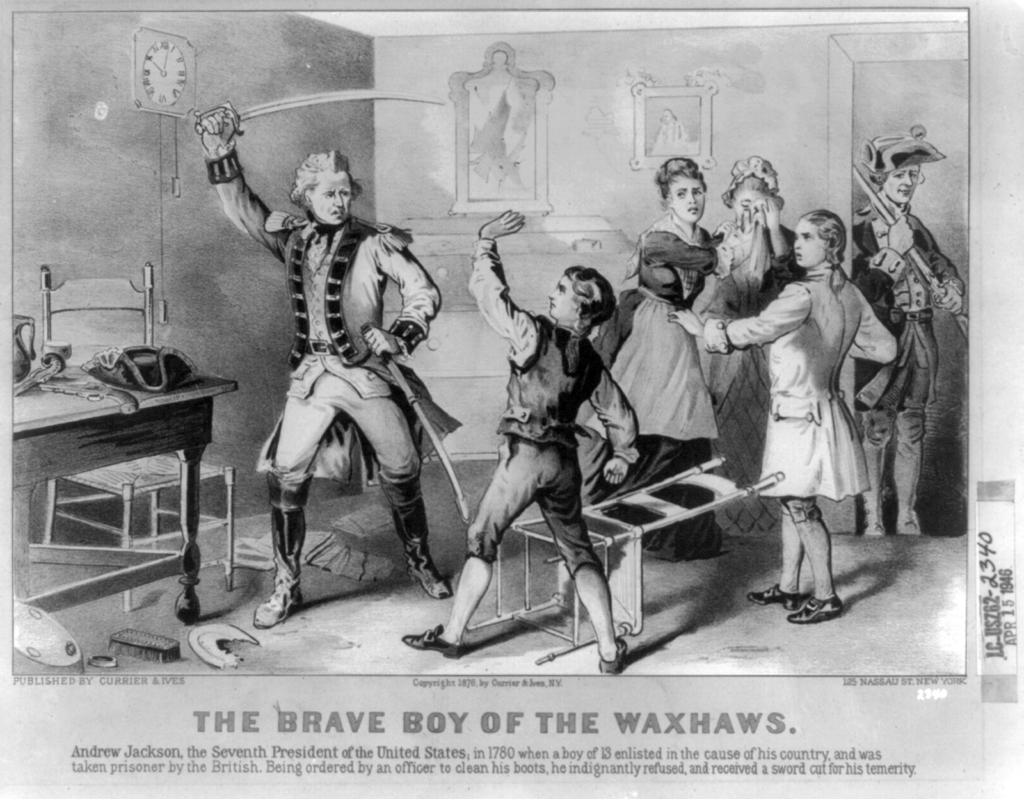
Andrew Jackson was born in 1767, on the border between North and South Carolina, to two immigrants from northern Ireland. He grew up during a dangerous time. At age thirteen, he joined an American militia unit in the Revolutionary War. He was soon captured, and a British officer slashed at his head with a sword when he refused to shine the officer’s shoes. Wartime disease claimed the lives of Jackson’s two brothers and his mother, leaving him an orphan. Their deaths and his wounds left Jackson with a deep and abiding hatred of Great Britain.
After the war, Jackson moved west to frontier Tennessee, where, despite his poor education, he prospered and made himself into a Southern gentleman, working as a lawyer and acquiring land and enslaved laborers—he would eventually come to keep 150 people enslaved at the Hermitage, his plantation near Nashville. In 1796, Jackson was elected as a US representative, and a year later he won a seat in the Senate, although he resigned within a year, citing financial difficulties.
Jackson’s significance in American history might have ended there, but, thanks to his political connections, he obtained a general’s commission at the outbreak of the War of 1812. Despite having no combat experience, General Jackson quickly impressed his troops, who nicknamed him “Old Hickory” after a particularly tough kind of tree.
Jackson led his militiamen into battle in the Southeast, first during the Creek War, a side conflict that started between different factions of Muskogee (Creek) fighters in present-day Alabama. In that war, he won a decisive victory at the Battle of Horseshoe Bend in 1814. A year later, he also defeated a large British invasion force at the Battle of New Orleans. There, Jackson’s motley crew of fighters—including backwoods militiamen, free African Americans, Native Americans, and a company of slave-trading pirates—successfully defended the city and inflicted more than two thousand casualties against the British, sustaining barely three hundred casualties of their own.25 Despite the fact that the battle occurred after a peace treaty had been signed, Jackson gained wide acclaim throughout the United States.
The end of the War of 1812 did not finish Jackson’s military career, however. In 1818, as commander of the US southern military district, the “Hero of New Orleans” also launched an invasion of Spanish-owned Florida. He was acting on vague orders from the War Department to break the resistance of the region’s Seminole people, who sheltered Black refugees from slavery and attacked American settlers from across the border. Jackson oversaw several atrocities during this conflict. On his orders in 1816, US soldiers and their Creek allies had already destroyed the “Negro Fort,” a British-built stronghold on Spanish soil, killing 270 formerly enslaved people and executing some survivors.26 Now, in 1818, Jackson’s troops crossed the border again. They occupied Pensacola, the main Spanish town in the region, and arrested two British subjects, whom Jackson promptly executed for helping the Seminoles.
The execution of these two Britons, combined with the dubious legality of invading Spanish territory in the first place, created a diplomatic crisis. Most officials in President James Monroe’s administration called for Jackson’s censure. But the secretary of state, John Quincy Adams, the son of former president John Adams, found Jackson’s behavior useful. He defended the impulsive general, arguing that he had been forced to act. Adams used Jackson’s military successes in this First Seminole War to pressure Spain to accept the Adams-Onís Treaty of 1819, which gave Florida to the United States.
Any friendliness between John Quincy Adams and Andrew Jackson, however, did not last long.
The Elections of 1824 and 1828
In 1824, four nominees competed for the presidency in one of the closest elections in American history. Conspicuously, the leading candidates represented different major sections of the country. The Northerner John Quincy Adams came from Massachusetts; the Southerner William H. Crawford came from Georgia; and two Westerners, Andrew Jackson and Henry Clay, hailed from Tennessee and Kentucky. All but Crawford were “favorite sons” nominated by their state legislatures rather than by a national party caucus.
Jackson had by far the least experience in Washington; but despite that, or perhaps because of it, he won the most popular votes. Still there was no majority winner in the Electoral College, so the election was thrown into the House of Representatives. There, John Quincy Adams used his political clout to claim the presidency, persuading Henry Clay to support him. After his election, Adams named Clay to serve as secretary of state, a powerful role that had often served as a step to the presidency. Jackson would never forgive Adams, whom his supporters accused of engineering a “corrupt bargain” with Clay to circumvent the people’s will.
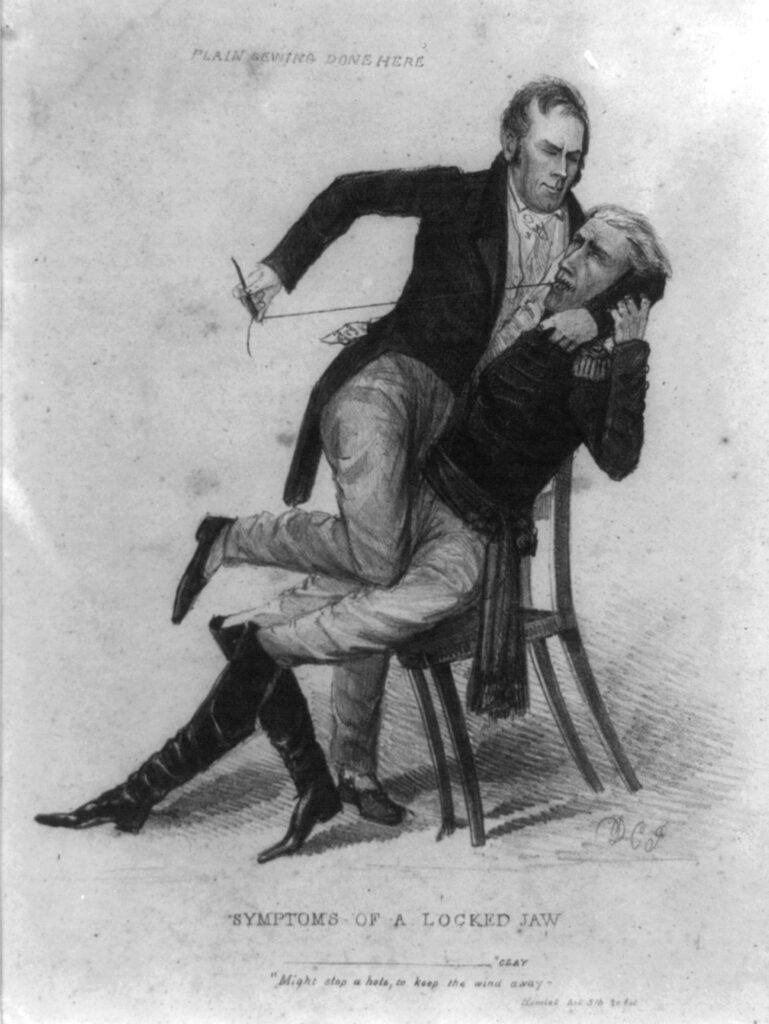
Four years later, in 1828, Adams and Jackson squared off in one of the dirtiest presidential elections to date.27 Pro-Jackson partisans accused the Harvard-educated Adams of elitism, and they claimed that while serving in Russia as a diplomat, he had offered the Russian emperor the services of an American sex worker. Adams’s supporters, on the other hand, accused Jackson of murder and attacked the morality of his marriage, pointing out that Jackson had married his wife Rachel under murky circumstances before her divorce from a prior husband was complete.
Despite the bitter attacks, Andrew Jackson won the election easily. But Rachel Jackson, with her reputation in tatters, died suddenly before his inauguration. Jackson would never forgive the people who attacked his wife’s character during the campaign.
For both supporters and opponents, Jackson was a potent symbol of the changes that were happening in America. To supporters, he was “Old Hickory,” the “Hero of New Orleans,” a leader of plain frontier folk. His wartime accomplishments appealed to their pride. Over the next eight years, he would claim to represent the interests of ordinary white Americans, especially from the South and West, against the country’s wealthy and powerful Northeastern elite. This attitude would lead him and his allies into a series of bitter political struggles.
In the process, Jacksonian politics would erode freedom for African Americans and Native Americans even as it expanded some freedoms for poor white people.

Worker Protests
During the early nineteenth century, many Americans grew uneasy with the stark gap between wage laborers and wealthy businessmen. Elite men like Daniel Webster might defend their wealth and privilege by insisting that all workers could achieve “a career of usefulness and enterprise” if they were merely “industrious and sober.” But labor activists like Seth Luther countered that capitalism created “a cruel system of extraction on the bodies and minds of the producing classes . . . for no other object than to enable the ‘rich’ to ‘take care of themselves’ while the poor must work or starve.”28
Wage work had traditionally been distained as a state of “dependence.” It was considered suitable only as a temporary waypoint for young men on their path toward the economic success necessary to support a wife and children. But now it was often a permanent condition. Hierarchy was always evident. Employers had both financial security and political power, while employees faced uncertainty and powerlessness in the workplace.
In this environment, even people who had already “gotten forward” could not feel secure. Depressions and downturns, such as the stunning Panic of 1819, might destroy businesses and throw their owners into wage work. Even in times of prosperity, male workers might lack good wages or economic security and therefore might need to depend on supplemental income from their wives and young children.
Dependent on the whims of their employers, some workers, like the Lowell mill girls, turned to unions to pool their resources, threatening to strike for better wages and working conditions. In 1825, a group of journeymen in Boston formed a Carpenters’ Union to protest their inability “to maintain a family at the present time, with the wages which are now usually given.”29 Working men organized unions to assert themselves and win both the respect and the resources due to a breadwinner and a citizen.
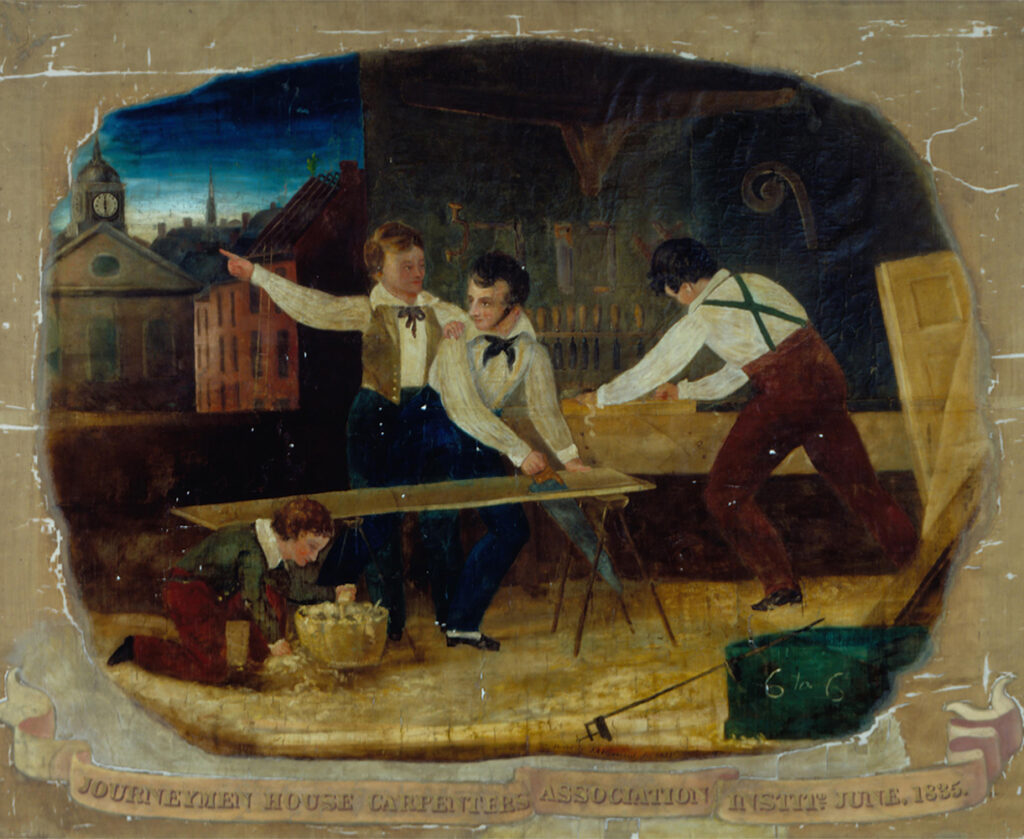
Managers, owners, and civic leaders thought these unions inflamed a dangerous and unnecessary antagonism between capital and labor. They responded by promoting an ideal of social mobility, justifying their own economic privilege as the natural product of superior character traits and hard work.
One group of master carpenters, for example, denounced their striking journeymen in 1825 with the claim that workers of “industrious and temperate habits, have, in their turn, become thriving and respectable Masters, and the great body of our Mechanics have been enabled to acquire property and respectability, with a just weight and influence in society.”30 In other words, they claimed, you could always get ahead if you worked hard. This claim did not always match the experience of wage earners.
Indeed, beyond the whims of employers, some workers believed they knew another specific culprit for the economic turmoil in their lives: the banks.
Banking
During the Transportation Revolution, state legislatures pumped capital into infrastructure projects by issuing corporate charters to banks. A corporate charter allowed investors and directors to avoid personal liability for a company’s debts, and legislatures often granted this privilege, along with certain monopoly rights, to promote investment in expensive and risky projects. The number of state-chartered banks in America skyrocketed from just one in 1783, to 266 in 1820, to 702 in 1840, to 1,371 in 1860.31 European finance also contributed to American infrastructure. By 1844, one British traveler declared that “the prosperity of America, her railroads, canals, steam navigation, and banks, are the fruit of English capital.”32
The business corporation was still unfamiliar in the daily lives of most people, and many Americans distrusted these strange, impersonal, and potentially foreign business organizations. Corporate officers, they feared, lacked personal responsibility for their actions, and worse, had been given authority that should belong only to representatives of the people. Many Americans sensed a potential conspiracy to consolidate power outside the elected government.
In 1816, Thomas Jefferson himself wrote that Americans should “crush in its birth the aristocracy of our monied corporations which dare already to challenge our government to a trial of strength, and bid defiance to the laws of our country.”33 A group of journeymen cordwainers (shoemakers) in New Jersey publicly declared in 1835 that they “entirely disapprov[ed] of the incorporation of Companies, for carrying on manual mechanical business, inasmuch as we believe their tendency is to eventuate and produce monopolies, thereby crippling the energies of individual enterprise.”34 But in Dartmouth v. Woodward (1819), the Supreme Court upheld the rights of private corporations, blocking an attempt by the government of New Hampshire to reorganize Dartmouth College.
Andrew Jackson’s political supporters included many Americans who blamed the special privileges of these “monied corporations,” especially state-chartered banks, for the unevenness of economic prosperity. Above all, they blamed the banks for promoting dangerous speculation. Major depressions struck the economy in 1819, 1837, and 1857. Each followed rampant speculation in various commodities: land in 1819, land and enslaved laborers in 1837, and railroad bonds in 1857.
The banks were suspect for another reason, as well. The bank notes they issued seemed inherently fraudulent to many Americans. These paper certificates were not technically money, but which circulated as if they were, passed around from buyer to seller to employee before eventually being presented to the bank for payment in coins. Printed in vast quantities by private firms, bank notes untethered the economy from tangible forms of wealth that seemed more reliable. Paper was no substitute for “cold, hard” metal—gold, silver, or copper. If a bank failed, its bills became worthless. Many bills weren’t even issued by the banks that had their names on them; counterfeits were everywhere.
With so many fake bills circulating, Americans were constantly on the lookout for the “confidence man,” or “con man” for short, and other deceptive characters. Just as false bank notes could pass as real in the national market, con men and women could circulate through communities, winning the trust of regular honest Americans. Middle-class culture, always uneasy about the morality of the commercial economy, reacted with horror. Advice literature offered young people strategies for avoiding hypocrisy. Intimacy in the domestic sphere became more important as duplicity proliferated in the public sphere. And even as Americans kept pushing “to get forward,” many looked for spiritual renewal.
IV. The Second Great Awakening
In the early nineteenth century, a succession of Protestant Christian religious movements collectively known as the Second Great Awakening remade the nation’s religious landscape. Preachers traveled on horseback and spoke to crowds outdoors, sharing a message of spiritual and moral “revival.” Residents of towns, rural farmlands, and frontier territories alike flocked to huge religious revival meetings, where intense physical and emotional enthusiasm accompanied evangelical conversion experiences.
These revivals contributed to movements for social change, which sometimes endured long after the revival meetings were over. Under the leadership of preachers and ministers, reform societies attacked many social problems. Believers concerned about the harms of alcohol could join temperance societies. Other groups focused on eradicating dueling and gambling. Evangelical reformers might have supported home or foreign missionary work, or Bible and tract societies that distributed Christian literature. Sabbatarians fought tirelessly to end nonreligious activity on Sunday, the Christian sabbath. Moral reform societies sought to end prostitution and redeem its “fallen women.”
Across the early nineteenth century, voluntary associations and benevolent activists also worked to reform bankruptcy laws, prison systems, mental hospitals, labor laws, and education. They built orphanages and free medical dispensaries and developed programs to provide social work, job placement, and day camps for children in city slums.
The Second Great Awakening was an expression of powerful intellectual and social currents in American life. Outdoor camp meetings, attended by people from all classes, captured the democratizing spirit of the American Revolution, but at the same time, they provided a unifying moral order and new sense of spiritual community for Americans uneasy with the great changes of the day. The camp meeting—held in close contact with nature, where believers meeting under a forest canopy might seal their conversions with full-immersion river baptisms—reflected the anxiety many felt about urban industrial society.35
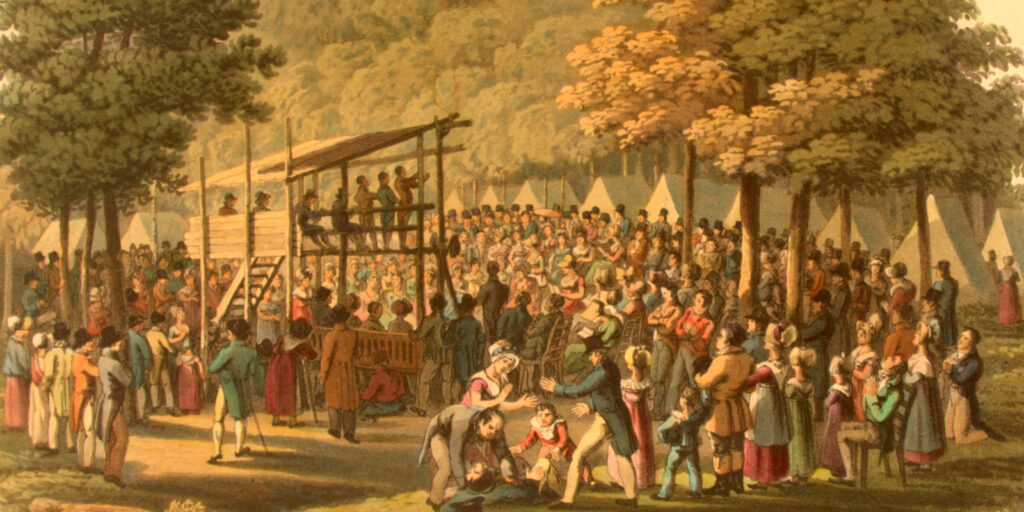
As the Market Revolution, western expansion, and European immigration, especially the arrival of large numbers of Catholic Christians, all challenged traditional bonds of authority, Protestant Christian evangelicalism promised equal measures of excitement and order. By the 1820s, religious revivals were spreading across the United States, swelling church membership, spawning new Protestant denominations, and inspiring social reform.
Unlike most long-established churches, which required ministers to have some formal theological training, growing alternatives like the Methodists, who had organized their American denomination the year after the Revolution ended, required only a conversion experience and a supernatural “call to preach.” This meant that a twenty-year-old man could practically overnight go from working in a mill to being a full-time circuit-riding preacher for the Methodists. Thus, the evangelical denominations attracted more new preachers to send into the field—and the lack of formal education meant their preachers could be paid significantly less than a pastor with a divinity degree might expect. It also sometimes meant these movements had a place—albeit a separate place—for enslaved and free Black preachers, and evangelical religious life became increasingly important to African American communities during these decades.
Because of the economic forces of the Market Revolution, middle-class evangelicals caught up in the revival movements also had the time and resources to devote to reform campaigns. Often, their reforms focused on creating and maintaining respectable middle-class culture throughout the United States. Evangelical women, who were active in the revivals, also played a leading role in reform activity. They became increasingly responsible for the moral maintenance of their homes and communities, and their leadership signaled a dramatic departure from previous generations, when such prominent public roles for ordinary women would have been unthinkable.36
Though deep ideological and theological disagreements divided Protestant Christians into many different sects, church leaders often worked on an interdenominational basis to establish benevolent societies and draw their followers into the work of social reform. These nondenominational Christian societies became a powerful cultural force sometimes known as the “benevolent empire.”
Temperance
Among all the social reform movements associated with the benevolent empire, the temperance crusade was perhaps the most successful. Championed by prominent preachers like Lyman Beecher, the movement’s effort to curb the consumption of alcohol galvanized widespread support among the middle class.
Alcohol consumption had become a significant social issue after the American Revolution. Commercial distilleries produced whiskey that was frequently more affordable than milk or beer and safer than water, and hard liquor became a staple beverage in many households. Consumption among adults skyrocketed in the early nineteenth century, and alcoholism became an endemic problem across the United States by the 1820s.

As alcoholism became more visible, most reformers escalated their efforts, switching from advocating moderation in liquor consumption to demanding full abstinence from all alcohol. They saw a direct correlation between alcohol and other forms of vice. Most importantly, they felt that it endangered family life.
In 1826, evangelical ministers organized the American Temperance Society to lead the national crusade. The ATS supported lecture campaigns, produced temperance literature, and organized Christian revivals specifically aimed at encouraging worshippers to give up the drink. The ATS was so successful that within a decade, it established five thousand branches and grew to over a million members.37 Temperance reformers pledged not to touch the bottle and canvassed their neighborhoods and towns to encourage other people to join their “Cold Water Army.” They also influenced lawmakers in several states to prohibit the sale of liquor.
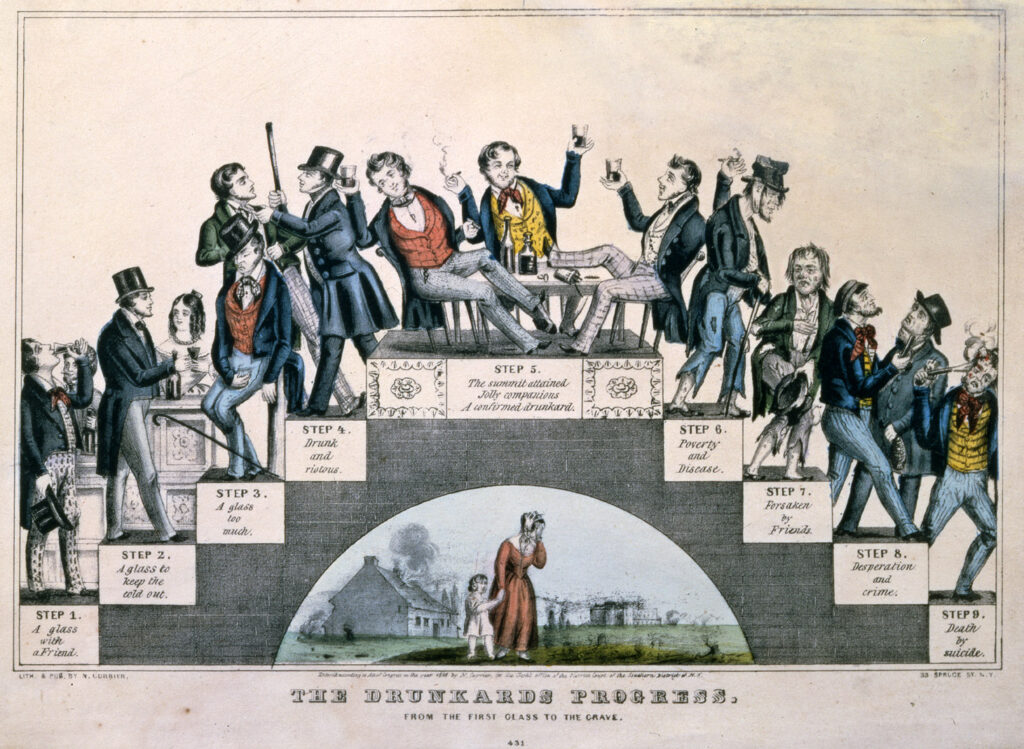
Associating heavy drinking with men who abused, abandoned, or neglected their families, middle-class women formed a significant presence in the temperance societies. But their movement threatened to intrude on the private lives of lower-class workers, many of whom were Irish Catholics in families of recent immigrants. These moral attacks by the Protestant middle class thus exacerbated class, ethnic, and religious tensions. Still, the movement was a great success for reformers. In the 1840s, Americans drank half of what they had in the 1820s, and per capita consumption continued to decline over the next two decades.38
The benevolent empire’s potent combination of social reform and evangelical piety produced agendas and institutional changes that have reverberated through the twentieth and twenty-first centuries. By devoting their time to the moral uplift of their communities and the world in general, middle-class reformers in the nineteenth century created many of the largest and most influential organizations in the nation’s history. For the optimistic, religiously motivated American, no problem seemed too great to solve. No problem, that is, except one.
V. The South, the West, and the Limits of Democracy
Revivals and reform extended well beyond American cities. Stirred by nationalism and moral purpose, evangelicals also labored to make sure the word of God reached far-flung settlers on the western American frontier. The American Bible Society distributed thousands of Bibles to areas where churches and clergy were scarce, while the American Home Missionary Society provided substantial financial assistance to frontier congregations struggling to achieve self-sufficiency. Missionaries also worked to translate the Bible into Native American languages in order to evangelize Indigenous populations.
Meanwhile, however, a troubling pattern emerged in national politics and culture. During the first decades of the nineteenth century, American politics shifted toward “sectional” conflict among the states of the North, South, and West. Many Northerners feared that the Southern states’ common interest in protecting slavery was creating a congressional voting bloc that would be difficult for “free states” to counter. The North and South began to clash over federal policy as Northern states gradually ended slavery but Southern states came to depend even more on enslaved labor.
In this way, even as industrialization and the cash economy tied diverse regions together in trade, ideology drove the same regions apart. And amid all the social reform movements of the age, the brutal system of forced labor that enriched the few in the South seemed only to be growing more secure.
The Cotton Revolution
As late as the 1820s, Southern life was predicated on a rural lifestyle—farming, laboring, acquiring land and enslaved laborers, and producing whatever that land and those enslaved laborers could produce. The market, often located in the nearest town or city, rarely stretched beyond state lines. But cotton and steam power changed much of this.
Before cotton became central to its economy, the South had few major seaports. Even on the nation’s great western waterway, the Mississippi River, which emptied into the Gulf of Mexico at New Orleans, shipping was almost entirely one-way—flowing with the current, not against it. But in January 1812, a 371-ton ship called the New Orleans arrived at its namesake city from the distant Ohio River port of Pittsburgh, Pennsylvania. This was the first steamboat to navigate the internal waterways of the North American continent from one end to the other and remain capable, thanks to coal and steam, of returning home. The technology was far from perfect—the New Orleans sank two years later after hitting a sandbar—but its successful trial promised a bright new future for river travel.

And that future was, indeed, bright. Just five years after the New Orleans arrived in the Crescent City, seventeen steamboats ran regular upriver lines. By the mid-1840s, more than 700 steamboats would do the same. And during 1860, the port of New Orleans would receive and unload 3,500 steamboats, all focused entirely on internal trade. These boats carried around 160,000 tons of raw product that merchants, traders, and agents converted into nearly $220 million in trade in a single year.39 More than 80 percent of the yield was from cotton alone.
Thus, the Market Revolution’s explosion of steam changed the South along with the rest of the country. Everything that could be steam-powered was steam-powered. Cotton gins, wagons, grinders, looms, and baths were all adapted to this technology. Most importantly, the South’s rivers, lakes, and bays were no longer barriers and hindrances to trade. They had become the way commerce flowed, the “roads” of a modernizing society and region.
In this way, while most Northern US cities developed as centers of manufacturing, creating public spaces to boost the morale of wage laborers, America’s Southern cities adapted the Industrial Revolution to cotton and slavery. In fact, the South experienced a greater rate of urbanization between 1820 and 1860 than the more industrial North. The growth of Southern cities, far from promoting free wage labor, allowed slavery to flourish.
Life in Slavery
The global and economic functions of the South were wholly dependent on enslaved labor. The South was home to nearly four million enslaved people by 1860, amounting to more than 45 percent of the entire Southern population.40
Enslaved Southerners, though unfree, developed a culture all their own. They created kinship and family networks, systems of trade, linguistic codes, religious congregations, and even benevolent and social aid organizations. They formed all these within the grip of slavery, a system dedicated to extraction and exploitation.
More than anything else, the concept of family organized the daily lives of enslaved people. Through family units and kinship networks, enslaved people could piece together a sense of community, feeling, and dedication separate from the system of forced production that defined their work lives. Ideas that were passed between relatives on different plantations, names that were given to children in honor of the deceased, and other basic forms of love and devotion created a sense of individuality, an identity that assuaged the loneliness and desperation of enslaved life. Family defined how each community functioned, grew, and labored.
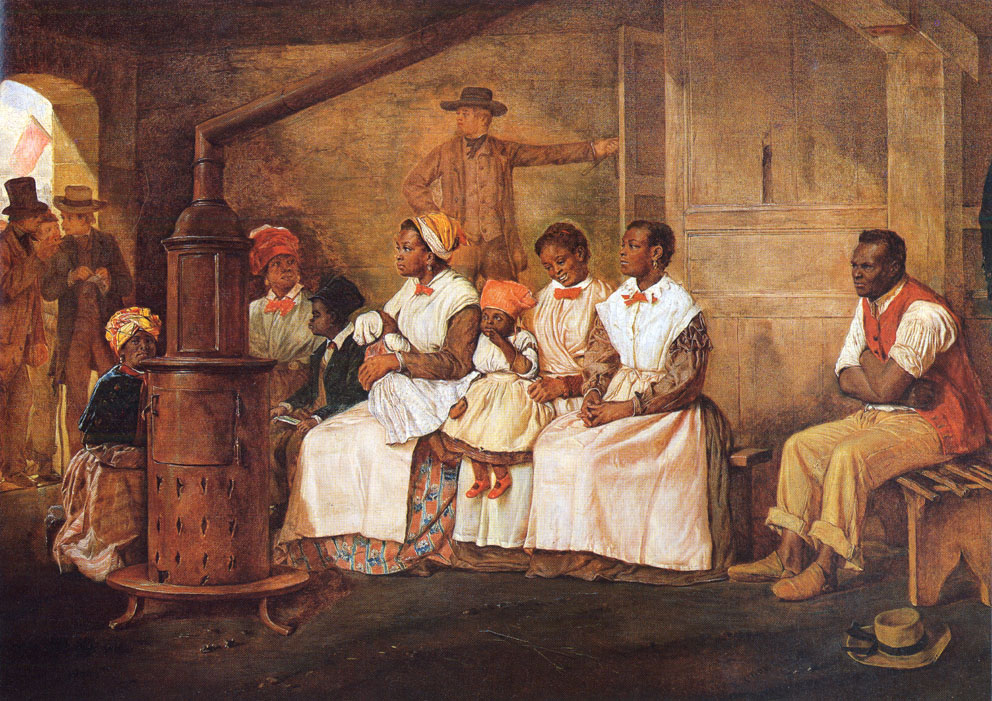
As American-born enslaved laborers overtook earlier African-born generations, the practice of marriage, especially among members of the same ethnic group or even residents of the same plantation, became vital to the continuation of traditions. Marriage served as the most important institution of cultural and identity formation, as it connected enslaved people to their own pasts and gave some sense of protection for the future.41 But marriages and other family bonds were never safe from the violence of slavery.
By the start of the Civil War, approximately two-thirds of enslaved people were members of nuclear households, each averaging six people. Such a family might have a mother, a father, children, and often a grandparent, an elderly aunt or uncle, and even “in-laws.” Enslaved Southerners who did not have a marriage bond still maintained family ties, often living with a single parent, brother, sister, or grandparent.42
Thus, culture thrived among the enslaved in ways that are difficult for us to see now through the bales of cotton sitting on the docks and the stacks of money filling the counting houses of the South’s urban centers. But religion, honor, and pride transcended material goods. Defying the cruel domination of slavery, enslaved people maintained traditions and crafted new culture. They fell in love, had children, and protected one another. They were resourceful, brilliant, and vibrant, and they created freedom where freedom seemingly could not exist. And within their communities, resilience and dedication often led to cultural sustenance.
Yet the threat of disruption, especially through sale, always loomed. As the internal slave trade increased after the constitutional ban on transatlantic slave importation in 1808 and the rise of cotton in the 1830s and 1840s, enslaved families, especially those established prior to arriving in the United States, came under increased threat. Hundreds of thousands of marriages, many with children, fell victim to sale “downriver”—a euphemism for the near constant flow of enslaved laborers down the Mississippi River to the developing cotton belt in the Southwest.43
In fact, during the Cotton Revolution alone, between one-fifth and one-third of all marriages between enslaved people were broken up through sale or forced migration. And the lure of a profitable sale was not the only threat. Enslavers recognized that marriage was, in the most basic and tragic sense, a privilege they granted and defined. Many enslavers used marriages, or threats against marriages, to wield power over the people they held in bondage.
Expansion and Conflict
The Southern economy’s appetite for cotton—and for land where enslaved workers could grow it—contributed to the nation’s westward sprawl during the early nineteenth century. Other forces also played a role in national expansion across North America. Economic busts like the Panic of 1819 constantly threatened Western farmers and communities. The dream of subsistence and stability abruptly ended as many migrants lost their land and felt the hand of the distant market economy forcing them even farther west to escape debt. As a result, the federal government consistently sought to increase access to Western land, including efforts to lower the amount of land required for purchase. Smaller lots made it easier for more farmers to clear land and begin farming faster.44 This contributed to frequent conflict between white settlers and Native American communities.
The expansion of American influence and territory off the continent, meanwhile, became an important corollary to westward expansion. The US government sought to keep European countries out of the Western Hemisphere even as it laid claim to more and more western territory. Thus, in 1821, while still serving as secretary of state for President James Monroe, John Quincy Adams helped formulate the “Monroe Doctrine,” declaring US hostility to British and Russian involvement in the Americas. Adams’s great fear was not territorial loss. Rather, the Monroe administration was worried mainly about the ability of the United States to compete commercially with the British in Latin America and the Caribbean. Expansion of economic opportunity and protection from foreign pressures became the overriding goals of US foreign policy in the age of the Market Revolution.45
The greatest test of the US government between 1815 and 1828, however, related to political conflict over the expansion of slavery in the West.
The Missouri Crisis
When white settlers in Missouri, a new territory carved out of the Louisiana Purchase, applied for statehood in 1819, the balance of political power between Northern and Southern states became the focus of public debate. Missouri already had more than ten thousand enslaved labors and was poised to join the Southern slave states in Congress. 46
Accordingly, Congressman James Tallmadge of New York proposed an amendment to Missouri’s application for statehood. Tallmadge claimed that the institution of slavery mocked the Declaration of Independence and the liberty it promised to “all men.” He proposed that Congress should admit Missouri as a state only if bringing more enslaved people to Missouri were prohibited and children born to those enslaved there were freed at age twenty-five.
Congressmen like Tallmadge opposed slavery for moral reasons, but they also wanted to maintain a sectional balance of power. Unsurprisingly, the Tallmadge Amendment met with firm resistance from Southern politicians. It passed in the House of Representatives with the support of nearly all the Northern congressmen, who had a majority there, but it was quickly defeated in the Senate.
When Congress reconvened in 1820, a senator from Illinois, another new Western state, proposed a compromise. Jesse Thomas hoped his offer would not only end the Missouri Crisis but also prevent any future sectional disputes over slavery and statehood. Another Westerner, Henry Clay of Kentucky, joined in promoting the deal, earning himself the nickname “the Great Compromiser.”
Their bargain, the Missouri Compromise of 1820, contained three parts.47 First, Congress would admit Missouri as a slave state. Second, Congress would admit Maine—which until now had been a territory of Massachusetts—as a free state, maintaining the balance between the number of free and slave states. Third, the rest of the Louisiana Purchase territory would be divided along the 36°30′ line of latitude—or in other words, along the southern border of Missouri. Slavery would be prohibited in other new states north of this line, but it would be permitted in new states to the south. The compromise passed both houses of Congress, and the Missouri Crisis ended peacefully.
Not everyone, however, felt relieved. The Missouri Crisis had made the sectional nature of American politics impossible to ignore. It had exposed just how divisive the slavery issue had grown. The debate had filled newspapers, speeches, and congressional records. Antislavery and proslavery positions from that point forward would repeatedly return to points made during the Missouri debates.
In these debates, white Southerners had not yet begun arguing that slavery was a “positive good” in the world. That claim would come later. But they had been insisting that the framers of the US Constitution had supported slavery and wanted to see it expand.
Likewise, the debates over Missouri’s admission to the Union in 1820 had offered the first sustained debate on the question of Black citizenship. A proposed clause in Missouri’s state constitution would have imposed a hard ban on any future Black migration into the state. Legislators ultimately had agreed that this ban violated the US Constitution, but they had reaffirmed Missouri’s right to deny citizenship to African Americans.
While the crisis lasted, many Americans, including seventy-seven-year-old Thomas Jefferson, were alarmed at how readily some Americans spoke of disunion and even civil war over the issue. “This momentous question, like a fire bell in the night, awakened and filled me with terror,” Jefferson wrote. “I considered it at once as the [death] knell of the Union.”48
For now, the Missouri Crisis did not result in disunion and civil war, as Jefferson and others feared. But it did fail to settle the issue of slavery’s expansion into new Western territories.
VI. Primary Sources
1. James Madison Asks Congress to Support Internal Improvements, 1815
2. A Traveler Describes Life Along the Erie Canal, 1829
3. Harriet H. Robinson Remembers a Mill Workers’ Strike, 1836
4. Missouri Controversy Documents, 1819-1820
5. President Monroe Outlines the Monroe Doctrine, 1823
7. Rebecca Burlend recalls her emigration from England to Illinois, 1848
8. County Election Painting, 1854
9. The Fruit of Alcohol and Temperance Lithographs, 1849
VII. Conclusion
Instead of marking the end of human bondage in the United States, the 1810s and 1820s ended the first great age of emancipation. In hindsight, it can be said that the movement to end slavery that began with the Revolution came to an end in 1817, when the state of New York adopted the North’s last gradual manumission law. For decades after this, despite the rise of wage labor, American “progress” would be impossible for many Americans to imagine apart from slavery.
The Market Revolution thus left open the question of what kind of labor would triumph in the United States. For all it did to spread hourly factory work, inspire social reform movements, and provoke the democratization of party politics, the national cash market only deepened the white South’s dependence on enslaved workers. America’s celebration of white, middle-class domestic life—with its commitment to temperance and piety, the sacredness of women and children, and belief in uplift through education—could hardly disguise what was happening. Indeed, the 1830s would usher in a new era of religiously inspired antislavery radicalism, responding to the contradictions of this moment.
Meanwhile, in electoral politics, both the hopes and the fears of many Americans were fastening on one man and the ideas about American identity that he seemed to embody. The presidential victory of Andrew Jackson in 1828 would inaugurate a new system of political partisanship—one that in some respects still exists today.
VII. Reference Material
This chapter was edited by Jonathan Wilfred Wilson, with content contributions by Kelly Arehart, Ian Beamish, Myles Beaurpre, Marjorie Brown, Steffi Cerato, Kristin Condotta, Emily Conroy-Krutz, Mari Crabtree, Jane Fiegen Green, Robert Gudmestad, Nathan Jeremie-Brink, Lindsay Keiter, Brenden Kennedy, William Kerrigan, Brenda Lakhani, Maria Montalvo, Katherine Rohrer, Christopher Sawula, David Schley, Evgenia Shayder Shoop, Marie Stango, Kevin Waite, James Wellborn, Jonathan Wilfred Wilson, Caroline Wright, Ben Wright, and Ashley Young.
Recommended Reading
• Beckert, Sven. Empire of Cotton: A Global History. Knopf, 2014.
• Blaakman, Michael A. Speculation Nation: Land Mania in the Revolutionary American Republic. University of Pennsylvania Press, 2023.
• Camp, Stephanie M. H. Closer to Freedom: Enslaved Women and Everyday Resistance in the Plantation South. University of North Carolina Press, 2004.
• Conroy-Krutz, Emily. Christian Imperialism: Converting the World in the Early American Republic. Cornell University Press, 2015.
• Dunaway, Wilma A. The African-American Family in Slavery and Emancipation. Cambridge University Press, 2003.
• English, Beth. A Common Thread: Labor, Politics, and Capital Mobility in the Textile Industry. University of Georgia Press, 2006.
• Feller, Daniel. The Jacksonian Promise: America, 1815–1840. Johns Hopkins University Press, 1995.
• Gomez, Michael A. Exchanging Our Country Marks: The Transformation of African Identities in the Colonial and Antebellum South. University of North Carolina Press, 1998
• Hall, Gwendolyn Midlo. Slavery and African Ethnicities in the Americas: Restoring the Links. University of North Carolina Press, 2005.
• Halttunen, Karen. Confidence Men and Painted Women: A Study of Middle-Class Culture in America, 1830–1870. Yale University Press, 1982.
• Hartigan-O’Connor, Ellen. The Ties That Buy: Women and Commerce in Revolutionary America. University of Pennsylvania Press, 2009.
• Howe, Daniel Walker. What Hath God Wrought: The Transformation of America, 1815–1848. Oxford University Press, 2007.
• Johnson, Walter. River of Dark Dreams: Slavery and Empire in the Cotton Kingdom. Belknap, 2013.
• Jones, Jacqueline. Labor of Love, Labor of Sorrow: Black Women, Work, and the Family, from Slavery to the Present. Basic Books, 2010.
• Lakwete, Angela. Inventing the Cotton Gin: Machine and Myth in Antebellum America. Johns Hopkins University Press, 2003.
• Larson, John Lauritz. The Market Revolution in America: Liberty, Ambition, and the Eclipse of the Common Good. Cambridge University Press, 2010.
• Marler, Scott P. The Merchants’ Capital: New Orleans and the Political Economy of the Nineteenth-Century South. Cambridge University Press, 2013.
• Matson, Cathy, and Wendy A. Woloson. Risky Business: Winning and Losing in the Early American Economy, 1780–1850. Library Company of Philadelphia, 2003.
• Rice, Stephen P. Minding the Machine: Languages of Class in Early Industrial America. University of California Press, 2004.
• Roediger, David R. The Wages of Whiteness: Race and the Making of the American Working Class. Verso, 1999.
• Rothman, Adam. Slave Country: American Expansion and the Origins of the Deep South. Harvard University Press, 2009.
• Rothman, Joshua D. Flush Times and Fever Dreams: A Story of Capitalism and Slavery in the Age of Jackson. University of Georgia Press, 2012.
• Sellers, Charles. The Market Revolution: Jacksonian America, 1815–1846. Oxford University Press, 1991.
• Wellman, Judith. Grassroots Reform in the Burned-Over District of Upstate New York: Religion, Abolitionism, and Democracy. Routledge, 2016.
• West, Emily. Chains of Love: Slave Couples in Antebellum South Carolina. University of Illinois Press, 2004.
Notes
- John Adams to Thomas Jefferson, February 3, 1821, Founders Online, National Archives, https://founders.archives.gov/documents/Jefferson/03-17-02-0200.[↩]
- Niles’ Weekly Register (December 2, 1815), 238.[↩]
- Charles Sellers, The Market Revolution: Jacksonian America, 1815–1846 (Oxford University Press, 1991).[↩]
- James Madison, Annual Message to Congress, December 5, 1815.[↩]
- William L. Garrison and David M. Levinson, The Transportation Experience: Policy, Planning, and Deployment (Oxford University Press, 2014), 51.[↩]
- Margaret Van Horn Dwight, A Journey to Ohio in 1810, ed. Max Farrand (Yale University Press, 1912), 13 and 37.[↩]
- Frances Trollope, Domestic Manners of the Americans, Vol. 1 (London, 1832), 274.[↩]
- Sarah “Sally” Rice to her father, February 23, 1845, in The New England Mill Village, 1790–1860, ed. Gary Kulik, Roger Parks, and Theodore Penn (MIT Press, 1982), 390.[↩]
- Factory Tracts: Factory Life as It Is, no. 1 (Female Labor Reform Association 1845), 4.[↩]
- Malenda M. Edwards to Sabrina Bennett, April 4, 1839, quoted in Thomas Dublin, ed., Farm to Factory Women’s Letters, 1830–1860 (Columbia University Press, 1993), 74.[↩]
- Steven Mintz, Huck’s Raft: A History of American Childhood (Belknap, 2004).[↩]
- Joseph Tuckerman, Mr. Tuckerman’s Eighth Semiannual Report in His Service as a Minister at Large in Boston (Boston, 1831), 21c.[↩]
- Warren Colburn, “Advertisement for Colburn’s school for young gentlemen preparing for mercantile and other pursuits, 19 Sep 1820,” Massachusetts Historical Society.[↩]
- Proceedings of the School Committee, of the Town of Boston, respecting an English Classical School (Boston, 1820).[↩]
- William Davis to Elizabeth Davis, March 21, 1816; June 23, 1816; November 17, 1816; Davis Family Papers, Massachusetts Historical Society.[↩]
- Alexis de Tocqueville, Democracy in America, vol. 2, ed. Phillips Bradley (Knopf, 1945), 196.[↩]
- A Catalogue of the Officers, Teachers, and Pupils in Bristol Academy (Taunton, MA, 1837).[↩]
- Nancy Denison recommendation, May 1825, Titus Orcott Brown Papers, Maine Historical Society.[↩]
- Indentures and other documents binding minor wards of the Society for the Reformation of Juvenile Delinquents of the City of New York as apprentices to Sylvester Lusk of Enfield, 1828–1838, Sylvester Lusk Papers, Connecticut Historical Society.[↩]
- Advertisement in Providence Gazette, October 1794.[↩]
- Quoted in James Parton, Life of Andrew Jackson, vol. 1 (New York, 1860), 297.[↩]
- Max Farrand, ed., The Records of the Federal Convention of 1787, vol. 1 (Yale University Press, 1911), 288.[↩]
- Farrand, Records of the Federal Convention of 1787, 1:48.[↩]
- Alexander Hamilton to James A. Bayard, April 1802, Founders Online, National Archives, http://founders.archives.gov/documents/Hamilton/01-25-02-0321. From The Papers of Alexander Hamilton, vol. 25, July 1800–April 1802, ed. Harold C. Syrett (Columbia University Press, 1977), 605–10.[↩]
- Robert V. Remini, The Battle of New Orleans: Andrew Jackson and America’s First Military Victory (Penguin, 1999), 167–68.[↩]
- Kenneth Wiggins Porter, “Negroes and the Seminole War, 1817–1818,” Journal of Negro History 36, no. 3 (July 1951): 264, https://doi.org/10.2307/2715671.[↩]
- See Lynn Hudson Parsons, The Birth of Modern Politics: Andrew Jackson, John Quincy Adams, and the Election of 1828 (Oxford University Press, 2009).[↩]
- Daniel Webster, “Lecture Before the Society for the Diffusion of Useful Knowledge,” in The Writings and Speeches of Daniel Webster: Writings and Speeches Hitherto Uncollected, vol. 1. Addresses on Various Occasions, ed. Edward Everett (Little, Brown, 1903); Carl Siracusa, A Mechanical People: Perceptions of the Industrial Order in Massachusetts, 1815–1880 (Wesleyan University Press, 1979), 157.[↩]
- “Notice to House Carpenters in the Country,” Columbian Centinel, April 23, 1825.[↩]
- John R. Commons, ed., A Documentary History of American Industrial Society, vol. 6 (Russell and Russell, 1958), 79.[↩]
- Warren E. Weber, “Early State Banks in the United States: How Many Were There and When Did They Exist?” Journal of Economic History 66, no. 2 (2006): 433–55, https://doi.org/10.1017/S0022050706000180.[↩]
- John Robert Godley, Letters from America (London, 1844), 267.[↩]
- Jefferson to George Logan, November 12, 1816, in Works of Thomas Jefferson, ed. Paul Leicester Ford, Federal Edition, vol. 12 (G. P. Putnam’s Sons, 1904), 12–43.[↩]
- Quoted in Michael Zakim and Gary John Kornblith, eds., Capitalism Takes Command: The Social Transformation of Nineteenth-Century America (University of Chicago Press, 2012), 158.[↩]
- Brett Malcolm Grainger, Church in the Wild: Evangelicals in Antebellum America (Harvard University Press, 2019).[↩]
- Lori D. Ginzberg, Women and the Work of Benevolence: Morality, Politics, and Class in the Nineteenth Century (Yale University Press, 1990).[↩]
- Milton A. Maxwell, “Washingtonian Movement,” Quarterly Journal of Studies on Alcohol 11 (1950): 410.[↩]
- Jack S. Blocker, American Temperance Movements: Cycles of Reform (Hall, 1989).[↩]
- For more cotton statistics, see Joshua D. Rothman, Flush Times and Fever Dreams: A Story of Capitalism and Slavery in the Age of Jackson (University of Georgia Press, 2012), 3–5, 96–103; Walter Johnson, River of Dark Dreams: Slavery and Empire in the Cotton Kingdom (Belknap, 2013), 254–60; Sven Beckert, Empire of Cotton: A Global History (Knopf, 2014), 102–4; Avery Plaw, “Slavery,” in Cynthia Clark, ed., The American Economy: A Historical Encyclopedia (ABC-Clio, 2011), 108–9, 787–98; William J. Phalen, The Consequences of Cotton in Antebellum America (McFarland, 2014), 110–14; and Gene Dattel, Cotton and Race in the Making of America: The Human Costs of Economic Power (Rowman and Littlefield, 2009), 370–71.[↩]
- The enslaved population of the South in 1860 was 3,950,511; the free, 8,289,782. For statistics on slavery, see Jenny Bourne, “Slavery in the United States,” Economic History Association, March 26, 2008, https://eh.net/encyclopedia/slavery-in-the-united-states/.[↩]
- See Brenda E. Stevenson, Life in Black and White: Family and Community in the Slave South (Oxford University Press, 1996), chap. 8, especially 231–38; and Emily West, Chains of Love: Slave Couples in Antebellum South Carolina (University of Illinois Press, 2004), particularly 21–33.[↩]
- See Stephen Crawford, “The Slave Family: A View from the Slave Narratives,” in Strategic Factors in Nineteenth Century American Economic History: A Volume to Honor Robert W. Fogel, ed. Claudia Goldin and Hugh Rockoff (University of Chicago Press, 1992), 331–50.[↩]
- For a fascinating visual treatment of “downriver” sales of enslaved people, see Maurie D. McInnis, Slaves Waiting for Sale: Abolitionist Art and the American Slave Trade (University of Chicago Press, 2011), chap. 3. More generally, see Johnson, River of Dark Dreams, 144–47; and Peter Kolchin, American Slavery: 1619–1877 (Hill and Wang, 1993), 95–98.[↩]
- Murray Newton Rothbard, Panic of 1819: Reactions and Policies (Columbia University Press, 1962).[↩]
- Gretchen Murphy, Hemispheric Imaginings: The Monroe Doctrine and Narratives of U.S. Empire (Duke University Press, 2009).[↩]
- A Century of Population Growth: From the First Census of the United States to the Twelfth, 1790–1900 (US Government Printing Office, 1909), 133, table 60, http://www2.census.gov/prod2/decennial/documents/00165897ch14.pdf.[↩]
- Conference committee report on the Missouri Compromise, March 1, 1820, Records of Joint Committees of Congress, 1789–1989, National Archives, http://www.ourdocuments.gov/doc.php?doc=22.[↩]
- Thomas Jefferson to John Holmes, April 22, 1820, Founders Online, National Archives, https://www.loc.gov/exhibits/jefferson/159.html.[↩]