
*The American Yawp is an evolving, collaborative text. Click here to help improve this chapter.*
- I. Introduction
- II. Connecting Cities and Goods in a Growing Nation
- III. Industry and Society
- IV. New Faiths
- V. Fighting Sin
- VI. Western Expansion
- VI. Indigenous People and Settler Pressures in the West
- VIII. Westward Expansion and the Politics of Slavery
- VII. The US-Mexican War
- X. Conclusion
- XI. Primary Sources
- XII. Reference Material
I. Introduction
The final years of the 1830s and the coming decade of the 1840s were a time of drastic, sudden, and reality-bending change for most Americans. The emergence of a cash-based economy, the harnessing of steam power, and the growth and increasing connection of the nation’s cities spawned cultural, social, and political transformations. Families changed, inspired in part by an age of moral reform. The new Democratic Party led the way into the West, emboldened by both political victories and a vision of the nation as a divinely ordained continental force. The opposition party of the Whigs largely shared this vision of the American empire, yet deep divisions loomed.
These changes in national politics, urban industry, and local domestic life combined to feed a bold new national imagination taking form across the nation, but especially in the West. Most white Americans believed that the United States had a divine obligation to expand its “empire of liberty” into the land beyond the Mississippi River. This belief proved disastrous for the Indigenous people who still controlled most of this land. In the end, this expansion and the reform, renewal, and renegotiation unknowingly led the country closer to war with itself, introducing, for the first time in clear and present terms, the problems of a national future split in two.
II. Connecting Cities and Goods in a Growing Nation
The transportation and communication revolutions reshaped the lives of Americans in both urban and rural places. Farmers who previously produced crops mostly for their own families now turned to the market. They now sold and earned cash for what they had previously consumed themselves, and they now purchased the goods they had once made, bartered for with neighbors, or simply gone without. Market-based farmers soon accessed credit through Eastern banks, which provided them with the opportunity to expand their enterprise but also left them exposed to new risks of catastrophic failure wrought by distant market forces. In the Northeast and Midwest, where farm labor was ever in short supply, ambitious farmers invested in new technologies that promised to increase the productivity of the limited workforce. The years between 1815 and 1850 witnessed an explosion of patents on agricultural technologies. The most famous of these, perhaps, was Cyrus McCormick’s horse-drawn mechanical reaper, which partially mechanized wheat harvesting, and John Deere’s steel-bladed plow, which more easily allowed for the conversion of unbroken ground into fertile farmland.
Most visibly, the market revolution encouraged the growth of cities and reshaped the lives of urban workers. In 1820, only New York had over 100,000 inhabitants. By 1850, six American cities met that threshold, including Chicago, which had been founded fewer than two decades earlier.1
New technology and infrastructure paved the way for such growth. The Erie Canal captured the bulk of the trade emerging from the Great Lakes region, securing New York City’s position as the nation’s largest and most economically important city. The steamboat turned St. Louis and Cincinnati into centers of trade, and Chicago rose as it became the railroad hub of the western Great Lakes and Great Plains regions. The geographic center of the nation shifted westward. The development of steam power and the exploitation of Pennsylvania coalfields shifted the locus of American manufacturing. By the 1830s, for instance, New England was slowly losing its competitive advantage to the West.
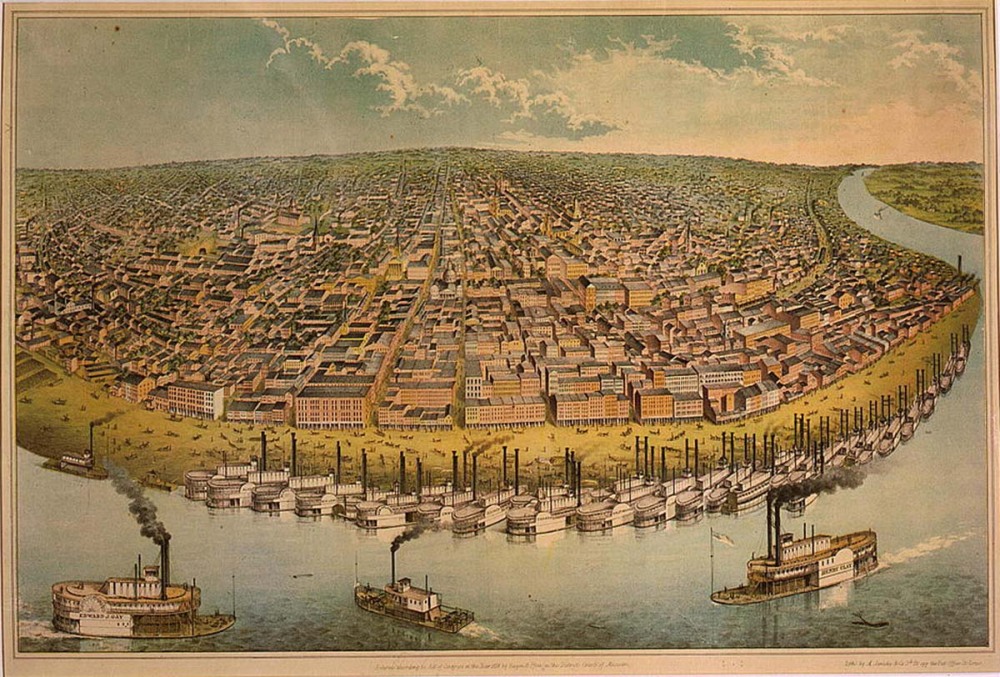
After several decades of the transportation revolution, by 1860, Americans had laid more than thirty thousand miles of railroad.2 The ensuing web of rail, paved roads, and canals made it much easier for farmers in the Northeast or Midwest to get their goods to urban markets. Railroad development was slower in the South, dedicated almost solely to connecting fields to ports, but the combination of rail lines and navigable rivers meant that few cotton planters struggled to transport their products to textile mills in the Northeast and Europe.
Such internal improvements spread not only goods but also information and people. The transportation revolution was accompanied by a communications revolution. The growing rail networks in the Northeast and Midwest linked urban spaces together, reducing the perceived distance between them by cutting travel times from weeks to days and days to hours. The telegraph likewise redefined the limits of human communication. By 1843, Samuel Morse had persuaded Congress to fund a forty-mile telegraph line stretching from Washington, DC, to Baltimore. Within a few short years, telegraph lines would carry news of battles in the Mexican-American War to Eastern newspapers within just a few days.
Meanwhile, the cash economy eclipsed older, local, informal systems of barter and trade, first in urban centers and then increasingly in rural spaces. Income and its consistency became the measure of economic worth and social privileges. Young workers might earn and expect wages as employees, rather than room, board, and training as part of a system of apprenticeships meant to propel rather than enrich. Moreover, a new form of economic organization appeared: the business corporation. Rooted in the idea that labor and laborers were a single part of a larger system of production, corporations offered the nation’s first top-down experiment in collective, profit-driven, integrated capitalism. Importantly, unlike the equally capitalistic and profit-driven system of racial slavery in the South, the developing corporate system in the urban North created a hierarchy of wage-earners, foremen, managers, and executives couched in the language of democracy and economic voluntarism.
The cotton boom fueled speculation in and dedication to slavery across the South. New technologies in tool manufacturing, such as steel plows, steam-powered cotton gins, and mechanical reapers, were nothing short of revolutionary and increased crop outputs over the 1830s and 1840s. Although more expensive to purchase, these products lasted longer and allowed for a massive repurposing of both labor and land, especially on large Southern plantations. Tilling fields and planting crops became faster and easier, as did harvesting and deseeding, increasing profits and leading to reinvestment at nearly every level of the Southern agricultural system. Increased global demand for cotton likewise led many enslavers to leverage potential profits into loans used to purchase ever-increasing numbers of enslaved laborers. For example, one 1840 Louisiana Courier ad warned that “it is very difficult now to find persons willing to buy slaves from Mississippi or Alabama on account of the fears entertained that such property may be already mortgaged to the banks of the above-named states.”3
This created a curious relationship between the Northern and Southern economies, as much of the money received from these loans flowed from Northern and Southern banks. While cities in the North and Border States became increasingly dedicated to the mass production, movement, and sale of finished goods, the financial sector it fueled was ever more tied to the Southern slave economy. Buttressed by investments in trade and budding industry, Northern banks and lenders saw the Southern slave market as a valuable way to invest in the production of raw materials—which in turn theoretically drove industrial production in the North—without the moral weight of direct investment in plantations and slavery itself. Instead of buying up land, slaves, and plantations of their own, Northern investors simply provided mortgages and loans with which Southern plantation owners and enslavers expanded their operations and increased their own investments in enslaved workers. By the beginning of the 1850s, and certainly by the end of that decade, cotton fueled much of the American economy, picked by the hands of enslaved Black workers in the Southern states and funded, finished, and shipped by investors, banks, factories, and corporations in cities across the North, South, and West. It was transported on rail lines, boxcars, paved roads, and steamships, through human-made canals and massive rivers, all of which made a vast, diverse, and once truly disconnected nation seem much smaller than it ever had before.
III. Industry and Society
The emerging industrial economy of the 1830s and 1840s gave rise to a number of as yet unimagined problems. Family life changed, defined by shifting meanings in individual value, collective labor, and the relationship between work, class, and politics. Men, women, and children took on new roles in the home as well as in the factory. In the public sphere, women increasingly challenged the moral direction of this new American society.
Femininity in the nation was intimately tied to the domestic sphere in what historians have described as the “cult of domesticity,” or the “cult of true womanhood.” These ideas developed in tandem with industrialization, the market revolution, and the Second Great Awakening. In reality, they applied primarily to upper-class and middle-upper-class women. Working-class women joined the public sphere through their labor, which was necessary for their families’ survival.
In the era of revivalism and reform, Americans understood the family and home as the hearthstones of civic virtue and moral influence. Women, the dominant understanding of gender claimed, were expected to be the guardians of virtue and the spiritual heads of the home. They were to be pious, pure, submissive, and domestic. Their responsibility was to pass these virtues on to their children. The Southern emphasis on honor affected women as well. While Southern men worked to maintain their sense of masculinity, so too Southern women cultivated a sense of femininity.4

Yet women took the very ideology that defined their place in the home and used it to fashion a public role for themselves. As a result, women became more visible and active in the public sphere than ever before. The influence of the Second Great Awakening, coupled with new educational opportunities available to girls and young women, enabled white middle-class women, especially in the North, to leave their homes en masse, joining and forming societies dedicated to everything from literary interests to the antislavery movement. Northern working-class women joined the public arena too, but in a different way. Young women workers organized strikes, including one at the Lowell Textile Mill in Massachusetts. Later, they created the Lowell Female Labor Reform Association, entering the political arena.5
While some Northern women began to organize reform societies, Southern women were more often instructed to offer a calming, moralizing influence on husbands and children and manage their households. Managing the household was not easy work, however. For Southern women on large plantations, managing the household would include subduing a population of humans who often fought against the oppressions of enslavement. For most women who did not live on plantations, managing the household included nearly constant work in keeping families clean, fed, and well behaved. On top of these duties, many women were required to help with agricultural tasks. Some women also sold eggs and butter or took in laundry to supplement the family’s income.
Female virtue, particularly in the South, came to be understood largely as a euphemism for sexual purity. Culture, law, and violence largely centered on protecting the virtue of sexual purity from any possible imagined threat. In a world saturated with the sexual exploitation of Black women, men developed a paranoid obsession with protecting the sexual purity of white women. Black men were presented as an insatiable sexual threat.
While some sought to overturn social hierarchies, many Southerners sought to preserve them. Southern manhood was largely shaped by an obsession with masculine honor. Honor prioritized the public recognition of white masculine claims to reputation and authority. Southern men developed a code to ritualize their interactions with each other and to perform their expectations of honor. This code structured language and behavior and was designed to minimize conflict. But when conflict did arise, the code also provided rituals that would reduce the resulting violence. Racial systems of violence and domination were wielded with crushing intensity for generations, all in the name of keeping white womanhood as pure as the cotton that anchored Southern society.
The formal duel exemplified the code of honor in action. If two men could not settle a dispute through the arbitration of their friends, they would duel to prove their equal honor status. Duelists arranged a secluded meeting, chose from a set of deadly weapons, and risked their lives as they clashed with swords or fired pistols at one another. Some of the most illustrious men in American history participated in a duel at some point during their lives, including President Andrew Jackson, Vice President Aaron Burr, and US Senators Henry Clay and Thomas Hart Benton. In all but Burr’s case, dueling helped elevate these men to prominence.
Violence among the lower classes, especially those in the backcountry, involved fistfights and shoot-outs. Tactics included the sharpening of fingernails and filing of teeth into razor-sharp points, which would be used to gouge eyes and bite off ears and noses. In a duel, a gentleman achieved recognition by risking his life rather than killing his opponent, whereas those involved in rough-and-tumble fighting achieved victory through maiming their opponent.
The legal system was partially to blame for the prevalence of violence in the Old South. Although states and territories had laws against murder, rape, and various other forms of violence, including specific laws against dueling, upper-class Southerners were rarely prosecuted, and juries often acquitted the accused. Although hundreds of duelists fought and killed one another, there is little evidence that many duelists faced prosecution, and only one, Timothy Bennett (of Belleville, Illinois), was ever executed. By contrast, prosecutors routinely sought cases against lower-class Southerners, who were found guilty in greater numbers than their wealthier counterparts.
These economic, religious, and social transformations increasingly seemed to divide the world into the public space of work and politics and the domestic space of leisure and morality. Women’s roles as guardians of moral virtue were used to address all forms of social issues that they felt contributed to the moral decline of society, including labor laws, prison reform, and antislavery. In spite of this apparent valuation of women’s position in society, there were clear limitations. Under the terms of coverture, men gained legal control over their wives’ property upon marriage, and women with children had no legal rights over their offspring. Additionally, women could not initiate divorce, make wills, sign contracts, or vote.
IV. New Faiths
By the 1830s, the Second Great Awakening had already brought about tectonic shifts in the landscape of American religion. A newfound evangelicalism had spread a more open, reactive, and malleable form of religious zeal into the West. As a result, reformers across the nation had begun to harness that passion by organizing movements and founding churches dedicated to perfecting the American character. The self-reliance, discipline, and moral righteousness that defined the new American middle-class’s image of itself found fertile ground in the rural spaces and working-class towns that linked the older Northeastern cities of New York, Boston, and Philadelphia with cities like Charleston, New Orleans, St. Louis, and Chicago. This produced an attitude of conscious reform and moral renegotiation that at once sought to escape and recreate the industrial, urban, middle-class outlook of the Northeast.
Perhaps most notable of these new religious groups were the Mormons. In Nauvoo, a small city in eastern Illinois founded as a haven for members of the uniquely American church, Joseph Smith moved beyond the bounds of 1840s Christian orthodoxy by continuing to pronounce personal revelations and introducing sacred rites to be performed only in front of church members in Mormon temples. Entrusted by God to rebuild the kingdom of Christ in the United States, Smith claimed, he and his followers were unrestricted in their criticism of modern society and its need for reform. Most controversially, Smith and a select group of his most loyal followers started to challenge standard notions of domesticity and marriage and began taking additional wives, a practice known at the time as “plural marriage.” Smith himself, for example, married at least thirty women over the course of just three or four years. Although Mormons did not publicly acknowledge or openly practice polygamy until 1852, when they moved to the shores of the Great Salt Lake, rumors of Smith’s involvement circulated almost immediately and played a part in the motivations of the mob that eventually murdered the Mormon prophet in the summer of 1844. The Mormon church continued under the leadership of Brigham Young, who led the group’s movement westward beginning in 1846.
Mormons were not the only religious community in antebellum America to challenge the domestic norms of the era through radical sexual experiments. Shakers strictly enforced celibacy in their communes scattered throughout New England and the upper Midwest, while John Humphrey Noyes introduced free love (or “complex marriage”) to his Oneida community in upstate New York.
Others challenged existing cultural customs in less radical ways. For individual worshippers, spiritual egalitarianism in revivals and camp meetings could break down traditional social conventions. For example, revivals generally admitted both men and women. Some preachers provided women with new opportunities to openly express themselves and participate in spiritual communities. This was particularly true in the Methodist and Baptist traditions, though by the mid-nineteenth century, most of these opportunities would be curtailed as these denominations attempted to move away from radical revivalism and toward the status of respectable, organized denominations. Some preachers also promoted racial integration in religious gatherings, expressing equal concern for white and Black people’s spiritual salvation and encouraging both enslavers and the enslaved to attend the same meetings. Historians have even suggested that the extreme physical and vocal manifestations of conversion seen at impassioned revivals and camp meetings like those seen in Pentecostal services offered the ranks of worshippers a way to enact a sort of social leveling by flouting the codes of self-restraint prescribed by upper-class elites. Although the revivals did not always live up to such progressive ideals in practice, particularly in the more conservative regions of the slaveholding South, the concept of spiritual egalitarianism nonetheless changed how Protestant Americans thought about themselves, their God, and one another.
Not all American Christians, though, were taken with revivalism. The early nineteenth century also saw the rise of Unitarianism as a group of ministers and their followers came to reject key aspects of “orthodox” Protestant belief, including the divinity of Christ. Christians in New England were particularly involved in the debates surrounding Unitarianism, as Harvard University became a hotly contested center of cultural authority between Unitarians and Trinitarians. Unitarianism had important effects on the world of reform when a group of Unitarian ministers founded the Transcendental Club in 1836.6 The club met for four years and included Ralph Waldo Emerson, Bronson Alcott, Frederic Henry Hedge, George Ripley, Orestes Brownson, James Freeman Clarke, and Theodore Parker. While initially limited to ministers or former ministers—except for the eccentric Alcott—the club quickly expanded to include numerous literary intellectuals. Among these were the author Henry David Thoreau, the proto-feminist and literary critic Margaret Fuller, and the educational reformer Elizabeth Peabody.
Transcendentalism had no established creed, and this was intentional. What united the Transcendentalists was their belief in a higher spiritual principle within each person that could be trusted to discover truth, guide moral action, and inspire art. They often referred to this principle as Soul, Spirit, Mind, or Reason. Deeply influenced by British Romanticism and German idealism’s celebration of individual artistic inspiration, personal spiritual experience, and aspects of human existence not easily explained by reason or logic, the Transcendentalists established an enduring legacy precisely because they developed distinctly American ideas that emphasized individualism, optimism, oneness with nature, and a modern orientation toward the future rather than the past. These themes resonated in an American nineteenth century where political democracy and readily available land distinguished the United States from Europe.
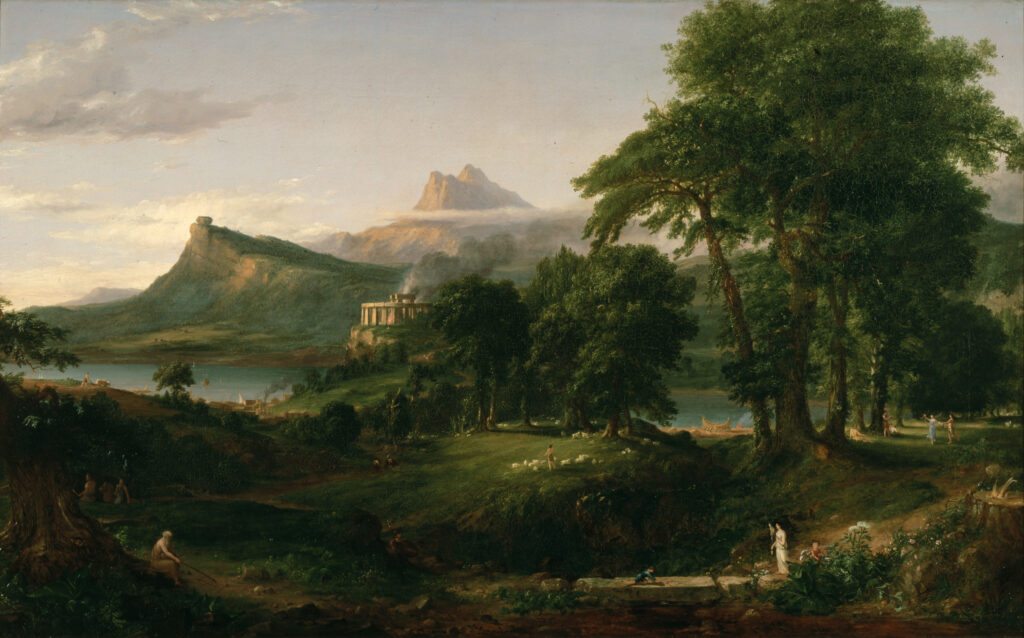
Ralph Waldo Emerson espoused a religious worldview wherein God, “the eternal ONE,” manifested through the special harmony between the individual soul and nature. In “The American Scholar” (1837) and “Self-Reliance” (1841), Emerson emphasized the utter reliability and sufficiency of the individual soul and exhorted his audience to overcome “our long apprenticeship to the learning of other lands.”7 Emerson believed that the time had come for Americans to declare their intellectual independence from Europe. Henry David Thoreau espoused a similar enthusiasm for simple living, communion with nature, and self-sufficiency. Thoreau’s sense of rugged individualism, perhaps the strongest among even the Transcendentalists, also yielded “Resistance to Civil Government” (1849).8 Several of the Transcendentalists also participated in communal living experiments. For example, in the mid-1840s, George Ripley and other members of the utopian Brook Farm community began to espouse Fourierism, a vision of society based on cooperative principles, as an alternative to capitalist conditions.9
Many of these different types of responses to the religious turmoil of the time had a similar endpoint in the embrace of voluntary associations and social reform work. During the antebellum period, many American Protestants responded to the moral anxiety of industrialization and urbanization by organizing to address specific social needs. Social problems such as intemperance, vice, and crime assumed a new and distressing scale that older solutions, such as almshouses, were not equipped to handle. These moralists grew concerned about the growing mass of urban residents who did not attend church, and who, thanks to poverty or illiteracy, did not even have access to scripture. Voluntary benevolent societies exploded in number to tackle these issues. Led by ministers and dominated by middle-class women, voluntary societies printed and distributed Protestant tracts, taught Sunday school, distributed outdoor relief, and evangelized in both frontier towns and urban slums. These associations and their evangelical members also lent moral backing and workers to large-scale social reform projects, including the temperance movement designed to curb Americans’ consumption of alcohol, the abolitionist campaign to eradicate slavery in the United States, and women’s rights agitation to improve women’s political and economic rights. As such wide-ranging reform projects combined with missionary zeal, evangelical Christians formed a “benevolent empire” that swiftly became a cornerstone of the antebellum period.
V. Fighting Sin
By the 1830s, the bounds of the domestic sphere, and by connection the role of women in American society more broadly, were expanding beyond the walls of the home. Importantly, one of the products of industrialization and urban development was a widespread belief in public outreach and social uplift. In some states, this took form in the creation of the nation’s first state-sponsored public-school systems led by Horace Mann. If the factory worker, wholesaler, manager, and banker were the modern-day representations of the virtuous yeoman of the Revolutionary and Jeffersonian eras, the domestic sphere that raised them needed a reimagining of its own. In part because women would work for lower wages and in part because the perceptions of the time held that women had the right nature and disposition to work with children, these schools became functional extensions of the republican household. They were places in which women, whether mothers of their own children or not, could take on the virtuous burden of educating the American public as a whole while also finding a place for themselves in the ranks of salaried workers across the nation.
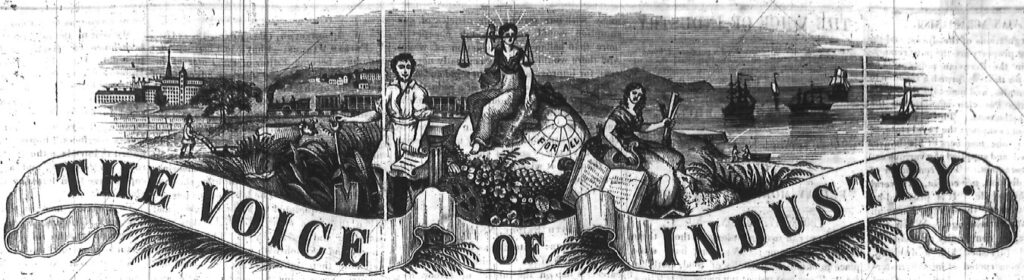
The role women took in helping society adjust to the demands of a new era did not stop with its domestic needs. An active labor source for factories since the early 1800s, women launched some of the earliest strikes demanding better conditions in textile mills and northern gin houses. By the 1840s, female operatives were central players in many organized labor reform movements. Indeed, in 1844, the Lowell Female Labor Reform Association organized under the leadership of Sarah Bagley, becoming the first union of working women in United States history. An auxiliary of the New England Workingmen’s Association, the organization led political pressure campaigns and public petition drives for better working conditions and more humane hours that drew thousands of signatures from “mill girls” across the region. Like their fellow male activists, Bagley and her associates used the desire for mental improvement as a central argument for reform. In an 1847 editorial published in the organization’s newspaper, Voice of Industry, Bagley pointedly asked, “Who, after thirteen hours of steady application to monotonous work, can sit down and apply her mind to deep and long continued thought?”10 Despite the widespread support for a ten-hour day, the movement achieved only partial success. President Martin Van Buren established a ten-hour-day policy for laborers on federal public works projects. New Hampshire passed a statewide law in 1847, and Pennsylvania followed a year later. Both states, however, allowed workers to opt out of these restrictions.
In 1842, child labor, long a common sight in every corner of the republic, became a dominant issue in the American labor movement. Because the landscape of American labor was changing, and factory work was in some places replacing less physically dangerous practices, the protection of child laborers gained a great deal of middle-class support. A petition from parents in Fall River, a southern Massachusetts mill town that employed a high portion of child workers, asked the state legislature for a child labor law.11 Massachusetts quickly passed a law prohibiting children under the age twelve from working more than ten hours a day. By the mid-nineteenth century, every state in New England had followed Massachusetts. Between the 1840s and 1860s, these statutes reinforced the increased value society had placed on education and the middle-class beliefs in the extension of the domestic sphere into the public realm. Throughout the region, public officials agreed that young children, between the ages of nine and twelve, should be prevented from working in dangerous occupations, and older children, between twelve and fifteen, should balance their labor with education and time for leisure.12
Male workers likewise sought to improve their income and working conditions. But labor gains were limited. Despite occasional calls for better working conditions within the emerging industrial system, Northern labor activists remained much more focused on placing the idea of free, wage labor in conflict with the system of enslaved labor in the South, claiming moral superiority to the Southern states’ peculiar institution. Indeed, the labor movement in the North and Midwest played a central role in popularizing the free-soil movement, challenging the spread of slavery into the West in the 1840s and forcing the debate into national politics in the 1850s. As a result, Northern industry, with all its flaws and internal challenges, came to represent for many people a more moral, pragmatic, and sustainable system of commerce than the Southern institution of slavery.
The most highly contested wing of the benevolent empire was the movement against slavery. In the face of substantial external opposition, the abolitionist movement began to splinter. In 1839, an ideological schism shook the foundations of organized antislavery. Moral suasionists, led most prominently by William Lloyd Garrison, felt that the US Constitution was a fundamentally proslavery document and that the present political system was irredeemable. They dedicated their efforts exclusively toward persuading the public to redeem the nation by reestablishing it on antislavery grounds. However, many abolitionists, reeling from the level of entrenched opposition met in the 1830s, began to feel that moral suasion was no longer realistic. Instead, they believed abolition would have to be effected through existing political processes. So, in 1839, political abolitionists formed the Liberty Party under the leadership of James G. Birney. This new abolitionist society was predicated on the belief that the US Constitution was actually an antislavery document that could be used to abolish the stain of slavery through the national political system.13
Many abolitionists who believed full-heartedly in moral suasion nonetheless felt compelled to leave the American Anti-Slavery Society because, in part, it elevated women to leadership positions and endorsed women’s suffrage. This question came to a head when, in 1840, Abby Kelly was elected to the business committee of the society. The elevation of women to full leadership roles was too much for some conservative members, who saw this as evidence that the society had lost sight of its most important goal. Under the leadership of Arthur Tappan, they left to form the American and Foreign Anti-Slavery Society. These disputes became so bitter and acrimonious that former friends cut social ties and traded public insults.
Another significant shift stemmed from the disappointments of the 1830s. Abolitionists in the 1840s increasingly moved from agendas based on reform to agendas based on resistance. Moral suasionists continued to appeal to hearts and minds, and political abolitionists launched sustained campaigns to bring abolitionist agendas to the ballot box. Meanwhile, the entrenched and violent opposition of both enslavers and the Northern public encouraged abolitionists to find other avenues of fighting slave power. Increasingly, for example, abolitionists aided runaway enslaved people and established international antislavery networks to pressure the United States to abolish slavery.

Frederick Douglass represented the intersection of these two trends. After escaping from slavery, Douglass came to the fore of the abolitionist movement as a naturally gifted orator and a powerful narrator of his experiences in slavery. His first autobiography, Narrative of the Life of Frederick Douglass, An American Slave, published in 1845, was so widely read that it was reprinted in nine editions and translated into several languages.14 Douglass traveled to Great Britain in 1845 and harnessed moral and financial support from British and Irish antislavery societies. His great success abroad contributed significantly to raising morale among weary abolitionists at home. Douglass was also a fervent supporter of women’s rights. In his abolitionist newspaper, the North Star, he wrote, “We hold women to be justly entitled to all we claim for man.”15

Women’s rights, too, divided abolitionists. The abolitionist movement was another important school for women’s public engagement. Many of the earliest women’s rights advocates began their activism by fighting the injustices of slavery, including Angelina and Sarah Grimké, Lucretia Mott, Sojourner Truth, Elizabeth Cady Stanton, and Susan B. Anthony. In the 1830s, women in cities such as Boston, New York, and Philadelphia established female societies dedicated to the antislavery cause. Initially, these societies were similar to the prayer and fundraising projects of other reform societies. As such societies proliferated, however, their strategies changed. Women could not vote, for example, but they increasingly used their right to petition to express their antislavery grievances to the government. Women like the Grimké sisters even began to travel on lecture circuits. This latter strategy, born of antislavery advocacy, tethered the cause of women’s rights to abolitionism.
Sarah Moore Grimké and Angelina Emily Grimké were born to a wealthy family in Charleston, South Carolina, where they witnessed the horrors of slavery firsthand. Repulsed by the treatment of the enslaved laborers on the Grimké plantation, they decided to support the antislavery movement by sharing their experiences on Northern lecture tours. At first speaking to female audiences, they soon attracted “promiscuous” crowds of both men and women. They were among the earliest and most famous American women to take such a public role in the name of reform. When the Grimké sisters met substantial harassment and opposition to their public speaking on antislavery, they began to see that they would need to fight for women’s rights in order to fight for the rights of enslaved people.16 Other female abolitionists soon joined them in linking the issues of women’s rights and abolitionism by drawing direct comparisons between the condition of free women in the United States and the condition of the slave.
As the antislavery movement gained momentum in Northern states in the 1830s and 1840s, so too did efforts for women’s rights. These efforts came to a head at the 1840 World Anti-Slavery Convention in London. The convention’s organizers refused to seat the female delegates or allow them to vote during the proceedings. Angered by such treatment, Lucretia Mott and Elizabeth Cady Stanton, whose husband was also a delegate, returned to the United States with a renewed interest in pursuing women’s rights. In 1848, they organized the Seneca Falls Convention, a two-day summit in New York state in which women’s rights advocates came together to discuss the problems facing women.
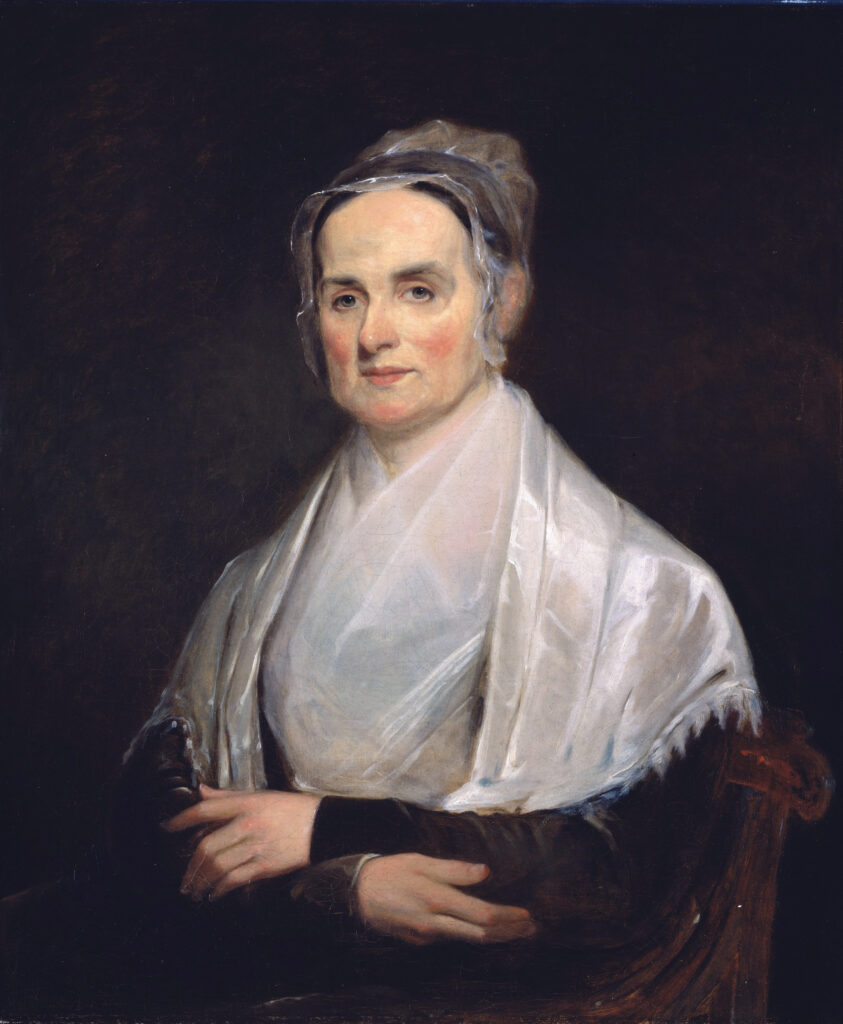
Stanton wrote the Declaration of Sentiments for the Seneca Falls Convention to capture the wide range of issues embraced by the early women’s rights movement. She modeled the document on the Declaration of Independence to make explicit the connection between women’s liberty and the rhetoric of America’s founding. The Declaration of Sentiments outlined fifteen grievances and eleven resolutions. They championed property rights, access to the professions (such as medicine and the law), and, most controversially, the right to vote. Sixty-eight women and thirty-two men signed the Declaration of Sentiments.17
Antebellum women fought what they perceived as senseless gender discrimination, such as the barring of women from college and inferior pay for female teachers. They also argued that men and women should be held to the same moral standards. The Seneca Falls Convention was the first of many such gatherings promoting women’s rights, held almost exclusively in the Northern states. Yet the women’s rights movement grew slowly and experienced few victories. Few states reformed married women’s property laws before the Civil War, and no state was prepared to offer women the right to vote during the antebellum period. At the onset of the Civil War, women’s rights advocates temporarily threw the bulk of their support behind abolition, allowing the cause of racial equality to temporarily trump that of gender equality. But the words of the Seneca Falls convention continued to inspire generations of activists.
Female education provides an example of the great strides made by and for women during the early 1800s. As part of a larger education reform movement in the early republic, several female reformers worked tirelessly to increase women’s access to education. They argued that if women were to take charge of the education of their children, they needed to be well educated themselves. While the women’s education movement did not generally push for women’s political or social equality, it did assert women’s intellectual equality with men, an idea that would eventually have important effects. Educators such as Emma Willard, Catharine Beecher, and Mary Lyon (founders of the Troy Female Seminary, Hartford Female Seminary, and Mount Holyoke Seminary, respectively) adopted the same rigorous curriculum that was used for boys. Many of these schools had the particular goal of training women to be teachers. Many graduates of these prominent seminaries would found their own schools, spreading women’s education across the country, and with it, ideas about women’s potential to take part in public life.
When the Civil War erupted in 1861, the revival and reform movements of the antebellum period had made an indelible mark on the American landscape. The Second Great Awakening ignited Protestant spirits by connecting evangelical Christians in national networks of faith. Social reform spurred members of the middle class to promote national morality and the public good. Not all reform projects were equally successful, however. While the temperance movement made substantial inroads against the excesses of alcohol consumption and reduced drinking by half, the abolitionist movement proved so divisive that it paved the way for a sectional crisis. Yet participation in reform movements, regardless of their ultimate success, encouraged many Americans to see themselves in new ways. Black activists became a powerful voice in antislavery societies, for example, developing domestic and transnational connections to pursue the cause of liberty. Middle-class women’s dominant presence in the benevolent empire encouraged them to pursue a full-fledged women’s movement. In their efforts to make the United States a more virtuous and moral nation, nineteenth-century reform activists developed cultural and institutional foundations for social change that have continued to reverberate through the twentieth and twenty-first centuries.
VI. Western Expansion
While women and men debated the bounds of politics, reform, and morality, Americans also pushed the physical limitations of their growing nation. Americans continued to push west. John Louis O’Sullivan, a popular newspaper editor and columnist, published the long-standing American belief that it was a God-given mission for the United States to lead the world in the peaceful transition to democracy. In a little-read essay printed in The United States Magazine and Democratic Review, Jane McManus Storm outlined the importance of annexing Texas to the United States:
Why, were other reasoning wanting, in favor of now elevating this question of the reception of Texas into the Union, out of the lower region of our past party dissensions, up to its proper level of a high and broad nationality, it surely is to be found, found abundantly, in the manner in which other nations have undertaken to intrude themselves into it, between us and the proper parties to the case, in a spirit of hostile interference against us, for the avowed object of thwarting our policy and hampering our power, limiting our greatness and checking the fulfillment of our manifest destiny to overspread the continent allotted by Providence for the free development of our yearly multiplying millions.1818
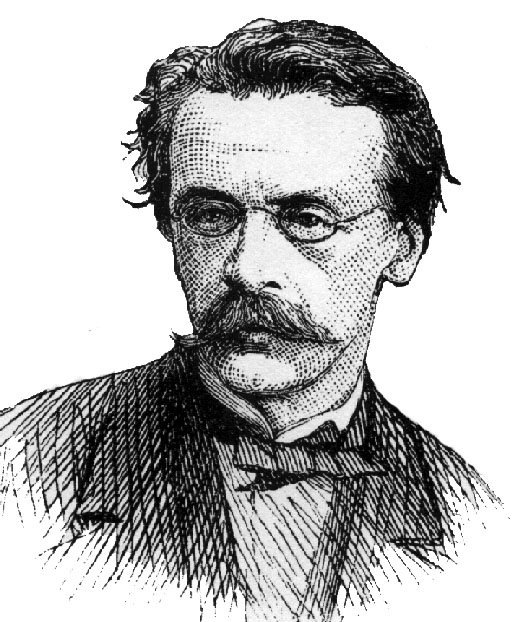
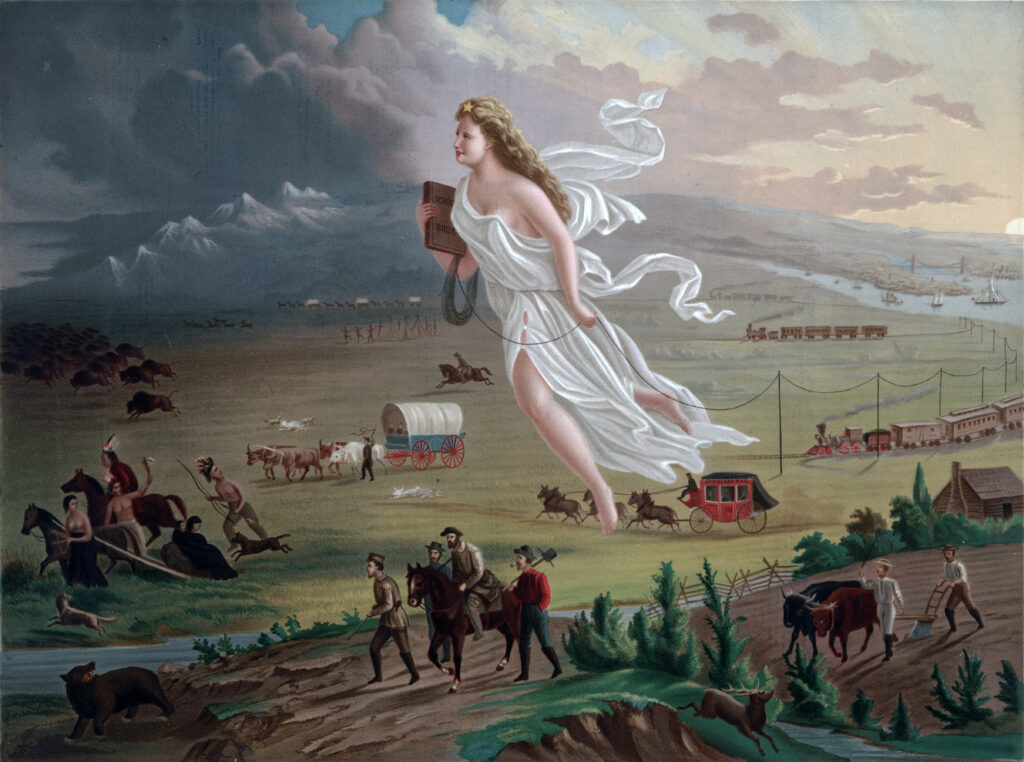
Storm, O’Sullivan, and many others viewed expansion as necessary to achieve America’s destiny and to protect American interests. “Manifest destiny” was grounded in the belief that a democratic, agrarian republic would save the world by spreading its religion, culture, and institutions across America. White Americans across the political spectrum embraced some elements of this belief as the United States continued to expand across the continent.
Although named by Storm and O’Sullivan in 1845, manifest destiny was a widely held but vaguely defined belief dating back to the nation’s founding. First, many Americans believed that the strength of American values and institutions justified moral claims to hemispheric leadership. Second, Americans viewed lands on the North American continent west of the Mississippi River (and later into the Caribbean) as destined for American-led political and agricultural improvement. Third, they believed that God and the Constitution ordained an irrepressible destiny to accomplish redemption and democratization throughout the world. These beliefs coupled with economic ambitions to create a tidal wave of western expansion. These beliefs and the resulting actions were often disastrous to anyone in the way of American expansion. The new religion of American democracy spread on the feet and in the wagons of those who moved west.
These impulses became articulated in a broad commitment to democratic expansion that grew into the Young America movement. Strongest among members of the Democratic Party but spanning the political spectrum, the Young America movement downplayed divisions over slavery and ethnicity by embracing a nationalist unity and emphasizing American exceptionalism, territorial expansion, democratic participation, and economic integration.19 Poet Ralph Waldo Emerson captured the political outlook of this new generation in a speech he delivered in 1844 titled “The Young American”:
In every age of the world, there has been a leading nation, one of a more generous sentiment, whose eminent citizens were willing to stand for the interests of general justice and humanity, at the risk of being called, by the men of the moment, chimerical and fantastic. Which should be that nation but these States? Which should lead that movement, if not New England? Who should lead the leaders, but the Young American?2020
However, many Americans, including Emerson, disapproved of aggressive expansion. For opponents of manifest destiny, the lofty rhetoric of the Young Americans was nothing other than a kind of imperialism that the American Revolution was supposed to have repudiated.21 Many members of the Whig Party (and later the Republican Party) argued that the United States’ mission was to lead by example, not by conquest. Abraham Lincoln summed up this criticism with a fair amount of sarcasm during a speech in 1859: “He [the Young American] owns a large part of the world, by right of possessing it; and all the rest by right of wanting it, and intending to have it. . . . He knows all that can possibly be known; inclines to believe in spiritual trappings, and is the unquestioned inventor of ‘Manifest Destiny.’”22
But Lincoln and other antiexpansionists struggled to win over popular opinion. The nation, fueled by the principles of manifest destiny, would continue westward. Along the way, Americans battled both Indigenous peoples and foreign nations, claiming territory to the very edges of the continent. “Do not lounge in the cities!” commanded publisher Horace Greeley in 1841. “There is room and health in the country, away from the crowds of idlers and imbeciles. Go west, before you are fitted for no life but that of the factory.”23 The New York Tribune often argued that American exceptionalism required the United States to benevolently conquer the continent as the prime means of spreading American capitalism and American democracy.
Settler-colonial dreams of creating a democratic utopia ultimately rested on those who picked up their possessions and their families and moved west. Western settlers usually migrated as families and settled along navigable and potable rivers. Settlements often coalesced around local traditions, especially religion, carried from Eastern settlements. These shared understandings encouraged a strong sense of cooperation among Western settlers that forged communities on the frontier.
Before the Mexican War, the West for most Americans still referred to the fertile area between the Appalachian Mountains and the Mississippi River, with a slight amount of overspill beyond its banks. With soil exhaustion and land competition increasing in the East, most early migrants sought a greater measure of stability and self-sufficiency by engaging in small-scale farming. Boosters of these new agricultural areas, along with the US government, encouraged perceptions of the West as a land of hard-built opportunity that promised personal and national bounty.
Women migrants bore the unique double burden of travel while also being expected to conform to restrictive gender norms. The key virtues of femininity, according to the “cult of true womanhood,” included piety, purity, domesticity, and submissiveness. The concept of “separate spheres” expected women to remain in the home. These values accompanied men and women as they traveled west to begin their new lives.
While many of these societal standards endured, there often existed an openness of frontier society that resulted in modestly more opportunities for women. Husbands needed partners in setting up a homestead and working in the field to provide food for the family. Suitable wives were often in short supply, enabling some to informally negotiate more power in their households and along the Overland Trails.24 Traditional gender lines broke down quickly on the trail. Women like Charlotte Pengra, for example, found themselves driving wagons and making bullets alongside the men who, at times, tended the children.25 In the 1860s, women, such as Lucinda Walker and Margaret Brown, were empowered as livestock owners in Texas. Census records, although spotty, reveal these women as heads of household and owners of cattle.26 Their relative freedom from traditional gender roles was possible because they lived in less populated areas on the frontier.
Americans debated the role of government in westward expansion. This debate centered on the proper role of the US government in paying for the internal improvements, or infrastructure projects, that soon became necessary to encourage and support economic development. Some saw frontier development as a self-driven undertaking that necessitated private risk and investment devoid of government interference. Others saw the federal government’s role as providing the infrastructural development needed to give migrants the push toward engagement with the larger national economy. While comprehensive support for federally funded infrastructure never fully materialized, halting efforts by state, local, and federal governments enabled an expansion of transportation networks that undergirded economic growth and settler migrations westward through the 1840s and beyond. Economic chains of interdependence stretched over hundreds of miles of land and through thousands of contracts and remittances. America’s manifest destiny became wedded not only to territorial expansion but also to economic development.27
In the end, federal aid proved essential for the conquest and settlement of the continent. Early railroads like the Baltimore and Ohio line hoped to link Mid-Atlantic cities with lucrative western trade routes. Railroad boosters encouraged the rapid growth of towns and cities along their routes. Not only did rail lines promise to move commerce faster, but the rails also encouraged the spreading of towns farther away from traditional waterway locations. Technological limitations, constant repairs, conflicts with Native Americans, and political disagreements all hampered railroading and kept canals and steamboats as integral parts of the transportation system. Nonetheless, this early establishment of railroads enabled a rapid expansion that would escalate during and after the Civil War, still furthering federal investment and involvement in the West.
VI. Indigenous People and Settler Pressures in the West
Yet the vast West was not empty. Until Indian Removal became national policy in the 1830s, Native Americans controlled much of the land east of the Mississippi River and almost all of the West. The political and legal processes of expansion always hinged on the belief that white Americans could best use new lands and opportunities. This belief rested on the idea that only Americans embodied the democratic ideals of yeoman agriculturalism extolled by Thomas Jefferson and expanded under Jacksonian democracy. Expansion hinged on the federal policy of Indian Removal that had begun in the East but would continue in the lands beyond the Mississippi River. American settlers came to covet the entire continent.
Still, some Native American groups remained too powerful to remove or subjugate. Beginning in the late eighteenth century, the Comanche rose to power in the Southern Plains region of what is now the southwestern United States. By quickly adapting to the horse culture first introduced by the Spanish, the Comanche transitioned from a foraging economy into a mixed hunting and pastoral society. After 1821, Mexico claimed the region as part of its northern frontier, but they had little control. Instead, the Comanche remained in power and controlled the economy of the Southern Plains. A flexible political structure allowed the Comanche to ally with some Indigenous groups while dominating others, as well as Mexican and American settlers in this borderland of the Southern Plains.
In the 1830s, the Comanche launched raids into northern Mexico, ending what had been an unprofitable but peaceful diplomatic relationship with Mexico. At the same time, they forged new trading relationships with Anglo-American traders in Texas. Throughout this period, the Comanche and several other independent Native groups, particularly the Kiowa, Apache, and Diné (Navajo), engaged in thousands of violent encounters with northern Mexicans. Collectively, these encounters comprised an ongoing war during the 1830s and 1840s as tribal nations vied for power and wealth.

By the 1840s, Comanche power peaked with an empire that controlled a vast territory in the trans-Mississippi West known as Comanchería. By trading in Texas and raiding in northern Mexico, the Comanche controlled the flow of commodities, including captives, livestock, and trade goods. They practiced a fluid system of captivity and captive trading, rather than a rigid chattel slavery system. The Comanche used captives for economic exploitation but also adopted captives into kinship networks. This allowed for the assimilation of diverse peoples in the region into the Comanche orbit. The ongoing conflict in the region had sweeping consequences on both Mexican and American politics. The US-Mexican War, beginning in 1846, can be seen as partly a consequence of this Indigenous-driven violence.28
In the Great Basin region, Mexican independence also escalated patterns of violence. This region, on the periphery of the Spanish Empire, was nonetheless integrated in the vast commercial trading network of the West.29 Mexican officials and Anglo-American traders entered the region with their own imperial designs. New forms of violence spread into the homelands of the Paiute and Western Shoshone. Traders, settlers, and Mormon religious refugees, aided by US officials and soldiers, committed acts of violence and laid the groundwork for violent conquest. This expansion of the American state into the Great Basin meant groups such as the Ute, Cheyenne, and Arapahoe had to compete over land, resources, captives, and trade relations with Anglo-Americans. Eventually, white incursion and ongoing wars against Native Americans resulted in the traumatic dispossession of land and the struggle for subsistence.30 Whether in the Great Basin, the Southern Plains, or the Pacific Northwest, as white settlers began to migrate west in larger numbers during the 1840s, their arrival signaled new pressures on Native lands and Indigenous ways of life.

VIII. Westward Expansion and the Politics of Slavery
Questions over slavery’s fate in the West endured in the United States. In late 1839, following the collective defeat of its four scattered candidates in the presidential election of 1836, the Whig Party held their first national convention in Harrisburg, Pennsylvania, emboldened by President Martin Van Buren’s failure to control the Panic of 1837 and seeking to take advantage of the growing call for reform. To party founder Henry Clay’s disappointment, the convention voted to nominate not him but General William Henry Harrison of Ohio as the Whig candidate for president in 1840. Harrison was known primarily for defeating Shawnee warriors led by Tecumseh before and during the War of 1812, most famously at the Battle of Tippecanoe in present-day Indiana. Whig leaders viewed him as a candidate with broad patriotic appeal. They portrayed him as the “log cabin and hard cider” candidate, a plain man of the country, unlike the Easterner Martin Van Buren. To balance the ticket with a Southerner, the Whigs nominated a slave-owning Virginia senator, John Tyler, for vice president. A compromise candidate, Tyler was originally a Democrat and a Jackson supporter in the 1820s and 1830s. Although he had broken with Jackson over his stance on states’ rights during the Nullification Crisis in 1832, Tyler never fully identified with the Whigs’ platform of government-led reform so popular among moralists and middle-class reformers across the expanding and changing country.
Although “Tippecanoe and Tyler Too” easily won the presidential election of 1840, this choice of ticket turned out to be disastrous for the Whigs. Harrison became ill (for unclear reasons, though tradition claims he contracted pneumonia after delivering a nearly two-hour inaugural address without an overcoat or hat) and died after just thirty-one days in office. Harrison thus holds the ironic honor of having the longest inaugural address and the shortest term in office of any American president.31 Vice President Tyler became president and soon adopted policies that looked far more like Andrew Jackson’s than like a Whig’s. After Tyler twice vetoed charters for another Bank of the United States, nearly his entire cabinet resigned, and the Whigs in Congress expelled “His Accidency” from the party.

The crisis of Tyler’s administration was just one sign of the Whig Party’s difficulty uniting around issues besides opposition to Democrats. The Whig Party succeeded in electing one more president but remained deeply divided. Its problems grew as the issue of slavery strained the Union in the 1850s.
Likewise, the push west only exacerbated the moral concerns of antislavery advocates in the North and Midwest and underlined the politically fraught prospects of slave-state representation in Congress and the national government more generally. Westward expansion seemed to also imply an expansion of the “slave interest” as Southern filibusters contemplated ways to graft new slave-holding territories onto the expanding nation. The 1840s opened with a number of disturbing developments for antislavery leaders. The 1842 Supreme Court case Prigg v. Pennsylvania ruled that the federal government’s Fugitive Slave Act trumped Pennsylvania’s personal liberty law.32 Antislavery activists believed that the federal government only served Southern enslavers, who were trouncing the states’ rights of the North. A number of Northern states reacted by passing new personal liberty laws in protest in 1843.
The rising controversy over the status of freedom-seeking people swelled partly through the influence of escaped formerly enslaved people, including Frederick Douglass. Other formerly enslaved people, including Sojourner Truth, joined Douglass in rousing support for antislavery, as did free Black Americans like Maria Stewart, James McCune Smith, Martin Delaney, and numerous others.33 But Black activists did more than deliver speeches. They also attacked the fugitive slave laws by helping thousands to escape. The incredible career of Harriet Tubman is one of the more dramatic examples. But the forces of slavery had powerful allies at every level of government, and as the 1840s progressed, those committed to the cause of abolition and antislavery would look for new political options as they continued to challenge the institutions of slavery.
The Whig Party had initially formed in opposition to Andrew Jackson’s presidency, and out of this opposition, it blamed Democrats for defending slavery at the expense of the American people. Yet antislavery was never a core component of the Whig platform. Several abolitionists grew so disgusted with the Whigs that they formed their own party, a true antislavery party. Activists in Warsaw, New York, organized the antislavery Liberty Party in 1839. Liberty leaders demanded the end of slavery in the District of Columbia, the end of the interstate slave trade, and the prohibition of slavery’s expansion into the West. But the Liberty Party also shunned women’s participation in the movement and distanced itself from visions of true racial egalitarianism. Few Americans voted for the party. The Democrats and Whigs continued to dominate American politics.
With this political status quo, Democrats and Whigs fostered a moment of relative calm on the slavery debate, partially aided by gag rules prohibiting discussion of antislavery petitions. Arkansas (1836) and Michigan (1837) became the newest states admitted to the Union, with Arkansas coming in as a slave state and Michigan coming in as a free state. Michigan gained admission through provisions established in the Northwest Ordinance, while Arkansas came in under the Missouri Compromise. Since its lands were below the line at 36°30′, the admission of Arkansas did not threaten the Missouri consensus. The balancing act between slavery and freedom continued.
Events in Texas would shatter the balance. In 1836, Anglo-Texans in the northern Mexican province of Tejas had successfully forced General Antonio Lopez de Santa Anna, then president of Mexico, to sign a treaty acknowledging Texas’s independence as a separate republic. Independent Texas soon gained recognition from a supportive Andrew Jackson administration in 1837. But Jackson’s successor, President Martin Van Buren, also a Democrat, had reasons to worry about the Republic of Texas. Texas struggled with ongoing conflicts with Mexico and raids from the powerful Comanche. The 1844 Democratic presidential candidate James K. Polk sought to bridge the sectional divide by promising new lands to whites in the North and South. Polk cited the annexation of Texas and the Oregon Territory as campaign cornerstones.34 Yet as Polk championed the acquisition of these vast new lands, Northern Democrats grew annoyed by their Southern colleagues, especially when it came to Texas.
Texas annexation had remained a political landmine since the Republic declared independence from Mexico in 1836. American politicians feared that adding Texas to the Union would provoke a war with Mexico and reignite sectional tensions by throwing off the balance between free and slave states. However, after his expulsion from the Whig party, President John Tyler saw Texas statehood as the key to saving his political career. In 1842, he began work on opening annexation to national debate. Harnessing public outcry over the issue, Democrat James K. Polk rose from virtual obscurity to win the presidential election of 1844. Polk and his party campaigned on promises of westward expansion, with eyes toward Texas, Oregon, and California. In the final days of his presidency, Tyler at last extended an official offer to Texas on March 3, 1845. The Republic accepted on July 4, becoming the twenty-eighth state. Mexico denounced annexation as “an act of aggression, the most unjust which can be found recorded in the annals of modern history.”35 Beyond the anger produced by annexation, the two nations both laid claim over a narrow strip of land between two rivers. Mexico drew the southwestern border of Texas at the Nueces River, but Texans claimed that the border lay roughly 150 miles farther west at the Rio Grande. Neither claim was realistic since the sparsely populated area, known as the Nueces Strip, was in fact controlled by Native Americans.
For many observers, the debates over Texas statehood illustrated that the federal government had fallen into the hands of proslavery radicals. Texas president Sam Houston managed to secure a deal with Polk and gained admission to the Union for Texas in 1845. Antislavery Northerners also worried about the admission of Florida, which entered the Union as a slave state in 1845. The year 1845 became a pivotal year in the memory of antislavery leaders. As Americans embraced calls to pursue their manifest destiny, antislavery voices looked at developments in Florida and Texas as signs that the sectional crisis had taken an ominous and perhaps irredeemable turn.
VII. The US-Mexican War
The Polk presidency signaled new reversals to the antislavery cause and the beginnings of a dark new era in American politics. President Polk and his Democratic allies were eager to see Western lands brought into the Union and were especially anxious to see the borders of the nation extended to the shores of the Pacific Ocean. Critics of the administration blasted these efforts as little more than land grabs on behalf of enslavers. In November 1845, President Polk secretly dispatched John Slidell to Mexico City to purchase the Nueces Strip along with large sections of New Mexico and California. The mission was an empty gesture, designed largely to pacify those in Washington who insisted on diplomacy before war. Predictably, officials in Mexico City refused to receive Slidell. In preparation for the assumed failure of the negotiations, Polk preemptively sent a four-thousand-man army under General Zachary Taylor to Corpus Christi, Texas, just northeast of the Nueces River. Upon word of Slidell’s rebuff in January 1846, Polk ordered Taylor to cross into the disputed territory. The president hoped that this show of force would push the lands of California onto the bargaining table as well. Unfortunately, he badly misread the situation. After losing Texas, the Mexican public strongly opposed surrendering any more ground to the United States. Popular opinion left the shaky government in Mexico City without room to negotiate. On April 24, Mexican cavalrymen attacked a detachment of Taylor’s troops in the disputed territory just north of the Rio Grande, killing eleven US soldiers.
The cagey Polk knew that since hostilities already existed, political dissent would be dangerous—a vote against war became a vote against supporting American soldiers under fire. Congress passed a declaration of war on May 13. Only a few members of both parties, notably John Quincy Adams and John C. Calhoun, opposed the measure. Upon declaring war in 1846, Congress issued a call for fifty thousand volunteer soldiers. Spurred by promises of adventure and conquest abroad, thousands of eager men flocked to assembly points across the country.36 However, opposition to “Mr. Polk’s War” soon grew. Polk’s shady actions in leading Congress to war in early 1846 seemed to justify antislavery complaints. Whigs, like Abraham Lincoln, found their initial protests to the war effort sidelined, but antislavery voices would become more vocal and more powerful as the Mexican War played out and new territories became annexed to the victorious United States.
In the early fall of 1846, the US Army invaded Mexico on multiple fronts, and within a year’s time General Winfield Scott’s men took control of Mexico City. However, the city’s fall did not bring an end to the war. Scott’s men occupied Mexico’s capital for over four months while the two countries negotiated. In the United States, the war had been controversial from the beginning. Embedded journalists sent back detailed reports from the front lines, and a divided press viciously debated the news. Volunteers found that war was not as they expected. Disease killed seven times as many American soldiers as combat.37 Harsh discipline, conflict within the ranks, and violent clashes with civilians led soldiers to desert in huge numbers. Peace finally came on February 2, 1848, with the signing of the Treaty of Guadalupe Hidalgo.
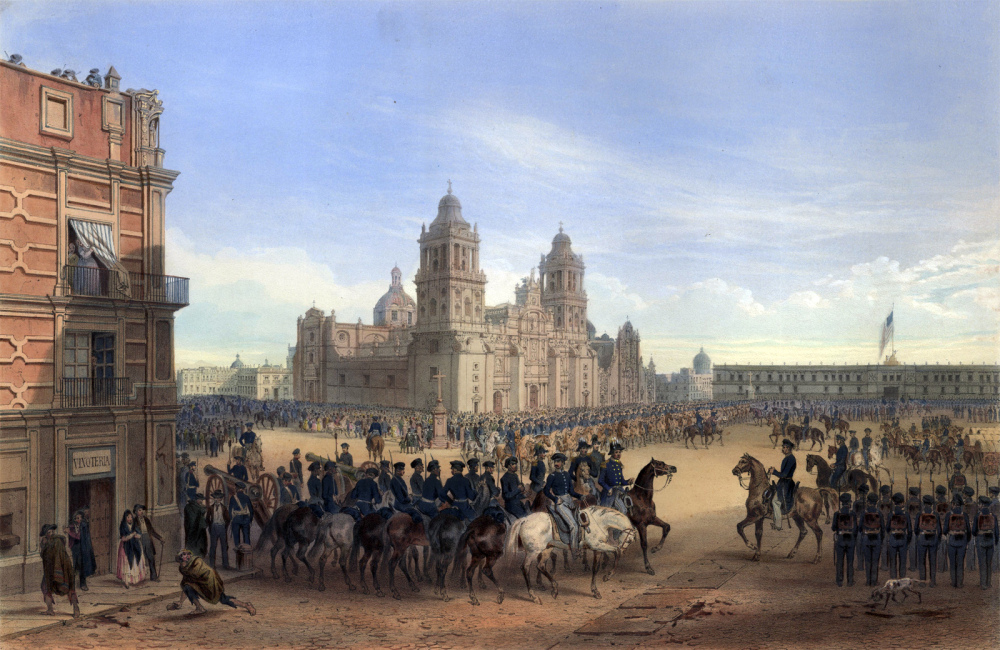
Through the treaty, the United States gained lands that would become the future states of California, Utah, and Nevada; most of Arizona; and parts of New Mexico, Colorado, and Wyoming. Mexican officials also had to surrender their claims to Texas and recognize the Rio Grande as its southern boundary. The United States offered $15 million for all of it. With American soldiers occupying their capital, Mexican leaders had no choice but to sign.
With the Treaty of Guadalupe Hidalgo and a newly forged peace, Polk opened up American expansion to the Pacific. New outlets for American expansion going forward, not just in Oregon but also in the Great Basin, Southern Plains, and far Southwest, became viable. The newly won American West attracted a diverse group of entrepreneurs and settlers to the commercial towns of New Mexico, the fertile lands of eastern Texas, the famed gold deposits of California, and the Rocky Mountains. This postwar migration built on earlier paths of travel dating back to the 1820s, when the lucrative Santa Fe trade enticed merchants to New Mexico and generous land grants brought numerous settlers to Texas. The Gadsden Purchase of 1854 further added to American gains north of Mexico and solidified the southern border from the Rio Grande across to the Pacific Ocean.
While the 1848 Treaty of Guadalupe Hidalgo secured vast tracts of land for American settlement, development, and overall expansion, the treaty infuriated antislavery leaders in the United States. The spoils of war were impressive, but it was clear they would help expand slavery. Antislavery activists, who already judged the Mexican War an enslavers’ plot, vowed that none of the newly won territories should be opened to slavery. But knowing that the Liberty Party was also not likely to provide a home to many moderate voters, leaders fostered a new and more competitive party, which they called the Free Soil Party. Antislavery leaders had thought that their vision of a federal government divorced from slavery might be represented by the major parties in the presidential election of 1848, but both the Whigs and the Democrats nominated candidates hostile to the antislavery cause. Left unrepresented, antislavery Free Soil leaders swung into action.
Demanding an alternative to the proslavery status quo, Free Soil leaders assembled so-called Conscience Whigs, the remnants of the Liberty Party, and antislavery Democrats under a new political umbrella. The Free Soil coalition called for a national convention in August 1848 at Buffalo, New York. A number of ex-Democrats committed to the party right away, including an important group of New Yorkers loyal to Martin Van Buren. The Free Soil Party’s platform bridged the Eastern and Western leadership together and called for an end to slavery in Washington, DC, and a halt on slavery’s expansion into the Western territories.38
The admission of Wisconsin as a free state in May 1848 helped cool tensions after the Texas and Florida admissions. Meanwhile, news from a number of failed European revolutions alarmed American reformers, but as exiled radicals filtered into the United States, a strengthening women’s rights movement also flexed its muscle at Seneca Falls, New York.39 Frederick Douglass also appeared at the convention and took part in the proceedings, where participants debated the Declaration of Sentiments, Grievances, and Resolutions.40 By August 1848, it seemed plausible that the Free Soil Movement might tap into these reforms and build a broader coalition. In some ways, that is precisely what it did. But come November, the spirit of reform failed to yield much at the polls. Whig candidate Zachary Taylor bested Democrat Lewis Cass of Michigan. The Free Soil movement hardly made a dent in the 1848 presidential election, but it drew more than four times the popular vote won by the Liberty Party in earlier elections. It was a promising start. In 1848, Free Soil leaders claimed just 10 percent of the popular vote but won over a dozen House seats and even managed to win one Senate seat in Ohio, which went to Salmon P. Chase.41 In Congress, Free Soil members had enough votes to swing power to either the Whigs or the Democrats, making them a sizable minority party that could no longer be ignored. In the years ahead, concerns about slavery’s expansion west and the proslavery leanings of the national government would continue to fuel the Free Soil opposition movement.
X. Conclusion
Expansion—in both the reform efforts of society’s morals and politics, and in the territorial sense as Americans pushed westward—shaped the era. In the aftermath of Jacksonian democracy’s advent on the national stage, Americans wrestled with how to shape the continent and its people in its own image. Various interest groups also increasingly debated how that American future for the continent would take shape—what role religion would play, what voice women might have in it, and crucially, whether the institution of slavery would be permitted to spill westward despite the prior controversies and compromises of Missouri.
The US-Mexican War (1846–1848) had an enormous impact on these questions and shaped the future of both countries. The American victory helped set the United States on the path to becoming a world power. It elevated Zachary Taylor to the presidency and served as a training ground for many of the Civil War’s future commanders. Most significantly, Mexico lost roughly half of its territory. Yet the US victory was not without danger. Ralph Waldo Emerson, an outspoken critic of the conflict, had predicted ominously at the beginning of the war, “We will conquer Mexico, but it will be as the man who swallows the arsenic which will bring him down in turn. Mexico will poison us.”42 Indeed, the conflict over whether to extend slavery into the newly won territory pushed the nation ever closer to disunion and civil war. The chauvinism of policies like Native American removal, the Mexican War, and filibustering existed alongside growing anxiety over the morality of the nation’s actions in the West and its continued reliance on slave labor in the South. Debates over reform, economics, diplomacy, and manifest destiny exposed some of the key weaknesses of the American system, begging the question of whether the nation could survive the growing pains of expansion in all of its capacities.
XI. Primary Sources
1. Sarah Grimké calls for women’s rights, 1838
2. Frederick Douglass, “What to the Slave is the Fourth of July?” 1852
3. George Fitzhugh argues that slavery is better than liberty and equality, 1854
4. Declaring America’s manifest destiny, 1845
5. Diary of a Woman Migrating to Oregon, 1853
6. Chinese Merchant Complains of Racist Abuse, 1860
7. Wyandotte woman describes tensions over slavery, 1849
9. Manifest destiny painting, 1872
XII. Reference Material
This chapter was edited by Andrew N. Wegmann and John William Nelson, with content contributions by Elena Abbott, Ian Beamish, Amanda Bellows, Cameron Blevins, Marjorie Brown, Matthew Byron, Steffi Cerato, Frank Cirillo, Justin Clark, Emily Conroy-Krutz, Jane Fiegen Green, Robert Gudmestad, John Harris, Nicolas Hoffmann, Christopher C. Jones, Brenda Lakhani, Jonathan Koefoed, Charles McCrary, Maria Montalvo, John William Nelson, James Anthony Owen, Katherine Rohrer, William E. Skidmore, Marie Stango, Megan Stanton, Kelly Weber, Andrew N. Wegmann, Jonathan Wilfred Wilson, Caroline Wright, and Ben Wright.
Recommended Reading
• Blackhawk, Ned. Violence Over the Land: Indians and Empires in the Early American West. Harvard University Press, 2006.
• Delano, Sterling F. Brook Farm: The Dark Side of Utopia. Harvard University Press, 2009.
• DeLay, Brian. War of a Thousand Deserts: Indian Raids and the U.S.-Mexican War. Yale University Press, 2009.
• Edwards, Justene Hill. Unfree Markets: The Slaves’ Economy and the Rise of Capitalism in South Carolina. Columbia University Press, 2021.
• Eyal, Yonatan. The Young America Movement and the Transformation of the Democratic Party, 1828–1861. Cambridge University Press, 2007.
• Ginzberg, Lori. Untidy Origins: A Story of Woman’s Rights in Antebellum New York. University of North Carolina Press, 2005.
• Greenberg, Amy S. Manifest Manhood and the Antebellum American Empire. Cambridge University Press, 2005.
• Gura, Philip F. American Transcendentalism: A History. Hill and Wang, 2008.
• Hahn, Steven, A Nation Without Borders: The United States and Its World in an Age of Civil Wars, 1830–1910. Viking, 2016.
• Holt, Michael. The Rise and Fall of the American Whig Party: Jacksonian Politics and the Onset of the Civil War. Oxford University Press, 1999.
• Jeffrey, Julie Roy. The Great Silent Army of Abolitionism: Ordinary Women in the Antislavery Movement. University of North Carolina Press, 1998.
• Johnson, Reinhard O. The Liberty Party, 1840–1848: Antislavery Third-Party Politics in the United States. Louisiana State University Press, 2009.
• Lepler, Jessica. The Many Panics of 1837: People, Politics, and the Creation of a Transatlantic Financial Crisis. Cambridge University Press, 2013.
• Lerner, Gerda. The Grimké Sisters from South Carolina: Pioneers for Women’s Rights and Abolition. University of North Carolina Press, 2009.
• Matson, Cathy, and Wendy A. Woloson. Risky Business: Winning and Losing in the Early American Economy, 1780–1850. Library Company of Philadelphia, 2003.
• Montalvo, Maria R. Enslaved Archives: Slavery, Law, and the Production of the Past. Johns Hopkins University Press, 2024.
• Murphy, Sharon Ann. Banking on Slavery: Financing Southern Expansion in the Antebellum United States. University of Chicago Press, 2023.
• Rayback, Joseph. Free Soil: The Election of 1848. University Press of Kentucky, 2014.
• Rothenberg, Winifred Barr. From Market-Places to a Market Economy: The Transformation of Rural Massachusetts, 1750–1850. University of Chicago Press, 1992.
• Saunt, Claudio. Unworthy Republic: The Dispossession of Native Americans and the Road to Indian Territory. Norton, 2020.
• Snyder, Christina. Great Crossings: Indians, Settlers, and Slaves in the Age of Jackson. Oxford University Press, 2017.
• Stewart, Whitney Nell. This Is Our Home: Slavery and Struggle on Southern Plantations. University of North Carolina Press, 2023.
• Suval, John. Dangerous Ground: Squatters, Statesmen, and the Antebellum Rupture of American Democracy. Oxford University Press, 2022.
• Waite, Kevin. West of Slavery: The Southern Dream of a Transcontinental Empire. University of North Carolina Press, 2021.
• Wegmann, Andrew N. An American Color: Race and Identity in New Orleans and the Atlantic World. University of Georgia Press, 2022.
Notes
- Leonard P. Curry, The Corporate City: The American City as a Political Entity, 1800–1850 (Greenwood, 1997), 46.[↩]
- Cathy Matson and Wendy A. Woloson, Risky Business: Winning and Losing in the Early American Economy, 1780–1850 (Library Company of Philadelphia, 2003), 29.[↩]
- Louisiana Courier, February 12, 1840.[↩]
- Barbara Welter, “The Cult of True Womanhood: 1820–1860,” American Quarterly 18, no. 2 (1966): 151–74, https://doi.org/10.2307/2711179.[↩]
- “Lowell Mill Women Create the First Union of Working Women,” AFL-CIO, https://aflcio.org/about/history/labor-history-events/lowell-mill-women-form-union.[↩]
- Philip F. Gura, American Transcendentalism: A History (Hill and Wang, 2008), 5.[↩]
- Ralph Waldo Emerson, “The American Scholar,” speech, 1837, https://archive.vcu.edu/english/engweb/transcendentalism/authors/emerson/essays/amscholar.html; Ralph Waldo Emerson, “Self Reliance,” in Essays, First Series, 1841, https://archive.vcu.edu/english/engweb/transcendentalism/authors/emerson/essays/selfreliance.html.[↩]
- Henry David Thoreau, Walden, and On the Duty of Civil Disobedience, http://www.gutenberg.org/files/205/205-h/205-h.htm.[↩]
- Sterling F. Delano, Brook Farm: The Dark Side of Utopia (Harvard University Press, 2009).[↩]
- [Sarah Bagley], “The Blindness of the Age,” Voice of Industry, April 23, 1847, https://www.industrialrevolution.org/the-blindness-of-the-age#topof blindnessofage.[↩]
- Legislative Documents, 1842, House, no. 4, 3, in Elizabeth Lewis Otey, The Beginnings of Child Labor Legislation in Certain States: A Comparative Study (Arno Press, 1974, 78).[↩]
- Miriam E. Loughran, “The Historical Development of Child-Labor Legislation in the United States,” PhD diss., Catholic University of America, 1921, 67.[↩]
- Reinhard O. Johnson, The Liberty Party, 1840–1848: Antislavery Third-Party Politics in the United States (Louisiana State University Press, 2009).[↩]
- Philip Gould, “The Rise, Development, and Circulation of the Slave Narrative,” in The Cambridge Companion to the African American Slave Narrative, ed. Audrey Fisch (Cambridge University Press, 2007), 24.[↩]
- “Frederick Douglass,” National Park Service, https://www.nps.gov/wori/learn/historyculture/frederick-douglass.htm.[↩]
- Gerda Lerner, The Grimké Sisters from South Carolina: Pioneers for Women’s Rights and Abolition (University of North Carolina Press, 2009).[↩]
- “Declaration of Sentiments,” in Elizabeth Cady Stanton, Susan B. Anthony, and Matilda Joslyn Gage, History of Woman Suffrage, vol. 1 (Rochester, NY, 1889), 70–71, https://sourcebooks.fordham.edu/mod/senecafalls.asp.[↩]
- Jane McManus Storm, “Annexation,” United States Magazine and Democratic Review 17, no. 85 (July–August 1845), 5, https://books.google.com/books?id=JvE7AQAAMAAJ.[↩]
- Yonatan Eyal, The Young America Movement and the Transformation of the Democratic Party, 1828–1861 (Cambridge University Press, 2007).[↩]
- Ralph Waldo Emerson, “The Young American: A Lecture Read Before the Mercantile Library Association, Boston, February 7, 1844,” https://emersoncentral.com/texts/nature-addresses-lectures/lectures/the-young-american/.[↩]
- See Peter S. Onuf, “Imperialism and Nationalism in the Early American Republic,” in Empire’s Twin: U.S. Anti-imperialism from the Founding Era to the Age of Terrorism, ed. Ian Tyrell and Jay Sexton (Cornell University Press, 2015), 21–40.[↩]
- Abraham Lincoln, “Lecture on Discoveries and Inventions,” 1858, http://www.abrahamlincolnonline.org/lincoln/speeches/discoveries.htm.[↩]
- Horace Greeley, New York Tribune, 1841. Although the phrase “Go west, young man,” is often attributed to Greeley, the exhortation was most likely only popularized by the newspaper editor in numerous speeches, letters, and editorials and always in the larger context of the comparable and superior health, wealth, and advantages to be had in the West.[↩]
- Adrienne Caughfield, True Women and Westward Expansion (Texas A&M University Press, 2005).[↩]
- Johnny Faragher and Christine Stansell, “Women and Their Families on the Overland Trail to California and Oregon, 1842–1867,” Feminist Studies 2, no. 2/3 (1975): 150–66, https://doi.org/10.2307/3177779.[↩]
- Deborah M. Liles and Cecilia Gutierrez Venable, Texas Women and Ranching: On the Range, at the Rodeo, and in Their Communities (Texas A&M University Press, 2019).[↩]
- For more on the technology and transportation revolutions, see Daniel Walker Howe, What Hath God Wrought: The Transformation of America, 1815–1848 (Oxford University Press, 2007).[↩]
- Pekka Hämäläinen, The Comanche Empire (Yale University Press, 2008); Brian DeLay, War of a Thousand Deserts: Indian Raids and the U.S.-Mexican War (Yale University Press, 2009).[↩]
- The Great Basin is bound to the west by the Sierra Mountains in California and the Cascades in Oregon, to the east by the Rocky Mountains, to the north by the Snake River Basin, and to the south by the Mojave Desert. It includes most of Nevada, the western half of Utah, and parts of Oregon, California, Wyoming, and Idaho.[↩]
- Ned Blackhawk, Violence Over the Land: Indians and Empires in the Early American West (Harvard University Press, 2006).[↩]
- Joseph Nathan Kane, Presidential Fact Book (Random House, 1998), 61.[↩]
- Richard Peters, Report of the Case of Edward Prigg against the Commonwealth of Pennsylvania (Philadelphia, 1842).[↩]
- See Sojourner Truth, The Narrative of Sojourner Truth, ed. Olive Gilbert (Boston, 1850), http://digital.library.upenn.edu/women/truth/1850/1850.html; Marilyn Richardson, ed., Maria W. Stewart: America’s First Black Woman Political Writer (Indiana University Press, 1987); John Stauffer, ed., The Works of James McCune Smith: Black Intellectual and Abolitionist (Oxford University Press, 2007); Frank A. Rollin, Life and Public Services of Martin R. Delaney (Boston, 1868), especially 313–67, https://archive.org/details/lifepublicservic00inroll.[↩]
- James K. Polk: “Inaugural Address,” March 4, 1845. Gerhard Peters and John T. Woolley, The American Presidency Project, https://www.presidency.ucsb.edu/documents/inaugural-address-30.[↩]
- Quoted in The Annual Register, or, a View of the History and Politics of the Year 1846, Volume 88 (Washington, DC, 1847), 377.[↩]
- Amy S. Greenberg, Manifest Manhood and the Antebellum American Empire (Cambridge University Press, 2005).[↩]
- James M. McCaffrey, Army of Manifest Destiny: The American Soldier in the Mexican War, 1846–1848 (New York University Press, 1992), 53.[↩]
- Eric Foner, Free Soil, Free Labor, Free Men: The Ideology of the Republican Party Before the Civil War (Oxford University Press, 1970).[↩]
- Eleanor Flexnor, Century of Struggle: The Women’s Rights Movement in the United States (Harvard University Press, 1975).[↩]
- Report of the Woman’s Rights Convention, Held at Seneca Falls, N.Y., July 19th and 20th, 1848 (Rochester, NY, 1848).[↩]
- Joseph Rayback, Free Soil: The Election of 1848 (University Press of Kentucky, 2014).[↩]
- Ralph Waldo Emerson, quoted in James McPherson, Battle Cry of Freedom: The Civil War Era (Oxford University Press, 1988), 51.[↩]