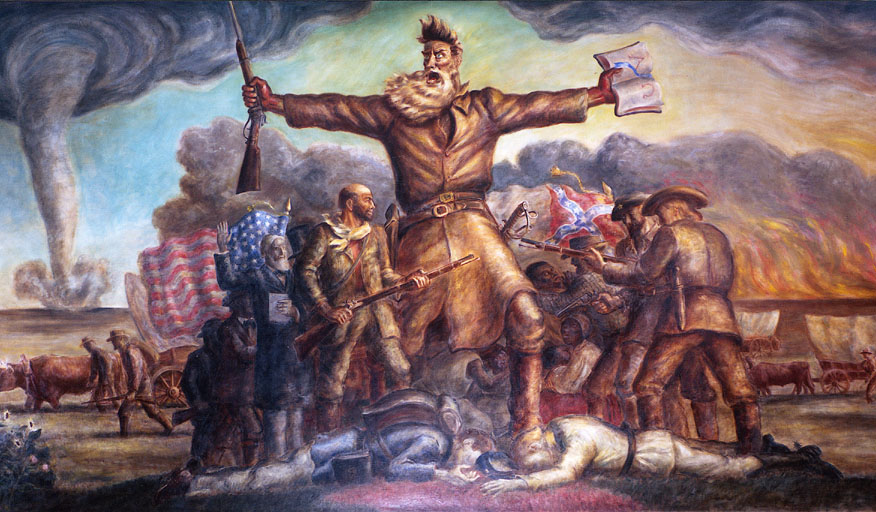
*The American Yawp is an evolving, collaborative text. Click here to help improve this chapter.*
I. Introduction
Near the end of the nation’s bloody Civil War, President Abraham Lincoln used his Second Inaugural Address to reflect on the war’s causes. Slavery, he said, had long “constituted a peculiar and powerful interest.” “All knew,” he added, “that this interest was somehow the cause of the war.”1
By the 1850s, it was widely understood that slavery’s expansion into the Western territories had generated deep and persistent problems for the United States. Americans had fought over whether slavery should be allowed to expand westward and what role the government should play in protecting the interests of enslavers since at least the 1770s. Many believed that slavery suppressed wages and monopolized land that might otherwise support poorer Americans in their pursuit of economic independence. Others feared that if slavery could not expand, the antislavery movement would soon dominate national politics. Still others were apprehensive that a growing, concentrated population of enslaved people would spark insurrection and spur even more widespread violence. Meanwhile, Indigenous Americans continued to resist US expansion and defend their homelands and ways of life.
A central dilemma for the federal government was that enslaved people’s persistent resistance demanded increasingly forceful proslavery policies to maintain order. As Northern and Northwestern states gradually abolished slavery, enslaved men and women fled, often seeking refuge in North America’s expanding Black and interracial antislavery communities. This movement triggered growing debate over the federal government’s responsibility to recapture freedom seekers. Some states invoked states’ rights to resist participation in personal liberty laws, while others demanded a national commitment to enforcing slavery.
These conflicts grew harder to manage as the national economy diversified. In Lincoln’s eyes, enslaved laborers formed a “powerful interest” not only because of their numbers but because their forced labor remained essential to the US economy. Slavery’s products—especially cotton—fueled not only the plantation South but also the nation’s industrializing sectors. At the same time, more and more Americans came to believe that wage labor represented a superior economic system. And then there were those who also resented what they saw as unfair labor competition from free Black people and formerly enslaved individuals.
After decades of conflict, American politics became sharply sectional in the 1850s. Many in both the North and South feared that the other region had seized permanent control of the federal government. In November 1860, Abraham Lincoln—an opponent of slavery’s expansion—was elected president as the candidate of the recently formed Republican Party. In the secession crisis that followed, tensions that had built over nearly a century erupted into Civil War.
II. Gold Rush
New Year’s Day in 1849 passed quietly and uneventfully for the then lame-duck Illinois Congressman Abraham Lincoln. Just months earlier, he had suffered political defeat for his outspoken opposition to the Mexican War. With only a short time remaining in his term, Lincoln did not participate in the congressional debates that were once again poised to erupt over the issue of slavery’s expansion.
By 1849, fierce disagreements over westward expansion and the future of slavery were nothing new. A decade earlier, advocates of US territorial growth had coined the phrase “manifest destiny.”2 By the mid-1840s, the idea had come to express the belief that it was America’s divine mission “to overspread the continent allotted by Providence for the free development of our yearly multiplying millions.”3 A term that once broadly evoked imperial ambition became increasingly tied to the interests of slaveholding expansion.
Lincoln’s opposition to the spread of slavery had been a central theme of his first congressional campaign in 1846. The Mexican War, however, far from settling the issue, only intensified it. David Wilmot introduced a proviso before the House that would ban slavery in territory land to be seized from Mexico. Southerners revolted. By 1849, debates over slavery had grown even more urgent, especially as new developments—both abroad and in the recently acquired Western territories, including the discovery of gold in California—once again pushed the issue to the forefront of national politics.
The situation by 1850 seemed to embolden some of the nation’s most ardent expansionists. Many Northern businessmen and Southern enslavers, for example, supported the idea of pushing US slavery into the Caribbean as a useful alternative to continental expansion, since slavery already existed in these areas. Some were critical of these attempts, seeing them as evidence of a growing slave-power conspiracy. Many others supported attempts at expansion, like those previously seen in eastern Florida, even if these attempts were not exactly legal. Filibustering, as it was called, involved privately financed schemes directed at capturing and occupying foreign territory without the approval of the US government.
Filibustering in the early 1850s took its greatest hold in the imaginations of Americans as they looked toward Cuba. Fears of racialized revolution in Cuba (as in Haiti and Florida before it), as well as the presence of an aggressive British abolitionist influence in the Caribbean, energized the movement to annex Cuba and encouraged filibustering as expedient alternatives to lethargic official negotiations. Despite filibustering’s chaotic planning and destabilizing repercussions, those intellectually and economically guiding the effort imagined a willing and receptive Cuban population carefully guided and managed by an agreeable American business class. In Cuba, manifest destiny for the first time sought territory off the continent and hoped to put a unique spin on the story of success in Mexico. Yet the annexation of Cuba, despite great popularity and some military attempts led by Narciso López, a Cuban dissident, never succeeded.4
Other filibustering expeditions were launched elsewhere, including two by the Tennessean William Walker, a former American soldier. Walker seized portions of the Baja Peninsula in Mexico in 1853 and then later took power and established a slaving regime in Nicaragua. Eventually, Walker was executed in Honduras.5 These missions violated the laws of the United States, but wealthy Americans regularly financed various filibusters, and less-wealthy adventurers were all too happy to sign up. Filibustering enjoyed its brief popularity into the late 1850s, at which point slavery and concerns over secession came to the fore. By the opening of the Civil War, most had changed their minds and now saw these attempts as simply territorial theft.
In the far western reaches of the lands seized from Mexico, meanwhile, the slavery issue also flared. California and Oregon in 1849 were at least three arduous months of overland travel from the nearest major American settlements in Missouri. Some Anglo-American settler communities dotted California’s fertile Sacramento Valley, but the rich farmlands of Oregon’s Willamette Valley at first attracted even more migrants. Since the 1840s opening of the Oregon Trail, dramatized stories of Indigenous attacks had filled these white settlers with a sense of foreboding. The region’s constant Indigenous challenge and presence, combined with slow progress, disease, poor trails, a lack of guidebooks, and generalized confusion, all made overland passage to the West difficult. And yet, despite the harshness of the journey, by the late 1840s, approximately twenty thousand white Americans lived west of the Rocky Mountains, with about three-fourths of that number in Oregon. Not all had been brought to the territory willingly, of course. Enslaved African Americans added not only to the growing demographics of the territory but ensured that debates over slavery and Black rights would again exacerbate tensions as Oregon moved to draft its state constitution. There, as in so many other places in 1849, the question again became: Would these territories be slave or free?6

The discovery of gold in the Sierra Nevada foothills of California had a similar effect to the slavery issue.7 On January 24, 1848, James W. Marshall, a contractor hired by John Sutter, discovered gold on Sutter’s sawmill land in the Sacramento Valley. When word of the discovery spread, an onrush of settlement from around the world began in 1849. The lure of getting rich quickly drew especially younger single men (with some women) to fast-rising gold towns spread throughout the region. These adventurers and fortune seekers in turn served as magnets for the arrival of others—from China, Mexico, Chile, Hawai‘i, and elsewhere—who were often relegated to providing services associated with the Gold Rush. Towns and cities grew rapidly, especially San Francisco, whose population surged from about five hundred in 1848 to almost fifty thousand by 1853. And once more, enslaved African Americans again provided many essential laborers for life in the “diggings,” as the mines were often referenced. Here again, the question of whether the territory and its incredibly diverse population would be admitted to the Union as “slave or free” loomed large.
The slavery question became an especially vexing one in California for several reasons. Obviously, with its long and expansive access to the Pacific Coast, California offered a tremendous economic opportunity to the expanding United States, with its potential for linking to lucrative Asian commercial markets. Yet California, as with the rest of the West, also had a robust Indigenous population that already laid claim to the lands. Making matters even more complicated, early white Californians were also lobbying hard to serve as the endpoint for a transcontinental railroad that could provide services for both passengers and goods from the East. The great influx of diverse peoples unleashed by the Gold Rush, in addition, raised additional questions about the boundaries and terms of American citizenship: Would these new residents be citizens, be voters? Linguistic, cultural, economic, and racial conflicts all roiled the state’s fast-expanding urban and rural areas as its great diversity took shape. By the end of the 1850s, Chinese and Mexican immigrants made up one-fifth of the state’s mining population. Many wondered if these populations, too, would become part of the fast-evolving nation.8
Observing these events, many Northern critics worried that without a strong antislavery presence, California would succumb to the wishes of the “Slave Power” (an idea that dated in many ways back to the nation’s first Federalist Party, and had also been reenergized for a time by antislavery Democrats in the 1830s) If California fell under the sway of the slaving South, they warned, life there would be hardly any different than that of life in Louisiana, Alabama, or South Carolina. Already, critics warned, the promising multiethnic patchworks of California’s frontier towns were threatened by migrating Southerners who insisted that whites resume their dominance in the territory as their major landowners and managers, while poorer whites and ethnic minorities were forced to work the mines and assorted jobs. The competition for land, resources, and riches furthered these individual and collective abuses, particularly against Native Americans and older Mexican communities. California’s towns, as well as those dotting the landscape throughout the West, struggled to balance security with economic development and the protection of civil rights and liberties.
III. “Cotton Is King”
Proslavery voices also grew increasingly emboldened in the 1850s and added to expansionist appeals. James Henry Hammond, a South Carolina senator and plantation owner, famously celebrated slavery in a speech before the US Senate in 1858: “Would any sane nation make war on cotton?” he asked. “No power on earth dares to make war upon it. Cotton is king.”9
Such rhetoric was common among slavery’s staunchest defenders by the 1850s, who often used it to downplay or obscure the fundamental instabilities of the slave system—instabilities that had long made slavery a central “problem” in American life.10 The problem of slavery in the cotton South at the time was twofold. First and most immediate for whites was the fear and risk of rebellion. With nearly four million enslaved people residing in the South in 1860, and nearly 2.5 million living in the Cotton Belt alone, the systems of communication, resistance, and potential violence among enslaved people did not escape the minds of enslavers across the region and the nation as a whole. Beginning in the 1780s, Thomas Jefferson wrote in his Notes on the State of Virginia that the enslaved should be freed, but then that they should be colonized to another country, where they could become an “independent people.” White people’s prejudices, and Black people’s “recollections . . . of the injuries they have sustained” under slavery, would keep the two races from successfully living together in America. If freedpeople were not colonized, eventually there would be “convulsions which will probably never end but in the extermination of the one or the other race.”11
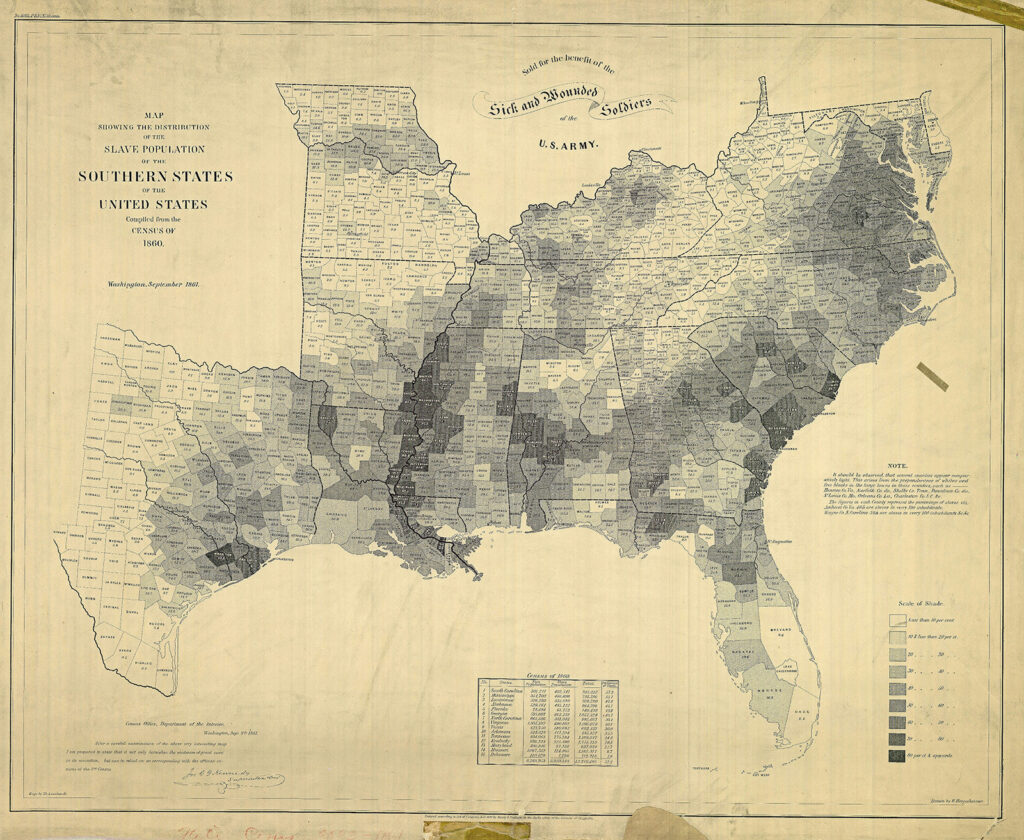
Many writers, planters, farmers, merchants, and politicians continued to express an interest in the dilemma presented by Black colonization in the 1850s. “The South cannot recede,” declared an anonymous writer in an 1852 issue of the New Orleans–based De Bow’s Review. “She must fight for her slaves or against them. Even cowardice would not save her.”12 To many enslavers in the South who turned against colonization as a reform, slavery was imagined as the saving grace of not only their own economic stability but also the maintenance of peace and security in everyday life. Much of the nation’s now fast-evolving proslavery ideology rested on the notion that slavery provided a sense of order, duty, and legitimacy to the lives of individual enslaved people, feelings that Africans and African Americans, it was said, could not otherwise experience. Without slavery, many thought, “the blacks” (the words most often used for “slaves” in regular conversation) would become violent, aimless, and uncontrollable. Colonization-minded reformers answered these challenges in turn by suggesting the best solution, perhaps, still rested with government-led mass deportations.
Complicating factors further in the 1850s was the endurance of the internal slave trade, the legal trade of enslaved laborers that had originated in the decades following the American Revolution between states, along rivers, and along the Atlantic coastline, but that in the decades since had expanded to include networks that now spanned the entire continent. This vast internal trade also gained speed in the decade before the Civil War as men and women with slaveholding interests spread into places like Arizona and New Mexico.13
The productivity of enslaved laborers increased as the 1850s progressed. But this increased productivity also came on the backs of laborers who now faced heavier workloads, longer hours, and more intense punishments. “The great limitation to production is labor,” wrote one commentator in the American Cotton Planter in 1853. And many planters recognized this limitation and worked night and day, sometimes literally, to find the furthest extent of that limit.14 By the mid-1850s, the expected production of an individual enslaved person in Mississippi’s Cotton Belt had increased from between four and five bales (weighing about 500 pounds each) per day to between eight and ten bales per day, on average.15 Other, perhaps more reliable sources, such as the account book of Buena Vista Plantation in Tensas Parish, Louisiana, list average daily production at between 300 and 500 pounds “per hand,” with weekly averages ranging from 1,700 to 2,100 pounds. Cotton production “per hand” increased by 600 percent in Mississippi between 1820 and 1860.16 Each enslaved person, then, was working longer, harder hours to keep up with his or her enslavers’ expected yield as the decade wore on.
Enslaved women endured some of the harshest realities of slavery, especially during the 1850s as Southern states aggressively embraced proslavery policies both domestically and internationally. Several factors exacerbated their suffering. A growing racial pseudoscience denied their fundamental humanity by claiming their essential biology made them inferior to whites, and this was a stance further reinforced by laws in multiple states that barred their testimony in court. Because slavery also incentivized natural reproduction, practices like sexual violence and rape were central to maintaining the system—an issue antislavery advocates had long highlighted. Yet enslaved women had few options for resistance; challenging or acting against their attackers was often criminalized. Enslavers, in turn, also produced few records detailing these abuses, but notable exceptions do exist. James Henry Hammond, for example, explicitly documented his rape of enslaved women in letters to his sons, writing that the offspring of these encounters had produced children “of my own blood.”17
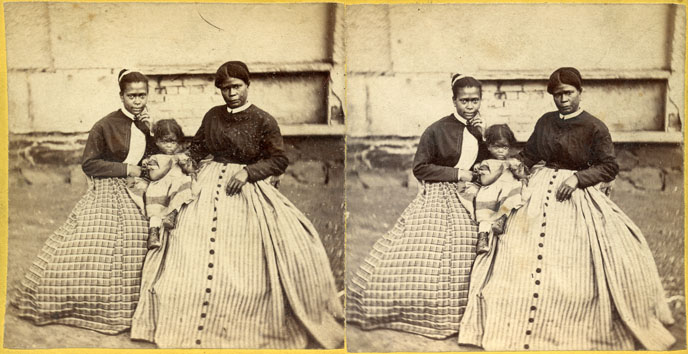
In extreme cases, enslaved women resisted violently, sometimes killing their attackers, and this too added to the fast-rising sense of crisis in the 1850s. One particularly infamous incident occurred in Missouri in 1855, involving a nineteen-year-old enslaved woman named Celia.
Between 1850 and 1855, Robert Newsom (Celia’s enslaver) raped her probably hundreds of times, producing two children and several miscarriages. In the summer of 1855, Newsom again tried to force himself upon Celia, but this time she took a club and struck him in the head two times, killing him. Instead of sympathy and aid, or even an honest attempt to understand and empathize with her plight, the community instead called for Celia’s execution. On November 16, 1855, after a trial of ten days, Celia was hanged for her “crimes.”18
By the mid-1850s, then, capitalism arose in its starkest colonial, violent, and exploitative forms. Humanity became a commodity used and worked to produce profit for a select group of investors, regardless of its shortfalls, dangers, and immoralities. But slavery, profit, and cotton did not exist only in the rural South. The Cotton Revolution sparked the growth of an increasingly urbanized and industrial nation as well, with cities that served as hubs of global markets, and conduits through which the work of enslaved people and the profits of planters met and funded a wider world.
New national and international markets fueled the cotton boom, and by the mid-1850s, it seemed the United States was moving ever more closely toward a permanent proslavery future. American cotton exports rose from 150,000 bales in 1815 to 4,541,000 bales in 1859, making the United States a rising international economic power. The Census Bureau’s 1860 Census of Manufactures stated that “the manufacture of cotton constitutes the most striking feature of the industrial history of the last fifty years.”19 Enslavers shipped their cotton to textile manufacturers and to financiers, many of them based in the Northern “free” states, for overseas shipments. Northern insurance brokers and exporters in the Northeast profited greatly as well. And yet, forces were fast assembling that would, and in the span of a mere decade, destroy “King Cotton.”
IV. Free Soil, Free Labor, Free Men
In March 1849, Abraham Lincoln returned home from Washington to Springfield, Illinois, presumably to resume a quiet life as a prairie lawyer. Having been defeated after just one term in Congress as a critic of the Mexican War, his political prospects appeared dim, and like many others, Lincoln may have expected never to return to the national stage. Yet events in the early 1850s prepared the groundwork for his dramatic political comeback.
The political realities unleashed by the Mexican War fast evolved during the early 1850s as Lincoln returned to Springfield. President Zachary Taylor remained in office only a brief time until his unexpected death from a stomach ailment in 1850. During Taylor’s brief time in office, the seeming fruits of the Mexican War began to spoil. When Taylor was alive, his administration struggled to find a good remedy. Increased clamoring for the admission of California, New Mexico, and Utah pushed the country closer to the edge as the question of slavery’s expansion again proved nearly irreconcilable.

As we have seen, gold had also been discovered by this time in California, and as thousands continued to pour into the West Coast and through the trans-Mississippi West, the admission of new states and territories loomed. In Utah, Mormons were making claims to an independent state they called Deseret. By 1850, California wanted admission as a free state. With so many competing dynamics underway, and with the president dead and replaced by Whig Millard Fillmore, the 1850s were off to a chaotic start.
Congressional leaders like Henry Clay and newer legislators like Stephen A. Douglas of Illinois were asked to broker a compromise, but this time it was clear no compromise could bridge all the diverging interests at play in the country. Clay eventually left Washington disheartened by the affairs. It fell to young Stephen Douglas, then, to shepherd the bills through Congress, which he in fact did. Legislators rallied behind the Compromise of 1850, an assemblage of bills passed late in 1850, which managed—briefly—to keep the promises of the Missouri Compromise alive.
The Compromise of 1850 tried to offer something to everyone, but in the end, it only worsened the sense of rising national crisis. For leaders in the slaveholding states, the package offered a tough new fugitive slave law that empowered the federal government to deputize regular citizens in arresting runaways. The New Mexico Territory and the Utah Territory would also be allowed to determine their own fates as slave or free states based on the concept of popular sovereignty. The compromise also allowed territories to submit suits directly to the Supreme Court over the status of freedom-seeking people within their bounds.
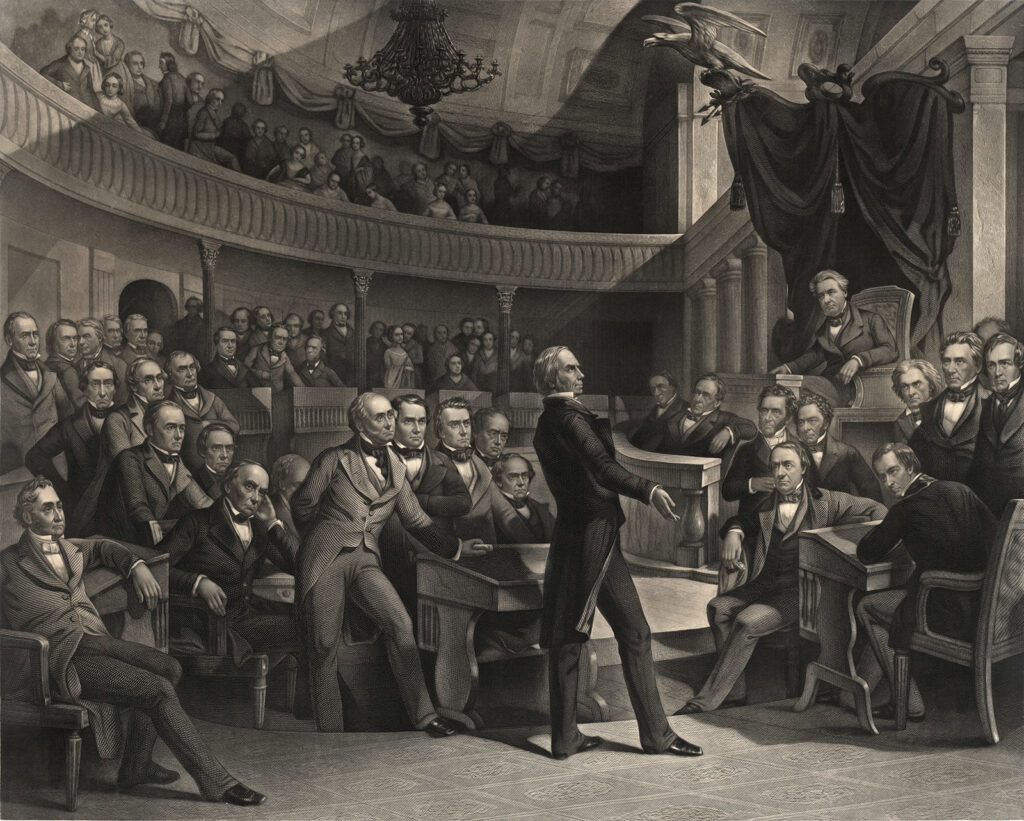
Those of an antislavery persuasion were less impressed with the terms of the deal. The proposed admission of California as a free state cheered many antislavery Northerners, but even the admission of a vast new state full of resources and rich agricultural lands seemed inadequate to the losses the “compromise” bill entailed. In addition to California, northerners also pressed for a ban on the slave trade in Washington, DC. As a further proposed consolation prize, Texas, which had already come into the Union as a slave state, was asked to give some of its land to New Mexico in return for the federal government absorbing some of the former republic’s debt. But the compromise debates failed to really please anyone, and the situation soon grew desperate and grim. It appeared increasingly likely that the nation was headed toward a civil war.
The change in the nation’s political rhetoric after 1850 was in many ways palpable. After the Compromise of 1850, antislavery critics, for example, became increasingly certain that enslavers had co-opted the federal government, and that a Southern “Slave Power” secretly controlled Washington, where it hoped to make slavery a national institution.20 These complaints also pointed back to how the three-fifths compromise of the Constitution gave Southerners proportionally more representatives in Congress. Antislavery leaders increasingly argued, in short, that Washington worked on behalf of enslavers while ignoring the interests of white working men.
Of all the measures included in the Compromise of 1850, however, none proved more troubling to antislavery Americans than the Fugitive Slave Act. While a legal obligation to return escaped enslaved people had existed since the 1787 Northwest Ordinance, the 1850 law significantly expanded the federal government’s enforcement powers.
The Fugitive Slave Act was a direct attempt to extend slavery’s reach across the entire country. It established a system of special federal commissioners who were authorized to determine the status of alleged fugitives without granting them a jury trial or allowing them to testify in their own defense. Local authorities were barred from interfering in the capture of freedom seekers under any circumstances. Even private citizens were required to assist in the arrest of so-called fugitive slaves when called upon by federal agents, regardless of their personal views on slavery. In this way, the law laid the foundation for a sweeping expansion of federal authority—especially its police powers—and it marked a serious disruption of American federalism. Many were especially alarmed by how the law directly undermined their local and state legal protections.
The response to the law was swift and intense. It inflamed antislavery sentiment and deepened public mistrust of the federal government, particularly due to the law’s built-in incentives for corruption. Federal commissioners, for example, were paid $10 if they ruled that the accused was enslaved, but only $5 if they ruled in favor of the accused’s freedom. The law also emboldened a growing industry of kidnappers, who worked alongside local authorities to abduct and reenslave free Black Northerners.
Free Black communities responded with heightened militancy and resistance. Many individuals fled to Canada, while others organized to defend their communities, sometimes using force. Across the North, desperate but determined confrontations between residents and federal authorities became increasingly common, as resistance to the law took on both legal and physical forms.21
With widespread disaffection toward the government now spreading, the first major political victim came in the 1852 presidential election. The election dealt the Whig Party a stunning defeat and effectively ended their existence as a national political party. Whigs captured just 42 of the 254 electoral votes needed to win. A peaceful resolution to the Mexican War had seemed, however briefly, in reach. Now, the two-party system appeared to be in shambles.
Antislavery resentment at the terms of the compromise debates continued to run deep as the Whigs crumbled. One measure of the enduring popularity of antislavery ideas came during the election cycle in 1852, when Harriet Beecher Stowe published her best-selling antislavery novel, Uncle Tom’s Cabin. Sales for Uncle Tom’s Cabin made it one of the bestselling books in American history, eclipsed only by sales of the Bible.22 The book became a sensation and helped move antislavery again into everyday conversation. Despite the powerful antislavery message, Stowe’s book also reinforced many racist stereotypes, however.

Democrats were themselves by 1853 also badly splintered along sectional lines over slavery. Yet the Democrats also had more reason to act with confidence than their rivals, the Whigs. Voters had, after all, returned the Democrats to majorities in 1852 following the bitter fights over the Compromise of 1850. Emboldened, Senator Douglas again introduced a set of additional amendments to a bill drafted in late 1853 to help organize the Nebraska Territory, the last of the still-unorganized portion of what had been the Louisiana Purchase lands. In 1853, that territory was huge: it extended from the northern end of Texas to the Canadian border, encompassing present-day Nebraska, Wyoming, South Dakota, North Dakota, Colorado, and Montana.
Douglas’s efforts to amend and introduce the bill in 1854 opened dynamics that would break the Democratic Party in two and, in the process, rip the country apart.
Douglas’s formidable Democratic Party coalition as it emerged in 1852 had traditionally served as the partisan home for the nation’s swelling ranks of immigrants. More than five million immigrants, in fact, arrived in the United States between 1820 and 1860. Irish, German, and Jewish incomers sought new lives and economic opportunities. By the Civil War, nearly one out of every eight Americans had been born outside the United States. A series of push and pull factors drew these new arrivals to the United States.
In England, for example, an economic slump prompted Parliament to modernize British agriculture by revoking common land rights for Irish farmers. These policies generally targeted Catholics in the southern counties of Ireland and motivated many to seek greater opportunity elsewhere. The booming American economy pulled Irish immigrants toward ports along the eastern United States. Between 1820 and 1840, over 250,000 Irish immigrants arrived in the United States.23
Without the capital and skills required to purchase and operate farms, Irish immigrants settled primarily in Northeastern cities and towns and performed unskilled work. Irish men usually emigrated alone and, when possible, practiced what became known as chain migration. Chain migration allowed Irish men to send portions of their wages home, which would then be used either to support their families in Ireland or to purchase tickets for relatives to come to the United States. Irish immigration followed this pattern into the 1840s and 1850s, when the infamous Irish Famine sparked a massive exodus out of Ireland. Between 1840 and 1860, 1.7 million Irish fled starvation and the oppressive English policies that accompanied it.24 As they entered manual, unskilled labor positions in urban America’s dirtiest and most dangerous occupations, Irish workers in Northern cities were compared to African Americans, and anti-immigrant newspapers portrayed them with apelike features. Despite this hostility, Irish immigrants retained their social, cultural, and religious beliefs and left an indelible mark on American culture.
While the Irish settled mostly in coastal cities, most German immigrants used American ports and cities as temporary waypoints before settling in the rural countryside. Over 1.5 million immigrants from the various German states arrived in the United States during the antebellum era. Although some southern Germans fled declining agricultural conditions and repercussions of the liberal revolutions of 1848, many Germans simply sought steadier economic opportunity. German immigrants tended to travel as families and carried with them skills and capital that enabled them to enter middle-class trades. Germans migrated to the Old Northwest to farm in rural areas and practiced trades in growing communities such as St. Louis, Cincinnati, and Milwaukee, three cities that formed what came to be called the “German Triangle.”
These Catholic and Jewish Germans transformed many areas of the republic during the 1850s. New York’s Jewish population, for example, rose from approximately five hundred in 1825 to forty thousand in 1860.25 Similar gains were seen in other American cities. Jewish immigrants hailing from southwestern Germany and parts of occupied Poland moved to the United States through chain migration and as family units. Unlike other Germans, Jewish immigrants rarely settled in rural areas. Once established, Jewish immigrants found work in retail, commerce, and artisanal occupations such as tailoring. They quickly found their footing and established themselves as an important part of the American market economy. Just as Irish immigrants shaped the urban landscape through the construction of churches and Catholic schools, Jewish immigrants erected synagogues and made their mark on American culture as well.
The Democrats counted on the support of this broad-based and multifaceted immigrant constituency as it set out to consolidate its power and national grip in the mid-1850s. Douglas proposed a bold plan in 1854 to cut off a large southern chunk of Nebraska as the Kansas Territory, where popular sovereignty, he said, would flourish. Douglas had several goals in mind. The expansionist Democrat wanted to organize the territory to facilitate the completion of a national railroad that would flow through Chicago. It would bring a broadly consolidated national economy that would link all of the new states and territories, east and west.
But before he had even finished introducing the bill, an antislavery opposition that suspected that all of this would also come with slavery’s expansion into these lands had already started to mobilize in response. Salmon P. Chase, one of the few resolutely antislavery leaders in the Senate at the time, drafted a response in Northern newspapers in January 1854 that framed the Kansas-Nebraska Bill as a measure to overturn the Missouri Compromise and open Western lands for slavery. Kansas-Nebraska protests emerged in response throughout the North that spring, with key meetings in places like Wisconsin, Michigan, and Maine. In the territories, meanwhile, legislators decided Kansas would become slave or free depending on the result of local elections. This in turn led to a dangerous situation wherein migrants flooding to the territory swelled the ranks of those who planned to vote for either expanding or constricting slavery. Making matters worse, many of these migrants traveled to Kansas with stockpiles of weapons and munitions suitable for war.
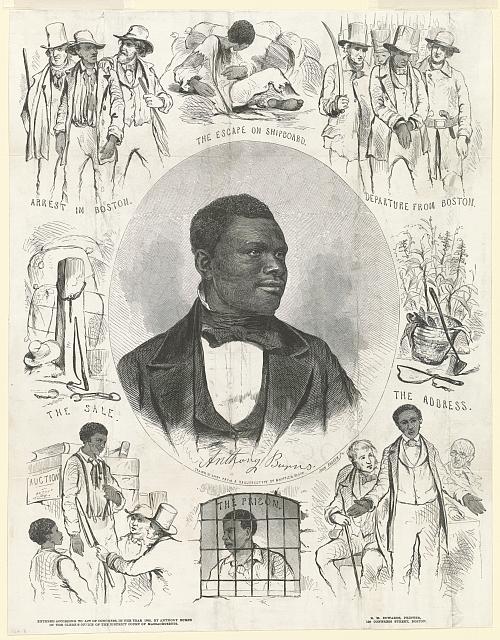
Ordinary Americans, meanwhile, increasingly resisted what they now believed to be a proslavery federal government. The rescues and arrests of enslaved men like Anthony Burns in Boston and Joshua Glover in Milwaukee in the spring and early summer of 1854 signaled the rising vehemence of resistance to the nation’s 1850 Fugitive Slave Law.
The case of Anthony Burns, as an example, illustrates how the Fugitive Slave Law radicalized the slavery issue in the eyes of many voters. On May 24, 1854, twenty-year-old Burns, a preacher who worked in a Boston clothing shop, was clubbed and dragged to jail. One year earlier, Burns had escaped slavery in Virginia, and a group of slave catchers had since come north to return him to Richmond. Word of Burns’s capture spread, and a mob gathered outside the courthouse demanding Burns’s release. Two days after the arrest, the crowd stormed the courthouse and shot a deputy US marshal to death. News reached Washington, and the federal government sent soldiers. Boston was placed under martial law. Federal troops lined the streets of Boston as Burns was marched onto a ship, where he was sent back to slavery in Virginia. After spending over $40,000, the US government successfully reenslaved Burns.26 For many white Northerners after the summer of 1854, there was no going back to a moderate stance on the issue. In the words of Amos Adams Lawrence, “We went to bed one night old-fashioned, conservative, compromise Union Whigs & woke up stark mad Abolitionists.”27
As Americans on all sides of the political spectrum radicalized, organizations like the New England Emigrant Aid Company provided still more guns and other goods for those willing to go to Kansas and establish the territory as antislavery through their votes.
The year 1855 then nearly fractured the Northern antislavery coalition, threatening to splinter it into disparate parts. The growing influx of immigrants—particularly Catholic Germans and Irish—triggered a backlash among many native-born Anglo-Protestant Americans. In response, a resurgent anti-immigrant movement briefly seized the momentum of the collapsing Whig Party and redirected political frustration away from the administration and toward the perceived threat posed by immigrant communities in American cities. This nativist movement gained popularity in places with large Catholic populations—such as Boston, Chicago, and Philadelphia—and even launched its own political party. Known informally as the “Know-Nothings” (because members often claimed ignorance when questioned about their activities), the group’s formal name was the American Party. They achieved notable electoral success in 1854 and 1855, especially in New England and the Mid-Atlantic states. Yet despite these gains, the anti-immigrant movement failed to resonate in the increasingly immigrant-rich American West—where antislavery politics remained far more compelling.28
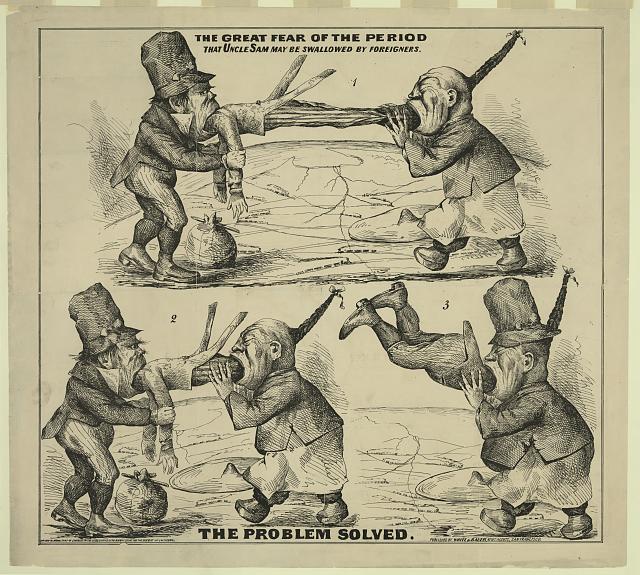
At the same time, the antislavery movements that started in the early part of 1854 coalesced with the formation of a new political party by the summer and fall of 1854. Harking back to the founding fathers, its organizers named it the Republican Party.
The Republicans had several advantages over the Know-Nothings in their attempts to become the nation’s second-party alternative to the Democrats. For one, the slavery issue remained as volatile as ever, and unlike immigration, it led to some spectacularly violent and unsettling episodes in 1855.
Following an explosive speech before Congress on May 19–20 of that year, for example, Senator Charles Sumner of Massachusetts was violently beaten with a cane by Representative Preston Brooks of South Carolina on the floor of the Senate chamber. Among other accusations, Sumner had accused Senator Andrew Butler of South Carolina, Brooks’s cousin, of defending slavery so he could have sexual access to Black women.29 Brooks felt that he had to defend his relative’s honor and nearly killed Sumner in response.
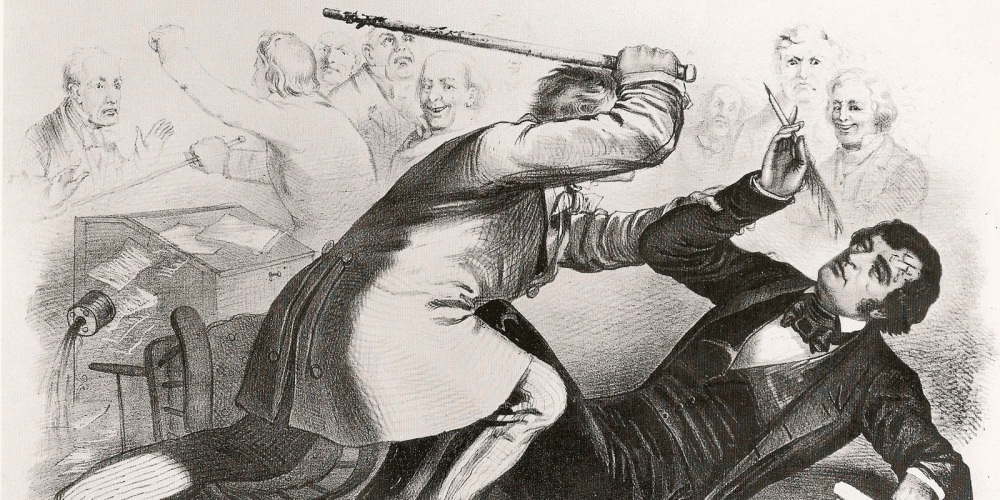
The violence in Washington was shocking enough, but it paled in comparison to what was soon underway in Kansas.30 Proslavery raiders attacked Lawrence, Kansas. Radical abolitionist John Brown retaliated, murdering several proslavery Kansans. As all of this played out, the House also failed to expel Brooks from his Congressional seat. Brooks resigned his position anyway, only to be reelected by his constituents later in the year. He received new canes emblazoned with the words “Hit him [Sumner] again!”31 With sectional tensions at a breaking point, a fair case could be made that the country had already descended into Civil War.
In this climate, both parties readied for the coming presidential election in 1856. In June, the newly named Republican Party held its nominating convention at Philadelphia and selected Californian John Charles Frémont. Frémont’s antislavery credentials may not have pleased many abolitionists, but his dynamic and talented wife, Jessie Benton Frémont, appealed to more radical members of the coalition, while John Frémont’s former Democratic Party ties and role in the California campaign pleased the coalition’s more conservative wings. As a self-professed moderate Whig, Abraham Lincoln was slow to abandon his old party for the Frémont-led ticket. But by the summer of 1856, Lincoln had also fully committed himself to the Frémont campaign and the Republican Party.
Frémont lost the election in 1856, much to the horror and disappointment of the antislavery movement. But Republicans celebrated that he won eleven of the sixteen free states. This showing, they urged, was truly impressive for any party making its first run at the presidency. Yet Northern Democrats unhappy with their party’s proslavery turn in crucial swing states remained unmoved by the Republican Party’s appeals. Ulysses S. Grant of Missouri, for example, a Mexican War veteran, worried that Frémont and the Republicans signaled trouble for the Union itself. Grant voted for the Democratic candidate, James Buchanan, believing a Republican victory might bring about disunion. In abolitionist and especially Black American circles, Frémont’s defeat was more than a disappointment. Believing their fate had been sealed as permanent noncitizens, some African Americans considered foreign emigration and colonization. Others began to explore the option of more radical and direct action against Slave Power.
V. From Sectional Crisis to National Crisis
The events in the middle 1850s motivated many Northerners to reengage with politics, and among the most prominent was Abraham Lincoln. In a speech delivered in Peoria, Illinois, in October 1854, Lincoln laid out his objections to slavery’s expansion with such clarity, logic, and moral force that the address became a foundational statement of his antislavery position—one that drew in scores of similarly minded Northerners for years to come. The speech also played a crucial role in reviving his political career.32
Two years later, during an 1856 speech in Kalamazoo, Michigan, Abraham Lincoln continued to assure his audience that the country’s commercial transformation had not reduced American laborers to slavery. Southerners, he said, “insist that their slaves are far better off than Northern freemen. What a mistaken view do these men have of Northern labourers! They think that men are always to remain labourers here—but there is no such class. The man who laboured for another last year, this year labours for himself. And next year he will hire others to labour for him.”33 This essential belief undergirded the Northern commitment to “free labor” and won the market revolution much widespread acceptance.
By late 1856 and early 1857, antislavery leaders had begun hailing Frémont’s defeat as a “glorious” one and looked ahead to the party’s future successes. For those still in slavery or hoping to see loved ones freed, the news of Frémont’s defeat was of course much harder to take. The Republican Party had promised the rise of an antislavery coalition, but voters rebuked it. The lessons seemed clear enough.
The situation in “Bleeding Kansas” continued to loom large over national developments, darkening the national mood. Rumors and misinformation surrounding the early votes in the territory had long plagued the situation on the ground there. In 1856, these concerns became exacerbated as new stories emerged detailing the ways in which proslavery partisans from Missouri had again crossed the border to tamper with the Kansas elections. Back in 1854, critics attacked the Pierce administration for not living up to the ideals of popular sovereignty by ensuring fair elections. By 1856, few could look to the situation surrounding the ongoing votes in Kansas with any kind of confidence.
The sectional crisis had at last become a national crisis. “Bleeding Kansas” was the first place to demonstrate that the sectional crisis could easily be, and in fact already was, exploding into a full-blown national crisis. As the national mood grew increasingly grim, Kansas attracted hundreds of armed militants from around the country, and their swelling numbers brought together the extreme sides of the slavery debate.
In the days after the 1856 presidential election, meanwhile, newly elected President James Buchanan made his plans for his time in office clear. He talked with Chief Justice Roger Taney on inauguration day about a court decision he hoped to see handled during his time in office. Indeed, not long after the inauguration, the Supreme Court handed down a decision that would come to define Buchanan’s presidency. The Dred Scott decision, Scott v. Sandford, ruled that Black Americans could not be citizens of the United States and therefore could be transported as chattel from any state to another regardless of state law.34 This gave the Buchanan administration and its Southern allies a direct repudiation of the Missouri Compromise. The court ruled that Scott, a Missouri slave, had no right to sue in US courts. The Dred Scott decision signaled that the federal government was now fully committed to extending slavery as far and as wide as it might want.

The Dred Scott decision seemed to settle the sectional crisis by making slavery fully national, but in reality, it just exacerbated sectional tensions further. In 1857, Buchanan sent US military forces to subdue Utah’s Mormon communities (known as the Utah War). This action, however, led to renewed charges, many of them leveled from within his own party, that the administration was abusing its powers. Far more important than the Utah invasion, however, were the ongoing events in Kansas. It was Kansas that at last proved to many Northerners that the sectional crisis would not go away unless slavery also went away.
The Illinois Senate race in 1858 put the scope of the sectional crisis on full display. Republican candidate Abraham Lincoln challenged the greatly influential Democrat Stephen Douglas. Pandering to appeals to white supremacy, Douglas hammered the Republican opposition as a “Black Republican” party bent on racial equality.35 The Republicans, including Lincoln, fired back with warnings of divisiveness and assertions that all Americans deserved equality of opportunity, even as they assured white audiences that they were no abolitionist party by yelling “white Republicans!” whenever Democrats offered their favorite attack line.
Democrats hung on as best they could, but the Republicans won the House of Representatives and picked up seats in the Senate. Lincoln, despite the good news for his party, lost his contest with Stephen Douglas that fall. But in the process, Lincoln firmly established himself as a leading national Republican. After the 1858 elections, all eyes turned to 1860. Given the Republican Party’s successes since 1854, it was expected that the 1860 presidential election might just produce the nation’s first antislavery president.
The year 1859 opened to a nation carefully navigating a crossroads moment in its history. In the troubled decades since the Missouri Compromise, the nation seemed to grow increasingly intent on tearing itself apart. As we have seen, congressmen clubbed each other nearly to death on the floor of Congress, and blood was now regularly being poured out in the war taking place on the Kansas and Missouri plains. Across the country, cities and towns were in various stages of revolt against federal authority. Fighting spread even farther against Native Americans in the Far West and against Mormons in Utah. The nation’s militants anticipated a coming breakdown and worked to exploit it.
John Brown, a radical abolitionist who had been active in the movement for decades, moved east from Kansas with plans to escalate his assault on the slave system. Assembling a team from across the West, including Black radicals from Oberlin, Ohio, and throughout communities in western Canada, Brown hatched a plan to attack Harper’s Ferry, a federal weapons arsenal in Virginia (now West Virginia). Brown and his cohorts would then use the weapons to lead a revolt of enslaved people. Brown also approached and tried to recruit Frederick Douglass to the raid, though Douglass refused to join.
Brown’s raid began on October 16. By October 18, a command under Robert E. Lee had crushed the revolt. Many of Brown’s men, including his own sons, were killed, but Brown himself lived and was imprisoned. Brown prophesied while in prison that the nation’s crimes would only be purged with blood. He went to the gallows in December 1859. Northerners made a stunning display of sympathy on the day of his execution. Southerners took their reactions to mean that the coming 1860 election would be, in many ways, a referendum on secession and disunion.

Republicans wanted little to do with Brown and instead tried to portray themselves as moderates opposed to both abolitionists and proslavery expansionists. In this climate, the parties opened their contest for the 1860 presidential election. The Democratic Party fared poorly as its Southern delegates revoted after its national convention at Charleston and ran their own candidate, Vice President John C. Breckenridge of Kentucky. Hoping to field a candidate who might nonetheless manage to bridge the broken party’s factions, the Democrats decided to meet again at Baltimore and nominated Stephen A. Douglas of Illinois.
The Republicans, meanwhile, held their boisterous convention in Chicago. The Republican platform made the party’s antislavery commitments clear, also making wide promises to its white constituents, particularly Westerners, with the promise of new land, transcontinental railroads, and broad support of public schools.36 Abraham Lincoln, a candidate few outside Illinois truly expected to win, nonetheless proved far less polarizing than the other names on the ballot. Lincoln won the nomination, and with the Democrats in disarray, Republicans knew their candidate, Lincoln, had a good chance of winning.
For all of the problems that abolitionists had faced since their resurgence in the 1820s and 1830s, the movement was far from a failure as conservative antislavery politicians seized the movement mantle in the late 1850s. The prominence of African Americans in abolitionist organizations offered a powerful, if imperfect, model of interracial coexistence. And while radical immediatists always remained a minority, their efforts had also paved the way for the moderately antislavery Republican Party to gain traction. It is hard to imagine that Abraham Lincoln could have become president in 1860 without the ground prepared by antislavery advocates and without the presence of radical abolitionists against whom he could be cast as a moderate alternative. Though it ultimately took a civil war to break the bonds of slavery in the United States, the evangelical moral compass of revivalist Protestantism provided motivation for these embattled abolitionists as well.
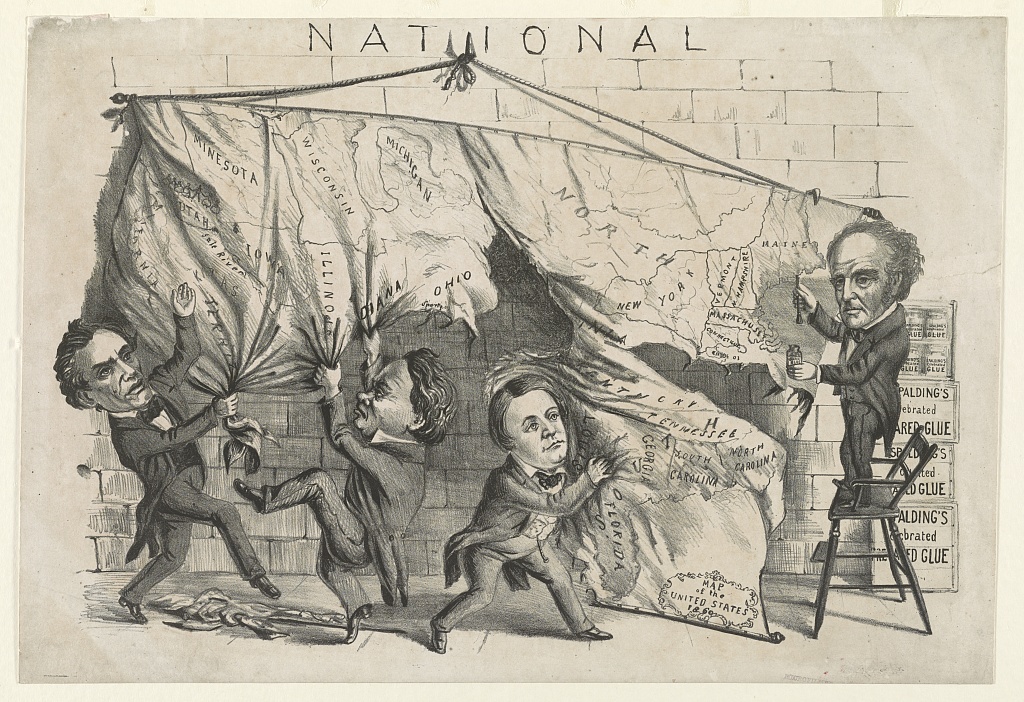
At the head of a badly disjointed coalition, nonetheless, Abraham Lincoln won the 1860 contest on November 6, gaining just 40 percent of the popular vote and not a single Southern vote in the Electoral College. Within days, Southern states were organizing secession conventions. John J. Crittenden of Kentucky proposed a series of compromises, but a clear pro-Southern bias meant they had little chance of gaining Republican acceptance. Crittenden’s plan promised renewed enforcement of the Fugitive Slave Law and offered a plan to keep slavery in the nation’s capital.37 Republicans by late 1860 knew that the voters who had just placed them in power did not want them to cave on these points, and Southern states proceeded with their plans to leave the Union. On December 20, South Carolina voted to secede and issued its “Declaration of the Immediate Causes.”38 The declaration highlighted the failure of the federal government to enforce the Fugitive Slave Act over competing personal liberty laws in Northern states. After the war, many Southerners claimed that secession was primarily motivated by a concern to preserve states’ rights, but the primary complaint of the very first ordinance of secession listed the federal government’s failure to exert its authority over the Northern states.
The year 1861, then, saw the culmination of the secession crisis. Before he left for Washington, Lincoln told those who had gathered in Springfield to wish him well and that he faced a “task greater than Washington’s” in the years to come. Southerners were also learning the challenges of forming a new nation. The seceded states grappled with internal divisions right away, as states with enslavers sometimes did not support the newly seceded states. In January, for example, Delaware rejected secession. But states in the Lower South adopted a different course. The state of Mississippi seceded. Later in the month, the states of Florida, Alabama, Georgia, and Louisiana also left the Union. By early February, Texas had also joined the newly seceded states. In February, Southerners drafted a constitution protecting slavery and named Jefferson Davis of Mississippi their president. Weeks after Abraham Lincoln’s inauguration, rebels in the newly formed Confederate States of America opened fire on Fort Sumter in South Carolina. Within days, Abraham Lincoln would demand seventy-five thousand volunteers from the North to crush the rebellion. The American Civil War had begun.
VI. Conclusion
Slavery had long divided the politics of the United States. In time, these divisions became both sectional and irreconcilable. The first and most ominous sign of a coming sectional storm occurred over the 1819 debates surrounding the admission of the state of Missouri. As westward expansion continued, these fault lines grew even more ominous, particularly as the United States managed to seize even more lands from its war with Mexico. The country seemed to teeter ever closer to a full-throated endorsement of slavery. But an antislavery coalition arose in the mid-1850s, calling itself the Republican Party. Eager to cordon off slavery and confine it to where it already existed, the Republicans won the presidential election of 1860 and threw the nation on the path to war.
Throughout this period, the mainstream of the antislavery movement remained committed to a peaceful resolution of the slavery issue through efforts understood to foster the “ultimate extinction” of slavery in due time. But as the secession crisis revealed, the South could not tolerate a federal government working against the interests of slavery’s expansion and decided to take a gamble on war with the United States. Secession, in the end, raised the possibility of emancipation through war, a possibility most Republicans knew, of course, had always been an option, but one they nonetheless hoped would never be necessary. By 1861, all bets were off, and the fate of slavery and of the nation depended on war.
VII. Primary Sources
1. Prigg v. Pennsylvania, 1842
Conflicts between the power of the federal government and states’ rights strained American politics throughout the antebellum era. During the 1840s and 1850s, the most consistent source of tension on the issue stemmed from northerners refusing to comply with fugitive slave laws. As early as the 1780s, Pennsylvania passed laws that made it illegal to take a Black person from the state for the purpose of enslaving them. In the majority opinion, excerpted here, Supreme Court justice Joseph Story decided that the national fugitive slave act overruled Pennsylvania’s law.
2. Stories from the Underground Railroad, 1855-56
William Still was an African-American abolitionist who frequently risked his life to help freedom-seekers escape slavery. In these excerpts, Still offers the readers some of the letters sent to him from abolitionists and formerly enslaved persons. The passages shed light on family separation, the financial costs of the journey to freedom, and the logistics of the Underground Railroad.
3. Harriet Beecher Stowe, Uncle Tom’s Cabin, 1852
In 1852 Harriet Beecher Stowe published her bestselling antislavery novel, Uncle Tom’s Cabin. Sales for Uncle Tom’s Cabin were astronomical, eclipsed only by sales of the Bible. The book became a sensation and helped move antislavery into everyday conversation for many northerners. In this passage, a senator and his wife debate the Fugitive Slave Law.
4. Charlotte Forten complains of racism in the North, 1855
Writer, activist, and teacher Charlotte Forten was born in Philadelphia in 1837 to a well-to-do African American family. Forten’s diary entries from 1854 illuminate sectional tensions, especially in her discussion of the trial of Anthony Burns, a fugitive from slavery. She also expressed frequent frustration over the racism she encountered in Boston.
5. Margaraetta Mason and Lydia Maria Child discuss John Brown, 1860
After John Brown was arrested for his raid on Harpers Ferry, Lydia Maria Child wrote to the governor of Virginia requesting to visit Brown. Margaretta Mason of Virginia wrote a searing letter to Child attacking her for supporting a murder. Child responded, and the exchange of letters was published by the American Antislavery Society.
6. 1860 Republican Party platform
The 1860 Republican Party convention in Chicago created a platform that clearly opposed the expansion of slavery in the West and the reopening of the slave trade. However, nothing in the document claimed that the government had the power to eliminate slavery where it already existed. Controversies over slavery suffuse the platform, but maybe even more noticeable is the importance of the West to the Republican Party.
7. South Carolina declaration of secession, 1860
Abraham Lincoln won the 1860 contest on November 6 with just 40% of the popular vote and not a single southern vote in the Electoral College. Within days, southern states were organizing secession conventions. On December 20, South Carolina voted to secede, and issued its “Declaration of the Immediate Causes.”
8. Effects of the Fugitive Slave Law lithograph, 1850
This lithograph imagines the consequences of the Fugitive Slave Act, part of the Compromise of 1850. Four well-dressed Black men are being hunted by a party of white men, seen in the background. There are a number of ambiguities in the image – are the Black men enslaved or free? Are they trying to escape or not? Where exactly are they? These ambiguities speak to the concerns many abolitionists had about the law, which required free citizens to return freedom-seeking people to their enslavers.
This piece of Republican propaganda from the 1856 election makes clear distinctions between free states, slave states, and territories. Featured at the top of the page are engravings of John C. Fremont and his running mate, William C. Dayton. A vibrant red sets off the free states. The chart, “Freedom vs. Slavery,” demonstrates the North’s economic and cultural superiority over slave states in terms of everything from population per square mile, capital in manufactures, miles of railroad, the number of newspapers and public libraries, and value of churches.
VIII. Reference Material
This chapter was edited by Jesse Gant, with content contributions by Jeffrey Bain-Conkin, Joshua Beatty, Ethan Bennett, Matthew A. Byron, Michelle Cassidy, Christopher Childers, Jesse Gant, Jonathan Grandage, Brenda Lakhani, Gregg Lightfoot, Jose Juan Perez Melendez, Jessica Moore, Christopher Null, Ryan Poe, Michael Robinson, Nick Roland, Matthew K. Saionz, Rowan Steinecker, Patrick Troester, Nicholas Wood, Michael Woods, Ben Wright, and Caroline Wright.
Recommended Reading
• Arenson, Adam. The Great Heart of the Republic: St. Louis and the Cultural Civil War. Harvard University Press, 2011.
• Bracey, Christopher Alan, Paul Finkelman, and David Thomas Konig, eds. The Dred Scott Case: Historical and Contemporary Perspectives on Race and Law. Ohio University Press, 2010.
• Burke, Diane Mutti. On Slavery’s Border: Missouri’s Small Slaveholding Households, 1815–1865. University of Georgia Press, 2010.
• Cutter, Barbara. Domestic Devils, Battlefield Angels: The Radicalization of American Womanhood, 1830–1865. Northern Illinois University Press, 2003.
• Engs, Robert F., and Randall M. Miller, eds. The Birth of the Grand Old Party: The Republicans’ First Generation. University of Pennsylvania Press, 2002.
• Epps, Kristen. Slavery on the Periphery: The Kansas-Missouri Border in the Antebellum and Civil War Eras. University of Georgia Press, 2016.
• Faust, Drew Gilpin. James Henry Hammond and the Old South: A Design for Mastery. Louisiana State University Press, 1985.
• Foner, Eric. The Fiery Trial: Abraham Lincoln and American Slavery. Norton, 2011.
• Foner, Eric. Free Soil, Free Labor, Free Men: The Ideology of the Republican Party Before the Civil War. Oxford University Press, 1970.
• Grant, Susan-Mary. North Over South: Northern Nationalism and American Identity in the Antebellum Era. University Press of Kansas, 2000.
• Greenberg, Amy. Manifest Manhood and the Antebellum American Empire. Cambridge University Press, 2005.
• Holt, Michael F. The Rise and Fall of the American Whig Party: Jacksonian Politics and the Onset of the Civil War. Oxford University Press, 1999.
• Jones-Rogers, Stephanie. They Were Her Property: White Women and Slave Owners in the American South. Yale University Press, 2019.
• Kantrowitz, Stephen. More Than Freedom: Fighting for Black Citizenship in a White Republic, 1829–1889. Penguin, 2012.
• Karp, Matthew. This Vast Southern Empire: Slaveholders at the Helm of American Foreign Policy. Harvard University Press, 2018.
• Keith, Leanna. When It Was Grand: The Radical Republican History of the Civil War. Hill and Wang, 2020.
• Levine, Bruce. Half Slave and Half Free: The Roots of Civil War. Hill and Wang, 2005.
• Oakes, James. The Long and Crooked Path to Abolition: Abraham Lincoln and the Antislavery Constitution. Norton, 2021.
• Potter, David M. The Impending Crisis, 1848–1861. HarperCollins, 1976.
• Quarles, Benjamin. Allies for Freedom: Blacks and John Brown. Oxford University Press, 1974.
• Richardson, Heather Cox. To Make Men Free: A History of the Republican Party. Basic, 2014.
• Sinha, Manisha. The Counterrevolution of Slavery: Politics and Ideology in Antebellum South Carolina. University of North Carolina Press, 2000.
• Smith, Kimberly K. The Dominion of Voice: Riot, Reason and Romance in Antebellum American Political Thought. University Press of Kansas, 1999.
• Smith, Stacey. Freedom’s Frontier: California and the Struggle Over Free Labor, Emancipation, and Reconstruction. University of North Carolina Press, 2013.
• Varon, Elizabeth. Disunion! The Coming of the American Civil War, 1789–1859. University of North Carolina Press, 2008.
Notes
- Abraham Lincoln, Second Inaugural Address, March 5, 1865, in Roy P. Basler, The Collected Works of Abraham Lincoln, vol. 8 (Rutgers University Press, 1953), 332, https://www.nps.gov/linc/learn/historyculture/lincoln-second-inaugural.htm.[↩]
- Jane McManus Storm (otherwise known as Cora Montgomery or simply “Montgomery”) first coined the term “manifest destiny” in 1839 within the pages of the United States Magazine and Democratic Review. It has often been attributed, however, to her editor, John L. O’Sullivan. See Amy Greenburg, Manifest Manhood and the Antebellum American Empire (Cambridge, 2005), 18–21, esp. 20.[↩]
- Jane McManus Storm, “Annexation,” United States Magazine and Democratic Review 17, no. 85 (July–August 1845), 5–10, https://books.google.com/books?id=JvE7AQAAMAAJ.[↩]
- Tom Chaffin, Fatal Glory: Narciso López and the First Clandestine U.S. War Against Cuba (Louisiana State University Press, 1996).[↩]
- Anne F. Hyde, Empires, Nations, and Families: A History of the North American West, 1800–1860 (University of Nebraska Press, 2011), 471.[↩]
- R. Gregory Nokes, Breaking Chains: Slavery on Trial in the Oregon Territory (Oregon State University Press, 2013).[↩]
- Susan Lee Johnson, Roaring Camp: The Social World of the California Gold Rush (Norton, 2000).[↩]
- Stacey L. Smith, Freedom’s Frontier: California and the Struggle Over Unfree Labor, Emancipation, and Reconstruction (University of North Carolina Press, 2013).[↩]
- James Henry Hammond, “Cotton Is King,” March 4, 1858, https://teachingamericanhistory.org/document/cotton-is-king/.[↩]
- “The institution of slavery, then, has always given rise to conflict, fear, and accommodation,” wrote the historian David Brion Davis in his summary of the “problem of slavery” back in 1975. David Brion Davis, The Problem of Slavery in the Age of Revolution, 1770–1823 (Oxford University Press, 1999), 41.[↩]
- Thomas Jefferson, Notes on the State of Virginia, ed. Frank Shuffelton (Penguin, 1999), 145.[↩]
- See “Excessive Slave Population: The Remedy,” De Bow’s Review 12, no. 2 (February 1852): 184–85, also quoted in Walter Johnson, River of Dark Dreams: Slavery and Empire in the Cotton Kingdom (Harvard University Press, 2013), 13.[↩]
- William S. Kiser, Coast-to-Coast Empire Manifest Destiny and the New Mexico Borderlands (University of Oklahoma Press, 2018).[↩]
- See “Cotton and Its Prospects,” American Cotton Planter 1, no. 8 (August 1853): 226, also quoted in Johnson, River of Dark Dreams, 246.[↩]
- See Thomas Prentice Kettel, Southern Wealth and Northern Profits, as Exhibited in Statistical Facts and Official Figures (New York, 1860), 23.[↩]
- Johnson, River of Dark Dreams, 244–47.[↩]
- Drew Gilpin Faust, James Henry Hammond and the Old South: A Design for Mastery (Louisiana State University, 1982), 87.[↩]
- Diane Mutti Burke, On Slavery’s Border: Missouri’s Small-Slaveholding Households, 1815–1863 (University of Georgia Press, 2010), 185, 189–90.[↩]
- US Census Office, Eighth Census, 1860, and James Madison Edmunds, Manufactures of the United States in 1860: Compiled from the Original Returns of the Eighth Census, Under the Direction of the Secretary of the Interior (US Government Printing Office, 1865).[↩]
- Thomas Earle, Jacksonian Antislavery and the Politics of Free Soil, 1824–1854 (University of North Carolina Press, 2004), 17.[↩]
- The above passages draw from Gloria J. Browne-Marshall, Race, Law and American Society (Routledge, 2013), 56; R. J. M. Blackett, The Captive’s Quest for Freedom: Fugitive Slaves, The 1850 Fugitive Slave Law, and the Politics of Slavery (Cambridge University Press, 2018), esp. Chapters 1–2, 3–87.[↩]
- Michael Winship, “Uncle Tom’s Cabin: History of the Book in the 19th-Century United States” (University of Virginia, 2007), http://utc.iath.virginia.edu/interpret/exhibits/winship/winship.html.[↩]
- Bill Ong Hing, Defining America Through Immigration Policy (Temple University Press, 2004), 278–84.[↩]
- John Powell, Encyclopedia of North American Immigration (Facts on File, 2005), 154.[↩]
- H. B. Grinstein, The Rise of the Jewish Community in New York, 1654–1860 (Jewish Publication Society, 1945), 469.[↩]
- Charles Harold Nichols, Many Thousand Gone: The Ex-slaves’ Account of Their Bondage and Freedom (Brill, 1963), 156.[↩]
- Amos A. Lawrence to Giles Richards, June 1, 1854, quoted in Jane J. Pease and William H. Pease, eds., The Fugitive Slave Law and Anthony Burns: A Problem in Law Enforcement (Lippincott, 1975), 43.[↩]
- Tyler Anbinder, Nativism and Slavery: The Northern Know Nothings and the Politics of the 1850s (Oxford University Press, 1992).[↩]
- Charles Sumner, The Crime Against Kansas, Speech of Hon. Charles Sumner in the Senate of the United States (Boston, 1856), https://www.senate.gov/artandhistory/history/resources/pdf/CrimeAgainstKSSpeech.pdf.[↩]
- Nicole Etcheson, Bleeding Kansas: Contested Liberty in the Civil War Era (University Press of Kansas, 2004).[↩]
- Williamjames Hull Hoffer, The Caning of Charles Sumner: Honor, Idealism, and the Origins of the Civil War (Johns Hopkins University Press, 2010), 92.[↩]
- Abraham Lincoln, “Peoria Speech, October 16, 1854,” in Collected Works of Abraham Lincoln, ed. Roy P. Basler (Rutgers University Press, 1953), 247–83, https://www.nps.gov/liho/learn/historyculture/peoriaspeech.htm.[↩]
- Abraham Lincoln, Speech at Kalamazoo, Michigan, August 27, 1856, in Collected Works of Abraham Lincoln, vol. 2 (Rutgers University Press, 1953), 364.[↩]
- Judgment in the US Supreme Court Case Dred Scott v. John F. A. Sandford, March 6, 1857; Case Files 1792–1995; Record Group 267; Records of the Supreme Court of the United States; National Archives, http://www.ourdocuments.gov/doc.php?flash=true&doc=29.[↩]
- Rodney O. Davis and Douglas L. Wilson, eds., The Lincoln-Douglas Debates (University of Illinois Press, 2008), 68.[↩]
- “Republican Party Platform of 1860,” May 17, 1860. Gerhard Peters and John T. Woolley, The American Presidency Project, https://www.presidency.ucsb.edu/documents/republican-party-platform-1860.[↩]
- Horace Greeley, The American Conflict: A History of the Great Rebellion in the United States of America, 1860–1864, Volume 1 (Hartford, CT, 1864), 366–67.[↩]
- “Declaration of the Immediate Causes Which Induce and Justify the Secession of South Carolina from the Federal Union,” Avalon Project, Yale Law School, http://avalon.law.yale.edu/19th_century/csa_scarsec.asp.[↩]