
*The American Yawp is an evolving, collaborative text. Click here to help improve this chapter.*
I. Introduction
The American Civil War, the bloodiest conflict in the nation’s history, resulted in approximately 698,000 deaths.1 The war touched the lives of nearly every American as military mobilization reached levels never seen before or since. The vast majority of Northern soldiers went to war to preserve the Union, but the war ultimately transformed into a struggle to eradicate slavery. African Americans, both enslaved and free, pressed the issue of emancipation and helped to catalyze this transformation. Simultaneously, women put themselves into critical wartime roles while navigating a world without many men of military age. The Civil War was a defining event in the history of the United States and, for the Americans thrust into it, a wrenching one.
II. The Election of 1860 and Secession
The 1860 presidential election was chaotic. In April, the Democratic Party convened in Charleston, South Carolina, the bastion of secessionist sentiment in the South. Democratic delegates sought to nominate a candidate for their party ticket, but the party was deeply divided. Northern Democrats supported Senator Stephen Douglas of Illinois, a champion of popular sovereignty, while Southern Democrats were intent on endorsing someone other than Douglas. The party leaders’ refusal to include a proslavery platform resulted in Southern delegates walking out of the convention, preventing Douglas from gaining the two-thirds majority required for a nomination. The Democrats ultimately ended up with two presidential nominees. Northern and Southern Democrats each held subsequent conventions in Baltimore, respectively nominating Douglas and the current vice president, John C. Breckinridge of Kentucky, as their candidates. The nation’s oldest party had split over the issue of slavery.2
Initially, the Republican Party was hardly unified around a single candidate itself. Several prominent Republicans vied for their party’s nomination. A consensus emerged at the May 1860 convention that the party’s nominee would need to carry all the free states—for only in that situation could a Republican nominee potentially win. Senator William Seward of New York, a leading contender, was passed over. Seward’s pro-immigrant position posed a potential obstacle, particularly in Pennsylvania and New Jersey. Abraham Lincoln of Illinois, as a relatively unknown but likable politician, rose from a pool of potential candidates and was selected by the delegates on the third ballot. The electoral landscape was further complicated through the emergence of a fourth candidate, Tennessee’s John Bell, and his Constitutional Union Party. The Constitutional Unionists, composed of former Whigs and a few Southern Democrats, made it their mission to avoid the specter of disunion while doing little else to address the issues tearing the country apart.
Abraham Lincoln’s nomination proved a great windfall for the Republican Party. Lincoln carried every free state except for New Jersey (which he split with Douglas). Of the voting electorate, 81.2 percent came out to vote, the highest ever for a presidential election to that point. Lincoln received less than 40 percent of the popular vote, but with the field split, that percentage yielded 180 electoral votes. Lincoln was trailed by Breckinridge with 72 electoral votes, carrying eleven of the fifteen slave states; Bell in third with 39 electoral votes; and Douglas in last place, with only 12 electoral votes despite carrying almost 30 percent of the popular vote. Since the Republican platform prohibited the expansion of slavery in future Western states, all future Confederate states, except for Virginia, excluded Lincoln’s name from their ballots.3
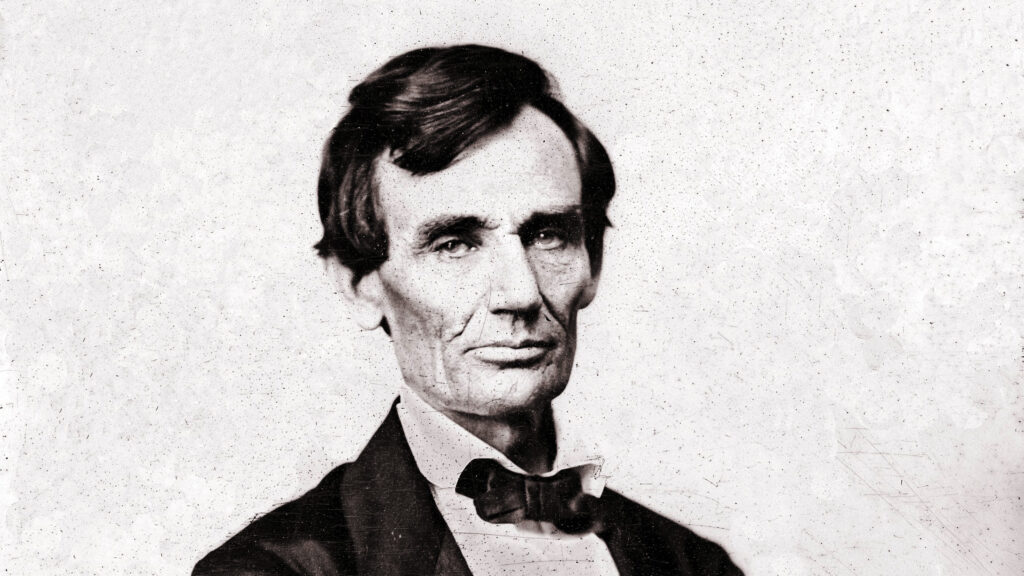
The election of Lincoln and the perceived threat to the institution of slavery proved too much for the deep Southern states. South Carolina acted almost immediately, calling a convention to declare secession. On December 20, 1860, the South Carolina convention voted unanimously, 169–0, to dissolve their union with the United States.4 The other states across the Deep South quickly followed suit. Mississippi adopted its own resolution on January 9, 1861, Florida on January 10, Alabama on January 11, Georgia on January 19, Louisiana on January 26, and Texas on February 1. Texas was the only state to put the issue up for a popular vote, but secession was widely popular throughout the South.
Confederates quickly shed their American identity and adopted a new Confederate nationalism. Confederate nationalism was based on several ideals, foremost among these being slavery and white supremacy. As Confederate Vice President Alexander Stephens stated, the Confederacy’s “foundations are laid, its cornerstone rests, upon the great truth that the negro is not equal to the white man; that slavery . . . is his natural and normal condition.”5 The election of Lincoln in 1860 demonstrated that the South was politically overwhelmed. Slavery was omnipresent in the antebellum South, and it served as the most common frame of reference for unequal power. To a white Southern man, there was no fate more terrifying than the thought of being reduced to the level of a slave. Religion likewise shaped Confederate nationalism, as Southerners believed that the Confederacy was fulfilling God’s will. The Confederacy even veered from the American Constitution by explicitly invoking Christianity in their founding document. Yet in every case, all rationale for secession could be thoroughly tied to slavery. “Our position is thoroughly identified with the institution of slavery—the greatest material interest of the world,” proclaimed the Mississippi statement of secession.6 For the original seven Confederate states (and the four that would subsequently join), slavery’s existence was the essential core of the fledgling Confederacy.
The Confederacy did not intend to be fledgling for long. Its leaders aimed to construct a vast slaveholding empire, encompassing everything from the mines of the American Southwest to the island plantations of the Caribbean. Confederate nationalists aspired to dominate the global markets for cotton and other cash crops, establishing their primacy atop a new world order.7

Not all Southerners participated in Confederate nationalism. White Unionists, most common in the upcountry where slavery was weakest, retained their loyalty to the Union. These Southerners joined the Union army (the army of the United States of America) and worked to defeat the Confederacy.8 Black southerners, most of whom were enslaved, overwhelmingly supported the Union, often running away from plantations and forcing the Union army to reckon with slavery.9
President James Buchanan would not directly address the issue of secession prior to his term’s end in early March. Any effort to try to solve the issue therefore fell upon Congress, specifically a Committee of Thirteen including prominent men such as Stephen Douglas, William Seward, Robert Toombs, and John Crittenden. In what became known as the Crittenden Compromise, Senator Crittenden proposed a series of Constitutional amendments that guaranteed the permanent existence of slavery in the Southern states, reinstituted and expanded the Missouri Compromise line to the Pacific, and offered to compensate enslavers whose enslaved people had escaped. The Committee of Thirteen ultimately voted down the measure, and it likewise failed in the full Senate vote (25–23). Reconciliation appeared impossible.10
The seven seceding states met in Montgomery, Alabama, on February 4 to organize a new nation. The delegates selected Jefferson Davis of Mississippi as president and established a capital in Montgomery (which would move to Richmond in May). Whether other states of the Upper South would join the Confederacy remained uncertain. North Carolina and Tennessee opted against holding secession conventions, while conventions in Virginia, Missouri, and Arkansas initially voted down secession. Despite this temporary boost to the Union, it became abundantly clear that these acts of loyalty in the Upper South were highly conditional and contingent upon the federal government’s noninterference in Southern affairs. Such was the precarious political situation facing Abraham Lincoln after his inauguration on March 4, 1861.
III. A War for Union, 1861–1863
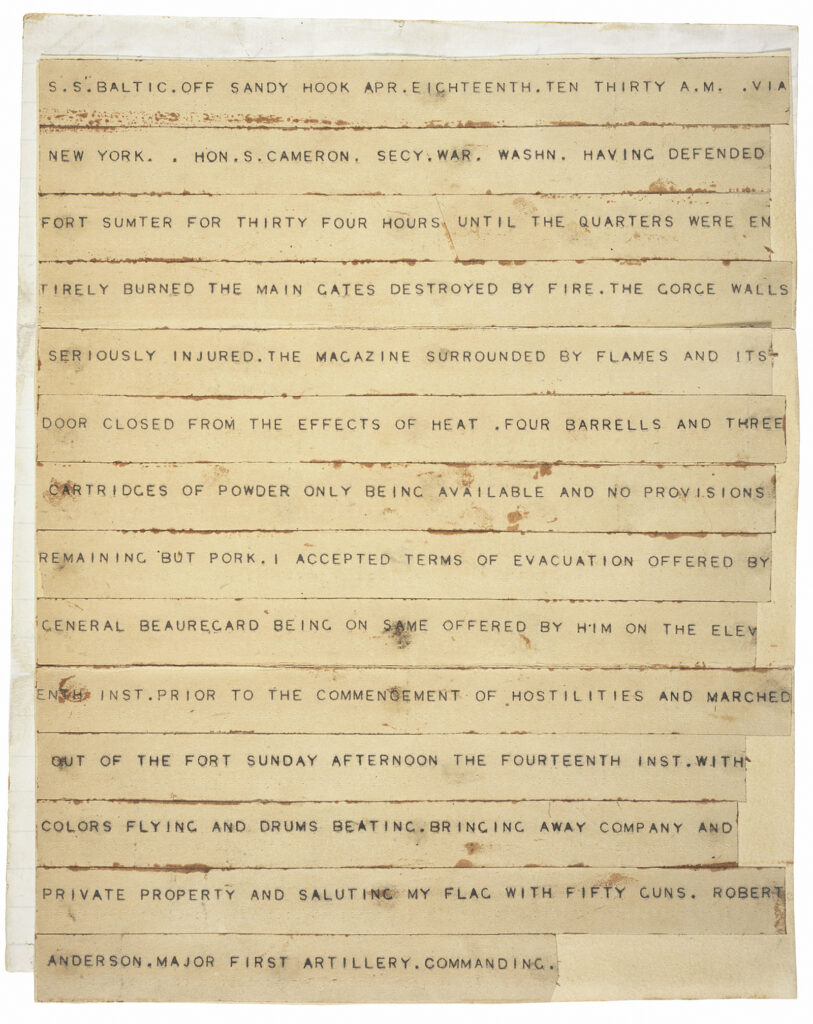
In his inaugural address, Lincoln declared secession “legally void.”11 While he did not intend to invade the seceded states, he would use force to maintain possession of federal property within them. Attention quickly shifted to the federal installation of Fort Sumter in Charleston, South Carolina. The fort’s garrison badly needed supplies, and Lincoln intended to resupply it. South Carolina demanded that the garrison evacuate the fort, but its commanding officer, Major Robert Anderson, refused. On April 12, 1861, Confederate Brigadier General P. G. T. Beauregard fired on Fort Sumter. Anderson surrendered on April 13, and the Union troops evacuated. In response to the attack, President Abraham Lincoln called for seventy-five thousand volunteers to serve for three months to suppress the rebellion. The American Civil War had begun.
The assault on Fort Sumter and subsequent call for troops provoked the Upper South states of Virginia, North Carolina, Tennessee, and Arkansas to join the Confederacy. In total, eleven states renounced their allegiance to the United States. The new Confederate nation was predicated on the institution of slavery and the promotion of any and all interests that protected it. Some Southerners couched their defense of slavery as a preservation of states’ rights. But to protect slavery, the Confederate Constitution left less power to the states compared to the US Constitution—an irony not lost on many.
Northerners, meanwhile, flocked into the Union army. Some of these men wished to deal a death blow to slavery, but most fought to preserve the Union. Northerners possessed a deeply held belief that the United States was the greatest experiment in self-government in human history. They were willing to put their lives on the line to ensure its survival—a goal on which everyone from Republicans to most Northern Democrats and former Whigs could agree.12
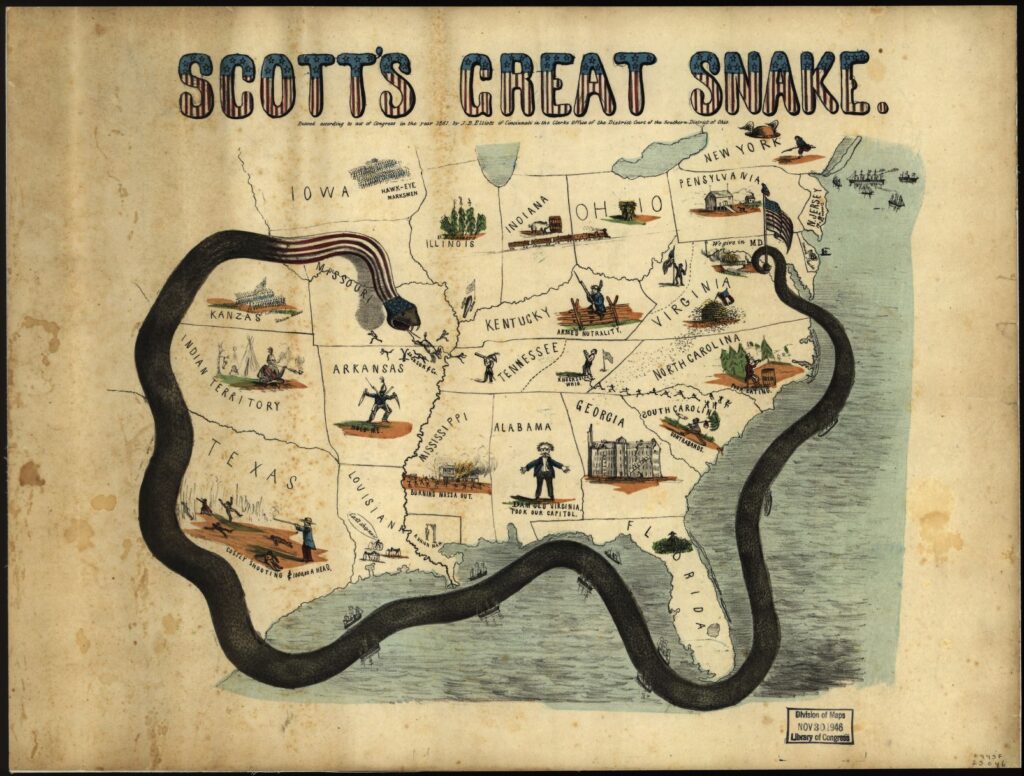
Shortly after Lincoln’s call for troops, the Union adopted Commanding General Winfield Scott’s Anaconda Plan to suppress the rebellion. This strategy attempted to strangle the Confederacy by cutting off access to coastal ports and inland waterways via a naval blockade. Ground troops would enter the interior, and like an anaconda snake, they planned to surround and squeeze the Confederacy.
The border states of Delaware, Maryland, Missouri, and Kentucky maintained geographic, social, political, and economic connections to both the North and the South. All four were immediately critical to the outcome of the conflict. Maryland was particularly important given its position relative to Washington. Abraham Lincoln suspended the writ of habeas corpus and allowed military commanders to arrest secession-friendly activists without charging them with a crime. Other border states were also important: as Lincoln famously quipped, “I think to lose Kentucky is nearly the same as to lose the whole game.”13 Lincoln and his military advisors realized that the loss of the border states could mean a significant decrease in Union resources and threaten the capital in Washington. Lincoln consequently hoped to foster loyalty among their citizens, enabling Union forces to minimize their occupation. Despite terrible guerrilla warfare in Missouri and Kentucky, the four border states remained loyal to the Union throughout the war.
Foreign countries, primarily in Europe, closely watched the unfolding war. The United States represented the greatest example of democratic thought at the time, and individuals from Britain, France, Spain, Russia, and beyond closely followed events across the Atlantic Ocean. If American democracy failed, democratic activists in Europe wondered what hope might exist for such experiments elsewhere. Conversely, those with close ties to the cotton industry watched with other concerns. War meant the possibility of disrupting the cotton supply, which could have catastrophic ramifications in commercial and financial markets abroad. Aware of this fact, the Confederacy engaged in “cotton diplomacy,” instituting a cotton embargo against Britain and France to coerce them into supporting its independence. But these nations instead turned to cultivating other markets. Though tensions flared between the United States and Britain on several occasions, no foreign power ultimately intervened in the Civil War.14
While Lincoln, his cabinet, and the War Department devised strategies to defeat the rebel insurrection, Black Americans quickly forced the issue of slavery as a primary issue in the debate. As early as 1861, Black Americans implored the Lincoln administration to serve in the army and navy.15 Lincoln initially waged a conservative, limited war. He stressed that his goal was to preserve the Union rather than to end slavery, lest he alienate the loyal slaveholding border states. He likewise refused to allow Black volunteers to join the military. Yet army commanders could not ignore the growing populations of formerly enslaved people who took matters into their own hands by escaping to freedom behind Union army lines. As the number of refugees ballooned, Lincoln and Congress increasingly found it harder to ignore the slavery question.16
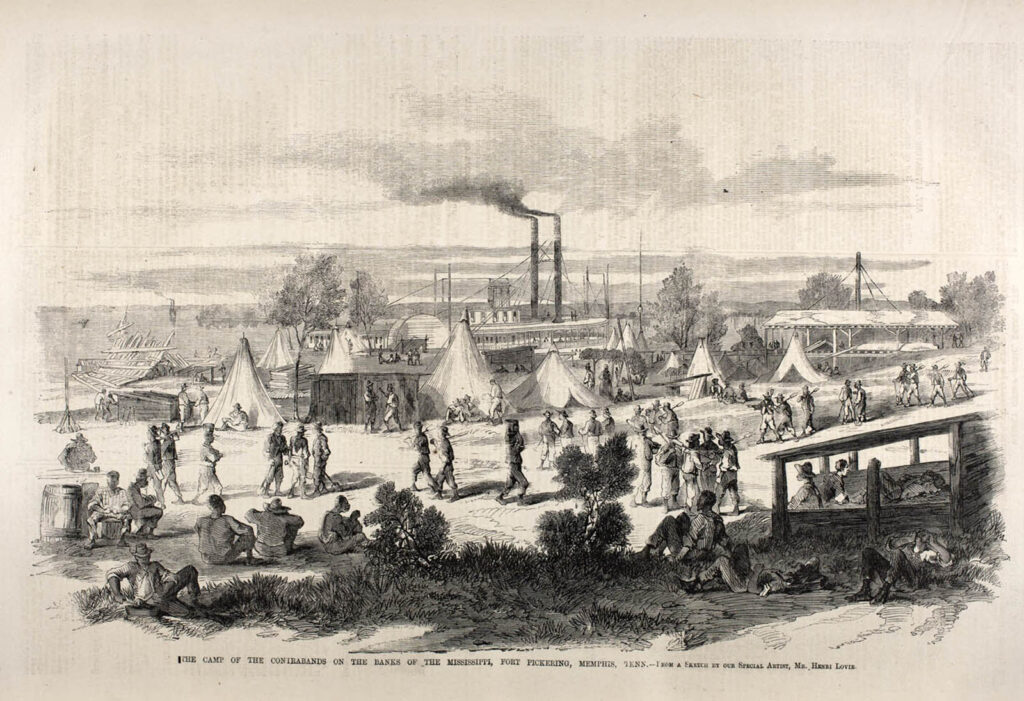
In May 1861, Union General Benjamin F. Butler went over his superiors’ heads and began accepting freedom-seekers who escaped to Fort Monroe in Virginia. Butler labeled runaways “contraband of war.” He reasoned that he had as much a right to confiscate this form of enemy property as he did to seize enemy horses or cannons.17 Later that summer, Congress affirmed Butler’s policy in the First Confiscation Act. The act left “contrabands,” as these runaways were called, in a state of limbo. Once an enslaved person escaped to Union lines, their enslaver’s claim was nullified. These persons were not, however, free citizens of the United States. Runaways lived in contraband camps, where disease and malnutrition were rampant. Women and men were required to perform the drudge work of war: raising fortifications, cooking meals, and laying railroad tracks. Still, thousands of enslaved people seized the opportunity of this potential path to freedom. These refugees managed to foster new communities amid the difficulties of the contraband camps.18
Fugitives posed a dilemma for the Union military. Soldiers were forbidden to interfere with slavery or assist runaways, but many soldiers found such a policy unchristian. Even those indifferent to slavery were reluctant to turn away potential laborers or help the enemy by returning his property. Formerly enslaved people possessed useful information on the local terrain and rebel positions and often offered to serve as spies and guides for the Union military. Union officers became particularly reluctant to turn away freedom-seeking people when Confederate commanders began forcing enslaved laborers to work on fortifications. Every enslaved person who escaped to Union lines was considered a loss to the Confederate war effort.19
Any hopes for a brief conflict were eradicated when Union and Confederate forces met on July 21, 1861, at the First Battle of Bull Run, near Manassas, Virginia. While not particularly deadly, the Confederate victory proved that the Civil War would be long and costly. Furthermore, in response to the embarrassing Union rout, Lincoln removed Brigadier General Irvin McDowell and promoted Major General George B. McClellan to commander of the newly formed Army of the Potomac. For nearly a year after Bull Run, the Eastern Theater remained relatively silent. Smaller engagements only resulted in a bloody stalemate.
But while the military remained quiet, the same could not be said of Republicans in Washington. The absence of obstructionist Southerners in Congress allowed Republicans to finally pass the Whig economic package, including the Homestead Act, the Land-Grant College Act (aka the Morrill Act), and the Pacific Railroad Act.20 The federal government also began moving toward a more nationally controlled currency (the greenback) and the creation of banks with national characteristics. New, centralized American financial systems vaulted onto the international stage, tying European nations more closely to the Union. These Republican acts proved instrumental in the expansion of the federal government and industry.21
The Democratic Party, absent its Southern leaders, divided into two camps. War Democrats largely stood behind President Lincoln in the fight to preserve the Union. Peace Democrats, also known as Copperheads, clashed frequently with both War Democrats and Republicans. Copperheads were sympathetic to the Confederacy; they exploited public antiwar sentiment (often the result of a lost battle or mounting Union casualties) and tried to pressure President Lincoln into negotiating an immediate peace. Had the Copperheads succeeded in their machinations, the Union would have been forced to recognize the Confederacy as a separate and legitimate government—and the institution of slavery would have remained intact.22
![A photograph of dead Civil War soldiers lying on the ground near a fence. Photography captured the horrors of war as never before. Some Civil War photographers arranged the actors in their frames to capture the best picture, even repositioning bodies of dead soldiers for battlefield photos. Alexander Gardner, [Antietam, Md. Confederate dead by a fence on the Hagerstown road], September 1862. Library of Congress.](https://www.americanyawp.com/textbook/wp-content/uploads/2014/11/antietam-1024x576.jpg)
While Washington buzzed with political activity, military life consisted of relative monotony punctuated by brief periods of horror. Daily life for a Civil War soldier was one of routine. A typical day began around six in the morning and involved drill, marching, lunch break, and more drilling, followed by policing the camp. Weapon inspection and cleaning followed, perhaps one final drill, dinner, and taps around nine or nine thirty in the evening. Soldiers in both armies grew weary of the routine. Picketing or foraging afforded welcome distractions to the monotony.
Soldiers devised clever ways of dealing with the boredom of camp life. The most common was reading and writing. These were highly literate armies; nine out of every ten Federals and eight out of every ten Confederates could read and write.23 Letters home served as a tether linking soldiers to their loved ones. Newspapers were often in high demand. News of battles, events in Europe, politics in Washington and Richmond, and local concerns were voraciously sought after and traded.
While there were nurses, camp followers, and some women who disguised themselves as men, camp life was overwhelmingly male. A sizable amount of these men—as much as 10 percent of Union soldiers—were underage boys who misrepresented their ages in enlisting. Soldiers drank liquor, smoked tobacco, gambled, and swore. Social commentators feared that when these men returned home with their hard-drinking and irreligious ways, all decency, faith, and temperance would depart. But not all methods of distraction were sinful. Soldiers also organized debate societies, composed music, sang songs, wrestled, raced horses, boxed, and played various sports.24

Neither side could consistently provide supplies for their soldiers, so it was not uncommon, though officially forbidden, for common soldiers to trade with the enemy. Confederate soldiers prized Northern newspapers and coffee. Northerners were glad to exchange these for Southern tobacco. Supply shortages and poor sanitation were synonymous with Civil War armies. The close proximity of thousands of men bred disease. Lice were soldiers’ daily companions.25
Music was popular among the soldiers of both armies, creating a diversion from the boredom and horror of the war. As a result, soldiers often sang on fatigue duty and while in camp. Favorite songs often reminded the soldiers of home, including “Lorena,” “Home, Sweet Home,” and “Just Before the Battle, Mother.” Dances held in camp offered another way to enjoy music. Since there were often few women nearby, soldiers would dance with one another.
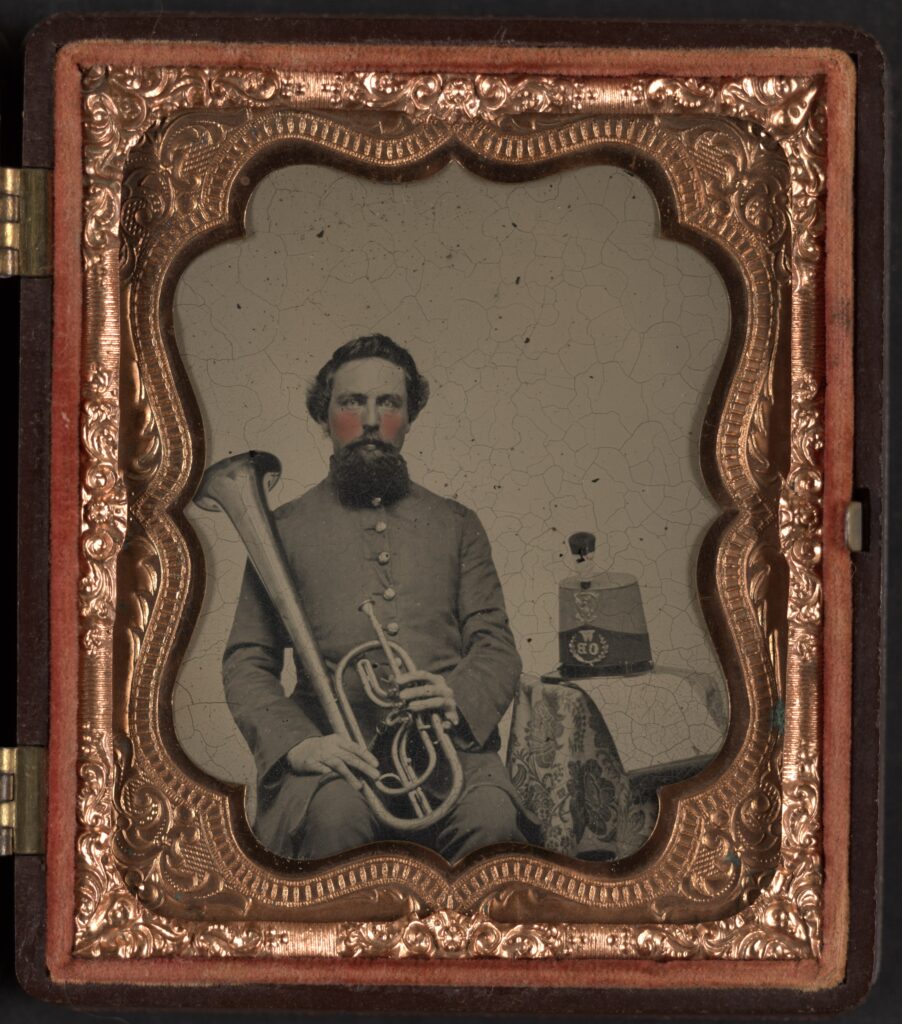
When the Civil War broke out, one of the most popular songs among soldiers and civilians was “John Brown’s Body,” which began with the lyrics, “John Brown’s body lies a-mouldering in the grave.” It emerged as a Union anthem praising John Brown’s actions at Harper’s Ferry, Virginia, before being appropriated by the Confederates to vilify Brown. Each side’s versions of the song stressed that theirs was the just cause. Eventually, the words to Julia Ward Howe’s poem “The Battle Hymn of the Republic” were set to the melody, further implying Union success. The themes of popular songs changed over the course of the war, as feelings of inevitable success alternated with feelings of terror and despair.26
After an extensive delay by Union commander George McClellan, his 120,000-man Army of the Potomac moved via ship to the peninsula between the York and James Rivers in Virginia in March 1862. Rather than crossing overland via the former battlefield at Manassas Junction, McClellan attempted to swing around the rebel forces and enter the capital of Richmond before they could react. McClellan, however, was an overly cautious man who consistently overestimated his adversaries’ numbers. This circumspect approach played into the Confederates’ favor on the outskirts of Richmond. Confederate General Robert E. Lee, who took over the Army of Northern Virginia after its previous commander was wounded, forced McClellan to retreat from Richmond, and the Peninsula Campaign ended in failure.27
While federal forces met with little success in the East, events in the Western Theater buoyed the Union cause. In February 1862, Union troops under General Ulysses S. Grant captured Forts Henry and Donelson along the Tennessee River. Fighting in the West greatly differed from that in the East. At the First Battle of Bull Run, two large armies fought for control of the nations’ capital. But Union and Confederate forces in the West fought for control of the rivers, since the Mississippi River and its tributaries were key components of the Union’s Anaconda Plan. One of the deadliest of these clashes occurred along the Tennessee River at the Battle of Shiloh on April 6–7, 1862. This battle, lasting only two days, was the costliest single battle in American history up to that time. The Union victory shocked both the Union and the Confederacy, with approximately 23,000 casualties, a number that exceeded casualties from all of the United States’ previous wars combined.28 The subsequent capture of New Orleans by Union forces in May 1862 proved a heavy blow to the Confederacy and capped a spring of success in the Western Theater.
War also came to the American Southwest. In response to secessionist sentiment in the southern portion of the New Mexico Territory (encompassing modern-day New Mexico, Arizona, and part of Nevada) the Confederates implemented their imperial ambitions. They invaded in 1861 and established the Arizona Territory, hoping to carve a path to California. The Union countered, driving the rebels out of the region in the Battle of Glorieta Pass in July 1862. Union forces then moved to carry out their own expansionist aims, waging a systematic and destructive campaign of total war against Apache and Navajo tribes in the territory. After eradicating the Navajos’ crops and cattle, Union troops led by frontiersman Kit Carson began forcing them onto reservations. The Navajo suffered thousands of deaths from disease and starvation on the forced journeys to the reservation at Fort Sumner, New Mexico, between 1864 and 1866, collectively known today as the Long Walk.29
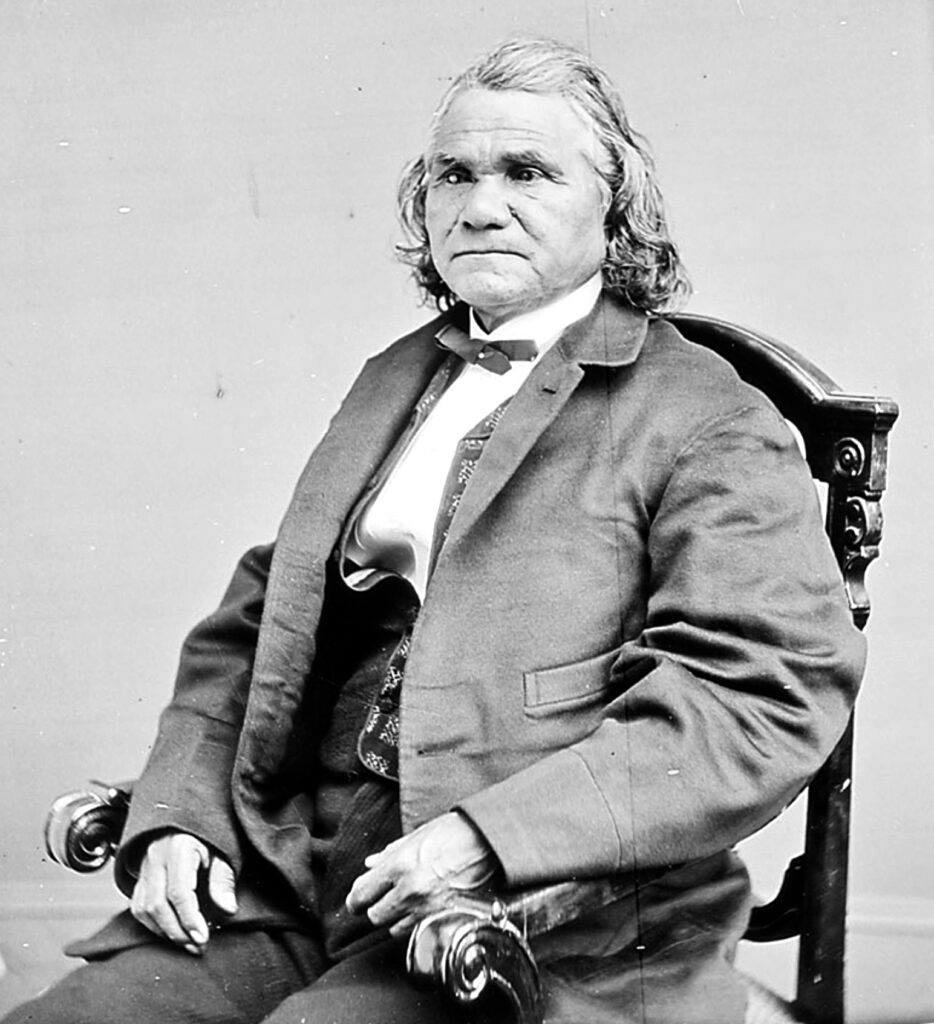
Native Americans were intertwined with the events of the Civil War beyond the Southwest as well. Native people strove to use their allegiances in the conflict as leverage to protect their own interests. Many tribes sided with the Union and sent warriors to fight in the military, hoping to ensure the Union would thereby honor its treaties with these tribes. However, other communities, specifically those found within “Indian Territory” in the south, allied with the Confederacy. The so-called Five Tribes of the Cherokee, Chickasaw, Muscogee (Creek), Choctaw, and Seminole needed little persuasion to resist the government that forced their removal decades before. Therefore, they signed treaties with the Confederacy who created their own Bureau of Indian Affairs. These nations hoped to maintain control of their lands—and to preserve the institution of slavery, which they relied on alongside white Southerners. However, many tribal leaders appealed to unionists as they disapproved of secession. In January 1862, the Union saw victory as it invaded Indian Territory at Pea Ridge, where conflict between Indigenous unionists and secessionists was evolving into a civil war within a civil war.30 Stand Watie, the chief of the Cherokee Nation, was commissioned as a general in the Confederate Army. He would become the last Confederate general to surrender to Union forces at the end of the Civil War.31
Far beyond the battlefields of the Civil War itself, conflicts arose between Northern settlers and Native peoples in the Union-controlled West, often ending in tragedy for the Native peoples. In 1862, violence erupted between the Dakota Nation and white settlers in Minnesota and the Dakota Territory. The US Census of 1850 recorded a white population of about 6,000 in Minnesota. By the time it became a state eight years later, its white population had exploded to over 150,000.32 Additionally, the 1851 Treaty of Traverse had traded 1,665,000 acres of Dakota land in exchange for “money annuity, the sum of $40,000, among other stipends.33 Unfortunately, the treaty was violated. The illegal influx of American farmers pushed the Dakota to the breaking point as hunting became unsustainable, and the Dakota who had taken up farming only found poverty, while annuity payments ceased altogether. When the federal Indian agent refused to disburse treaty-promised food, many starved. Andrew Myrick, a trader at the agency, refused to sell food on credit. “If they are hungry,” he is alleged to have said, “let them eat grass or their own dung.”34 Tensions boiled over on August 17, 1862, when four young men of the Santee, a Dakota band, killed five white settlers near the Redwood Agency, a Union administrative office. In the face of an inevitable American retaliation, and over the protests of many members, the tribe chose war. On the following day, Dakota warriors attacked settlements near the Agency. They killed thirty-one men, women, and children (including Myrick, whose mouth was found filled with grass). They then ambushed a US military detachment at Redwood Ferry, killing twenty-three. The governor of Minnesota called up militia and several thousand Americans waged war against the Indigenous insurgents. Fighting broke out at New Ulm, Fort Ridgely, and Birch Coulee, but the United States broke Indigenous resistance at the Battle of Wood Lake on September 23, ending the Dakota War.35
More than two thousand Dakota had been taken prisoner during the fighting. Many were tried at federal forts for murder, rape, and other atrocities, in a kind of legalistic choreography that conveyed American ideas of Native guilt and white innocence. Military tribunals convicted 303 Dakota and sentenced them to hang. At the last minute, President Lincoln commuted all but thirty-eight of the sentences. Minnesota settlers and government officials insisted not only that the Dakota lose much of their reservation lands and be removed farther west, but that those who had fled be hunted down and placed on reservations as well. The American military gave chase. On September 3, 1863, after a year of attrition, American military units surrounded a large encampment of Dakota. American troops killed an estimated three hundred men, women, and children. Dozens more were taken prisoner. Troops spent the next two days burning winter food and supply stores to starve out the Dakota resistance, which continued to insist on Dakota sovereignty and treaty rights.36
Farther south, settlers inflamed tensions in Colorado. In 1851, the first Treaty of Fort Laramie secured right-of-way access for Americans passing through on their way to California and Oregon. But a gold rush in 1858 drew approximately 100,000 white gold seekers, and they demanded new treaties be made with local Indigenous groups to secure land rights in the newly created Colorado Territory. Cheyenne bands splintered over the possibility of signing a new treaty that would confine them to a reservation. Settlers, already wary of raids by powerful groups of Cheyenne, Arapaho, and Comanche, began reading sensationalist accounts of the uprising in Minnesota in their local newspapers. Militia leader John M. Chivington warned settlers in the summer of 1864 that the Cheyenne were dangerous. He fanned the flames of war and promised a swift military victory. The settlers soon sparked open conflict, and sporadic fighting broke out. The aged Cheyenne chief Black Kettle, believing that a peace treaty would be best for his people, traveled to Denver to arrange for peace talks. He and his followers traveled toward Fort Lyon in accordance with government instructions. But on November 29, 1864, Chivington ordered his seven hundred militiamen to move to the Cheyenne camp near Fort Lyon at Sand Creek. Even though the Cheyenne attempted to declare their peaceful intentions, Chivington’s militia mercilessly cut them down. Chivington’s men killed two hundred men, women, and children in an unmitigated slaughter. The Sand Creek Massacre became a national scandal, alternately condemned and applauded across the land.37
The Civil War raged on, both on sea and land. Union and Confederate navies helped or hindered army movements around the many marine environments of the southern United States. Each navy employed the latest technology to outmatch the other. The Confederate Navy, led by Stephen Russell Mallory, had the unenviable task of constructing a fleet from scratch and trying to fend off a vastly better-equipped Union Navy. Led by Gideon Welles of Connecticut, the Union Navy successfully implemented Winfield Scott’s Anaconda Plan. The future of naval warfare also emerged in the spring of 1862 as two “ironclad” warships fought a duel at Hampton Roads, Virginia. The age of the wooden sail was gone, and naval warfare would be fundamentally altered.
On the ground, the actions of Black Americans were pushing the Union toward a war of emancipation by the summer of 1862.38 So, too, were their allies in the biracial abolitionist movement. Antislavery activists developed an innovative strategy to convince white Northerners that emancipation was in their self-interest—that it was the only way to weaken the slavery-powered Confederacy and win the war. Their increasingly popular arguments eventually gained the support even of War Democrats and old Whigs like Daniel S. Dickinson and Edward Everett, who embraced the necessity of emancipation as a war measure.39
![A photograph of Black men in Union uniforms standing in a row in front of a building that may well be a barracks. They stand with guns held in front of them with the butts resting on the ground. William Morris Smith, [District of Columbia. Company E, 4th U.S. Colored Infantry, at Fort Lincoln], between 1863 and 1866. Library of Congress.](https://www.americanyawp.com/textbook/wp-content/uploads/2014/08/04294v-1024x821.jpg)
Such sentiment soon translated into political action. In April 1862, Congress abolished the institution of slavery in the District of Columbia. That July, Congress passed the Second Confiscation Act, effectively emancipating enslaved people on land that came under Union control. Word traveled fast among enslaved people, and this legislation led to even more runaways making their way into Union lines. Abraham Lincoln’s intentions on emancipation also evolved. Over the summer of 1862, Lincoln began floating the idea of an Emancipation Proclamation to members of his cabinet. By August, he proposed the first iteration of the Emancipation Proclamation. While his cabinet supported such an idea, Secretary of State William Seward insisted that Lincoln wait for a “decisive” Union victory so the proclamation would not appear to be the desperate measure of a faltering government.
![This African American family dressed in their finest clothes (including a USCT uniform) for this photograph, projecting respectability and dignity that was at odds with the southern perception of Black Americans. [Unidentified African American soldier in Union uniform with wife and two daughters], between 1863 and 1865. Library of Congress.](https://www.americanyawp.com/textbook/wp-content/uploads/2014/08/36454v-1024x866.jpg)
That decisive victory—or a reasonably clear-cut one, at least—occurred in the fall of 1862 along Antietam Creek in Maryland. Emboldened by their successes over the previous spring and summer, Lee and Confederate President Jefferson Davis planned to win a decisive victory in Union territory and end the war. On September 17, 1862, McClellan’s and Lee’s forces collided at the Battle of Antietam near the town of Sharpsburg. This was the first major battle of the Civil War to occur on Union soil. It remains the bloodiest single day in American history: over 20,000 soldiers were killed, wounded, or missing.
Despite the Confederate withdrawal and the high death toll, the Battle of Antietam was not a definitive Union triumph. Yet it provided enough of a victory for Lincoln to issue the Emancipation Proclamation, which freed enslaved people in areas under Confederate control. There were significant exemptions to the Emancipation Proclamation, including the loyal border states and Union-occupied areas of the Confederacy. But while it was a far cry from a universal end to slavery, the Emancipation Proclamation proved unquestionably vital by transforming a war for the Union into one for both the Union and emancipation. Lincoln framed his Proclamation as a war measure, hoping that stripping the Confederacy of its labor force would not only debilitate the Southern economy but also weaken Confederate morale. Furthermore, the Battle of Antietam and the issuance of the Emancipation Proclamation all but ensured that the Confederacy would not be recognized by European powers. The Confederacy nonetheless fought on. Union and Confederate forces clashed again at Fredericksburg, Virginia, in December 1862, resulting in a Confederate victory—and staggering Union casualties.
IV. War for Emancipation, 1863–1865
As Union armies penetrated deeper into the Confederacy, politicians and generals came to understand the necessity and benefit of enlisting African American men in the army and navy. Although a few commanders began forming Black units in 1862, such as Massachusetts abolitionist Thomas Wentworth Higginson’s First South Carolina Volunteers (the first regiment of Black soldiers), widespread enlistment did not occur until the Emancipation Proclamation went into effect on January 1, 1863. “And I further declare and make known,” Lincoln’s proclamation read, “that such persons of suitable condition, will be received into the armed service of the United States to garrison forts, positions, stations, and other places, and to man vessels of all sorts in said service.”40
The language describing Black enlistment indicated Lincoln’s implicit desire to segregate African American troops from the main campaigning armies of white soldiers. “I believe it is a resource which, if vigorously applied now, will soon close the contest. It works doubly, weakening the enemy and strengthening us,” Lincoln remarked in August 1863 about Black soldiering.41 Although more than 180,000 Black men (10 percent of the Union army) served during the war, most United States Colored Troops (USCT) remained stationed behind the lines as garrison forces, often laboring and performing noncombat roles.
Black soldiers in the Union army endured rampant discrimination and earned less pay than white soldiers, while also facing the possibility of being murdered or sold into slavery if captured. James Henry Gooding, a Black corporal in the famed 54th Massachusetts Volunteers, wrote to Abraham Lincoln in September 1863, questioning why he and his fellow volunteers were paid less than white men. Gooding argued that because he and his brethren were born in the United States and selflessly left their private lives to enter the army, they should be treated “as American SOLDIERS, not as menial hirelings.”42

African American soldiers defied the inequality of military service and used their positions in the army to reshape society in the North and South. The majority of the USCT had once been enslaved, and their presence as armed, blue-clad soldiers sent shock waves throughout the Confederacy. To their friends and families, African American soldiers symbolized the embodiment of liberation and the destruction of slavery. To white Southerners, they represented the utter disruption of the Old South’s racial and social hierarchy. As members of the armies of occupation, Black soldiers wielded martial authority in towns and plantations. At the end of the war, as a Black soldier marched by a cluster of Confederate prisoners, he noticed his former enslaver among the group. “Hello, massa,” the soldier exclaimed, “bottom rail on top dis time!”43
Leaders in the African American community recognized the greater importance of this military service. Through their martial valor on the battlefield, such leaders hoped, Black soldiers would convince white Northerners to grant their race full and equal rights. As Frederick Douglass argued, “Let the black man get an eagle on his button, and a musket on his shoulder,” and none could refuse him the “right of citizenship.” Douglass, Henry Highland Garnet, and other Black leaders threw their all into recruiting for the new USCT regiments to make this dream a reality.44
The majority of the USCT occupied the South by performing garrison duty; other Black soldiers performed admirably on the battlefield, shattering white myths that docile, cowardly Black men would fold in the maelstrom of war. Black troops fought in more than four hundred battles and skirmishes, including Milliken’s Bend and Port Hudson, Louisiana; Fort Wagner, South Carolina; Nashville; and the final campaigns to capture Richmond, Virginia. Fifteen Black soldiers received the Medal of Honor, the highest honor bestowed for military heroism. Through their voluntarism, service, battlefield contributions, and even deaths, Black soldiers successfully made their claims for citizenship.
Many enslaved laborers accompanied their enslavers in the Confederate army. They served their enslavers as “camp servants,” cooking their meals, raising their tents, and carrying their supplies. The Confederacy also impressed enslaved laborers to perform manual labor. There are three key points to make about these enslaved “Confederates.” First, their labor was almost always coerced. Second, people are complicated and have varying, often contradictory loyalties. An enslaved person could yearn for freedom and the Confederacy’s collapse, but at the same time be concerned for the safety of his enslaver and the rebel soldiers he saw daily.
And finally, white Confederates did not see African Americans as their equals, much less as soldiers. There was never any doubt that Black laborers and camp servants were property. It is a stretch to claim that no enslaved person ever fired a gun for the Confederacy; a camp servant whose enslaver died in battle might well pick up his dead enslaver’s rifle and continue firing, if for no other reason than to protect himself. But this would always have been on an informal basis. As a last act of desperation, the Confederate government did pass a law in March 1865 allowing for the enlistment of Black soldiers. Only a few dozen African Americans (mostly Richmond hospital workers) signed up by the war’s conclusion, however. African Americans never served on a battlefield as enlisted Confederate soldiers, despite modern-day claims to the contrary.45
As 1863 dawned, Lee’s Army of Northern Virginia continued its offensive strategy in the East. One of the war’s major battles occurred near the village of Chancellorsville, Virginia, from April 30 to May 6, 1863. While the Battle of Chancellorsville was a stunning Confederate victory, it also resulted in heavy casualties and the mortal wounding of an important Confederate commander, Major General Thomas “Stonewall” Jackson, who was killed by friendly fire.
Despite Jackson’s death, Lee continued his offensive against federal forces and invaded Pennsylvania in the summer of 1863. During the three-day battle (July 1–3) at Gettysburg, heavy casualties crippled both sides. But after a failed—and devastating—infantry assault on July 3 against the Union center, known as Pickett’s Charge, Lee retreated from Pennsylvania. The Gettysburg Campaign was Lee’s final incursion into the North. The Battle of Gettysburg remains the bloodiest battle of the war, and in American history, with 51,000 casualties.
In the West, meanwhile, Union forces continued their movement along the Mississippi River and its tributaries. Grant launched his campaign against Vicksburg, Mississippi, in the winter of 1862. Known as the “Gibraltar of the West,” Vicksburg was the last Confederate strongpoint on the Mississippi River, and its seizure would enable uninhibited Union travel along the waterway. Grant’s Vicksburg Campaign ended with the city’s surrender on July 4, 1863. The fall of Vicksburg split the Confederacy in two.
Despite Union success in the summer of 1863, discontent over the war simmered across the North. This was particularly true in the wake of the Enrollment Act, which initiated a draft of military-age men in the North. Working-class Northerners were especially angry that the wealthy could pay $300 for substitutes, sparing themselves from the carnage of war. “A rich man’s war, but a poor man’s fight,” went a popular refrain.46 The Emancipation Proclamation convinced many immigrants in Northern cities that freed slaves would soon take their jobs. These racial and economic anxieties culminated in the New York City Draft Riots in July 1863. White rioters killed some 120 citizens over the span of four days, lynching at least eleven Black New Yorkers. Property damage was in the millions, including the destruction of more than fifty properties, most notably that of the Colored Orphan Asylum. It was the largest civil disturbance to date in the United States (aside from the war itself) and was only stopped by the deployment of Union soldiers, some of whom came directly from the battlefield at Gettysburg.47
The North was also capable of impressive acts of unity. Sanitary fairs originated in the Old Northwest and raised millions of dollars for supplies for Union soldiers. Indeed, many women rose to take pivotal leadership roles in the sanitary fairs, making strong contributions to the Union war effort. The fairs also encouraged national unity within the North, something that became more important as the war dragged on and casualties continued to mount. The Northern home front remained ever complicated: overt displays of loyalty contrasted with violent dissent.

A similar situation played out in the Confederacy. The Confederate Congress passed its first conscription act in the spring of 1862, a full year before its Northern counterpart. Military service was required from all able-bodied males between ages eighteen and thirty-five (eventually extended to forty-five). Notable class exemptions likewise existed in the Confederacy: those who owned twenty or more enslaved laborers could escape the draft. Popular discontent reached a boiling point in 1863. Throughout the spring of 1863, consistent food shortages led to “bread riots” in several Confederate cities, most notably Richmond and the Georgia cities of Augusta, Macon, and Columbus. Confederate women led these mobs to protest food shortages and rampant inflation within the Confederate South. Exerting their own political control, women dramatically impacted the war through violent actions in these cases, as well as constant petitions to governors for aid and the release of husbands from military service. One such woman wrote a letter to North Carolina Governor Zebulon Vance, pleading, “Especially for the sake of suffering women and children, do try and stop this cruel war.”48 Confederates waged a multifront struggle against Union incursion and internal dissent.
Some women supported their respective sides by spying on the enemy. When the war broke out, Rose O’Neal Greenhow was living in Washington. Utilizing her role as a well-regarded socialite in the capital, she began gathering information for her Confederate contact. Suspecting Greenhow of espionage, Allan Pinkerton of the Union Intelligence Service placed her under surveillance, instigated a raid on her house to gather evidence, and then put her under house arrest, after which she was incarcerated in Old Capitol Prison. Upon her release she was sent, under guard, to Baltimore, Maryland. From there, Greenhow went to Europe to attempt to bring support to the Confederacy. Having failed to curry favor, Greenhow decided to return to America aboard the blockade runner Condor. The ship ran aground off the North Carolina coast, however, and Greenhow ultimately drowned when her lifeboat capsized in a storm.
While Greenhow gave her life for the Confederate cause, Elizabeth “Crazy Bet” Van Lew sacrificed her social standing for the Union. A member of a prominent Richmond family who harbored antislavery sympathies, Van Lew organized a Union spy ring in the Confederate capital, leading to her being “held in contempt & scorn by the narrow-minded men and women of my city for my loyalty.”49 Indeed, when General Ulysses Grant took control of Richmond, he detailed a special guard to protect Van Lew. In addition to her espionage activities, Van Lew also acted as a nurse to Union prisoners in Libby Prison.50

Pro-Confederate Southern women, meanwhile, were eager to show their scorn for the enemy. Some women in New Orleans went so far as to dump their chamber pots onto the heads of unsuspecting federal soldiers standing underneath their balconies, leading to Benjamin Butler’s infamous General Order Number 28, which arrested all rebellious women as prostitutes.
Military strategy shifted in 1864. The new tactics of “hard war” evolved slowly, as restraint toward Southern civilians and property gave way to a concerted effort to demoralize Southern civilians and destroy the Southern economy. Grant’s successes at Vicksburg and Chattanooga, Tennessee (November 1863), as well as Meade’s overly cautious pursuit of Lee after Gettysburg, prompted Lincoln to promote Grant to Commanding General of the United States Army in early 1864. This change in command brought some of the bloodiest battles of the Eastern Theater. Grant launched the Overland Campaign to take Richmond, demonstrating his willingness to tirelessly grind down the ever-dwindling Army of Northern Virginia. The two armies clashed repeatedly in the horrific battles of The Wilderness, Spotsylvania, and Cold Harbor. By June 1864, Grant’s army surrounded the Confederate depot of Petersburg, Virginia. Siege operations cut off Confederate forces and supplies from the capital of Richmond. Out west, meanwhile, Union armies under the command of William Tecumseh Sherman implemented hard-war strategies and made their way through central Tennessee and northern Georgia, capturing the vital rail hub of Atlanta in September 1864.
Deaths mounted in 1864 not only from the battles themselves, but also from disease. Sickness afflicted both armies and accounted for over half of all Civil War casualties. Sometimes as many as half of the men in a company could be ill. The overwhelming majority of Civil War soldiers came from rural areas, where less exposure to diseases meant soldiers lacked certain immunities. Vaccines for diseases such as smallpox were largely unavailable to those outside cities or towns. Despite the common nineteenth-century tendency to see city men as weak or soft, soldiers from urban environments tended to succumb to fewer diseases than their rural counterparts. Tuberculosis, measles, rheumatism, typhoid, malaria, and smallpox spread almost unchecked among the armies.

Civil War medicine focused almost exclusively on curing the patient rather than preventing disease. Many soldiers attempted to cure themselves by concocting elixirs and medicines themselves. These ineffective home remedies were often made from various plants the men found in woods or fields. There was no understanding of germ theory, and many soldiers did things that we would consider unsanitary today.51 They ate food that was improperly cooked and handled, while practicing what we would consider poor personal hygiene. They did not take appropriate steps to ensure that drinking water was free from bacteria. Diarrhea and dysentery were common. These diseases proved especially dangerous, as Civil War soldiers did not understand the value of replacing fluids as they were lost. As such, men affected by these conditions would weaken and become unable to fight or march. As they became dehydrated, their immune system became less effective, inviting other infections to attack the body. Through trial and error, soldiers began to protect themselves from some of the more preventable sources of infection. Around 1862, both armies began to dig latrines rather than rely on the local waterways. Burying human and animal waste also cut down on exposure to diseases considerably.
Medical surgery was limited and brutal. If a soldier was wounded in the torso, throat, or head, little could be done by surgeons. Invasive procedures to repair damaged organs or stem blood loss invariably resulted in death. Luckily for soldiers, only approximately one in six combat wounds were to one of those areas. The remaining wounds were to limbs and were only treatable by amputation. Soldiers had the highest chance of survival if the limb was removed within forty-eight hours of injury. A skilled surgeon could amputate a limb in three to five minutes from start to finish. While the ignorance of germ theory again resulted in numerous unsafe practices, such as using the same tools on multiple patients, wiping hands on filthy gowns, and placing hands in communal buckets of water, there is evidence that amputation offered the strongest chance of survival.
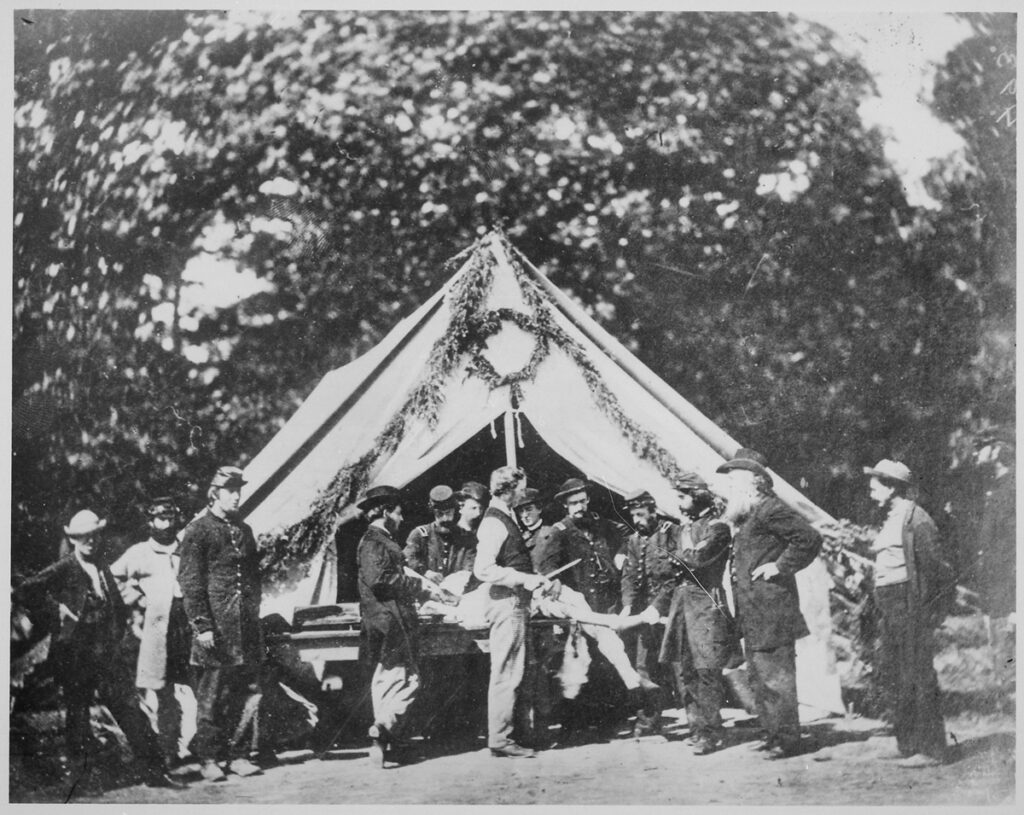
It is a common misconception that amputation was done without anesthesia and against a patient’s wishes. Since the 1830s, Americans understood the benefits of nitrous oxide and ether in easing pain. Chloroform and opium were also used to either render patients unconscious or dull pain during the procedure. Moreover, surgeons would not amputate without the patient’s consent.
In the Union army alone, 2.8 million ounces of opium and over 5.2 million opium pills were administered. In 1862, William Alexander Hammon was appointed surgeon general of the United States Army. He sought to regulate dosages and manage supplies of available medicines, both to prevent overdosing and to ensure that an ample supply remained for the next engagement. However, his guidelines generally applied only to the regular federal army. Most Union soldiers were in volunteer units and organized at the state level. Their surgeons often ignored posted limits on medicines, or worse, experimented with their own concoctions made from local flora.
The conditions in Union hospitals were somewhat superior to those in the Confederacy. This was partly due to the organizational skills of women like Dorothea Dix, the Union’s superintendent for army nurses. Additionally, many women were members of the United States Sanitary Commission and helped to staff and supply hospitals in the North.
Women took on key roles within hospitals, both North and South. The publisher’s notice for Nurse and Spy in the Union Army stated, “In the opinion of many, it is the privilege of woman to minister to the sick and soothe the sorrowing—and in the present crisis of our country’s history, to aid our brothers to the extent of her capacity.”52 Mary Chesnut wrote, “Every woman in the house is ready to rush into the Florence Nightingale business.”53 After visiting a hospital, however, she declared that “I can never again shut out of view the sights that I saw there of human misery. I sit thinking, shut my eyes, and see it all.”54 Hospital conditions were often so bad that many volunteer nurses quit soon after beginning. Kate Cumming volunteered as a nurse shortly after the war began. She and other volunteers traveled with the Army of Tennessee. All but one of the women who volunteered with Cumming quit within a week.
Death came in many forms; disease, prisons, bullets, even lightning and bee stings took men slowly or suddenly. Their deaths affected more than their regiments. Before the war, a wife expected to sit at her husband’s bed, holding his hand, and ministering to him after a long, fulfilling life. This noble type of death, the “Good Death,” disappeared during the Civil War as men died often far from home among strangers.55 Casualty reporting was inconsistent, so a woman was often at the mercy of the men who fought alongside her husband to learn not only the details of his death, but even that the death had occurred.
“Now I’m a widow. Ah! That mournful word. Little the world think of the agony it contains!,” wrote Sally Randle Perry in her diary.56 After her husband’s death at Antietam, Sally received the label she would share with over 200,000 other women. The death of a husband and loss of financial, physical, and emotional support could shatter lives. It also had the perverse power to free women from bad marriages and open doors to financial and psychological independence.
Widows had an important role to play in the conflict. The ideal widow wore black, mourned for a minimum of two and a half years, resigned herself to God’s will, focused on her children, devoted herself to her husband’s memory, and brought his body home for burial. Most tried, but not all widows were able to live up to this ideal. Many widows were unable to purchase proper mourning garb. Black silk dresses, heavy veils, and other features of antebellum mourning were expensive and in short supply. Because most of these women were in their childbearing years, the war created an unprecedented number of widows who were pregnant or still nursing infants. In a time when the average woman gave birth to eight to ten children in her lifetime, it is perhaps unsurprising that the Civil War created so many widows who were also young mothers with little free time for formal mourning. Widowhood permeated American society. But in the end, it was up to each widow to navigate her own mourning. She joined the ranks of sisters, mothers, cousins, girlfriends, and communities in mourning men.57
By the fall of 1864, affairs in the North played out against the backdrop of the upcoming presidential election. This contest featured a transformed electorate. Three new states (West Virginia, Nevada, and Kansas) had been added since 1860, while the eleven states of the Confederacy did not participate. Lincoln and his vice-presidential nominee, Andrew Johnson of Tennessee, ran as the “National Union Party” to attract conservative Unionists into the Republican fold. The main competition came from his former commander, General George B. McClellan. Though McClellan himself was a War Democrat, the Copperhead-friendly official platform of the Democratic Party in 1864 revolved around negotiating an immediate end to the war. McClellan’s vice-presidential nominee was George H. Pendleton of Ohio—a well-known Copperhead.58
Lincoln and McClellan each needed 117 electoral votes (out of a possible 233) to win the presidency on November 8. Lincoln doubted his chances of reelection throughout the campaign season, while McClellan assumed that large numbers of Union soldiers would grant him support. But thanks in great part to William Sherman’s capture of Atlanta on September 2, 1864, as well as overwhelming support from Union troops, Lincoln easily won the election. He ultimately consolidated support from more radical Republican factions and members of the Radical Democracy Party, which demanded the end of slavery.
Lincoln defeated McClellan in the popular vote, 55.1 percent to 44.9 percent. In the Electoral College, Lincoln’s victory was even more pronounced: 212 to 21. Lincoln won twenty-two states, while McClellan only carried three: New Jersey, Delaware, and Kentucky.59
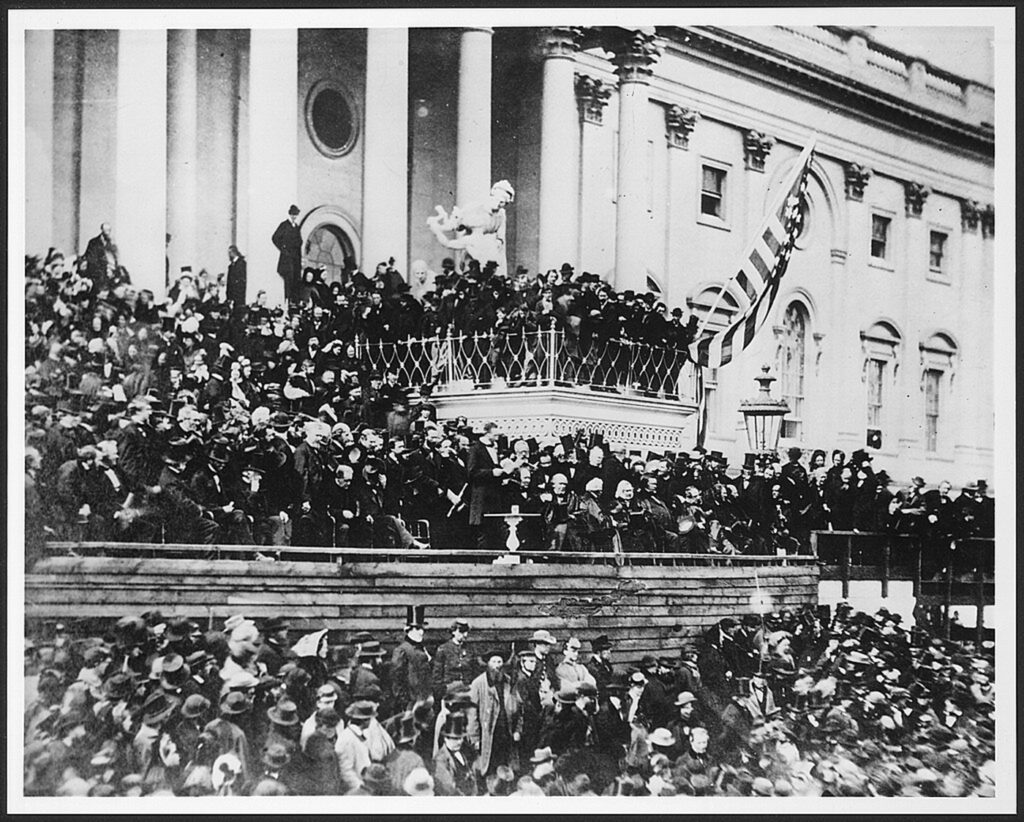
In the wake of his reelection, Abraham Lincoln delivered his second inaugural address on March 4, 1865, in which he concluded in soaring rhetoric:
With malice toward none; with charity for all; with firmness in the right, as God gives us to see the right, let us strive on to finish the work we are in; to bind up the nation’s wounds; to care for him who shall have borne the battle, and for his widow, and his orphan—to do all which may achieve and cherish a just, and a lasting peace, among ourselves, and with all nations.6060
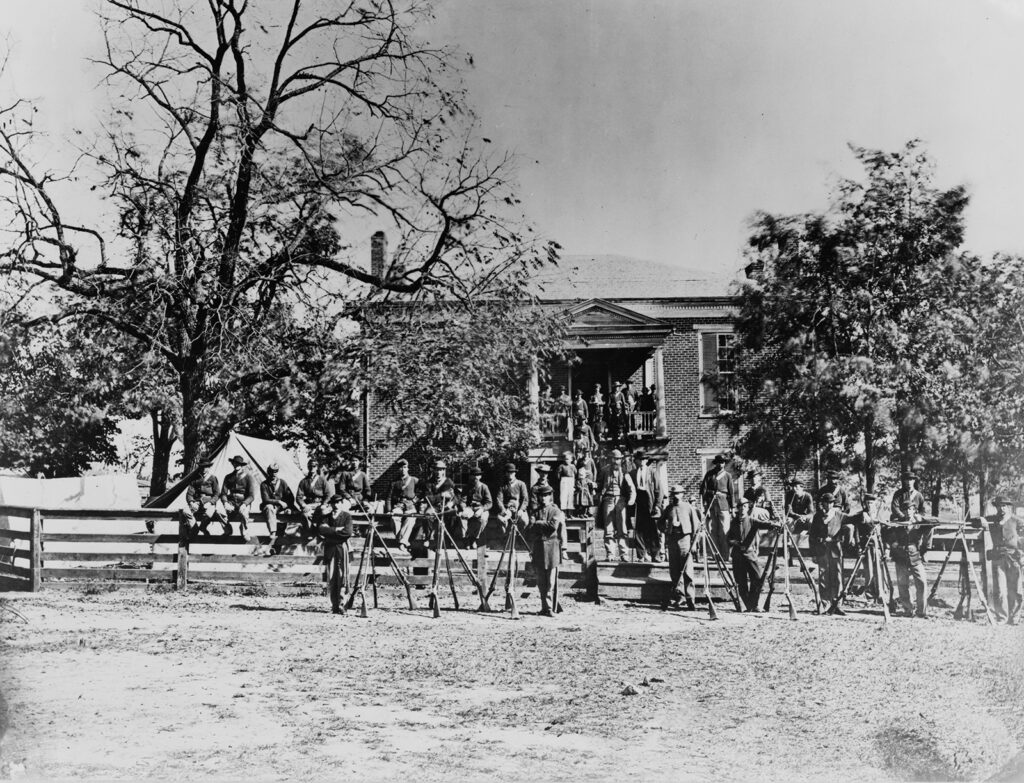
Throughout late 1864 and 1865, the conflict ground on, proving incredibly deadly for both sides. Hard-war Union campaigns in the West and the East destroyed Confederate infrastructure and demonstrated the efficacy of the Union’s strategy. Following his successful capture of Atlanta, William Sherman initiated his March to the Sea in November 1864, arriving in Savannah in time to capture it and deliver it as a Christmas present for Abraham Lincoln. Sherman’s path of destruction took on an even more destructive tone as he moved into the heart of the Confederacy in South Carolina in early 1865. The burning of Columbia, South Carolina, and subsequent capture of Charleston brought the hard hand of war to the birthplace of secession. In the East, Grant’s ever-tightening siege of Petersburg finally forced Lee to abandon his lines and flee south, leaving Richmond to Union forces. After a dogged pursuit, Lee surrendered to Grant at Appomattox Court House on April 9, 1865, ending major Confederate military operations. Peace came at last—at least in theory.61
To ensure the permanent destruction of slavery, Republicans drafted and passed the Thirteenth Amendment during the war. Yet the legal end of slavery did not mean the end of racial injustice. Disease-ridden contraband camps remained even after emancipation. After the war, the Republican Reconstruction program of guaranteeing the rights of Black Americans succumbed to persistent racism and white Southern violence. Long after 1865, most Black Southerners continued to labor on plantations, albeit as nominally free tenants or sharecroppers, while facing public segregation and disfranchisement. Slavery’s effects endured long after abolition.
V. Conclusion
As the guns fell silent in 1865, the question of secession had been answered, slavery had been eradicated, and the Union was territorially restored. But in many ways, the conclusion of the Civil War created more questions than answers. How would the nation become one again? Who was responsible for rebuilding the South? What role would African Americans occupy in this society? Northern and Southern soldiers returned home with broken bodies, broken spirits, and broken minds. Plantation owners had land but not labor. Recently freed African Americans had their labor but no land. Formerly enslaved people encountered a world of possibilities—legal marriage, family reunions, employment, and fresh starts—but also one of prejudice, violence, and limited opportunity. The Civil War may have been over, but the struggle over the peace was just beginning.
VI. Primary Sources
1. Alexander Stephens on slavery and the Confederate constitution, 1861
Confederates had to quickly create not only a government but also a nation, including all of the cultural values required to foster patriotism. In this speech, Alexander Stephens, Vice President of the Confederacy, proclaims that slavery and white supremacy were not only the cause for secession but also the “cornerstone” of the Confederate nation.
2. General Benjamin F. Butler reacts to self-emancipation, 1861
Self-emancipating people posed a dilemma for the Union military. Soldiers were forbidden to interfere with slavery or assist runaways, but many soldiers disobeyed the policy. In May 1861, General Benjamin F. Butler went over his superiors’ heads and began accepting freedom-seeking people who came to Fortress Monroe in Virginia. Butler reasoned that these people were “contraband of war,” and he had as much a right to seize them as he did to seize enemy horses or cannons. Later that summer Congress affirmed Butler’s policy in the First Confiscation Act.
3. William Henry Singleton, a formerly enslaved man, recalls fighting for the Union, 1922
William Henry Singleton was born to his enslaved mother, Lettice, and her enslaver’s brother, William Singleton. At the age of four, he was sold away from his mother but ran back to her several times throughout his life. When the war broke out, he escaped to Union lines and volunteered for service. After being dismissed, he rallied one thousand Black soldiers and received a promotion as a sergeant.
4. Poem about Civil War nurses, 1866
The massive casualty rates of the Civil War meant that nurses were always needed. Women, North and South, left the comforts of home to care for the wounded. Hospital conditions were often so bad that many volunteer nurses quit soon after beginning. After the war, Kate Cumming, a nurse who traveled with the Army of Tennessee, published an account of her experience. She included a poem, written by an unknown author about nursing in the war.
5. Ambrose Bierce recalls his experience at the Battle of Shiloh, 1881
Civil War soldiers described the experience of combat as both terrifying and confusing. The American writer, Ambrose Bierce, captures both the confusion and terror of the Battle of Shiloh in the below excerpt of his 1881 recollections of the battle.
Music played an important role in the Civil War. Songs celebrated the cause, mourned the loss of life, and bound sings together in shared commitments to mutual sacrifice. These two songs, both written by women, one in the North and the other in the South, show the flexibility of Civil War music. The first is an example of the somber, sacralizing function of music, while the latter is an example of a lighthearted attempt at humor.
7. Abraham Lincoln’s second inaugural address, 1865
Abraham Lincoln offered a first draft of history in his second inaugural address, casting the Civil War as a war for union that later became a spiritual process of national penance for two hundred and fifty years of slaveholding. Lincoln also looked to the future, envisioning a harmonious and speedy Reconstruction that would take place “with malice toward none” and “with charity for all.”
8. Civil War nurses illustration, 1864
The Civil War ultimately opened a variety of arenas for Union and Confederate women’s participation. In the North, the United States Sanitary Commission in particular centralized women’s opportunities to volunteer as nurses, donate supplies, and to raise funds at Sanitary Fairs. This 1864 image from popular periodical Harper’s Weekly celebrates women’s contributions on the battlefield, in the hospital, in the parlor, and at the fair.
9. Burying the dead photograph, 1865
Death pervaded every aspect of life during the years of the Civil War. This gruesome photograph, taken after the battle of Cold Harbor, shows the hasty burial procedures used to reckon with unprecedented death. Dirty jobs like this were often left to Black soldiers or freedpeople in Contraband Camps.
VII. Reference Material
This chapter was edited by Frank Cirillo, with content contributions by Thomas Balcerski, William Black, Lauren Brand, Frank Cirillo, Angela Esco Elder, Matthew C. Hulbert, Brenda Lakhani, Andrew F. Lang, Lindsay Stallones Marshall, John Patrick Riley, Angela Riotto, Gregory N. Stern, Emma Teitelman, David Thomson, Ann Tucker, Ben Wright, Caroline Wright, and Rebecca Zimmer.
Recommended Reading
• Ayers, Edward L. In the Presence of Mine Enemies: War in the Heart of America, 1859–1863. Norton, 2003.
• Berry, Stephen, ed. Weirding the War: Stories from the Civil War’s Ragged Edges. University of Georgia Press, 2011.
• Blight, David. Race and Reunion: The Civil War in American Memory. Harvard University Press, 2001.
• Brasher, Glenn David. The Peninsula Campaign and the Necessity of Emancipation: African Americans and the Fight for Freedom. University of North Carolina Press, 2012.
• Carwadine, Richard. Righteous Strife: How Warring Religious Nationalists Forged Lincoln’s Union. Knopf, 2025.
• Devine, Shauna. Learning from the Wounded: The Civil War and the Rise of American Medical Science. University of North Carolina Press, 2014.
• Fahs, Alice. The Imagined Civil War: Popular Literature of the North and South, 1861–1865. University of North Carolina Press, 2003.
• Faust, Drew Gilpin. This Republic of Suffering: Death and the American Civil War. Knopf, 2008.
• Gannon, Barbara A. The Won Cause: Black and White Comradeship in the Grand Army of the Republic. University of North Carolina Press, 2005.
• Glymph, Thavolia. The Women’s Fight: The Civil War’s Battles for Home, Freedom, and Nation. University of North Carolina Press, 2020.
• Grimsley, Mark. The Hard Hand of War: Union Military Policy Towards Southern Civilians, 1861–1865. Cambridge University Press, 1995.
• Hulbert, Matthew C. The Ghosts of Guerrilla Memory: How Civil War Bushwhackers Became Gunslingers in the American West. University of Georgia Press, 2016.
• Janney, Caroline E. Remembering The Civil War: Reunion and the Limits of Reconciliation. University of North Carolina Press, 2013.
• Jones, Howard. Blue and Gray Diplomacy: A History of Union and Confederate Foreign Relations. University of North Carolina Press, 2010.
• Lang, Andrew F. A Contest of Civilizations: Exposing the Crisis of American Exceptionalism in the Civil War Era. University of North Carolina Press, 2022.
• Manning, Chandra. What This Cruel War Was Over: Soldiers, Slavery, and the Civil War. Knopf, 2007.
• McCurry, Stephanie. Confederate Reckoning: Power and Politics in the Civil War South. Harvard University Press, 2012.
• McPherson, James. Battle Cry of Freedom: The Civil War Era. Oxford University Press, 1988.
• Meier, Kathryn Shively. Nature’s Civil War: Common Soldiers and the Environment in 1862 Virginia. University of North Carolina Press, 2013.
• Nelson, Megan Kate. Ruin Nation: Destruction and the American Civil War. University of Georgia Press, 2012.
• Richardson, Heather Cox. The Greatest Nation of the Earth: Republican Economic Policies During the Civil War. Harvard University Press, 1997.
• Sheehan-Dean, Aaron. The Calculus of Violence: How Americans Fought the Civil War. Harvard University Press, 2018.
• Taylor, Amy Murrell. Embattled Freedom: Journeys through the Civil War’s Slave Refugee Camps. University of North Carolina Press, 2020.
• Varon, Elizabeth. Armies of Deliverance: A New History of the Civil War. Oxford University Press, 2019.
• Whites, LeeAnn. The Civil War as a Crisis in Gender: Augusta, Georgia, 1860–1890. University of Georgia Press, 2000.
Notes
- This most recent estimation of 698,000 wartime deaths was put forward by Joan Barceló, Jeffrey L. Jensen, Leonic Peisakhin, and Haoyu Zhai, “New Estimates of US Civil War Mortality from Full-Census Records,” Proceedings of the National Academy of Sciences 121, no. 48 (2024): e2414919121, https://doi.org/10.1073/pnas.2414919121.[↩]
- Proceedings of the Conventions at Charleston and Baltimore: Published by Order of the National Democratic Convention (Washington, DC, 1860).[↩]
- William J. Cooper, We Have the War upon Us: The Onset of the Civil War, November 1860–April 1861 (Knopf, 2012), 14.[↩]
- “A Declaration of the Immediate Causes Which Induce and Justify the Secession of South Carolina from the Federal Union,” January 9, 1861, Avalon Project, Yale Law School, http://avalon.law.yale.edu/19th_century/csa_scarsec.asp.[↩]
- Alexander Stephens, speech in Savannah, Georgia, delivered March 21, 1861, quoted in Henry Cleveland, Alexander Stephens, in Public and Private. With Letters and Speeches Before, During and Since the War (Philadelphia, 1866), 719.[↩]
- “Declaration of the Immediate Causes.”[↩]
- For Confederate nationalism and imperial goals, see Adrian Brettle, Colossal Ambitions: Confederate Planning for a Post-Civil War World (University of Virginia Press, 2000); Andrew F. Lang, A Contest of Civilizations: Exposing the Crisis of American Exceptionalism in the Civil War Era (University of North Carolina Press, 2000); Kevin Waite, West of Slavery: The Southern Dream of a Transcontinental Empire (University of North Carolina Press, 2021).[↩]
- See Jon L. Wakelyn, ed., Southern Unionist Pamphlets and the Civil War (University of Missouri Press, 1999).[↩]
- Steven Hahn, The Political Worlds of Slavery and Freedom (Harvard University Press, 2009), 55–114; David Williams, I Freed Myself: African American Self-Emancipation in the Civil War Era (Cambridge University Press, 2014).[↩]
- Horace Greeley, The American Conflict: A History of the Great Rebellion in the United States of America, 1860–1864, Volume 1 (Hartford, CT, 1864), 366–67.[↩]
- Abraham Lincoln, “Inaugural Address,” March 4, 1861, Abraham Lincoln Papers, Library of Congress, Washington, DC.[↩]
- For Northern motivations, see Gary W. Gallagher, The Union War (Harvard University Press, 2011); Elizabeth R. Varon, Armies of Deliverance: A New History of the Civil War (Oxford University Press, 2019); Lang, A Contest of Civilizations. For conservative Northerners and the Union war, see Adam I. P. Smith, The Stormy Present: Conservatism and the Problem of Slavery in Northern Politics, 1846–1865 (University of North Carolina Press, 2017); Jack Furniss, Between Extremes: Seeking the Political Center in the Civil War North (Louisiana State University Press, 2024).[↩]
- Lincoln to Orville Browning, September 22, 1861, Abraham Lincoln Papers, Library of Congress, Washington, DC.[↩]
- For democratic activists, see W. Caleb McDaniel, The Problem of Democracy in the Age of Slavery: Garrisonian Abolitionists and Transatlantic Reform (Louisiana State University Press, 2013). For foreign powers, see Richard Blackett, Divided Hearts: Britain and the American Civil War (Louisiana State University Press, 2001); Stève Sainlaude, France and the American Civil War: A Diplomatic History (University of North Carolina Press, 2019).[↩]
- See David W. Blight, Frederick Douglass: Prophet of Freedom (Simon & Schuster, 2018); Brian M. Taylor, Fighting for Citizenship: Black Northerners and the Debate over Military Service in the Civil War (University of North Carolina Press, 2020).[↩]
- Excerpt from Benjamin F. Butler to Lieutenant General Winfield Scott, May 27, 1861, B-99 1861, Letters Received Irregular, Secretary of War, Record Group 107, National Archives, Washington, DC, http://www.freedmen.umd.edu/Butler.html. For Lincoln’s conservative war aims, see Daniel W. Crofts, Lincoln and the Politics of Slavery: The Other Thirteenth Amendment and the Struggle to Save the Union (University of North Carolina Press, 2016). For a different interpretation of Lincoln as a willing and eager emancipator, see James Oakes, The Crooked Path to Abolition: Abraham Lincoln and the Antislavery Constitution (W. W. Norton, 2021); Kate Masur, Until Justice Be Done: America’s First Civil Rights Movement to Reconstruction (W. W. Norton, 2021).[↩]
- “The Slave Question; Letter from Major-Gen. Butler on the Treatment of Fugitive Slaves,” New York Times, August 6, 1861.[↩]
- See Chandra Manning, Troubled Refuge: Struggling for Freedom in the Civil War (Knopf, 2016); Amy Murrell Taylor, Embattled Freedom: Journeys through the Civil War’s Slave Refugee Camps (University of North Carolina Press, 2018).[↩]
- Glenn David Brasher, The Peninsula Campaign and the Necessity of Emancipation: African Americans and the Fight for Freedom (University of North Carolina Press, 2012), 81–83.[↩]
- Heather Cox Richardson, The Greatest Nation of the Earth: Republican Economic Policies During the Civil War (Harvard University Press, 1997).[↩]
- David K. Thomson, Bonds of War: How Civil War Financial Agents Sold the World on the Union (University of North Carolina Press, 2022).[↩]
- See Mark E. Neely Jr., Lincoln and the Democrats: The Politics of Opposition in the Civil War (Cambridge University Press, 2017); J. Matthew Gallman, The Cacophony of Politics: Northern Democrats and the American Civil War (University of Virginia Press, 2021); Furniss, Between Extremes.[↩]
- For literacy rates within the armies, see Bell Irvin Wiley, The Life of Billy Yank: The Common Soldier of the Union (Bobbs-Merrill, 1952), 304–6; Bell Irvin Wiley, The Life of Johnny Reb: The Common Soldier of the Confederacy (Bobbs-Merrill, 1943), 335–37.[↩]
- Frances M. Clarke and Rebecca Jo Plant, Of Age: Boy Soldiers and Military Power in the Civil War Era (Oxford University Press, 2023).[↩]
- See Judkin Browning and Timothy Silver, An Environmental History of the Civil War (University of North Carolina Press, 2020).[↩]
- For more on music in the Civil War, see Christian McWhirter, Battle Hymns: The Power and Popularity of Music in the Civil War (University of North Carolina Press, 2012).[↩]
- See Gary W. Gallagher, ed., The Richmond Campaign of 1862: The Peninsula Campaign and the Seven Days (University of North Carolina Press, 2000); Ethan S. Rafuse, McClellan’s War: The Failure of Moderation in the Struggle for the Union (Indiana University Press, 2005).[↩]
- Steven E. Woodworth, ed., The Shiloh Campaign (Southern Illinois University Press, 2009).[↩]
- See Andrew E. Masich, Civil War in the Southwest Borderlands: 1861–1867 (University of Oklahoma Press, 2017); Megan Kate Nelson, The Three-Cornered War: The Union, the Confederacy, and Native Peoples in the Fight for the West (Scribner, 2020); Waite, West of Slavery.[↩]
- Alvin M. Josephy Jr., The Civil War in the American West (Knopf, 1992), 330.[↩]
- Laurence M. Hauptman, Between Two Fires: American Indians in the Civil War (Simon & Schuster, 1996); Fay A. Yarbrough, Choctaw Confederates: The American Civil War in Indian Country (University of North Carolina Press).[↩]
- Robert Utley, The Indian Frontier 1846–1890 (University of New Mexico Press, 1984), 76.[↩]
- “Treaty with the Sioux—Sisseton and Wahpeton Bands, 1851,” in Charles J. Kappler, ed., Indian Affairs: Law and Treaties, vol. 2 (Government Printing Office, 1904), 588–89.[↩]
- Mary Butler Renville, A Thrilling Narrative of Indian Captivity: Dispatches from the Dakota War (University of Nebraska Press, 2012), 268n188.[↩]
- Jeffrey Ostler, The Plains Sioux and U.S. Colonialism from Lewis and Clark to Wounded Knee (Cambridge University Press, 2004).[↩]
- Gary Clayton Anderson, Massacre in Minnesota: The Dakota War of 1862, the Most Violent Ethnic Conflict in American History (University of Oklahoma Press, 2019).[↩]
- Elliott West, The Contested Plains: Indians, Goldseekers, and the Rush to Colorado (Kansas University Press, 1998).[↩]
- Brasher, The Peninsula Campaign.[↩]
- See Stanley Harrold, American Abolitionism: Its Direct Political Impact from Colonial Times into Reconstruction (University of Virginia Press, 2019); Frank J. Cirillo, The Abolitionist Civil War: Immediatists and the Struggle to Transform the Union (Louisiana State University Press, 2023).[↩]
- Emancipation Proclamation, January 1, 1863, Presidential Proclamations, 1791–1991, Record Group 11, General Records of the United States Government, National Archives, Washington, DC.[↩]
- Lincoln to Ulysses S. Grant, August 9, 1863, Abraham Lincoln Papers, Library of Congress, Washington, DC.[↩]
- James Henry Gooding to Abraham Lincoln, September 28, 1863, Abraham Lincoln Papers, Library of Congress, Washington, DC.[↩]
- James McPherson, Battle Cry of Freedom: The Civil War Era (Oxford University Press, 1988), 862.[↩]
- See Stephen Kantrowitz, More Than Freedom: Fighting for Black Citizenship in a White Republic, 1829–1889 (Penguin, 2012); Taylor, Fighting for Citizenship.[↩]
- See Kevin Levin, Searching for Black Confederates: The Civil War’s Most Persistent Myth (University of North Carolina Press, 2019).[↩]
- See Eugene C. Murdock, One Million Men: The Civil War Draft in the North (State Historical Society of Wisconsin, 1971).[↩]
- Ivar Bernstein, The New York City Draft Riots: Their Significance for American Society and Politics in the Age of the Civil War (Oxford University Press, 1991).[↩]
- Laura Edwards, Scarlett Doesn’t Live Here Anymore: Southern Women in the Civil War Era (University of Illinois Press, 2000), 85. Also see Stephanie McCurry, Confederate Reckoning: Power and Politics in the Civil War South (Harvard University Press, 2012).[↩]
- Quoted in Heidi Schoof, Elizabeth Van Lew: Civil War Spy (Compass Books, 2006), 85.[↩]
- Elizabeth Varon, Southern Lady, Yankee Spy: The True Story of Elizabeth Van Lew, a Union Agent in the Heart of the Confederacy (Oxford University Press, 2003).[↩]
- Shauna Devine, Learning from the Wounded: The Civil War and the Rise of American Medical Science (University of North Carolina Press, 2014), 70–71.[↩]
- Emma Edwards, Nurse and Spy in the Union Army: Comprising the Adventures and Experiences of a Woman in Hospitals, Camps, and Battle-Fields (Hartford, CT, 1865), 6.[↩]
- C. Vann Woodward, ed., Mary Chesnut’s Civil War (Yale University Press, 1981), 85.[↩]
- Woodward, Mary Chesnut’s Civil War, 158.[↩]
- Drew Gilpin Faust, This Republic of Suffering: Death and the American Civil War (Knopf, 2008).[↩]
- Sally Randle Perry, November 30, 1867, Sally Randle Perry Diary, 1867–1868, Alabama Department of Archives and History, Montgomery, Alabama.[↩]
- LeeAnn Whites, The Civil War as a Crisis in Gender: Augusta, Georgia, 1860–1890 (University of Georgia Press, 2000), 93–95.[↩]
- Adam I. P. Smith, No Party Now: Politics in the Civil War North (Oxford University Press, 2006).[↩]
- Presidential Elections, 1789–2008 (CQ, 2010), 135, 225.[↩]
- Abraham Lincoln, Second Inaugural Address; endorsed by Lincoln, April 10, 1865, March 4, 1865, General Correspondence, 1837–1897, The Abraham Lincoln Papers, Library of Congress, Manuscript Division, Washington, DC.[↩]
- Books discussing the weeks and months after Appomattox as a time of uncertainty and upheaval include Elizabeth Varon, Appomattox: Victory, Defeat, and Freedom at the End of the Civil War (Oxford University Press, 2013); and Caroline Janney, Ends of War: The Unfinished Fight of Lee’s Army After Appomattox (University of North Carolina Press, 2021).[↩]