John White, “Village of the Secotan, 1585, via Wikimedia.
Introduction
Millions of Indigenous people called the Americas home long before Europeans arrived. By the time Europeans crossed the Atlantic, Native people spoke hundreds of languages, built diverse political systems, created cultures adapted to hundreds of distinct environments—human beings lived and loved and lost. Kinship ties knit ancient Indigenous communities together over distance, time, and space. Each community possessed unique art forms and spiritual practices and participated in extensive trade networks where they exchanged items such as salt, pottery, shell jewelry, and even bison meat. Political units ranged from small family units to vast empires. These continents teemed with life. The historians who study these people do so by recording oral testimony from Indigenous people as well as using the tools of science to analyze the natural world and material culture of these ancient communities.
Documents
Richard Hakluyt used this document to persuade Queen Elizabeth I to devote more money and energy into encouraging English colonization. In twenty-one chapters, summarized here, Hakluyt emphasized the many benefits that England would receive by creating colonies in the Americas.
Thomas Morton both admired and condemned aspects of Native American culture. In his descriptions, we can find not only information about the people he is describing but also a window into the concerns of Englishmen like Morton who could use descriptions of Native Americans as a means of criticizing English culture.
The journey across the Atlantic was difficult at best and deadly at worst. Francis Pastorius left his home in Germany to create a new life in Pennsylvania. This account shows the discomforts and dangers of oceanic travel in the seventeenth century.
John Winthrop delivered the following sermon before he and his fellow settlers reached New England. The sermon is famous largely for its use of the phrase “a city on a hill,” used to describe the expectation that the Massachusetts Bay colony would shine like an example to the world. But Winthrop’s sermon also reveals how he expected Massachusetts to differ from the rest of the world.
John Lawson took detailed notes on the various peoples he encountered during his exploration of the Carolinas. Lawson recorded many aspects of Native American life and even noticed the progress of disease as it swept through native communities.
Chrestien Le Clercq traveled to New France as a missionary, but found that many Native Americans were not interested in adopting European cultural practices. In this document, LeClercq records the words of a Gaspesian man who explained why he believed that his way of life was superior to Le Clercq’s.
In 1731, Manuel Trujillo accused two Pueblo men, Acensio Povia and Antonio Yuba, of committing sodomy. Both Povia and Yuba denied this accusation, and Yuba invoked his status as a Christian in order to bolster his credibility. Governor Gervasio Cruzat y Góngora chose to exile Povia and Yuba to different pueblos for a period of four months, during which time they were to cease any and all communication with one another. This case explores sexual practices deemed “nefarious sins” as well as illustrates what scholars have called the colonial dilemma—the situation where Indigenous peoples remained in a subjected state despite theological equality following their Christian conversion.
Media
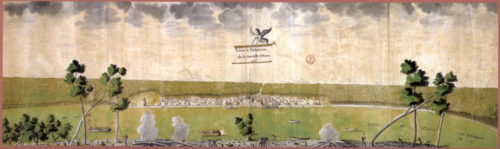
Jean-Pierre Lassus, “Veüe et Perspective de la Nouvelle Orleans,” 1726, Centre des archives d’outre-mer, France via Wikimedia. During the contact period, the frontier was constantly shifting and places that are now considered old were once tenuous settlements. This watercolor painting depicts New Orleans in 1726 when it was an 8-year-old French frontier settlement, nearly forty years prior to the Spanish acquisition of the Louisiana territory. In the foreground, enslaved Africans fell trees on land belonging to the Company of the Indies, and another enslaved man spears a massive alligator. Land has been cleared only just beyond the town limits and a wooden palisade provides meager protection from competing European empires.
John White, “Village of the Secotan, 1585, via Wikimedia. Native settlements were usually organized around political, economic, or religious activity. John White shows this Algonquin community engaged in some kind of celebration across from the fire he identified as “The place of solemne prayer,” indicating that ceremonial activity could be both solemn and raucous. In the center of the image, a communal meal has been laid alongside crops that are in varying stages of growth, suggesting the use of planting techniques like crop rotation. He also shows the interior of several longhouses, made of bent saplings and covered with bark and woven maps. Among the Powhatan, similar structures were called yehakins. In putting the longhouses and the settlement in a series of rows, White’s English perspective comes through: archaeological evidence shows that these houses were usually situated around communal gathering places or moved next to fields under cultivation not ordered in European-style rows.