
Cantino planisphere (1502), Biblioteca Estense, Modena, Italy. Wikimedia.
Introduction
Millions of Indigenous people called the Americas home long before Europeans arrived. By the time Europeans crossed the Atlantic, Native people spoke hundreds of languages, built diverse political systems, created cultures adapted to hundreds of distinct environments—human beings lived and loved and lost. Kinship ties knit ancient Indigenous communities together over distance, time, and space. Each community possessed unique art forms and spiritual practices and participated in extensive trade networks where they exchanged items such as salt, pottery, shell jewelry, and even bison meat. Political units ranged from small family units to vast empires. These continents teemed with life. The historians who study these people do so by recording oral testimony from Indigenous people as well as using the tools of science to analyze the natural world and material culture of these ancient communities.
Documents
First encounters between Europeans and Native Americans were dramatic events. In this account, we see the assumptions and intentions of Christopher Columbus, as he immediately began assessing the potential of these people to serve European economic interests. He also predicted easy success for missionaries seeking to convert these people to Christianity.
King Alfonso I of the Kingdom of Kongo wrote this letter to King João III of Portugal in 1526. Alfonso wanted the King of Portugal to help stop the widespread practice of kidnapping and selling free people into Atlantic markets.
This source aggregates a number of early written reports by Aztec authors describing the destruction of Tenochtitlan at the hands of a coalition of Spanish and Indigenous armies. This collection of sources was assembled by Miguel Leon Portilla, a Mexican anthropologist.
Bartolomé de Las Casas, a Spanish Dominican priest, wrote directly to the King of Spain hoping for new laws to prevent the brutal exploitation of Native Americans. Las Casas’s writings quickly spread around Europe and were used as humanitarian justification for other European nations to challenge Spain’s colonial empire with their own schemes of conquest and colonization.
The Coronado expedition laid siege to a Native town in the Southwest. This account reveals both Indigenous resistance and the devastating violence of Spanish conquest.
Cuauhtlatoatzin was one of the first Aztec men to convert to Christianity after the Spanish invasion. Renamed as Juan Diego, he soon thereafter reported an appearance of the Virgin Mary called the Virgin of Guadalupe. This apparition became an important symbol for a new native Christianity. These excerpts are translated from an account first published in Nahuatl by Luis Lasso de la Vega in 1649.
Spanish explorer, Alvar Nuñez Cabeza de Vaca, traveled across the Gulf South, from Florida to Mexico. As he traveled, Cabeza de Vaca developed a reputation as a faith healer. In his account he claimed several instances of performing miracles, illustrating his spiritual beliefs as well as offering a rare, if perhaps unreliable, glimpse at the life of Native Americans in the area.
Media
Map of the Atlantic World
Cantino planisphere (1502), Biblioteca Estense, Modena, Italy. Wikimedia.
By the fifteenth century, the Portuguese had established forts and colonies on islands and along the rim of the Atlantic Ocean; other major European countries soon followed. An anonymous cartographer created this map, known as the Cantino Map, the earliest known map of European exploration in the New World, to depict these holdings and argue for the greatness of his native Portugal. Cantino planisphere (1502), Biblioteca Estense, Modena, Italy. Wikimedia.
Casta Painting
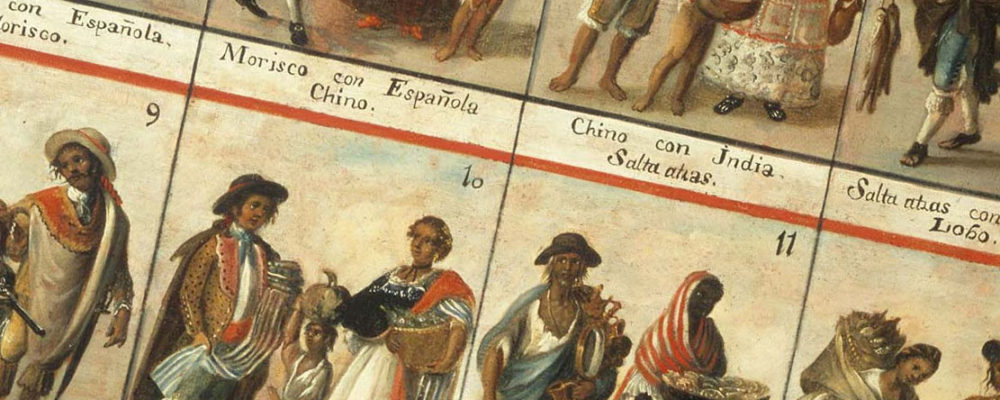
Unknown artist, “Las Castas,” Museo Nacional del Virreinato, Tepotzotlan, Mexico, via Wikimedia.
The elaborate Sistema de Castas revealed one of the less-discussed effects of Spanish conquest: sexual liaisons and their progeny. Casta paintings illustrated the varying degrees of intermixture between colonial subjects, defining them for Spanish officials. Race was less fixed in the Spanish colonies, as some individuals, through legal action or colonial service, “changed” their race in the colonial records. Though this particular image does not, some casta paintings attributed particular behaviors to different groups, demonstrating how class and race were intertwined.