![This anti-Catholic print depicts Catholic priests arriving by boat and then threatening Uncle Sam and a young Protestant boy who holds out a Bible in resistance. N. Currier, “The Propagation Society, More Free than Welcome,” 1855, http://www.loc.gov/pictures/item/2003656589/. An anti-Catholic cartoon, reflecting the nativist perception of the threat posed by the Roman Church's influence in the United States through Irish immigration and Catholic education. The invading Catholics have speech bubbles which say, "Only let us get a good foothold on the soil and we'll burn up those [uncldar] and elevate this country to the same degree of happiness and prosperity to which we have brought Italy, Spain, Ireland, and many other lands." "Soverign pontiff say that if his friends have any money when he dies, they may purchase a hole for him in my cemetery at a fair price." "I cannot bear to see that boy with that horrible book [the Bible]" "Go ahead Reverend Father, I'll hold our boat by this sprig of shamrock." "My friend we have concluded to take charge of your spiritual welfare and your temporal estate, so that you need not be troubled with the care of them in future, we will say your prayers and spend your money while you live and bury you in the Potters Field when you die. Revel then, and kiss our big toe in token of submission. The boy and man on the shore respond, "You can neither coax nor frighten our boys, Sir! We can take care of our own worldly affairs and are determined to know nothing but this book [the Bible] to guide us in spiritual things." The man adds, "No you don't Mr. Pope! You're altogether [unclear] but you can't put the mark of the beast on Americans!"](http://www.americanyawp.com/reader/wp-content/uploads/headernoborders.jpg)
N. Currier, “The Propagation Society, More Free than Welcome,” 1855, via Library of Congress.
Introduction
In the early years of the nineteenth century, Americans’ endless commercial ambition—what one Baltimore paper in 1815 called an “almost universal ambition to get forward”—remade the nation. Steam power, the technology that moved steamboats and railroads, fueled the rise of American industry by powering mills and sparking new national transportation networks. More and more farmers grew crops for profit, not self-sufficiency. Vast factories and cities arose in the North. As northern textile factories boomed, the demand for southern cotton swelled, and the institution of American slavery accelerated. The market revolution sparked not only explosive economic growth and new personal wealth but also devastating depressions—“panics”—and a growing lower class of property-less workers. Many Americans labored for low wages and became trapped in endless cycles of poverty. Although northern states gradually abolished slavery, their factories fueled the demand for slave-grown southern cotton that ensured the profitability and continued existence of the American slave system. And so, as the economy advanced, the market revolution wrenched the United States in new directions as it became a nation of free labor and slavery, of wealth and inequality, and of new promise and peril. These sources illustrate how the market revolution transformed how Americans worked, traveled, politicked, and even loved.
Documents
1. James Madison asks Congress to support internal improvements, 1815
2. A traveler describes life along the Erie Canal, 1829
3. Harriet H. Robinson remembers a mill workers’ strike, 1836
4. Missouri controversy documents, 1819-1820
5. President Monroe outlines the Monroe Doctrine, 1823
6. Letters from Venezuelan General Francisco de Miranda regarding Latin American Revolution, 1805-1806
7. Rebecca Burlend recalls her emigration from England to Illinois, 1848
Media
County Election Painting, 1854
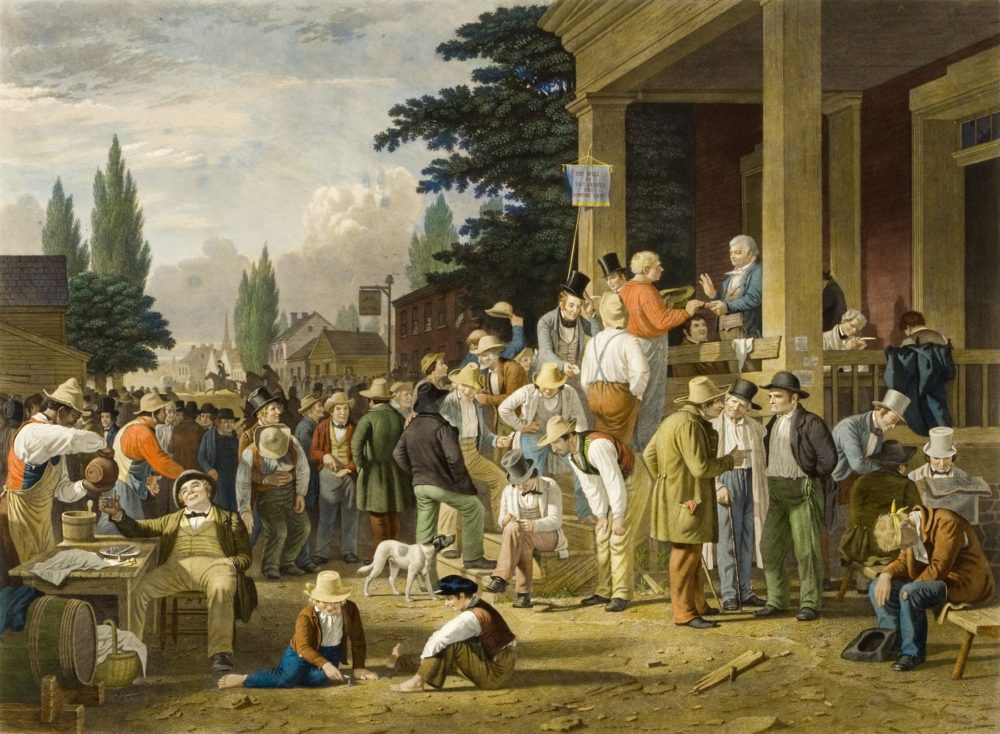
George Caleb Bingham, “The County Election,” 1854, via Reynolda House Museum of American Art.
Beginning in the late 1840s, George Caleb Bingham created a series of paintings illustrating American democracy. He was drawn to the energy and near-chaos of speeches, rallies, election days, public announcements of voting results and more. Prior to painting this work, Bingham himself ran for state office in Missouri as a Whig. Here he shows the tumult of a county election day. Children play games, drunkards raise their glass (while political operatives drag inebriated men to the poll), citizens carefully debate the issues, while others study the newspaper. Art historians argue whether Bingham is celebrating or mocking American democracy.
The Fruit of Alcohol and Temperance Lithographs, 1849
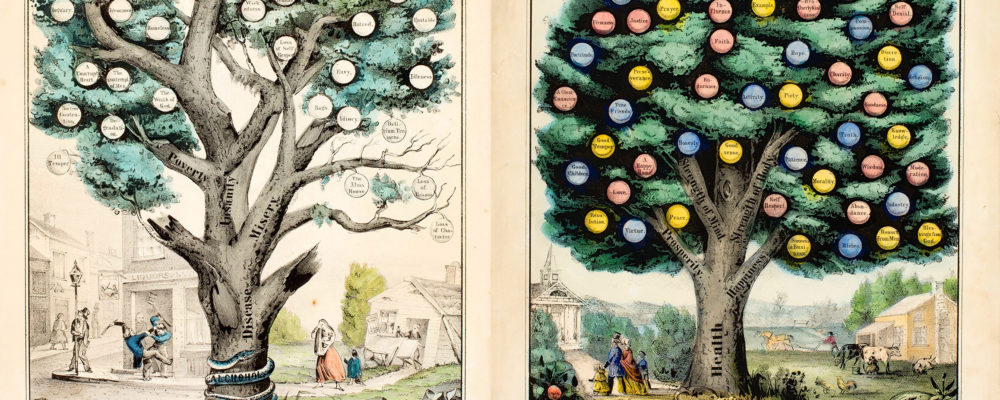
N. Currier, “Tree of Temperance” and “Tree of Intemperance,” 1849, via American Antiquarian Society.
This pair of lithographs, created by Nathaniel Currier (later of Currier & Ives fame), contrasts the “fruits” of abstaining from alcohol to those of indulging in strong drink. It leaves little to the imagination. Intemperance is symbolized by a diseased tree, surrounded by drunks outside of a pawn shop and a woman and her children being thrown out of their home. The lush foliage of temperance, on the other hand, is surrounded by prosperous church-going farm families.