Introduction
The early nineteenth century was a period of great optimism, with the possibilities of self-governance infusing everything from religion to politics. Yet it was also a period of great discord, as the benefits of industrialization and democratization increasingly accrued along starkly uneven lines of gender, race, and class. Westward expansion distanced urban dwellers from frontier settlers more than ever before, even as the technological innovations of industrialization—like the telegraph and railroads—offered exciting new ways to maintain communication. The spread of democracy opened the franchise to nearly all white men, but urbanization and a dramatic influx of European migration increased social tensions and class divides. Americans looked on these changes with a mixture of enthusiasm and suspicion, wondering how the moral fabric of the new nation would hold up against emerging social challenges. Increasingly, many turned to two powerful tools to help understand and manage the various transformations: spiritual revivalism and social reform. These sources illustrate how religion and reform encouraged Americans to dream of a better nation and a better world.
Documents
David Walker was the son of an enslaved man and a free Black woman. He traveled widely before settling in Boston where he worked in and owned clothing stores and involved himself in various reform causes. In 1829, he wrote the remarkable Appeal to the Colored Citizens of the World. In it, he exposed the hypocrisies of American claims of freedom and Christianity, attacked the plan to colonize Black Americans in Africa, and predicted that God’s justice promised violence for the enslaving United States.
William Lloyd Garrison participated in reform causes in Massachusetts from a young age. In the 1820s he advocated Black colonization in Africa and the gradual abolition of slavery. Reading the work of Black northerners like David Walker changed his mind. In 1831, he created a newspaper, called The Liberator. The following is the opening essay that Garrison used to explain the purpose of his paper.
In August, 1831, Nat Turner led a group of enslaved and free Black men in a rebellion that killed over fifty white men, women, and children. Nat Turner understood his rebellion as an act of God. While he awaited trial, Turner spoke with the white attorney, Thomas Ruffin Gray, who wrote their conversations into the following document.
Maria Stewart electrified audiences in Boston with a number of powerful speeches. Her most common theme was the evil of slavery. However, here she attacks the soul-crushing consequences of racism in American capitalism, claiming that the lack of social and economic equality doomed Black Americans to a life of suffering and spiritual death.
President Andrew Jackson, like Thomas Jefferson before him, was highly suspicious of the Bank of the United States. He blamed the bank for the Panic of 1819 and for corrupting politics with too much money. After congress renewed the bank charter, Jackson vetoed the bill. The following was the message he gave to congress after issuing his veto. Jackson’s decision was controversial. Some Americans accused him of acting like a dictator to redistribute wealth. Others saw the act as an attack on a corrupt system that only favored the rich.
Harriet Jacobs was born into slavery in North Carolina. After escaping to New York, Jacobs eventually wrote a narrative of her enslavement under the pseudonym of Linda Brent. In this excerpt Jacobs explains her experience struggling with sexual assault from her enslaver.
Native Americans responded differently to the constant encroachments and attacks of American settlers. Some resisted violently. Others worked to adapt to American culture and defend themselves using particularly American weapons like lawsuits and petitions. The Cherokee did more to adapt than perhaps any other Native American group, creating a written constitution modeled off the American constitution and adopting American culture in dress, speech, religion and economic activity. In this document, Cherokee leaders protested the loss of their territory using a very American tactic: petitioning.
Media
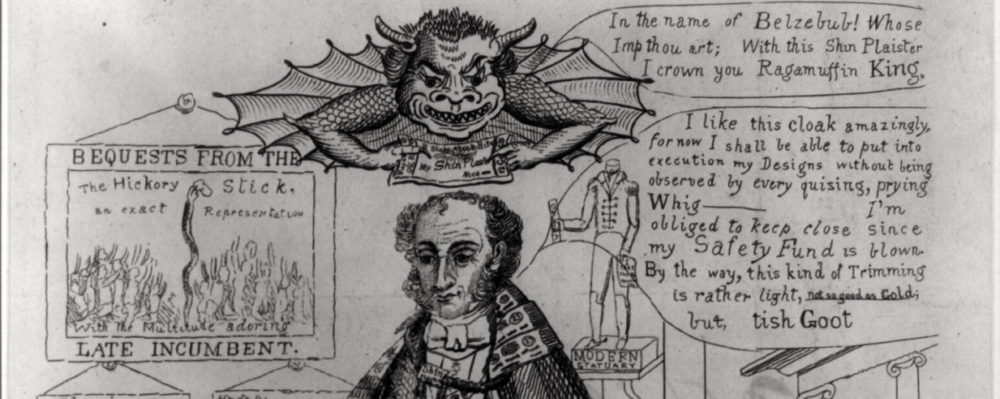
This caricature of President Martin Van Buren cloaked in worthless bank notes was created during the Panic of 1837. The artist mocks Van Buren and the policies of his predecessor, Andrew Jackson. The cartoon includes mentions to Jackson’s “Specie Circular,” an order that government officials only accept gold or silver as payment for land and Van Buren’s “Safety Fund,” a program designed to offset the damage of bank failures. A document labeled “Indian claims” also refers to Jackson’s policy of Indian Removal. These and other subtle details reveal the anxieties of economic collapse and the policy differences between Democrats and Whigs.
Irish immigration transformed American cities. Yet many Americans greeted the new arrivals with suspicion or hostility. Nathanial Currier’s anti-Catholic cartoon reflected the popular American perception that Irish Catholic immigrants posed a threat to the United States.
![This anti-Catholic print depicts Catholic priests arriving by boat and then threatening Uncle Sam and a young Protestant boy who holds out a Bible in resistance. N. Currier, “The Propagation Society, More Free than Welcome,” 1855, http://www.loc.gov/pictures/item/2003656589/. An anti-Catholic cartoon, reflecting the nativist perception of the threat posed by the Roman Church's influence in the United States through Irish immigration and Catholic education. The invading Catholics have speech bubbles which say, "Only let us get a good foothold on the soil and we'll burn up those [uncldar] and elevate this country to the same degree of happiness and prosperity to which we have brought Italy, Spain, Ireland, and many other lands." "Soverign pontiff say that if his friends have any money when he dies, they may purchase a hole for him in my cemetery at a fair price." "I cannot bear to see that boy with that horrible book [the Bible]" "Go ahead Reverend Father, I'll hold our boat by this sprig of shamrock." "My friend we have concluded to take charge of your spiritual welfare and your temporal estate, so that you need not be troubled with the care of them in future, we will say your prayers and spend your money while you live and bury you in the Potters Field when you die. Revel then, and kiss our big toe in token of submission. The boy and man on the shore respond, "You can neither coax nor frighten our boys, Sir! We can take care of our own worldly affairs and are determined to know nothing but this book [the Bible] to guide us in spiritual things." The man adds, "No you don't Mr. Pope! You're altogether [unclear] but you can't put the mark of the beast on Americans!"](http://www.americanyawp.com/reader/wp-content/uploads/cropped-1000x398.jpg)