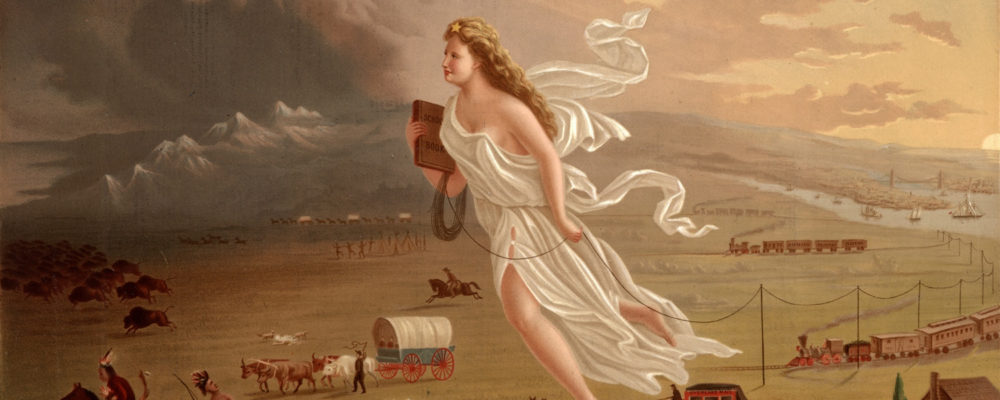
John Gast, American Progress, 1872. Wikimedia .
Introduction
Many Americans believed that the United States was destined to conquer the American continent and perhaps beyond. Other Americans protested these expansions as betrayals of American values. Questions haunted the nation about the role of slavery in the republic, and particularly in the West. The United States struggled to chart the boundaries of equality, slavery, race, gender, and identity, not to mention the actual physical boundaries of the nation. Disagreements on these issues and more divided Americans even as the nation grew in size and strength. These sources explore those disagreements and the dreams that Americans harbored to solve them.
Documents
Antebellum Americans increasingly confined middle-class white women to the home, where they were responsible for educating children and maintaining household virtue. Yet women used these ideas to become more active in the public sphere than ever before, taking prominent roles in all the major reform causes of the era. Women’s participation in the antislavery crusade most directly inspired specific women’s rights campaigns. In this document, Sarah Moore Grimké calls for equality between men and women.
Frederick Douglass was born into slavery in Talbot County, Maryland in 1818. He was separated from his mother in infancy and lived with his grandmother until he was separated from her as well at age seven. After several attempts, he finally successfully escape slavery in 1838. He became one of the most influential abolitionist speakers and before a crowd of white abolitionists in 1852, he delivered this, one of the greatest abolitionist speeches.
As the nineteenth century progressed, some Americans shifted their understanding of slavery from a necessary evil to a positive good. George Fitzhugh offered one of the most consistent and sophisticated defenses of slavery. His study Sociology for the South attacked northern society as corrupt and slavery as a gentle system designed to “protect” the inferior Black race and promote social harmony.
This newspaper editorial articulated the long-standing American belief in the God-given mission of the United States to lead the world in the transition to democracy. He called this America’s “manifest destiny.” This idea motivated wars of American expansion. He explained this idea in the following essay where he advocated adding Texas to the United States.
The experience of migrating west into territory still controlled by Native Americans was difficult and dangerous. In these diary excerpts we find the experience of Amelia Stewart Knight who traveled with her husband and seven children from Iowa to Oregon. She was pregnant the entire trip and gave birth to her eighth child on the side of the road near the journey’s end.
The California Gold Rush of 1849 brought a major influx of Asian immigrants to the new state. This number only grew after railroad companies turned to Chinese laborers to build western railroads. Life for these immigrants was particularly difficult, as even financially successful Chinese immigrants faced considerable discrimination. In 1860, the Chinese merchant Pun Chi drafted this petition to congress, calling on the legislature to do more to protect Chinese immigrants.
In 1843, the Wyandotte nation was forcefully removed from their homeland in Ohio and brought to the Kansas Territory. They found themselves on a borderland between Missouri’s slave society and land held by Native Americans. When the national Methodist church split, debates over slavery threatened the Christianity of the Wyandotte. This letter depicts the complex relationship between recently removed Native peoples, Christianity, and slavery.
Media
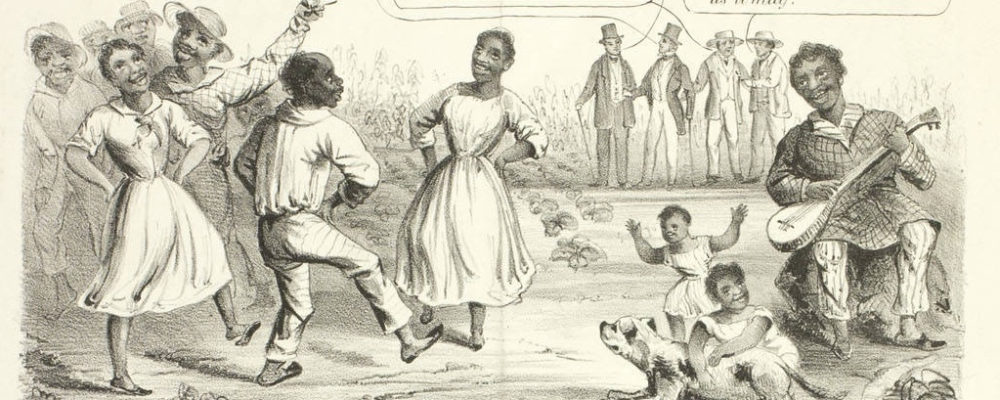
European alliances helped the American antislavery movement. But proslavery supporters also drew transatlantic comparisons. This proslavery image ignorantly portrays enslaved people who, according to white observers, were cheerful and pleased with their bondage. Proslavery advocates attempted to claim that English factory workers suffered a worse “slavery” than enslaved Africans and African Americans in the American South.
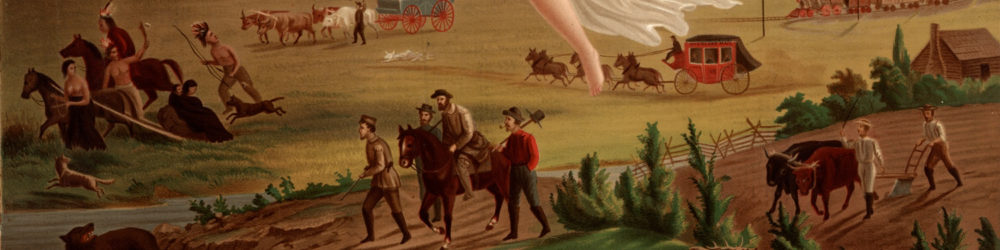
John Gast, American Progress, 1872. Wikimedia .
Columbia, the female figure of America, leads Americans into the West and into the future by carrying the values of republicanism (as seen through her Roman garb) and progress (shown through the inclusion of technological innovations like the telegraph) and clearing native peoples and animals, seen being pushed into the darkness.