Introduction
Millions of Indigenous people called the Americas home long before Europeans arrived. By the time Europeans crossed the Atlantic, Native people spoke hundreds of languages, built diverse political systems, created cultures adapted to hundreds of distinct environments—human beings lived and loved and lost. Kinship ties knit ancient Indigenous communities together over distance, time, and space. Each community possessed unique art forms and spiritual practices and participated in extensive trade networks where they exchanged items such as salt, pottery, shell jewelry, and even bison meat. Political units ranged from small family units to vast empires. These continents teemed with life. The historians who study these people do so by recording oral testimony from Indigenous people as well as using the tools of science to analyze the natural world and material culture of these ancient communities.
Documents
1. Cherokee origin story
This Cherokee creation story is among thousands of accounts for the origins of the world. This story exhibits the common Native American tendency to locate spiritual power in the natural world.
2. Haudenosaunee (Iroquois) origin story
The Iroquois origin story recalls the first formation of Turtle Island. This story teaches the importance of balance, gratitude for nature, and cooperation among all living things.
3. Cherokee storytellers on the origins of disease and medicine
Cherokee storytellers explain that disease resulted from the broken relationship between humans and nature. Animals created disease to punish humans for being carelessly violent. Plants came to the rescue by creating medicine. The story teaches the importance of reciprocity and warns of the dangers of abusing nature.
4. The legend of Moshup
The Wampanoag legend of Moshup describes an ancient giant who lived on Martha’s Vineyard Island and offered stories about the history of the region. The story speaks to the dangers nature can present and offers an origin for fog in the region.
5. Archaeological research on interactions between Native Americans and manatees before colonization
Scholars who study the ancient ancestors of Native Americans sometimes use the tools of science to shed light on life before colonization. This archaeologist offers evidence to show that Native Americans rarely hunted manatees in precolonial Florida.
6. A cultural anthropologist discusses Muskogee mount-building
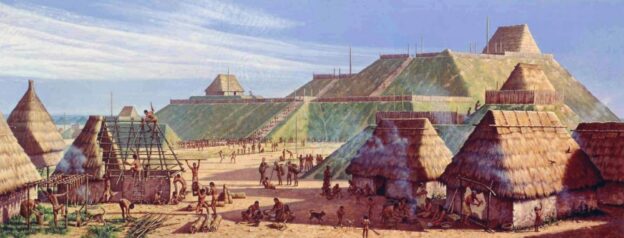
This anthropologist uses both archaeological research and conversations with Muskogee elders to argue that Native American mounds are living places that connect contemporary communities with their ancestors. The anthropologist also notes how Indigenous narratives challenge understandings of time and even history itself.
7. Paleontologists explore the diet of Native American ancestors
The chemical remains of ancient humans allow paleontologists to reconstruct the diets of some of the earliest people in the Americas. The findings of these scholars show that some communities hunted mammoths for food.
Media
A Seneca artist paints Sky Woman

Ernest Smith was a Seneca artist. In this piece, he painted the story of Sky Woman falling to earth, where she would land on a great turtle. On the back of this turtle, and with the help of birds and animals, she would create Turtle Island.
Kwantlen elders perform the First Salmon Ceremony

The First Salmon Ceremony is a sacred, ancient sacrament practiced by Indigenous communities across the Pacific Northwest, Northern California, and the Columbia River basin. Held every spring, it welcomes the return of the salmon runs, expresses gratitude to the Creator and the Salmon People, and reinforces the delicate balance of ecological stewardship