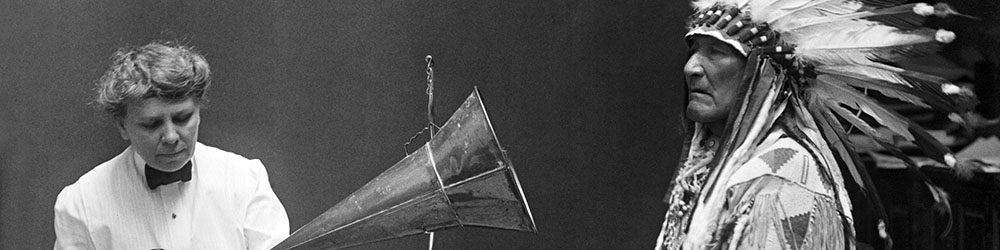
American anthropologist and ethnographer Frances Densmore records the Blackfoot chief Mountain Chief in 1916 for the Bureau of American Ethnology.
Introduction
In the decades after the American Civil War, the United States, long busy fulfilling its “Manifest Destiny,” roared across the continent and asserted itself overseas. Settlers poured into the US West, and, alongside the American military, destroyed Indigenous sovereignties. Investors and ranchers raced into the US-Mexico borderlands, overwhelming long-standing Mexican American communities with American economic and racial systems. And, increasingly, Americans looked overseas, flooding much of the world with missionaries, consumer goods, and territorial ambitions. By the end of the century, the United States, flexing its power and sovereignty more widely than ever before, had established itself as a global power. The following sources explore new American “geographies of empire.”
Documents
1. Chief Joseph on Indian Affairs (1877, 1879)
2. Turning Hawk and American Horse on the Wounded Knee Massacre (1890/1891)
On February 11, 1891, a Sioux delegation met with the Commissioner of Indian Affairs in Washington D.C. and gave their account of the Wounded Knee Massacre six weeks prior.
3. Laura C. Kellogg on Indian Education (1913)
The United States used education to culturally assimilate Native Americans. Laura Cornelius Kellogg, an Oneida author, performer, and activist who helped found the Society of American Indians (SAI) in 1913, criticized the cultural chauvinism of American policy. Speaking to the SAI, she challenged her Indian audience to embrace modern American democracy while maintaining their own identity.
4. James D. Phelan, “Why the Chinese Should Be Excluded” (1901)
James D. Phelan, the mayor of San Francisco, penned the following article to drum up support for the extension of laws prohibiting Chinese immigration.
5. Chinese Immigrants Confront Anti-Chinese Prejudice (1885, 1903)
Mary Tape, a Chinese immigrant mother, fought for her daughter, Mamie Tape, to integrate public schools in California. The case, Tape v. Hurley (1885), reached the California Supreme Court in 1885 and, despite a favorable ruling for Tape, the San Francisco Board of Education built a segregated Chinese school which Mamie Tape was forced to attend. In the following letter, Mary Tape protested the denial of her daughter’s entry to Spring Valley School; Lee Chew immigrated from China at the age of 16. He worked as a domestic servant for an American family in San Francisco, started a laundry business, and later ran an importing business in New York City. In the following passage, he attacked anti-Chinese prejudice in the United States.
6. William McKinley on American Expansionism (1899)
After the surrender of the Spanish in the Spanish-American War, the United States assumed control of the Philippines and struggled to contain an anti-American insurgency.
7. William James on “The Philippine Question” (1903)
Many Americans opposed imperialist actions. Here, the philosopher William James explains his opposition in the light of history.
8. Black Americans Debate Enlistment (1898)
Thousands of Black troops served in in the Spanish-American and Philippine-American Wars. Confronted with racial violence and discrimination at home, they did so with a mix of hope, skepticism, satisfaction, and disappointment. Here, the Indianapolis Freeman reports on recruiting efforts in Hartford, Connecticut.
Media
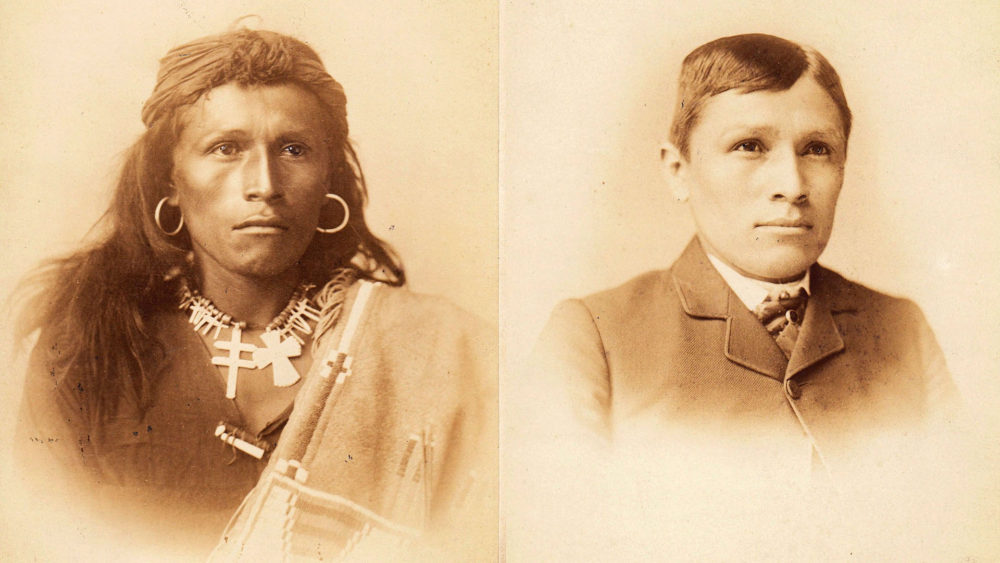
Tom Torlino (1882, 1885)
School Begins (1899)
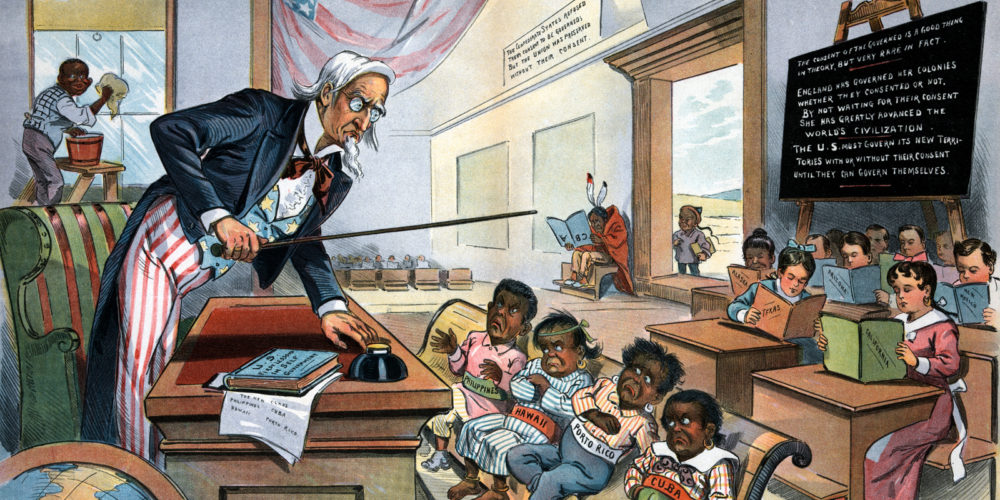
“School Begins,” Puck, January 25, 1899.
In this 1899 cartoon published, Uncle Sam lectures his new students: The Philippines, Hawaii, Puerto Rico, and, Cuba. Past and potentially future U.S. acquisitions fill the rest of the classroom.